Inspiration
Neurological rehabilitation is deeply dependent on repeated movement practice and accurate feedback. But a patient performing an exercise is not necessarily performing it correctly.
During recovery from stroke, brain injury, or other neurological conditions, a patient may complete a movement by compensating with another part of the body. From a simple exercise counter, both movements can look like success.
NeuroTwin was created around a different question:
What if rehabilitation software could understand how a person moves, not simply whether the movement was completed?
Our goal is to transform an ordinary phone or laptop camera into an intelligent rehabilitation companion capable of measuring movement quality, identifying possible compensatory patterns, tracking recovery over time, and helping patients perform prescribed exercises more consistently.
What it does
NeuroTwin is an AI-powered computer-vision platform for neurorehabilitation.
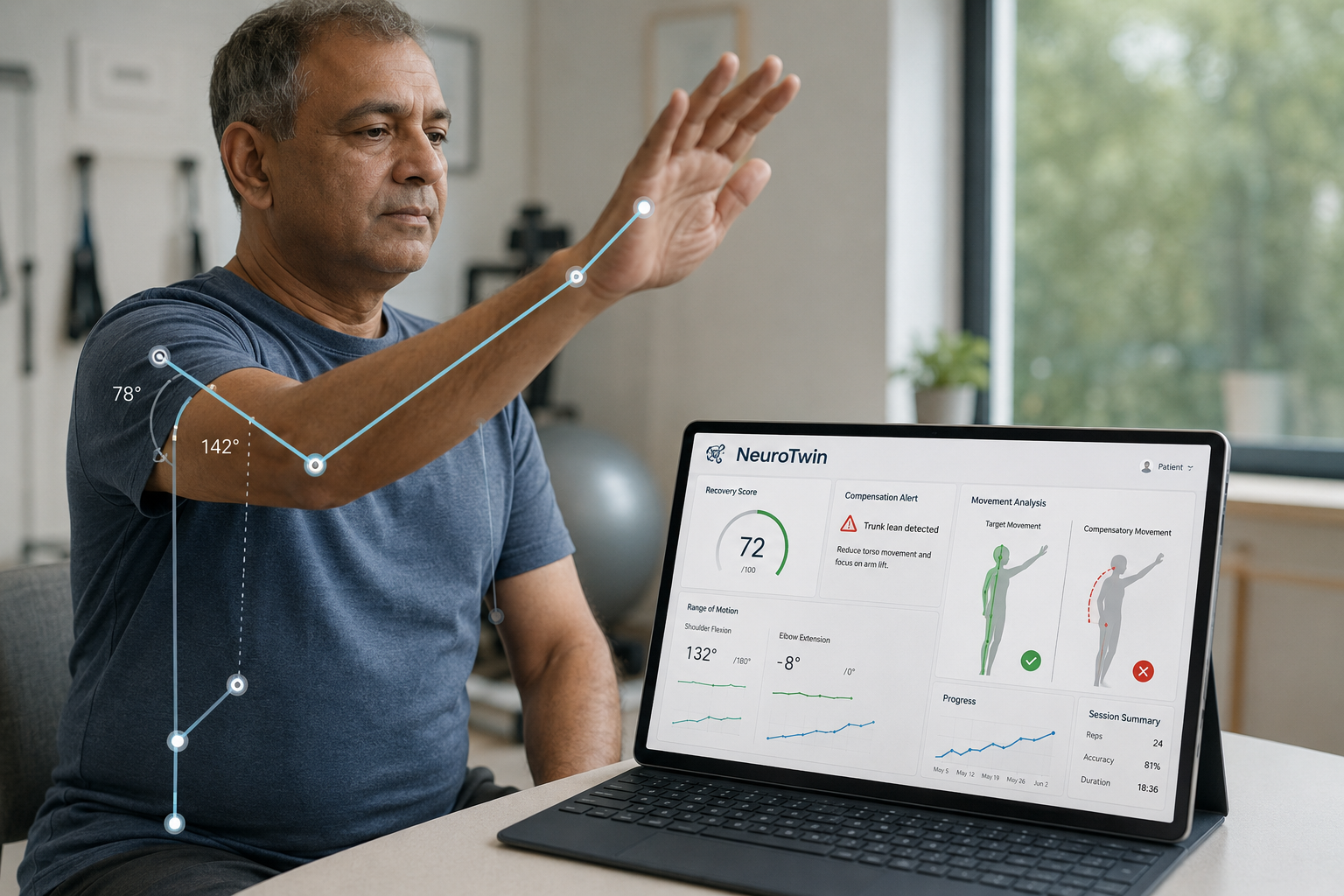
A patient performs rehabilitation exercises in front of a camera. NeuroTwin analyzes body landmarks and movement dynamics to create a digital representation of the exercise session.
Instead of simply counting repetitions, the system is designed to evaluate:
- joint movement and range of motion
- left/right body symmetry
- movement speed and control
- exercise consistency
- possible compensatory movements
- improvement across rehabilitation sessions
The patient receives simple visual feedback while their progress is recorded over time.
The long-term goal is to give clinicians a clearer picture of what happens between appointments while giving patients useful feedback when performing exercises independently.
The NeuroTwin concept
At the center of the project is a lightweight movement digital twin.
For each rehabilitation session, NeuroTwin converts camera observations into structured biomechanical measurements such as joint positions, angles, trajectories, timing, symmetry, and movement quality.
This allows the system to compare:
the intended movement → the observed movement → the patient's previous movement
Rather than treating every repetition as equal, NeuroTwin attempts to understand how the repetition was performed.
For example, if a patient has difficulty raising one arm and begins leaning their torso to compensate, a conventional repetition counter may record a successful movement.
NeuroTwin is designed to identify that the arm reached its target while also detecting the abnormal torso contribution.
That distinction is important for meaningful rehabilitation tracking.
How we built it
NeuroTwin combines computer vision, movement analysis, AI, and a patient-focused software interface.
The system is designed around several components:
1. Vision layer
Camera frames are processed using human pose estimation to identify key body landmarks without requiring specialized motion-capture equipment.
2. Biomechanical feature engine
Landmark coordinates are converted into interpretable movement features such as joint angles, displacement, velocity, symmetry, and trajectory.
3. Movement intelligence
The system analyzes these features across time to distinguish normal exercise execution from potential compensatory movement patterns.
4. NeuroTwin profile
Each session contributes to a longitudinal movement profile so progress can be compared against the patient's own previous performance rather than relying only on population averages.
5. Patient experience
The interface provides simple instructions, exercise feedback, session summaries, and progress visualization.
6. Clinician view
Structured movement metrics can be summarized so a healthcare professional can review rehabilitation trends instead of relying solely on self-reported exercise completion.
Privacy by design
NeuroTwin is being designed with healthcare privacy in mind.
Raw video does not need to become the primary medical record. Wherever possible, the system can extract movement landmarks and numerical features from video and retain those measurements instead.
This creates a path toward privacy-preserving rehabilitation monitoring and, eventually, on-device processing.
Challenges we faced
One of the hardest problems is determining the difference between a movement that looks successful and a movement that is biomechanically meaningful.
Human movement is highly variable. Camera position, lighting, body proportions, mobility limitations, and assistive devices can all affect pose-estimation results.
Another major challenge is avoiding the temptation to turn NeuroTwin into a diagnostic system.
NeuroTwin is designed as a rehabilitation measurement and decision-support tool, not as a replacement for a doctor, physiotherapist, or occupational therapist.
Clinical validation would be required before measurements produced by the system could be used for real-world medical decision making.
What we learned
Building NeuroTwin showed me that useful healthcare AI is not only about predicting a diagnosis.
AI can also help measure subtle changes in human function.
Computer vision becomes significantly more meaningful when raw landmark coordinates are transformed into interpretable measurements that patients and clinicians can understand.
We also learned that healthcare software must balance technical capability with explainability, privacy, accessibility, and safety.
What's next
Our next steps are to expand NeuroTwin into a more complete neurorehabilitation platform by adding:
- personalized rehabilitation exercise plans
- additional compensation-detection models
- longitudinal recovery scoring
- clinician-configurable movement targets
- upper- and lower-limb rehabilitation modules
- hand and fine-motor tracking
- accessible voice-guided exercises
- offline/on-device inference
- wearable sensor integration
- patient-clinician progress sharing
- validation using rehabilitation movement datasets
- future integration with rehabilitation robotics and assistive devices
Our long-term vision is for NeuroTwin to become an intelligent software layer between patients, clinicians, cameras, wearables, and rehabilitation robotics.
Vision
Every rehabilitation movement should tell us something about recovery.
NeuroTwin aims to turn those movements into measurable, understandable and useful information.

Log in or sign up for Devpost to join the conversation.