Inspiration
Here's the moment that started this: I was staring at a blank doc, and instead of writing the first sentence myself, my hand just... reached for ChatGPT. Not because the sentence was hard. Because reaching for it had become the default, faster than deciding to write. I wasn't losing my job to AI. I was losing the small, boring, essential reps — the ones where your brain actually does the lifting. Writing the first draft. Finishing your own sentence. Deciding, on your own, what today's problem even is. MIT Media Lab gave this a name in June 2025: cognitive debt. I read the paper, nodded, and thought: fine, I have a villain. Now what do I do about it.
So I went looking for what already existed. Every brain-training app I found was the same shape underneath: tap a tile, match a color, watch a number go up, open the app again tomorrow so the number keeps going up. It's a game loop wearing a lab coat. None of it asked me to put the phone down — which felt backwards, for something that's supposed to be training a brain the rest of my life happens outside of. That gap is what made me start building.
I almost shipped the easy version — an app that just scolds you for using AI too much. Then I showed an early build to a friend, and she said something that reframed the whole thing: your brain doesn't only go quiet because of AI. It goes quiet because nothing in your day is new. Same commute. Same coffee order. Same six-step morning on autopilot, AI or no AI. That one sentence tore up my onboarding quiz and rebuilt it from four equal factors instead of one villain.
I didn't want to build a better version of that tap-and-match loop. I wanted to be the one thing in your day that happens away from a screen, with a reason, already thought through, already timed, already backed by a name and a year you could go look up yourself.
What it does
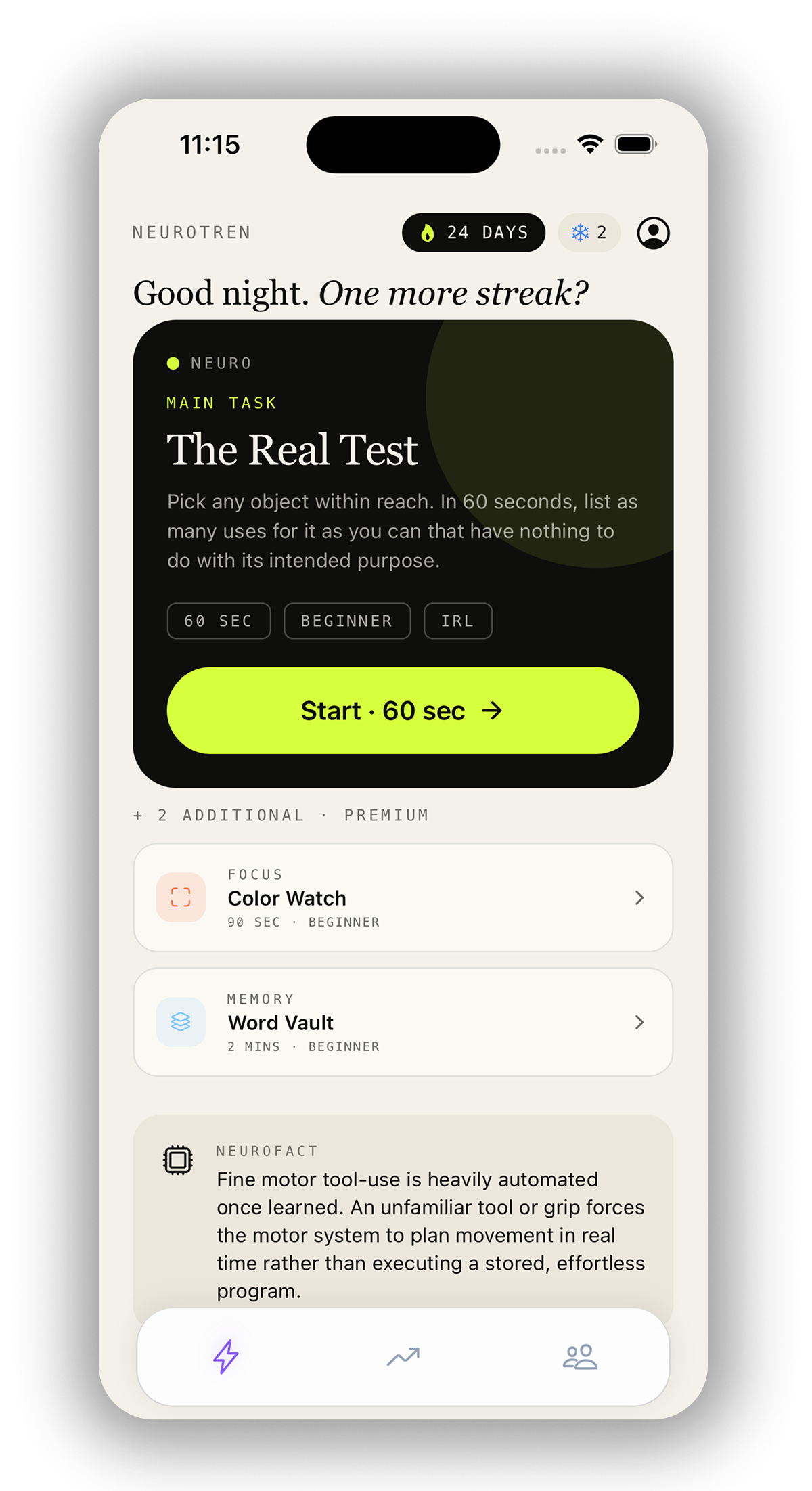
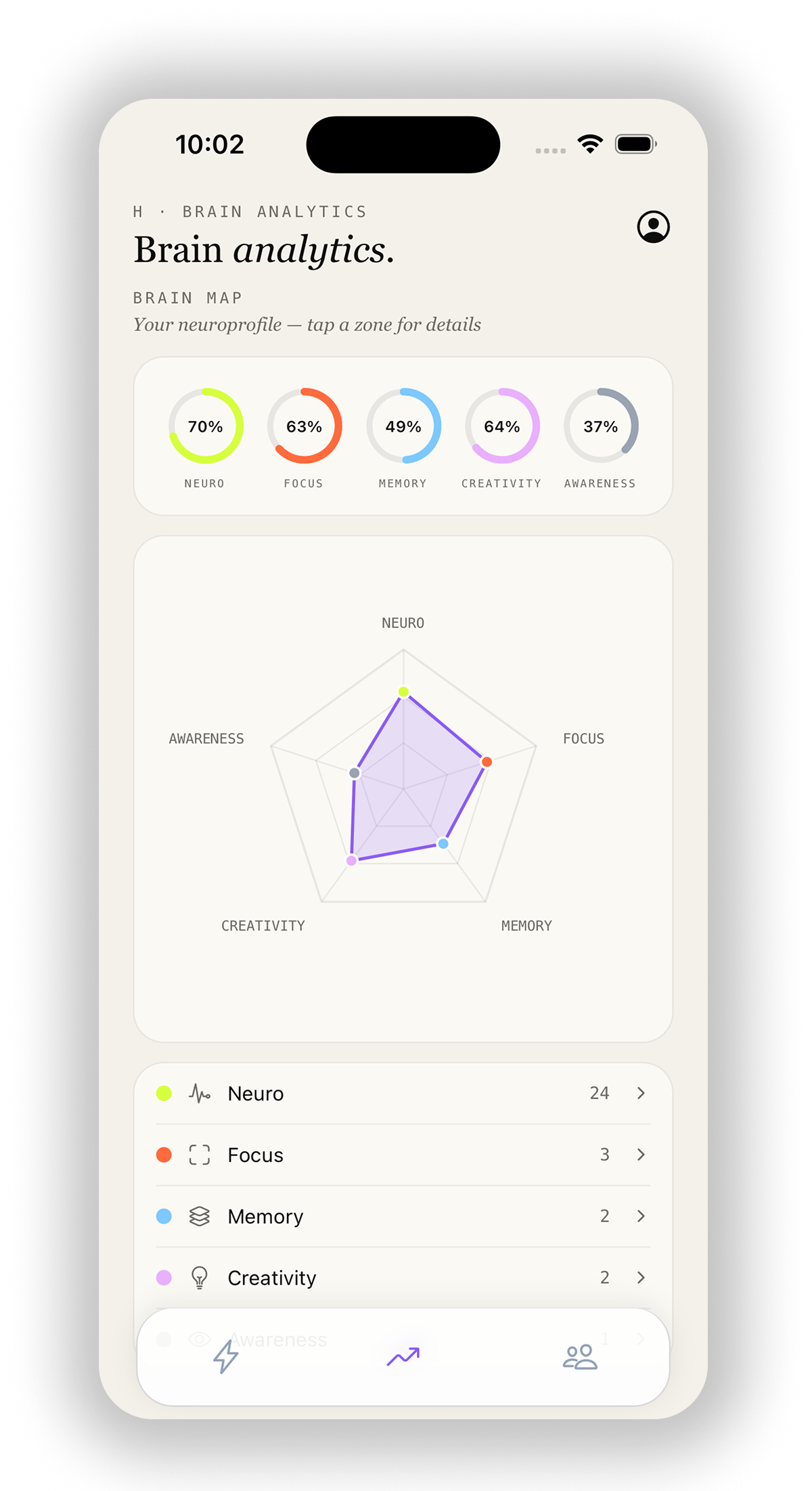
Neurotren gives you real-world cognitive challenges across five zones — Neuro, Focus, Memory, Creativity, Awareness. One free zone every day; Premium unlocks all five. Nothing happens on a screen, and nothing is the obvious "switch hands to brush your teeth" advice everyone's already heard and ignored. The Flagship collection runs on real, named studies — Miller's "magic number seven," testing how many digits you can actually hold in working memory before you lose the thread. Thirty seconds to five minutes, done in real life, every time tied to a study you could go read yourself.
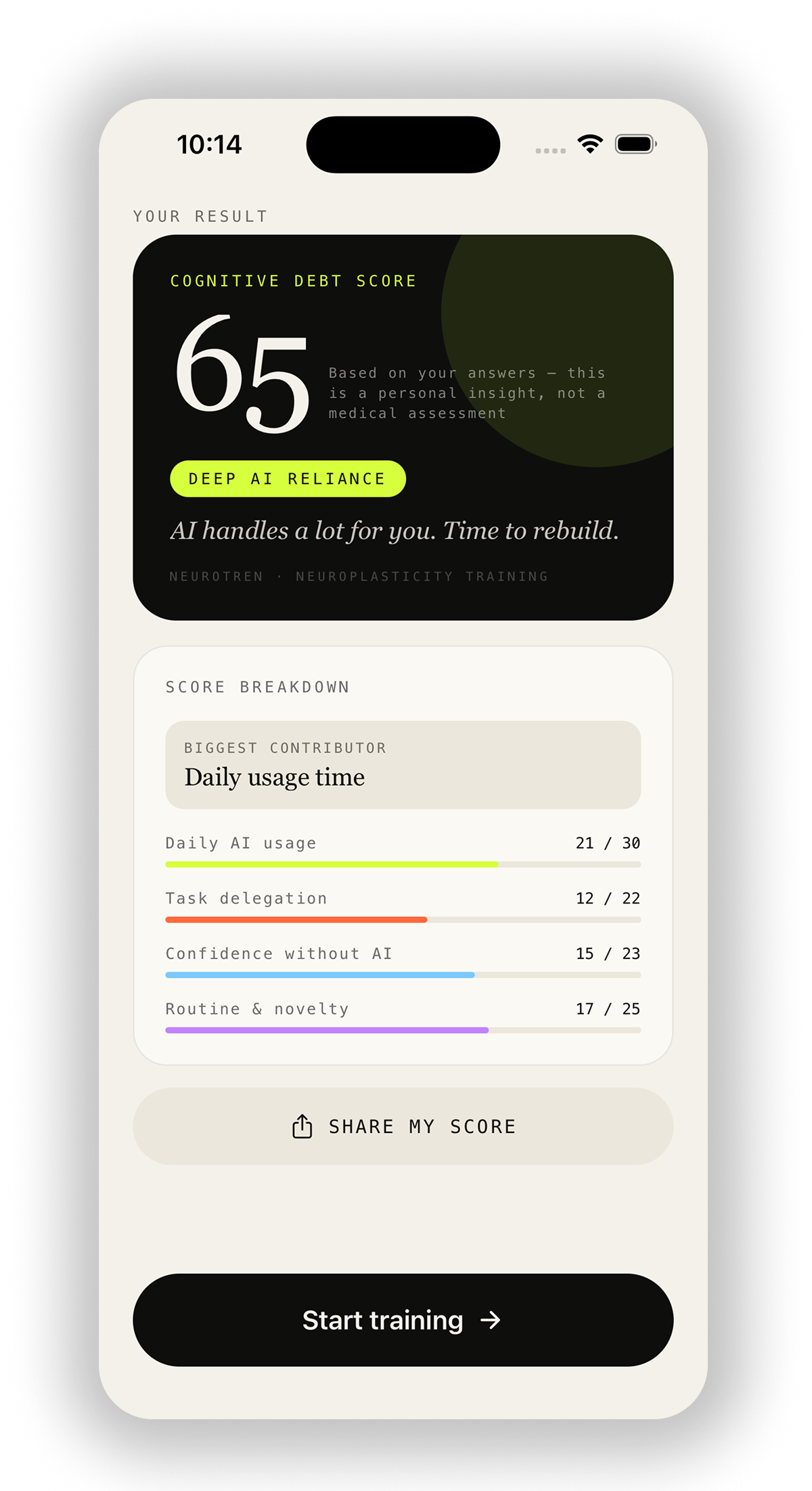
Onboarding starts with a short self-check — how much you lean on AI, how much routine runs your day, how confident you feel without either. It's self-reported, not clinical, and it's kept deliberately separate from your actual activity in the app, so finishing a streak can never quietly inflate your own self-assessment.
The part I'm proudest of is the Flagship collection — challenges tied to a real, named study, shown right on the screen. Not "research shows." An actual citation. I fact-checked every single one before it shipped, which took longer than I expected and was worth every bit of it.
There's a small social layer too — add a friend, send a nudge if they haven't trained today. No leaderboard, no public shaming if you miss a day. I specifically didn't want this app to make anyone feel bad about being human.
How we built it
React Native with Expo, TypeScript, Firebase underneath (Auth, Firestore, Cloud Functions), RevenueCat running the subscriptions, PostHog and Sentry watching everything in production.
733 challenges across five categories, in English, Ukrainian, Russian, and Spanish — and not machine-translated. I learned the hard way that translation isn't just swapping words: a memory task calibrated in English can get quietly harder or easier in another language purely because the translated words are longer or shorter. Had to rebuild entire word lists for the Memory category to keep the difficulty honest across languages.
Challenges we ran into
The math had to actually check out. My "save 33%" badge on the yearly plan was quietly comparing against a stale monthly price at one point. The kind of bug that's invisible until you sit down with a calculator and refuse to trust a label you wrote yourself — which is exactly what I did, more than once, every time I touched pricing.
Fact-checking science doesn't scale the way writing copy does. Deciding whether a citation is solid enough to put in front of a stranger is a completely different job than writing a snappy line about "brain rewiring." One study I was genuinely excited about turned out not to have fully replicated in a later attempt — so instead of quietly dropping it, I left the caveat right there in the app copy. That felt like the only version of "cited research" worth shipping.
Offline sync had a silent data-loss bug. Streaks and progress have to survive a phone going offline mid-task and reconciling later. For a while, a second queued write to the same document was silently overwriting the first instead of merging the fields — easy to miss in testing, because the app never threw an error, it just quietly lost half a user's progress. Fixed it by merging field-by-field instead of replacing the whole document, then wrote a real offline test (airplane mode, two completions, verify Firestore) specifically to make sure it couldn't regress.
Rebuilding a core metric based on one piece of feedback. The cognitive-debt score originally leaned almost entirely on AI usage. A tester pointed out — correctly — that brains go idle from routine too, not just AI. I rebuilt the scoring into four equal factors instead of one dominant one, which meant re-deriving the math and re-testing the entire onboarding flow to make sure the new weights actually produced sane results across edge cases, not just the happy path.
App Review made the app genuinely better, not just compliant. Between subscription metadata, functional legal links, and proper moderation tooling for the Friends feature (report, block, a profanity filter on display names), every round of reviewer feedback forced a level of rigor I probably wouldn't have reached on my own timeline. By the time it shipped, it had been checked harder than I would have checked it myself.
Accomplishments that we're proud of
Shipped, not just built. Neurotren passed App Review and is live on the App Store — subscriptions, moderation tooling, legal metadata, all of it checked and working, not sitting in a demo folder.
733 real challenges, properly localized in four languages. Not machine-translated. English, Ukrainian, Russian, Spanish, each one checked for meaning and — for Memory tasks specifically — difficulty, since word length alone can quietly change how hard a memory task is from one language to the next.
30 citations, every one fact-checked by hand. No "studies show." Named researchers, real years, real findings — including the honesty to flag the one finding that hasn't fully held up in later replication, instead of quietly dropping it.
A working free tier that's actually useful, not a teaser. One full zone, every day, forever — not a three-day trial dressed up as "free." Premium is an expansion, not a paywall in disguise.
Streak protection instead of streak guilt. Miss a day and the app protects your streak instead of resetting it to zero and making you feel bad about being a person with a life.
Took real feedback and rebuilt a core metric because of it. The cognitive-debt score went from a narrow AI-only measure to a four-factor one because a tester was right and I listened, even though it meant re-deriving the math days before I wanted to be done with that screen.
Built and shipped solo. Product, content, copy, App Review back-and-forth, pricing math at midnight — one person, start to finish.
What we learned
A hackathon deadline is a surprisingly good filter for scope. With a fixed date, every "nice to have" idea had to justify itself against "does this help someone finish their first week." A lot of good ideas lost that argument and got written down for later instead of built now.
Competitors are easier to learn from when you stop trying to beat them point-for-point. I spent real time looking at what established brain-training apps do well before deciding what to deliberately not copy — the screen-game mechanic, the vague science claims. Knowing the category well enough to walk away from most of it was more useful than a feature-by-feature comparison would have been.
Users read more carefully than I expected, in good ways. The feedback that reshaped the cognitive-debt score came from someone reading the onboarding questions closely enough to notice what they implied about the product's worldview, not just whether the buttons worked. That raised my bar for how much thought a single line of copy deserves.
Regulatory edges show up in places you don't expect. A routine App Review note flagged that the app's description mentioned a specific AI tool by name, which triggers separate legal requirements for distribution in some regions. I'd never have thought to check that on my own — it's not a mobile-dev problem, it's a different kind of problem entirely, and now I know to look for it.
What's next for Neurotren - Brain Training App
Turning every challenge into something shareable. The app already has a "challenge a friend" mechanic baked in — the next step is making that moment genuinely TikTok-native: a clean, vertical share card generated the second you finish a Flagship challenge, built to be posted, not just sent to one friend. If the Stroop effect test is fun enough to beat, it should be fun enough to go viral.
Actually marketing this thing. Up to now this has been a one-person build-and-ship sprint. Next is real, active promotion — content, community, getting it in front of people who aren't me — specifically to get a wider spread of feedback than one founder and a handful of testers can give.
A gentle-mode toggle. A handful of challenges involve light physical movement (balance, eyes-closed tasks). They're already flagged in the data; the next step is a real toggle that filters them out entirely for anyone who'd rather skip that category.
Android. Roughly half the market I'm not reaching yet.
Longer term: I'd like Neurotren to be the place people check when they catch themselves mid-scroll and think "I used to be sharper than this." Right now it's a good daily habit. I want it to be the obvious one.
Built With
- cloud-functions)
- expo.io
- firebase
- firebase-underneath-(auth
- firestore
- posthog
- reactnative
- revenuecat
- revenuecat-running-the-subscriptions
- sentry
- typescript


Log in or sign up for Devpost to join the conversation.