About the Project
What Is This?
A hackathon research project that compares five different spiking neuron models — the mathematical engines that drive spiking neural networks (SNNs). The project builds a controlled laboratory for neuroscience: put each neuron model into the same network, give it the same data, and measure the results.
What Are Spiking Neurons?
Biological neurons communicate through electrical pulses called spikes. Conventional neural networks use continuous activation values; spiking neural networks use discrete spike events, making them closer to how real brains compute.
Spiking neurons are categorized by their mathematical complexity:
- IF (Integrate-and-Fire): accumulator + threshold. Simplest model.
- LIF (Leaky Integrate-and-Fire): adds a decay term — the membrane slowly returns to rest between inputs.
- Adaptive LIF: threshold rises after each spike, modeling neural fatigue.
- Izhikevich: combines biologically observed firing patterns (bursting, chattering) at low computational cost.
- Hodgkin-Huxley: the biophysical gold standard — models individual ion channels (Na+, K+). Slower but most realistic.
What Is PyTorch?
PyTorch is the underlying machine learning framework. All five neuron models are implemented as PyTorch nn.Module classes, enabling automatic differentiation and GPU acceleration.
What Is Streamlit?
Streamlit is a Python web framework built specifically for machine learning and data science. It lets you build interactive web apps by writing standard Python — no HTML, CSS, or JavaScript required.
Instead of writing:
<form><input id="slider"><button>Submit</button></form>
You write:
neuron = st.selectbox("Neuron Model", ["IF", "LIF", "Adaptive LIF", "Izhikevich", "HH"])
steps = st.slider("Simulation Steps", 4, 24, 12)
Streamlit handles the browser rendering, state management, and user interaction. The result is a shareable interactive demo that judges and collaborators can explore live.
Our demo lets you:
- Select any neuron model
- Choose a dataset (synthetic, MNIST, Fashion-MNIST)
- Adjust noise level, simulation steps, and training epochs
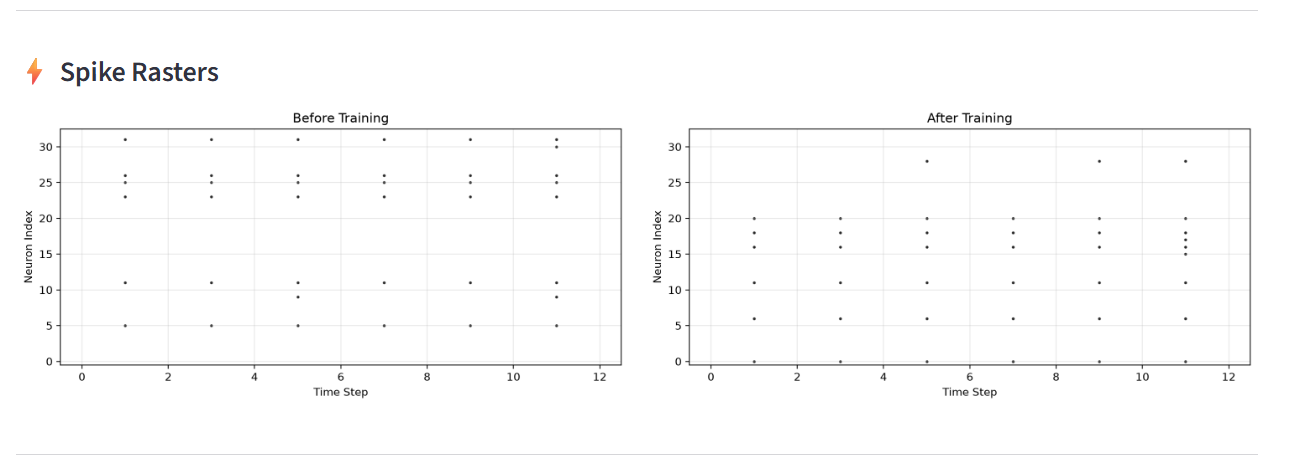
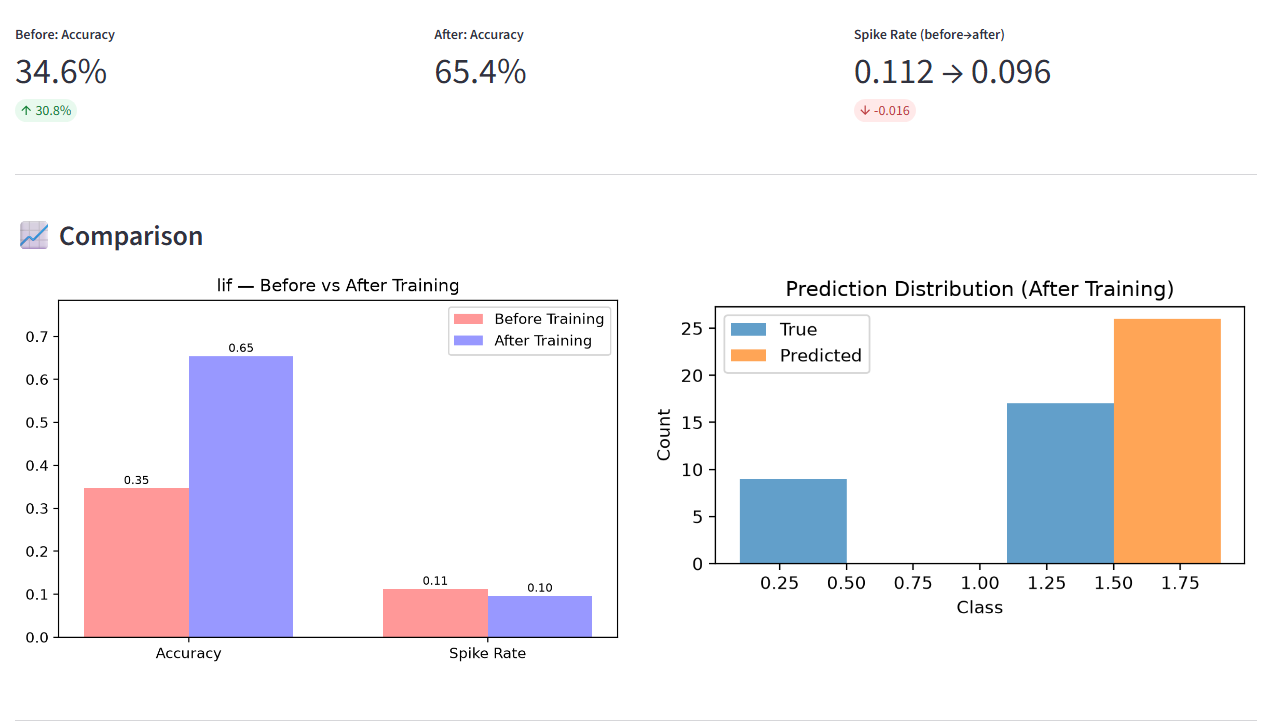
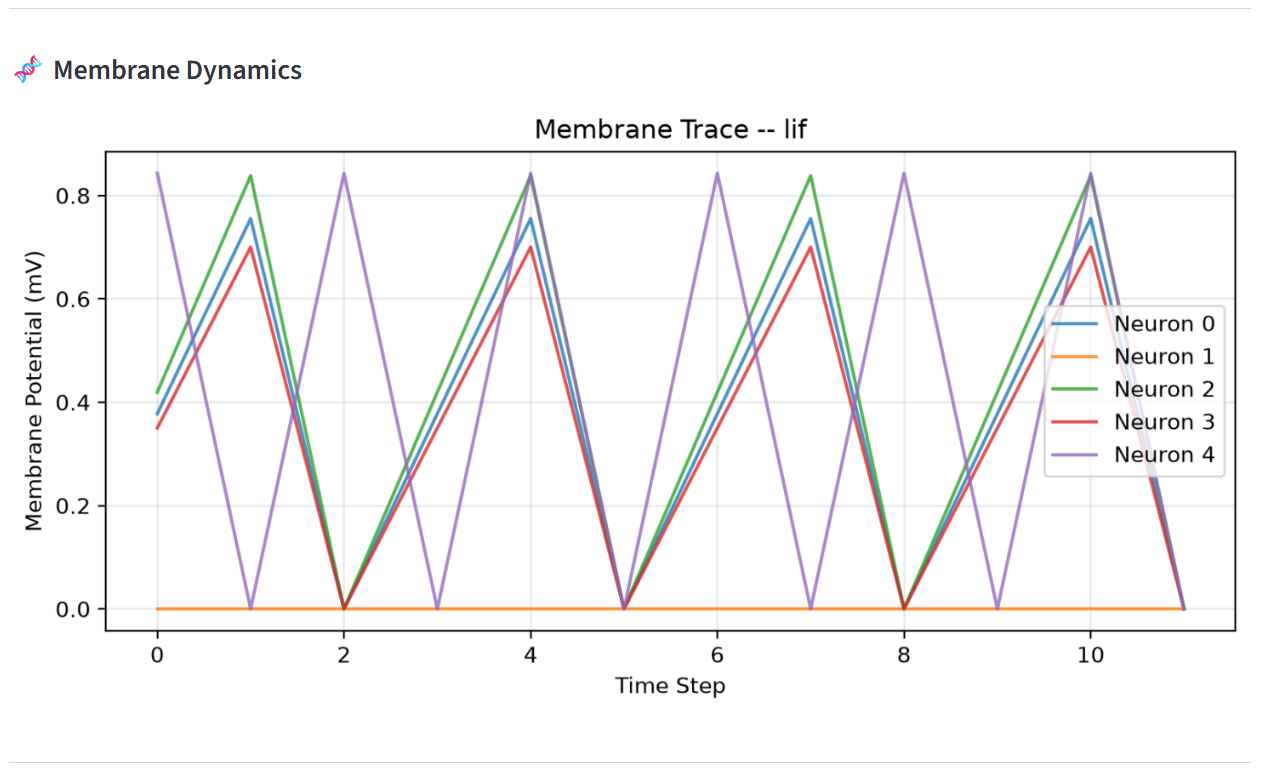
- See before/after training metrics, spike rasters, membrane traces, and prediction distributions
- Download results as JSON
Project Structure
src/neuron_benchmark/
  neurons.py      -- All five neuron models (PyTorch)
  model.py        -- Shared SNN architecture
  data.py         -- Synthetic + MNIST + Fashion-MNIST
  training.py     -- Shared training loop with multi-seed support
  robustness.py   -- Noise, timestep, and data-size experiments
  metrics.py      -- Energy proxy and efficiency scoring
  plots.py        -- Visualizations
  demo.py         -- Streamlit interactive demo
  cli.py          -- Command-line benchmark interface
Why Does This Matter?
The choice of neuron model involves a fundamental tradeoff:
- Simpler models (IF, LIF) are fast and cheap to simulate, but may not capture the temporal dynamics of real neurons.
- Richer models (Izhikevich, Hodgkin-Huxley) produce more realistic spike patterns, but are slower to simulate and harder to train.
For a given task — say, classifying MNIST digits — does the biologically richer model actually perform better? By how much? At what computational cost?
This benchmark provides controlled, reproducible answers to those questions.
Key Results So Far
| Neuron | Test Accuracy | Training Time | Spike Rate |
|---|---|---|---|
| IF | ~100% | ~0.05s | ~0.12 |
| LIF | ~100% | ~0.06s | ~0.10 |
| Adaptive LIF | ~96% | ~0.07s | ~0.12 |
| Izhikevich | ~96% | ~0.12s | ~0.18 |
| Hodgkin-Huxley | ~65% | ~0.40s | ~0.08 |
The simple models converge faster on this task, while Hodgkin-Huxley requires significantly more compute for worse accuracy — a key finding for anyone building real SNN systems.
Running the Demo
# Install dependencies
pip install -e .

# Launch the interactive Streamlit demo
streamlit run src/neuron_benchmark/demo.py
The demo runs locally in your browser. No server or internet connection required after installation.
Built With
- brian2
- neuroscience
- python


Log in or sign up for Devpost to join the conversation.