-
-
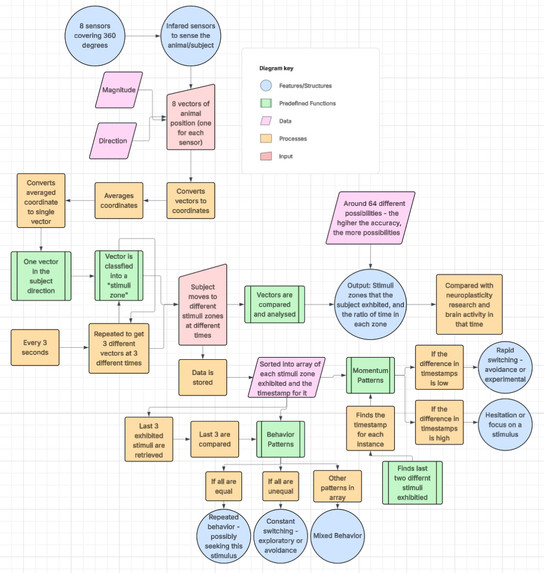
Flowchart of software
-
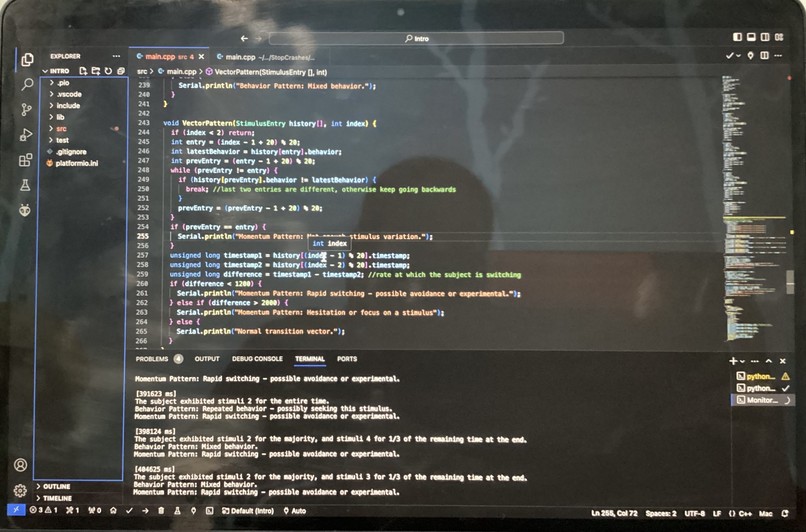
Software and output


Inspiration
My interest in the field of neuroscience research was sparked in my trip to the Princeton University Neuroscience Institute Through PDS. As they explained their different processes of research and experimentation, I was absolutely astonished. Even more so, I was surprised by how learning more about neuroplasticity in animals like transgenic mice or fruit flys can lead to analytical breakthroughs in neuroscience as a whole. Through this, I started asking more about neuroscience research: how is it done, or what are its limits? I came across two things. One: it involves lots of manual labor, with scientists simply collecting data on animals, stimuli around them, and neural reactions to that stimuli. Two: because of this tedious work, mapping the first mammalian brain (mouse) in the history of the world would take 100 years, something they mentioned at the institute while talking about their Flywire project. This is too long to wait before looking for solutions to enhance the research process. Thus, I sought out ways in which I could use automation to expedite the field of neuroscience research.
What it does
"NeuroTech: Reshaping Brain Research With Autonomous Systems" is a program consisting of software and hardware inputs and outputs that expedite the field of autonomous research. It is able to autonomously track and analyze the behavior, momentum, and stimuli-seeking patterns of an animal being used in neuroscience research (ex. rapid switching in accordance with given timestamps and stimuli). The data is regularly yielded from inputs as the robot is able to track the animals movements relative to given stimuli in the environment. This data can then be graphed, collected, and/or contrasted with the neural reactions of the subject at the given time. Through this project, there no longer is a need for tedious, laborious, or time-eating research. Now, this software can expedite the next century of neuroscience innovation.
How I built it
I used a combination of C++ and inputs from 8 infrared sensors to create this project. Through this, I coded multiple functions, This includes functions for getting the vector and position of the animal, analyzing data stored in an array, as well as providing behavior and momentum pattern tracking. These functions exist along with other formulas, trigonometric ratios, and processes, all used to manipulate and analyze the data provided from the sensors to achieve various outputs in the code.
Challenges I ran into
I was challenged most by the task of creating an array and storing both behaviors and timestamps within it. On top this, I was challenged by iterating my software, going from simply identifying what stimuli the subject was at to analyzing behavior and momentum patterns. Generally, I struggled with integrating the multiple functions and hardware. In the end, I was able to creatively solve these problems by being innovative and using unique ideas, functions, and techniques.
What I learned
Through the process of creating “NeuroTech: Reshaping Brain Research With Autonomous Systems”, I have learned many valuable skills along the way. Firstly, I learned how to integrate online interfaces with hardware and real sensors. Additionally, I learned a great deal about how to set up arrays and manipulate them to call, assess, and analyze various pieces of data. In that sense, I believe I acquired lots of knowledge on data analyzation, which I hope to use to learn more about Machine Learning and AI one day. Overall, this journey of creating this software has been a prominent one for me, by being highly educational and teaching me more about the comprehensive importance of social good in our lives.
What's next for NeuroTech: Reshaping Brain Research With Autonomous Systems
For the project itself, I would like to incorporate more methods of analyzing the data as well as a greater number of trials if I had more time. On a larger scale, I would want to automate the neural data collection system, and use an AI platform to be able to integrate these two softwares for one comprehensive and efficient research process. Like any other revolutionary project, my main goal for "NeuroTech: Reshaping Brain Research With Autonomous Systems" would be to inspire change. If we can start automizing and redefining research processes in all fields, we can accelerate innovation as we know it, and most importantly, the social good that comes with it.
Built With
- c++
- vscode


Log in or sign up for Devpost to join the conversation.