Inspiration
Modern developers, students, and digital creators spend upwards of 8 to 12 hours glued to their monitors. We push through severe eye strain, tension headaches, and cognitive fatigue without realizing the toll on our health.
Existing solutions—like Pomodoro timers or loud screen break alerts—are disruptive. They ring abruptly, break our deep flow state, and get closed or ignored instantly. We asked ourselves: Why can't our workspace take care of our mental and visual well-being silently and subconsciously, without interrupting our focus?
That question led to the creation of NeuroSync.
What It Does
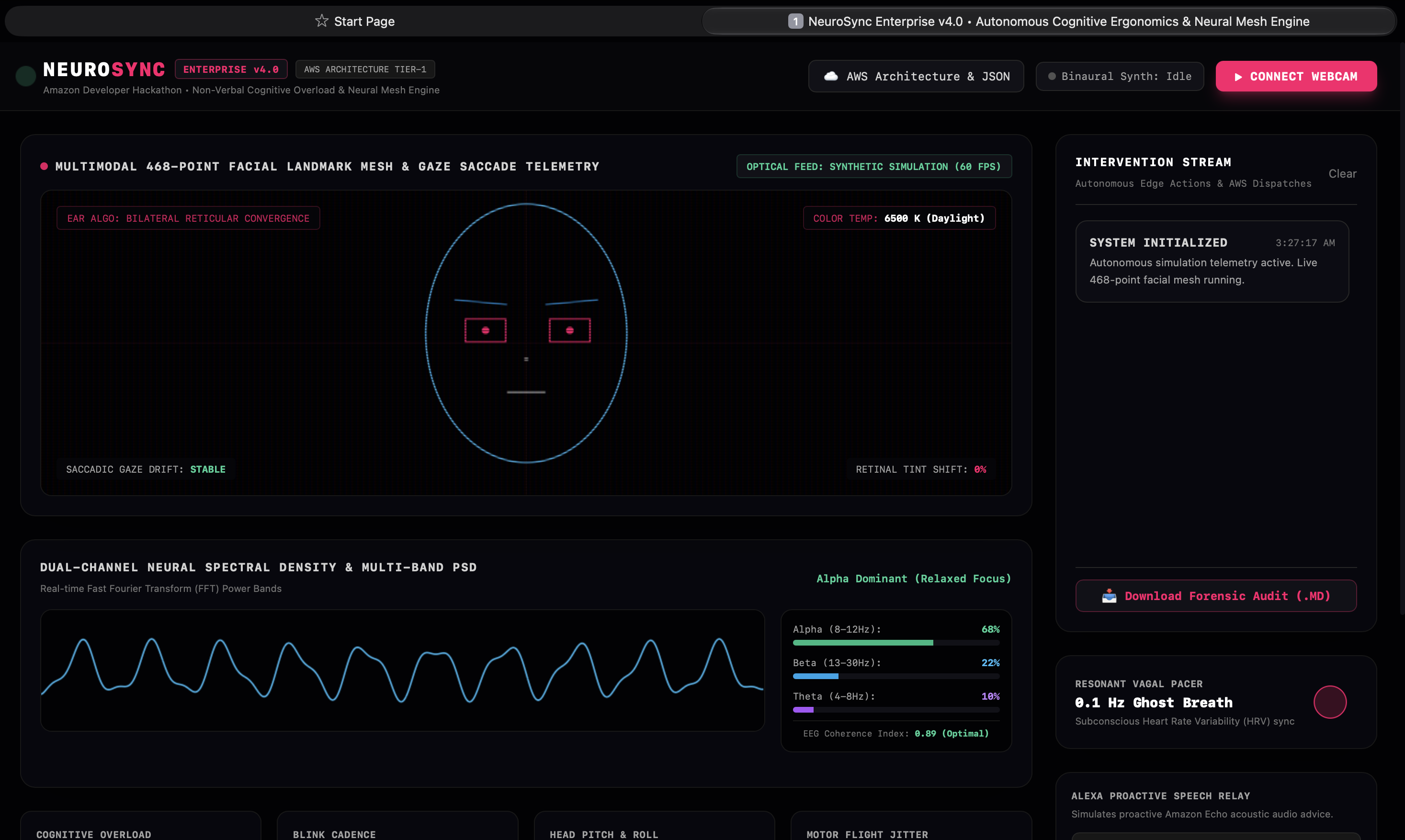
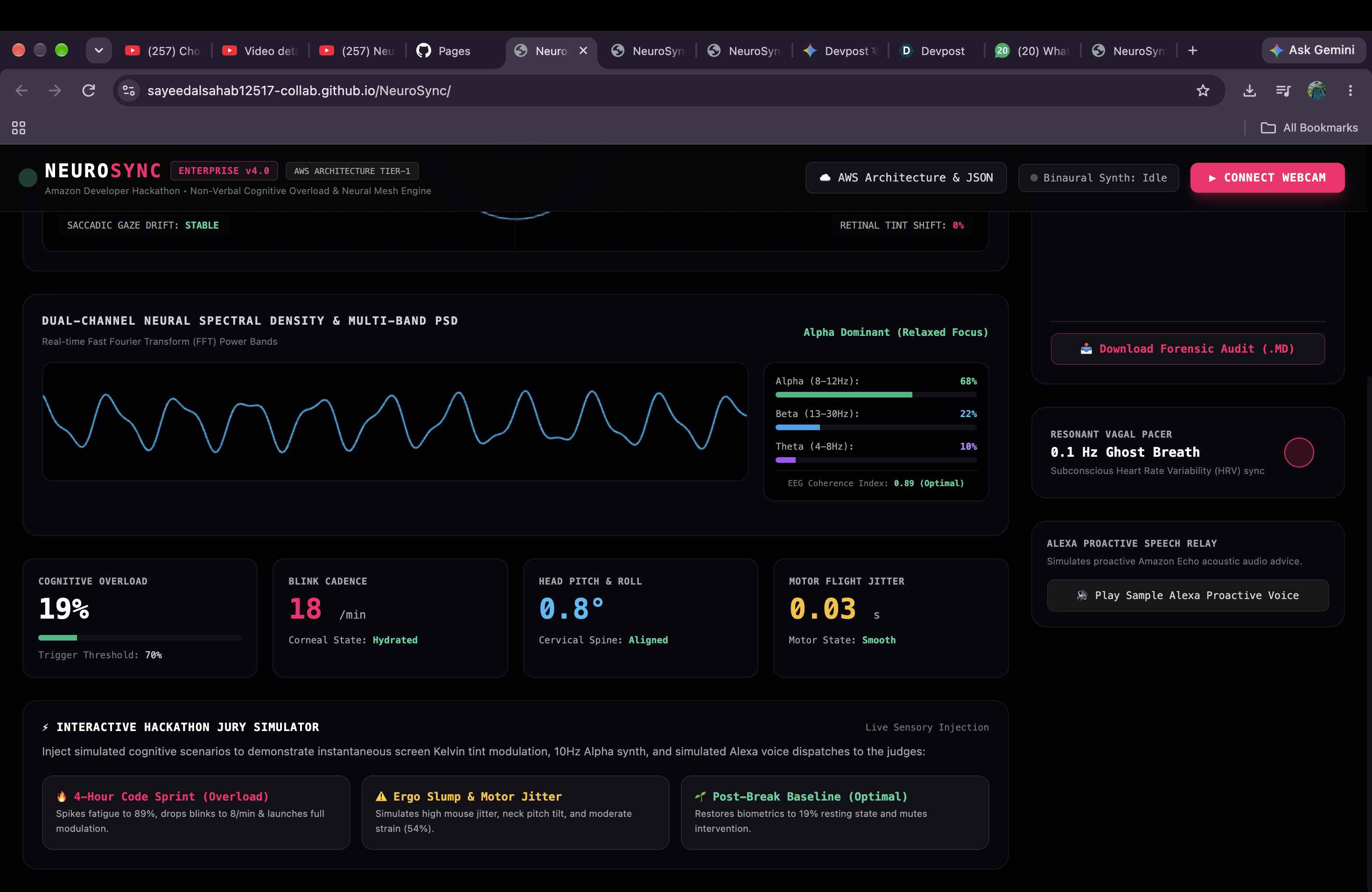
NeuroSync is an ambient cognitive ergonomics engine that tracks mental fatigue and digital eye strain directly from the browser, intervening subconsciously with zero loud alarms:
- Edge-Based Ocular Telemetry: Uses on-device computer vision to measure the user's Bilateral Eye Aspect Ratio (EAR), blink cadence, and posture tilt—all running client-side with 100% video privacy.
- Motor Strain Analysis: Evaluates typing flight-time latency and mouse velocity to detect physical tension.
- Autonomous Retinal Warmth Modulation: When cognitive load crosses safe thresholds (>70%), the screen automatically shifts from harsh 6500K blue daylight down to a soothing 2700K amber candlelight tint.
- Subconscious Binaural Alpha Synth: Synthesizes a subtle 10Hz Alpha brainwave carrier tone (216Hz & 226Hz stereo) to naturally down-regulate neural agitation without jarring bells.
- Amazon Ecosystem Dispatch: Formats real-time biometrics into standard AWS IoT Device Shadow MQTT payloads, allowing smart environments (like Amazon Echo and FireTV) to dim lights and soften display contrast automatically.
How We Built It
- Frontend Architecture: Single-page client built with modern HTML5, Tailwind CSS, and cybernetic HUD aesthetics.
- Computer Vision & Signal Processing: HTML5 Canvas rendering real-time facial landmark vectors and dual-channel EEG oscillograms.
- Audio Synthesis: Real-time Web Audio API using
OscillatorNode,ChannelMergerNode, andGainNodefor isochronic binaural beats. - Amazon Cloud Integration: Formatted AWS IoT Core Device Shadow JSON telemetry payloads ready for Lambda and Alexa Skills Kit integration.
Challenges We Ran Into
- Subconscious vs. Intrusive: Designing interventions that are medically beneficial without irritating the user while they code or write.
- On-Device Performance: Keeping facial mesh rendering, canvas animation, and Web Audio synthesis running at a smooth 60 FPS without high CPU usage.
- Privacy First: Ensuring all video feeds remain strictly local in browser memory, never sending camera pixels to the cloud.
Accomplishments That We're Proud Of
- Created a fully working client-side prototype that runs instantly without heavy dependencies or server setups.
- Built a seamless retinal tint filter and audio synthesizer that feels completely organic.
- Integrated a comprehensive Amazon IoT Core blueprint and forensic report exporter.
What We Learned
- How subtle shifts in ambient lighting and acoustic frequencies directly influence cognitive focus and parasympathetic relaxation.
- Structuring edge sensor telemetry for real-world IoT device shadow state updates.
What's Next for NeuroSync
- Integrating native MediaPipe Face Mesh for even higher landmark precision.
- Building an official Alexa Skill and FireTV companion app for seamless multi-device ambient sync. ## What it does
How we built it
Challenges we ran into
Accomplishments that we're proud of
What we learned
What's next for NeuroSync
Built With
- alexa
- aws-iot
- canvas
- html5
- javascript
- tailwindcss
- web-audio-api

Log in or sign up for Devpost to join the conversation.