-
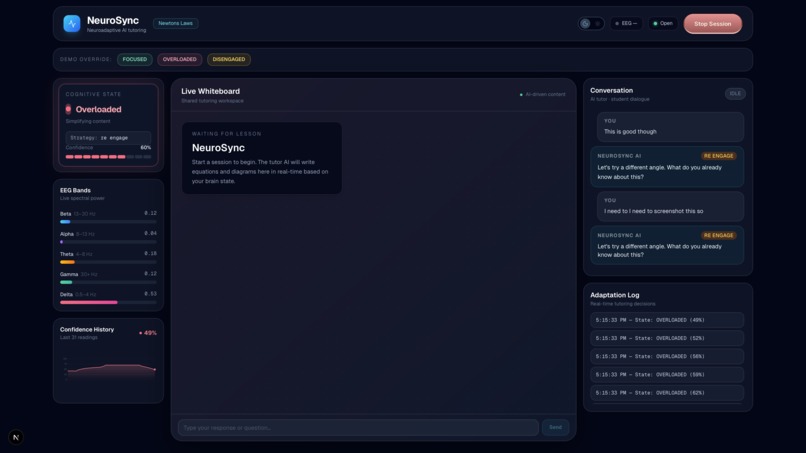
UI Example
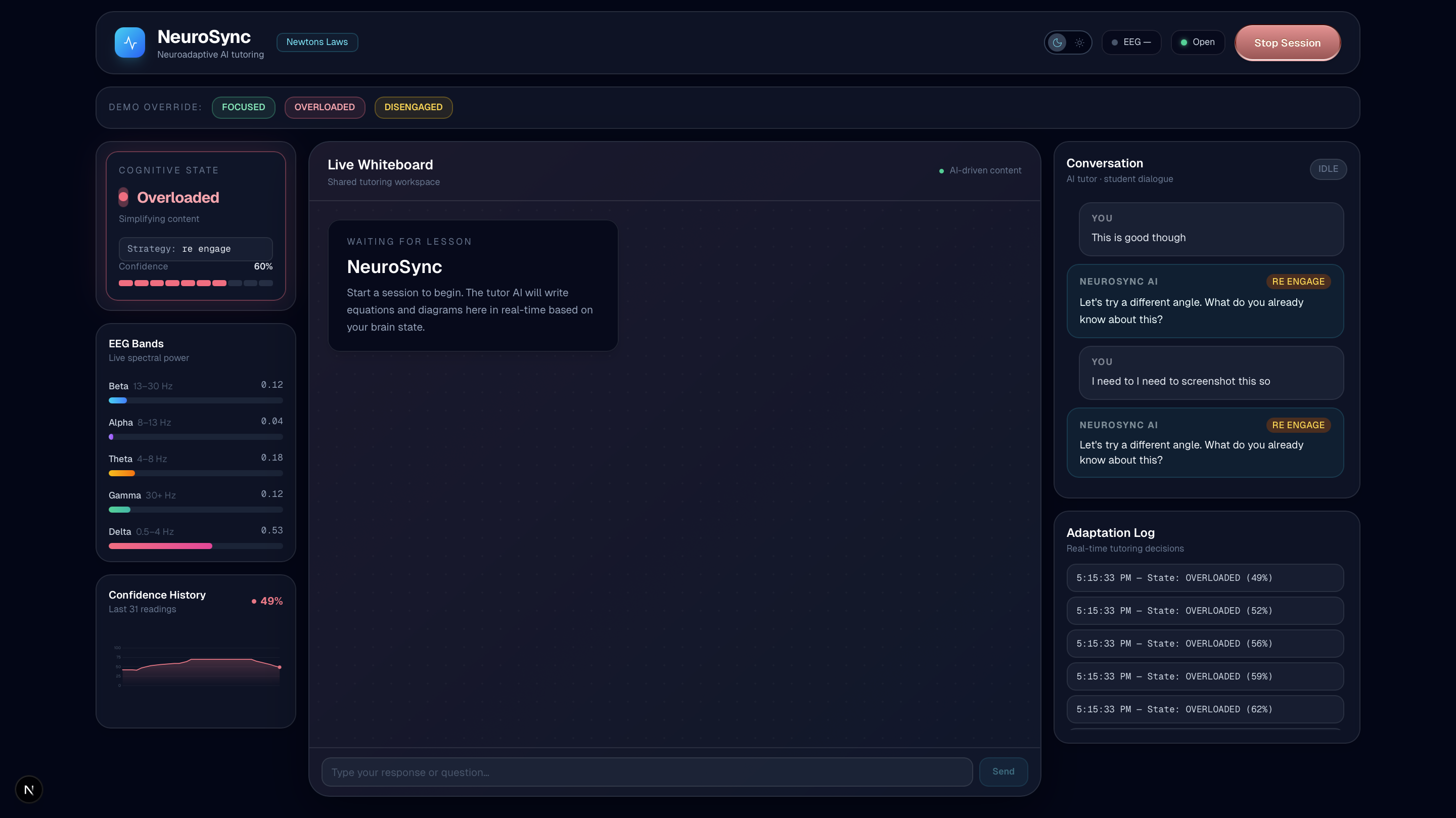
NeuroSync
Inspiration
Students today deal with a lot of academic pressure, especially in competitive environments. Online learning platforms and AI tutors have made tutoring more accessible, but they still rely entirely on what students say or type. In reality, many students struggle silently. They might be confused, overwhelmed, or losing focus without explicitly saying it.
We started wondering what would happen if a tutor could understand how a student’s brain is responding during a lesson.
That idea led to NeuroSync, a tutoring system that adapts its teaching based on real‑time brain signals.
What it does
NeuroSync is an AI tutor that adapts to a learner’s cognitive state in real time.
Using a Muse EEG headset, the system reads brain signals and classifies the learner’s state as:
- Focused
- Overloaded
- Disengaged
Those signals feed into an AI tutoring system that changes how the tutor teaches.
The loop looks like this:
EEG signals
→ cognitive state detection
→ AI strategy adjustment
→ tutor response through voice and whiteboard
If the system detects cognitive overload, the tutor might slow down, simplify the explanation, or ask a question to re‑engage the learner.
Instead of only reacting to what a student says, the tutor can respond to how the student’s brain is reacting during the lesson.
How we built it
NeuroSync combines EEG hardware, real‑time signal processing, and AI agents.
The Muse headset streams brain signals using muselsl and Lab Streaming Layer. A Python backend processes the signals and extracts band power features like alpha, beta, theta, and gamma activity. From those features we classify the learner’s cognitive state.
We built the tutor using a two‑agent AI setup.
The planner agent manages the lesson strategy and updates it when the cognitive state changes.
The speaker agent generates quick conversational responses based on the current strategy.
For interaction, the tutor communicates through voice and a shared whiteboard. Voice responses are generated using Hume AI, while the browser handles microphone transcription. The frontend is built with Next.js and connects to a FastAPI backend through WebSockets so updates happen in real time.
Challenges we ran into
Working with EEG signals was one of the biggest challenges. Brain signals are noisy and fluctuate a lot, so we had to add filtering and stability rules so the cognitive state would not constantly flicker.
Latency was another challenge. The system needed to feel natural during a conversation, so signal processing, AI responses, and voice playback all had to happen quickly.
Coordinating two AI agents also required careful state management. We had to make sure the planner could update strategies without interfering with the speaker while it was generating a response.
What we learned
This project gave us experience with real‑time signal processing, multi‑agent AI systems, and designing interfaces where humans interact with AI in a more natural way.
We also learned that combining hardware signals with AI systems introduces a completely different set of engineering problems compared to normal software projects.
Potential impact
NeuroSync explores the idea of neuroadaptive learning, where educational tools respond to a learner’s mental state.
Systems like this could eventually help with personalized tutoring, supporting students with ADHD, or detecting when learners are becoming overwhelmed during lessons.
Instead of waiting for students to ask for help, the system could detect cognitive struggle and adapt the lesson automatically.
Built With
- claude
- featherless
- python

Log in or sign up for Devpost to join the conversation.