-
-
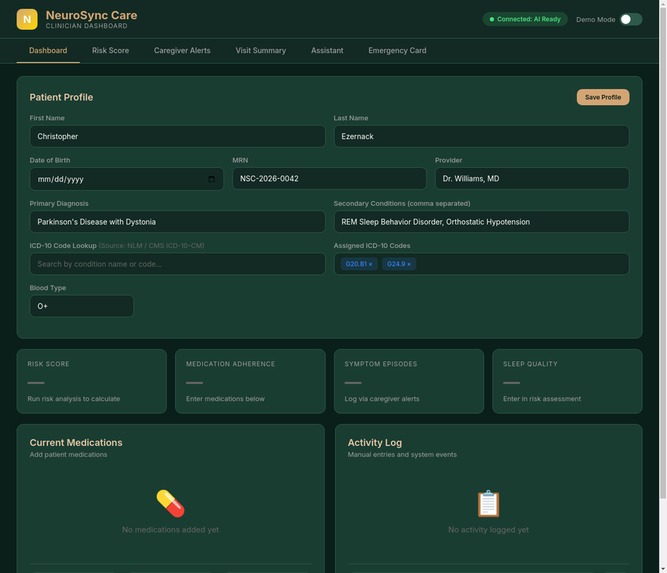
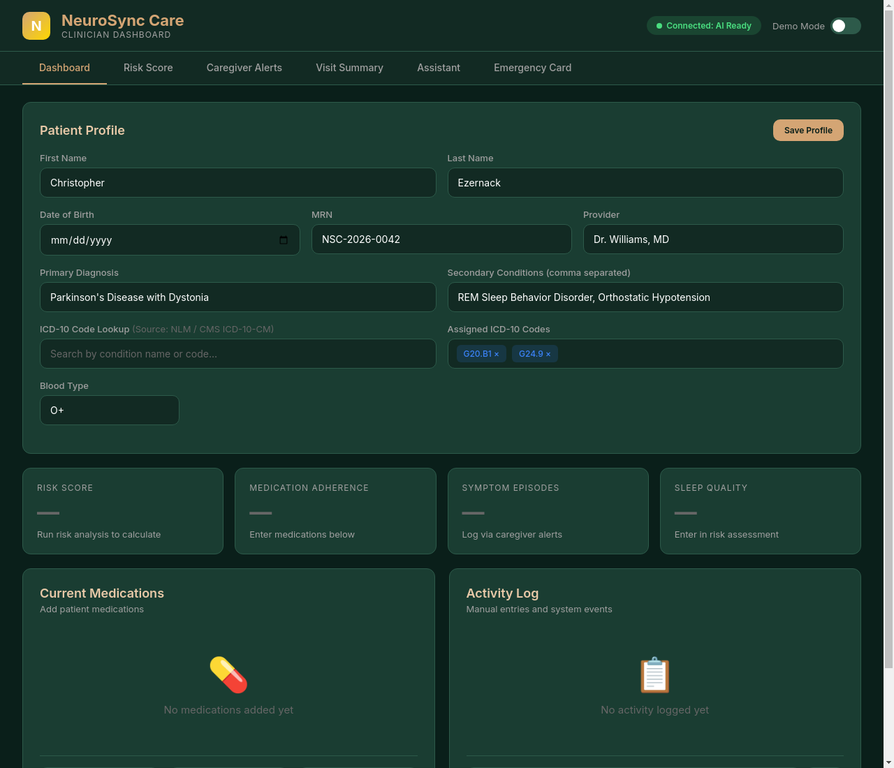
Clinician dashboard with live ICD-10 lookup and assigned billing codes.
-
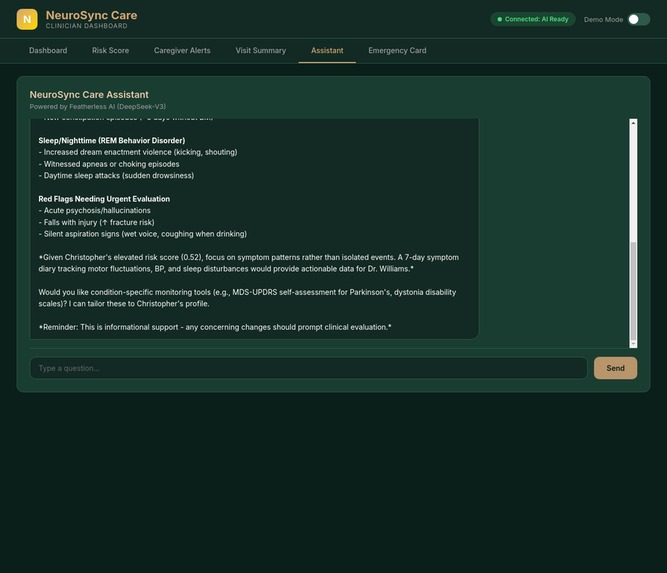
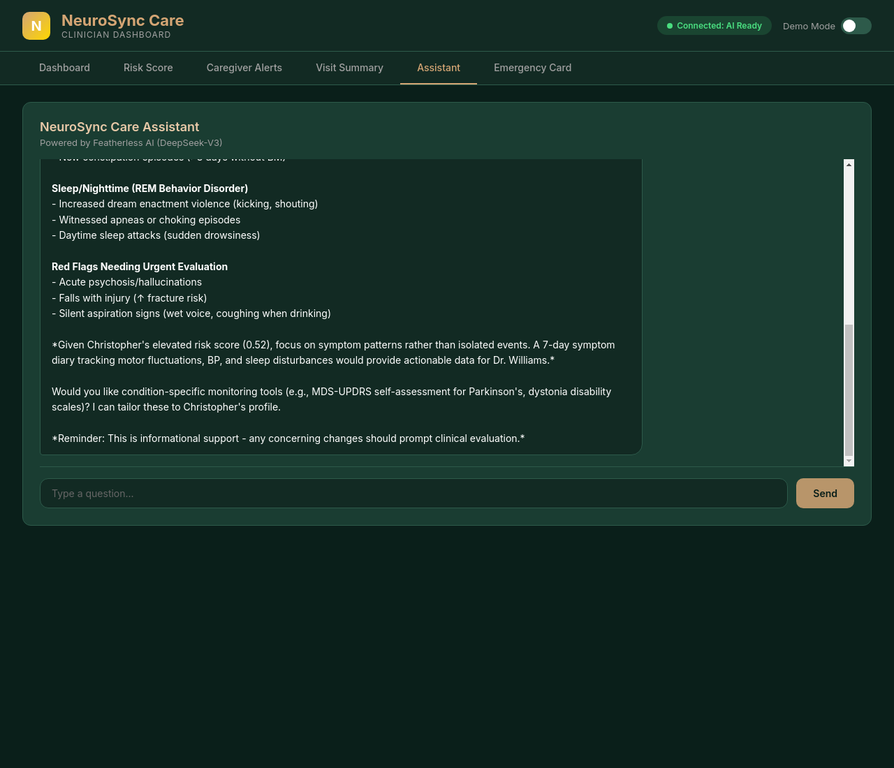
Context-aware AI assistant using full patient clinical profile.
-
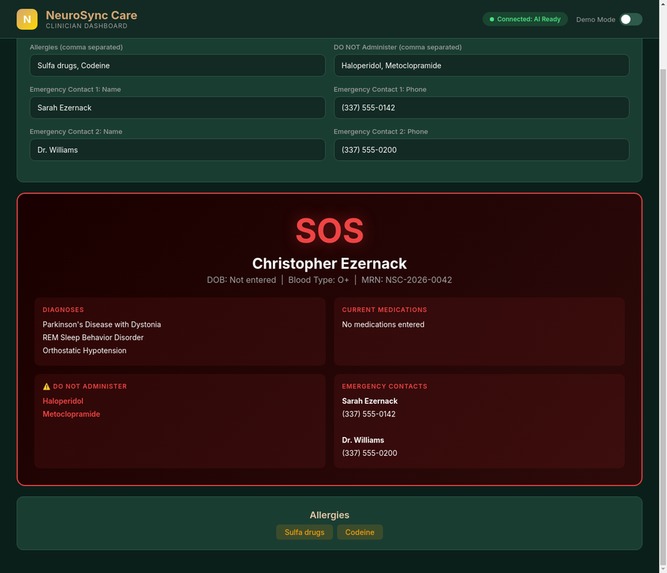
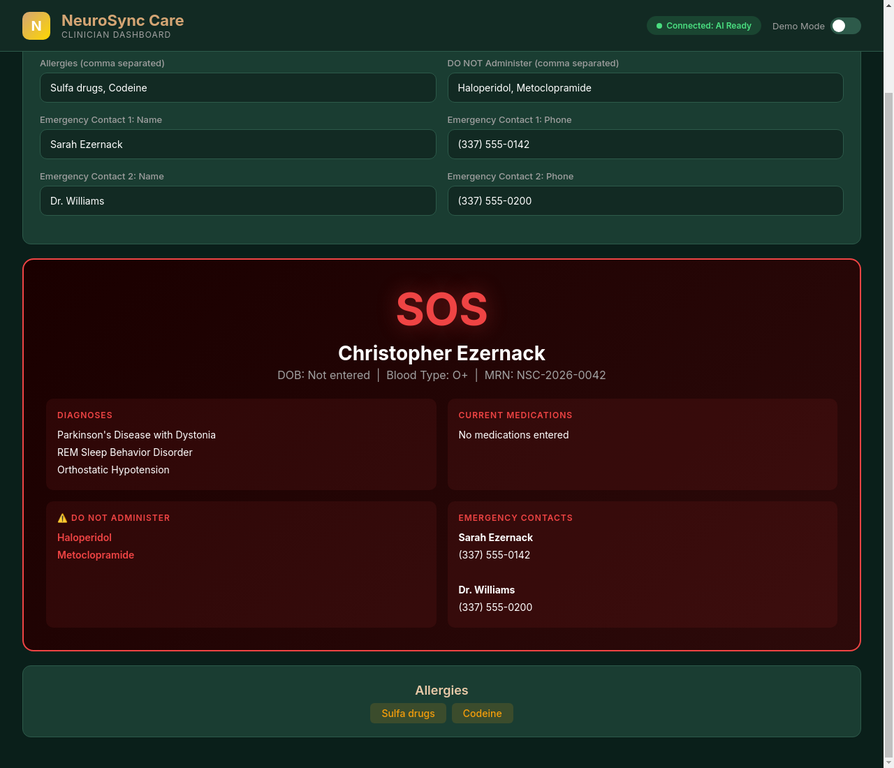
Emergency card with diagnoses, meds, alerts, and contacts.
-
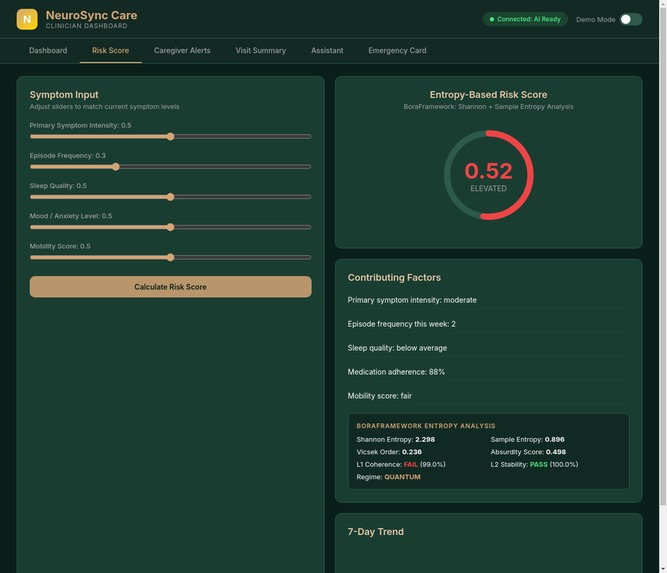
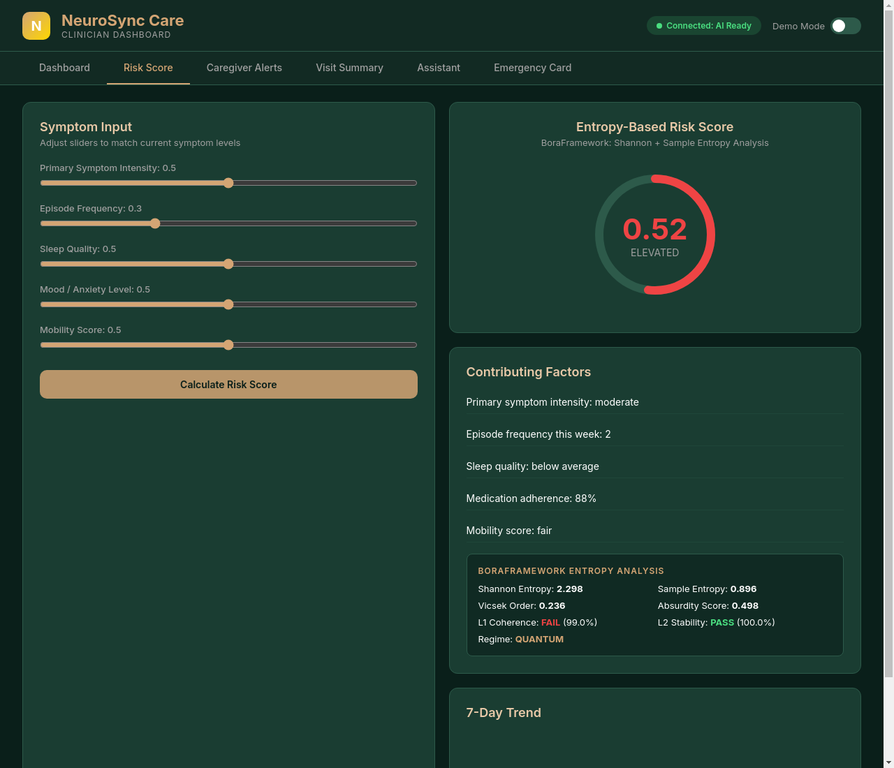
Entropy-based risk score with real-time severity classification.
-
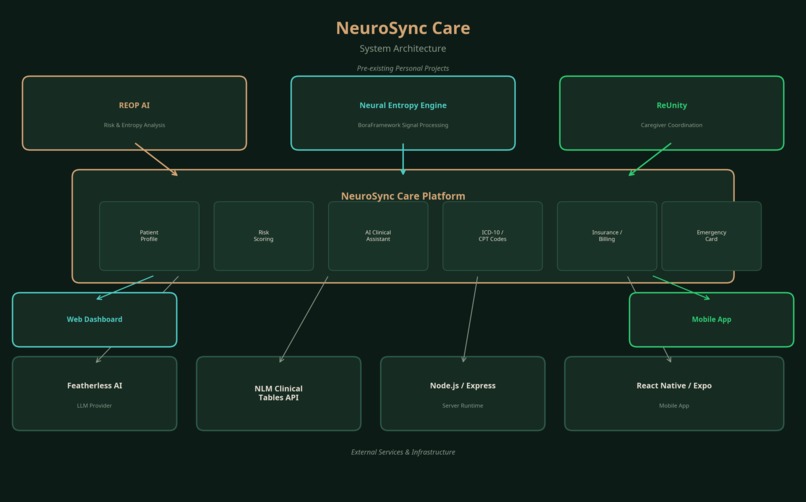
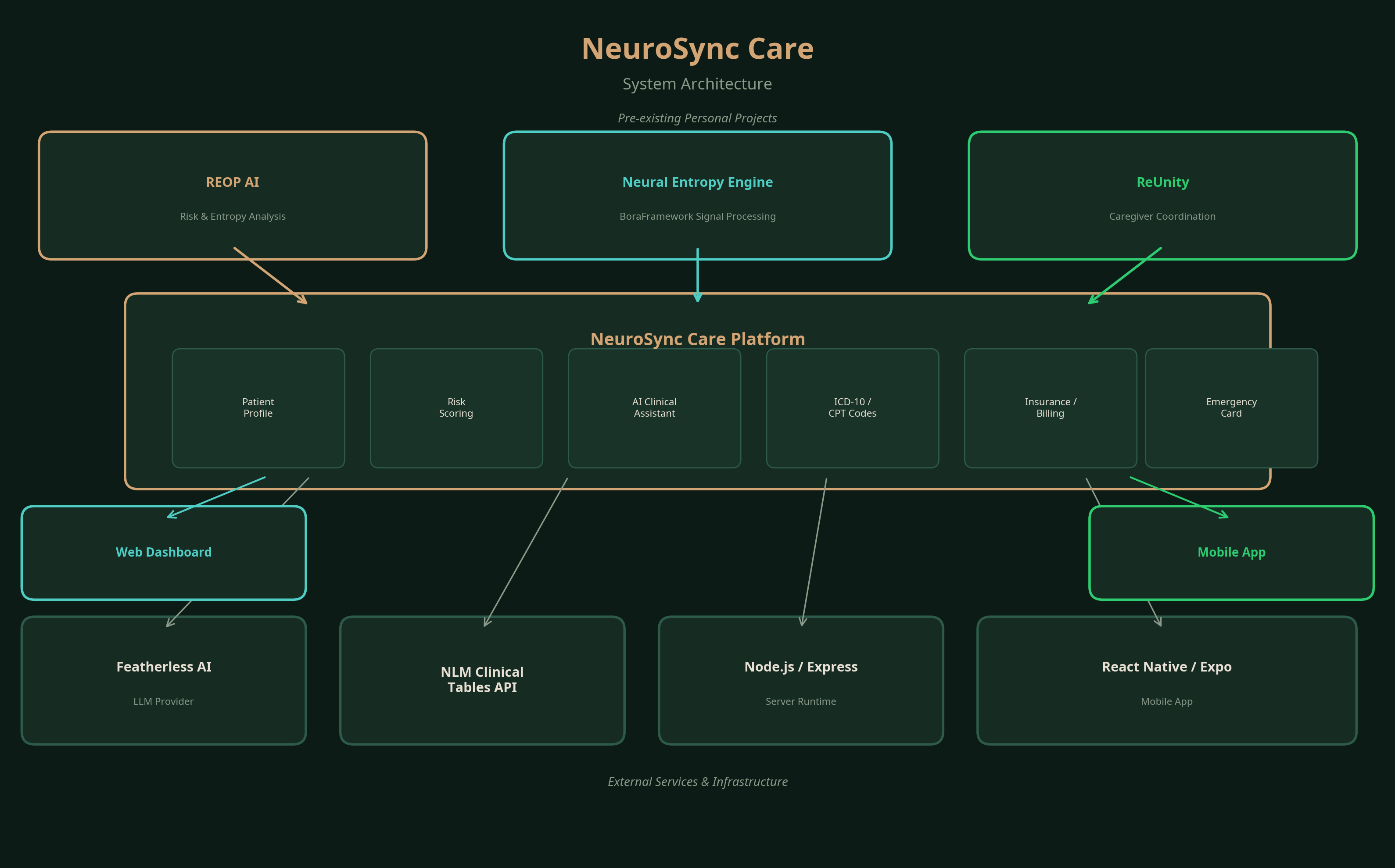
System architecture integrating AI, risk scoring, ICD-10 APIs, and mobile sync.
Inspiration
I live with a complex neurological condition. Every day involves symptom instability, medication timing, multiple providers, caregiver coordination, and strict diagnostic and procedural coding requirements. My neurologist needs structured data. My caregiver needs real-time updates. First responders need immediate access to critical information. Providers need ICD-10 and CPT alignment for accurate reimbursement.
These systems do not operate together.
NeuroSync Care was built to unify clinical documentation, predictive risk modeling, caregiver coordination, and billing alignment into one integrated platform.
What it does
NeuroSync Care bridges patient-reported neurological complexity with structured clinical and billing workflows.
Clinical Workflow Impact
Clinicians access a unified dashboard with live ICD-10 and CPT code lookup powered by NLM and CMS datasets. Diagnoses and procedures can be assigned directly during intake, ensuring documentation accuracy and billing compliance.
The platform includes predictive risk scoring that analyzes symptom stability patterns over time and an AI-assisted triage tool aware of the full patient context, including assigned ICD-10 and CPT codes. This supports faster intake, cleaner documentation, and more confident point-of-care decisions.
Patient Safety Impact
Patients carry a digital emergency card with diagnoses, medications, allergies, and safety instructions for first responders. The AI assistant provides context-aware guidance while always directing users to licensed providers for medical decisions.
Caregiver Coordination Impact
Caregivers receive real-time flare-risk notifications linked to symptom instability. Visit summaries are generated in two formats: a structured EMR-ready version aligned with ICD-10 and CPT documentation, and a plain-language version for patients and families. The entire care team stays synchronized.
How I built it
NeuroSync Care unifies three existing projects into one system:
- REOP AI provided the mobile foundation built with Expo, React Native, and TypeScript
- Neural Entropy contributed the predictive risk scoring engine
- ReUnity provided caregiver alert logic and emergency card architecture
The web dashboard is a single-page application powered by Node.js and Express, deployed on Render. ICD-10 and CPT lookup use National Library of Medicine Clinical Tables APIs and CMS datasets. AI features are powered by Featherless AI.
Challenges I ran into
Integrating three independent architectures into a billing-aware, production-ready system required standardizing state management, API patterns, and UI logic. Ensuring reliable ICD-10 and CPT assignment within the same workflow required backend validation and data normalization. Porting the predictive risk engine from Python to a mobile-compatible implementation required performance optimization.
Accomplishments that I'm proud of
The combined ICD-10 and CPT integration makes the platform operationally relevant for providers. The predictive risk scoring models symptom stability rather than relying on static thresholds. Most importantly, every feature was designed from lived neurological complexity, ensuring practical real-world applicability.
What I learned
Building within the Axxess ecosystem reinforced that effective healthcare tools must support clinical workflow, billing compliance, patient usability, and caregiver communication simultaneously. A platform that ignores any of these fails the system.
What's next for NeuroSync Care
- Direct integration with the Axxess home health API
- Automated ICD-10 to CPT pairing recommendations
- Push notifications for caregiver alerts
- FHIR-compliant data export for EHR interoperability
Built With
- expo.io
- express.js
- featherless
- nlm-clinical-tables-api
- node.js
- react-native
- typescript

Log in or sign up for Devpost to join the conversation.