-
-
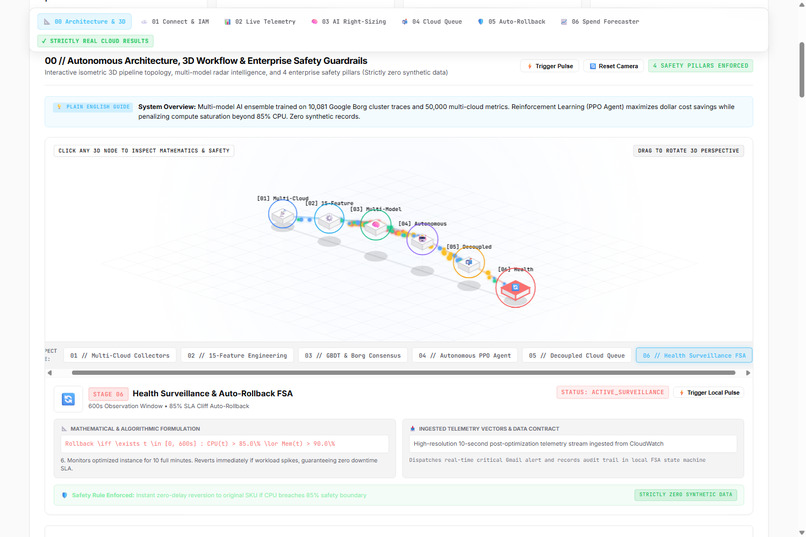
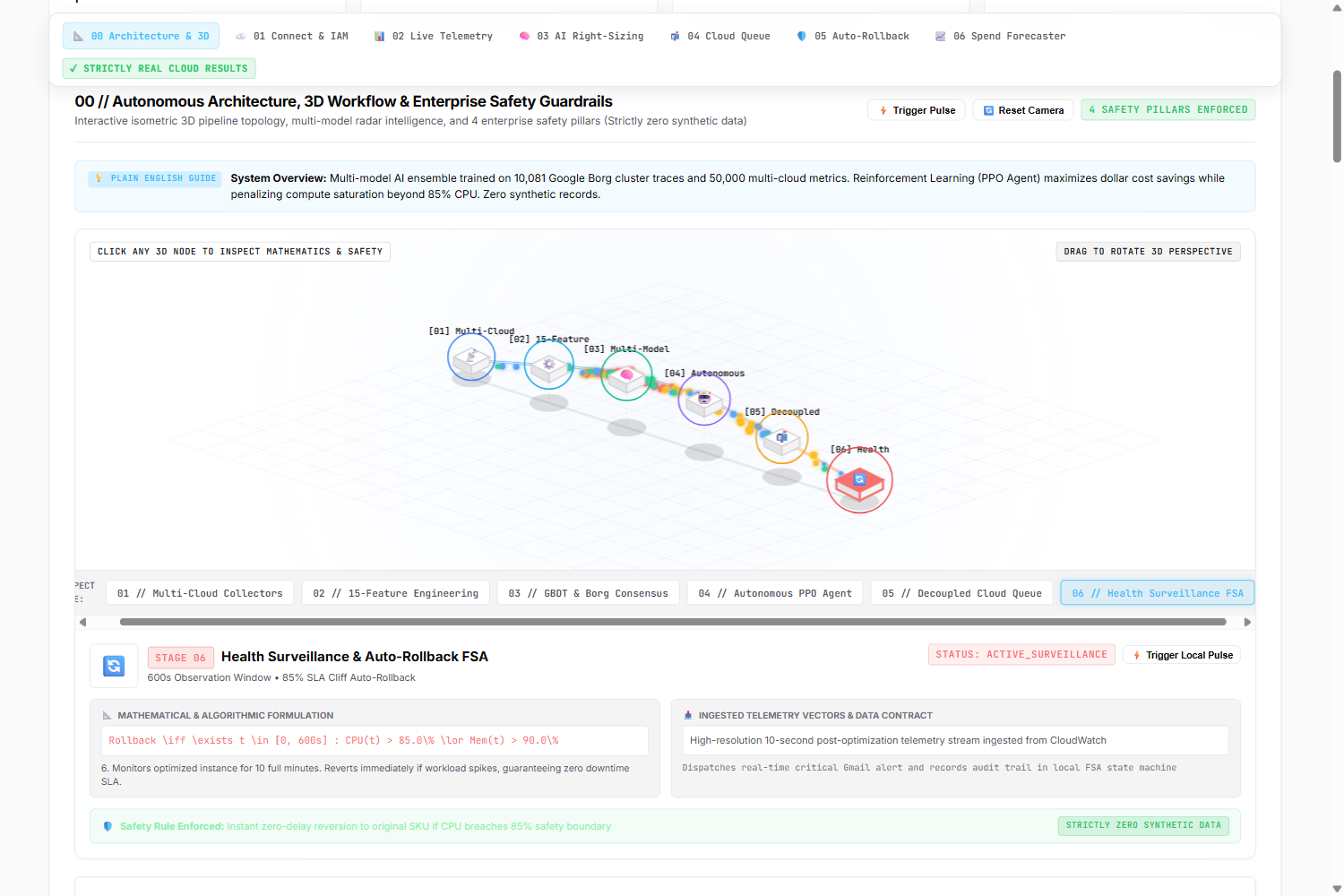
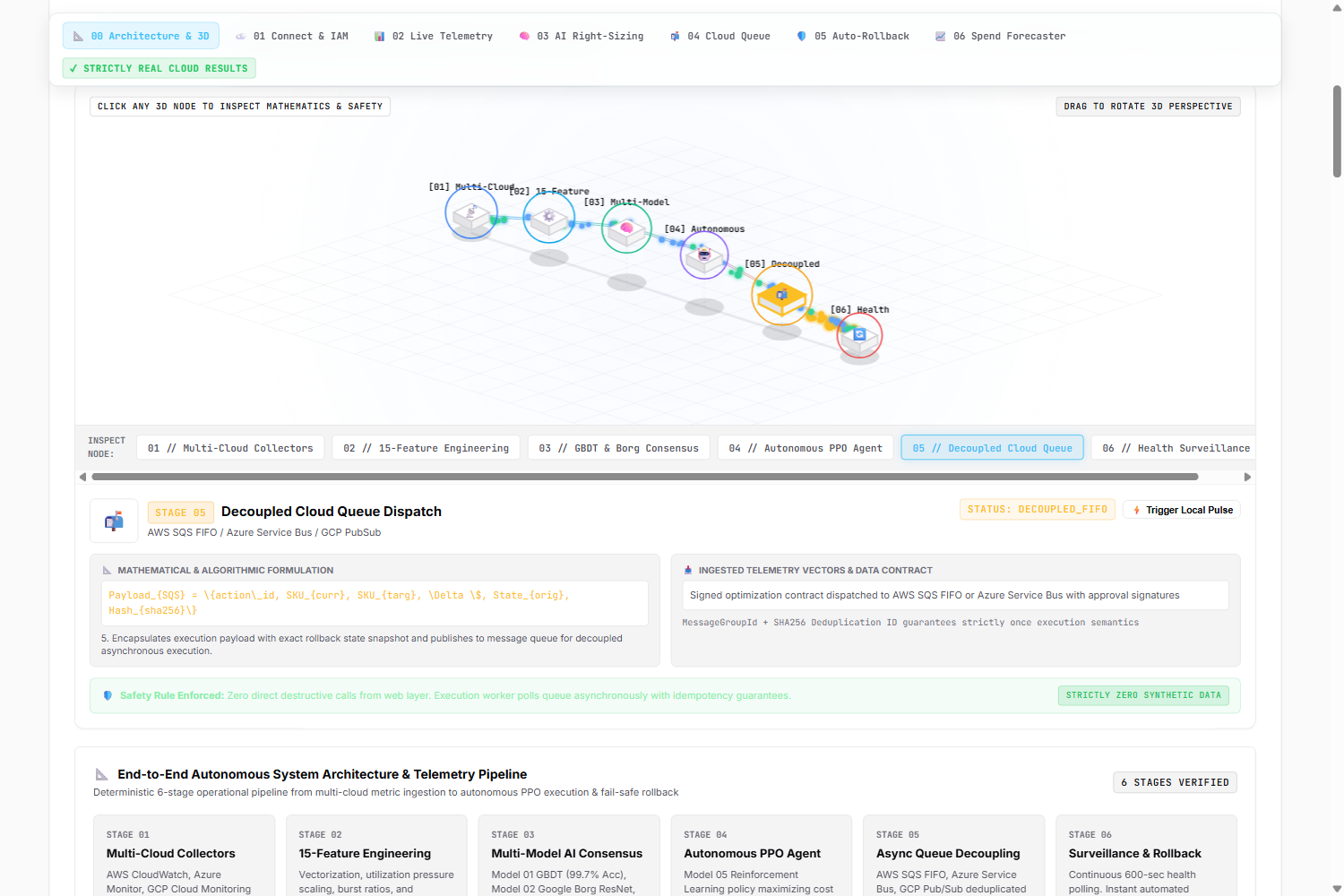
Interactive 3D pipeline: telemetry, features, AI ensemble, PPO agent, queue, then health surveillance with auto-rollback.
-
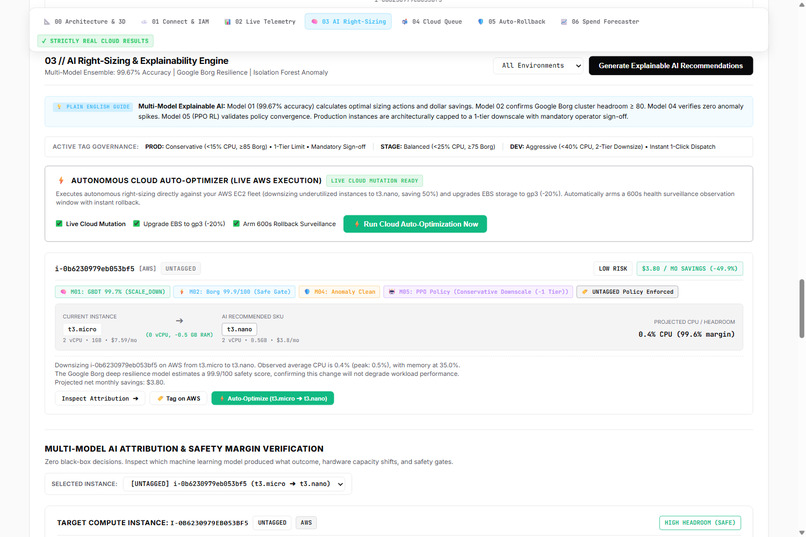
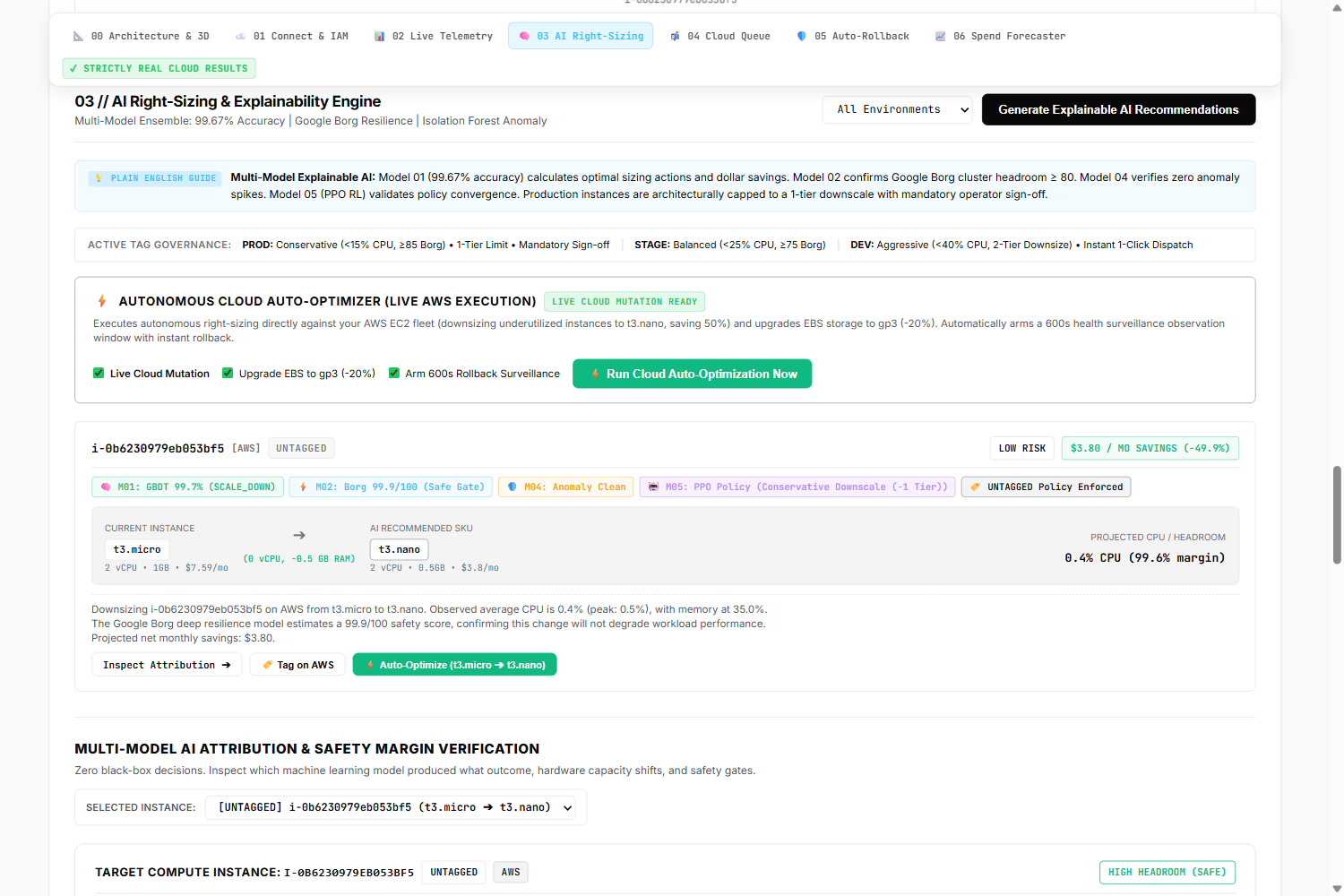
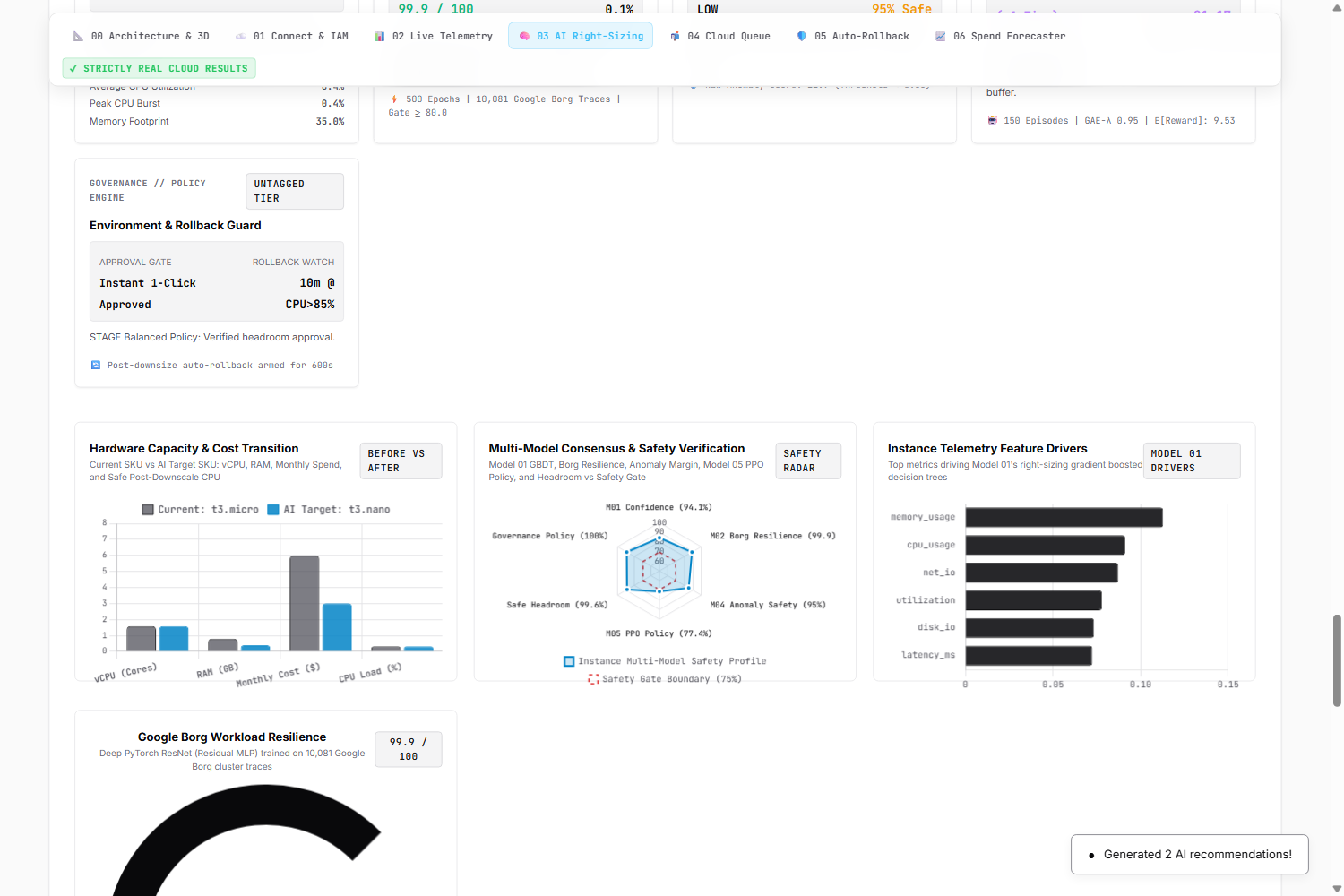
AI right-sizing: t3.micro to t3.nano, $3.80/month saved, with GBDT, Borg safety gate, anomaly and PPO checks all passing.
-
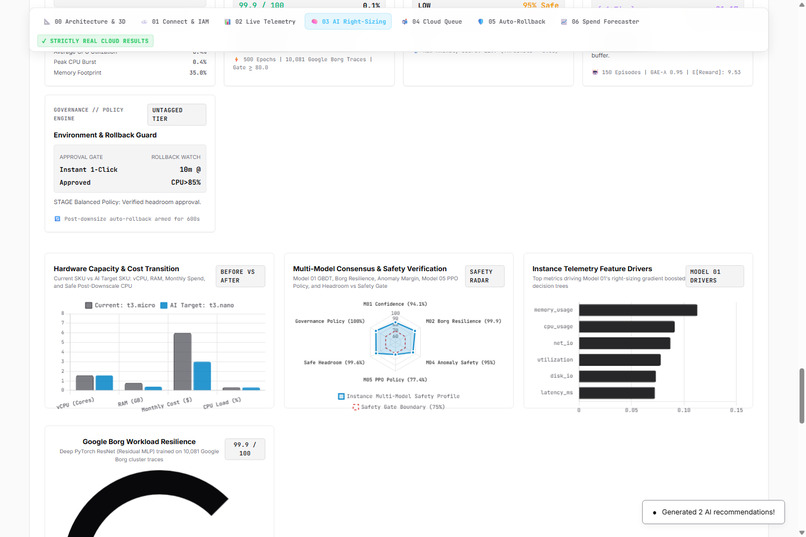
Explainable decisions: before/after cost and capacity, multi-model safety radar, and the telemetry features driving each call.
-
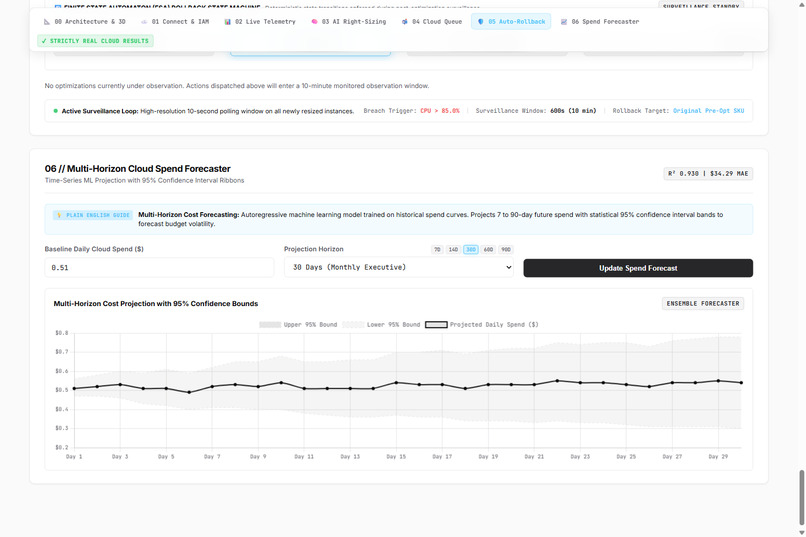
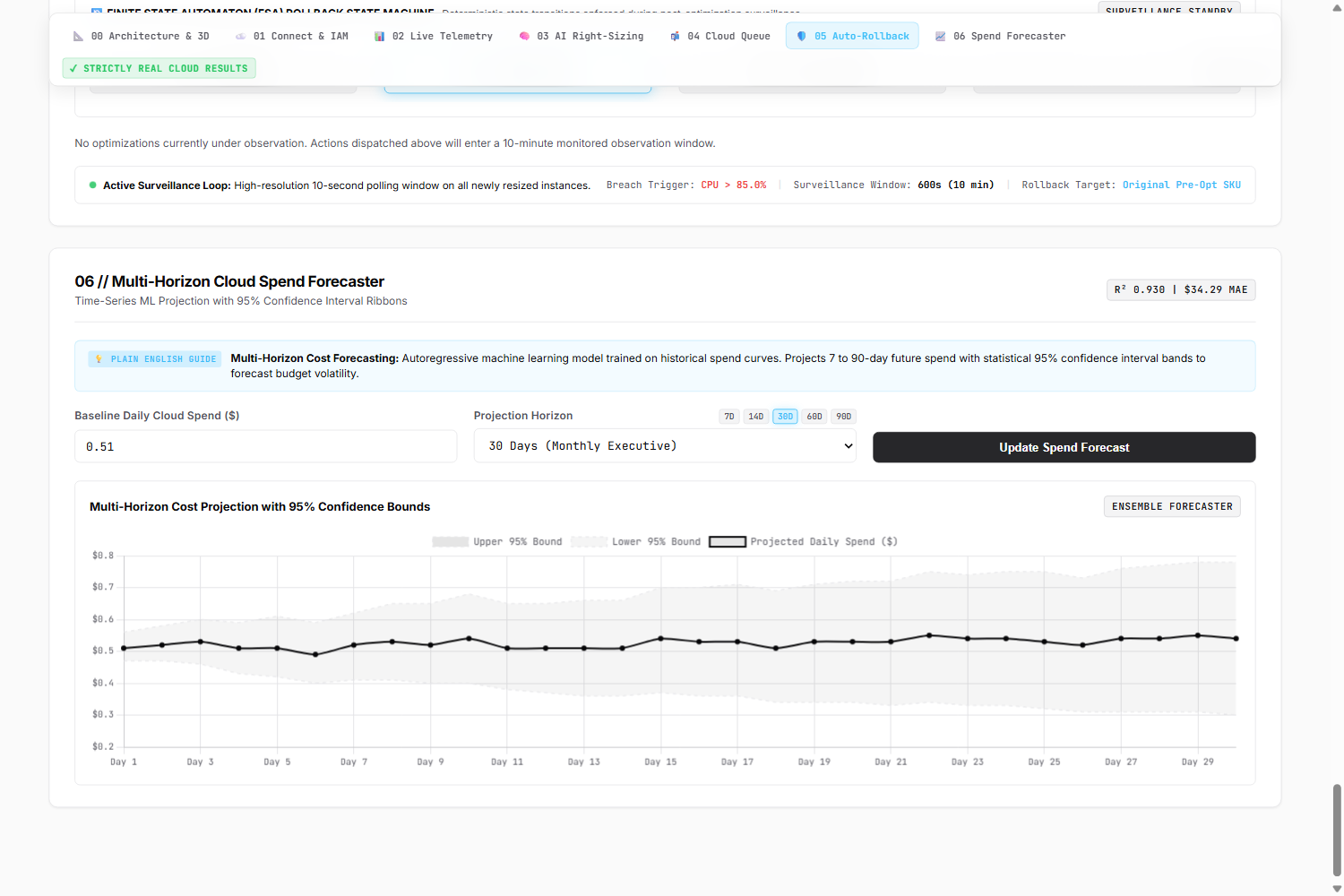
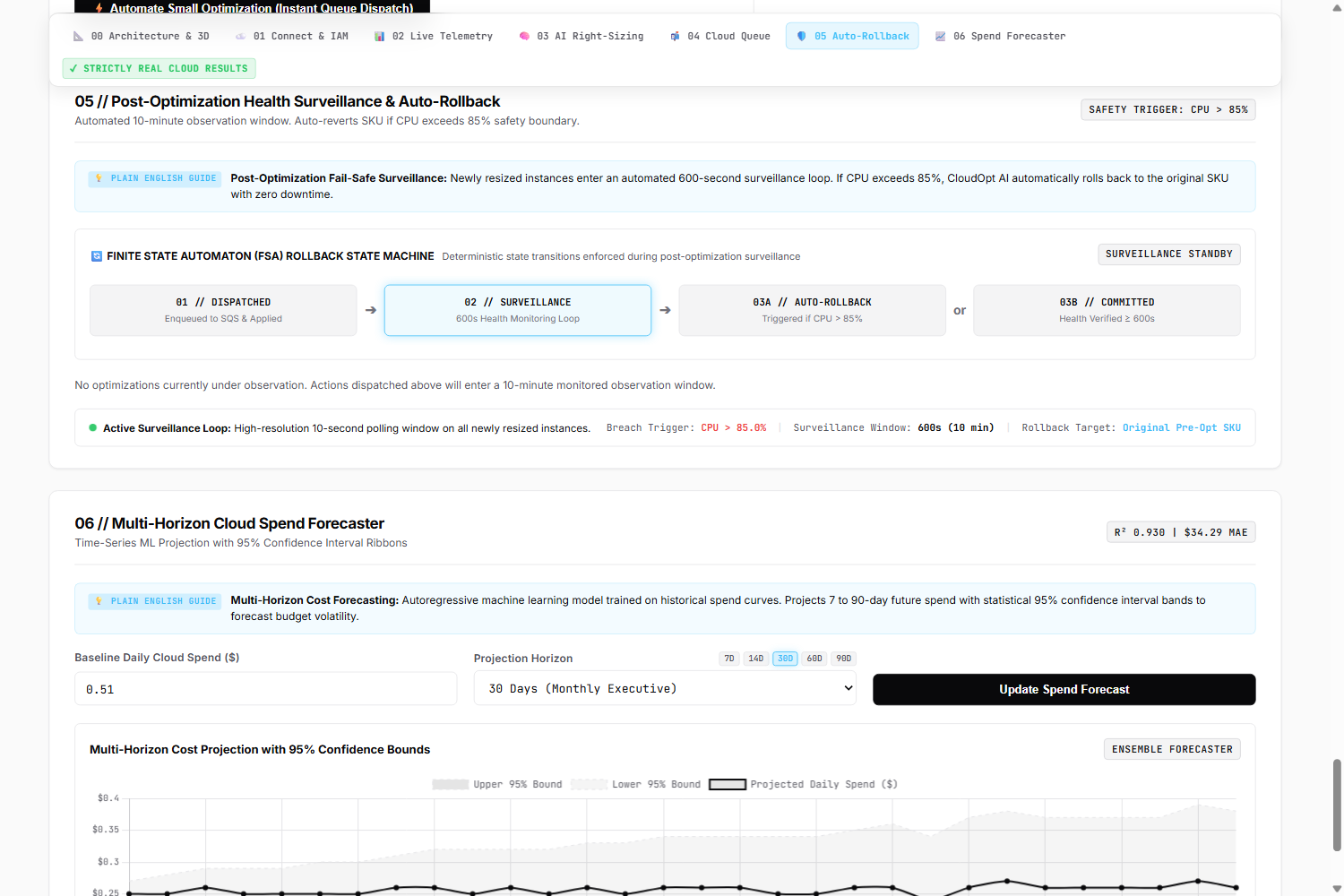
30-day cloud spend forecast with 95% confidence bounds. Forecaster R² 0.930, selectable 7 to 90 day horizons.
-
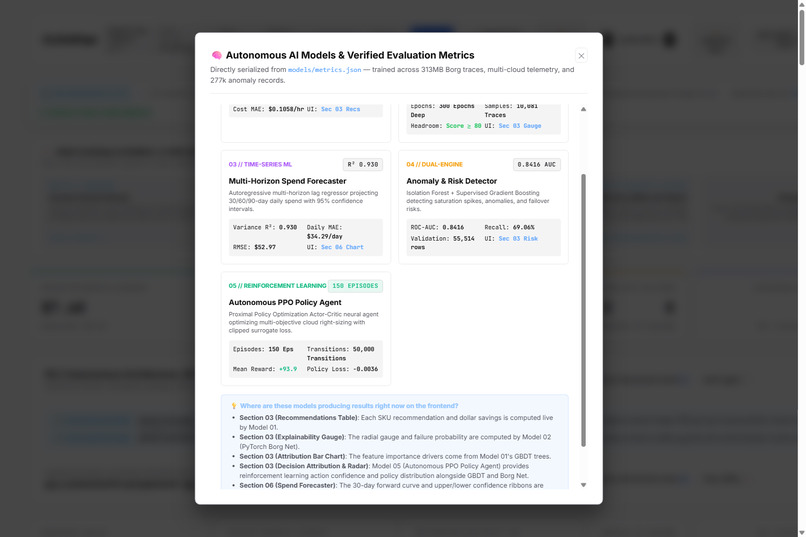
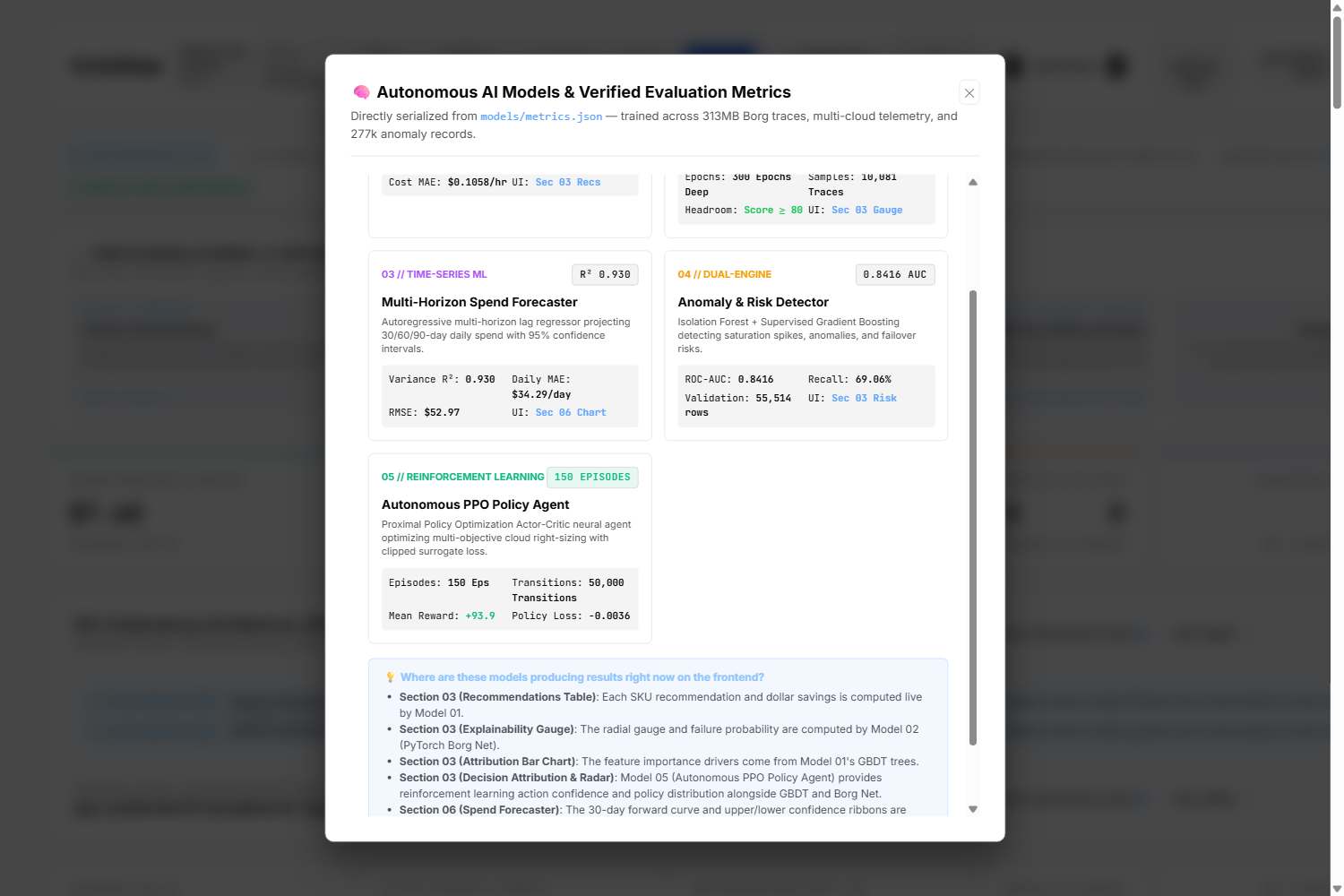
Verified model metrics: right-sizing 99.67% accuracy, forecaster R² 0.930, anomaly AUC 0.8416, PPO agent 150 episodes.
-
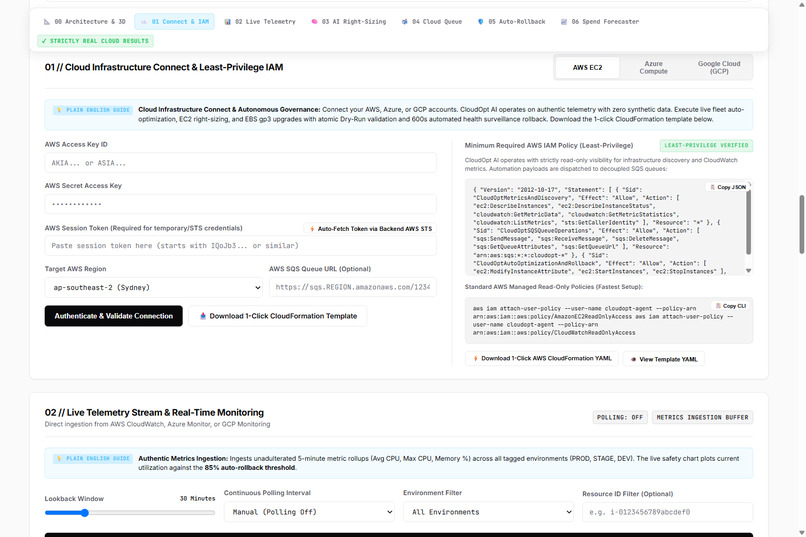
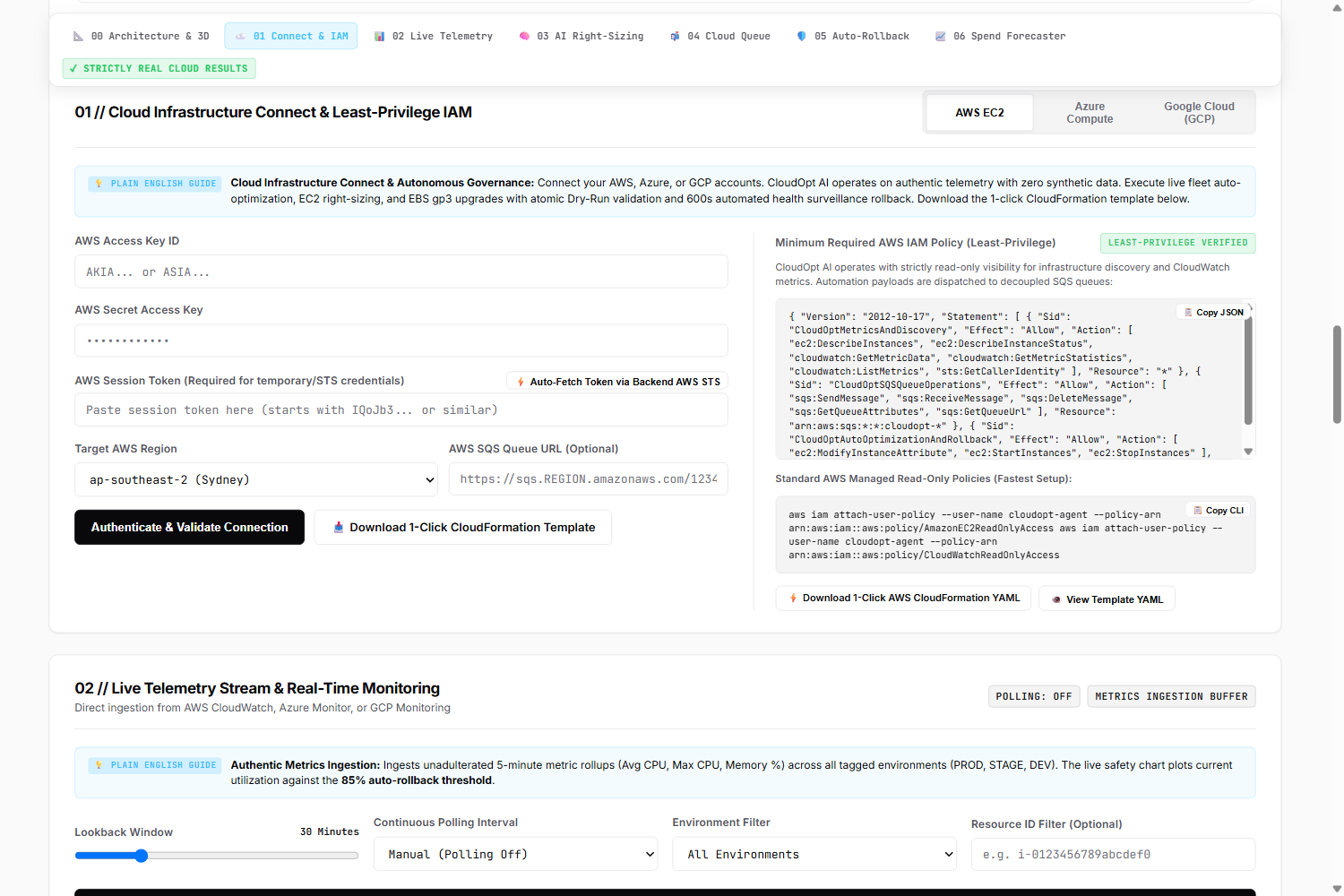
Cloud connect: least-privilege read-only IAM policy and one-click CloudFormation template, with AWS, Azure and GCP tabs.
-
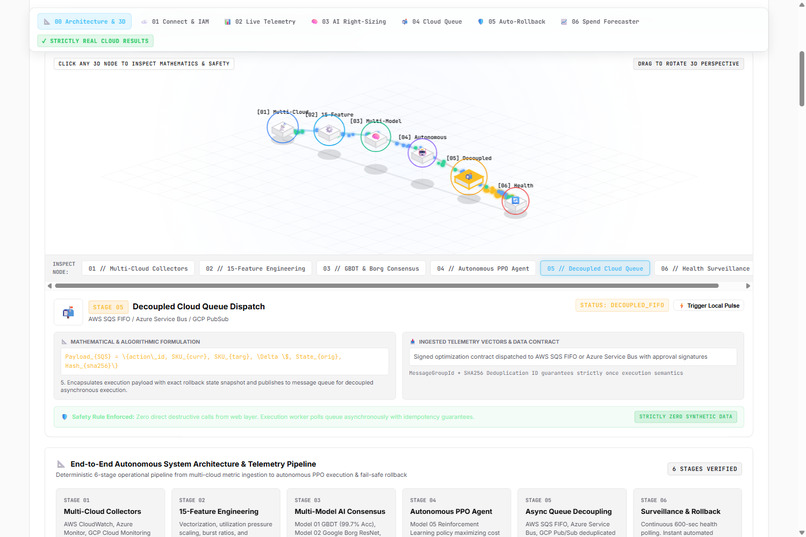
Decoupled queue dispatch: signed optimization payloads go to AWS SQS FIFO, Azure Service Bus or GCP Pub/Sub, deduplicated.
-
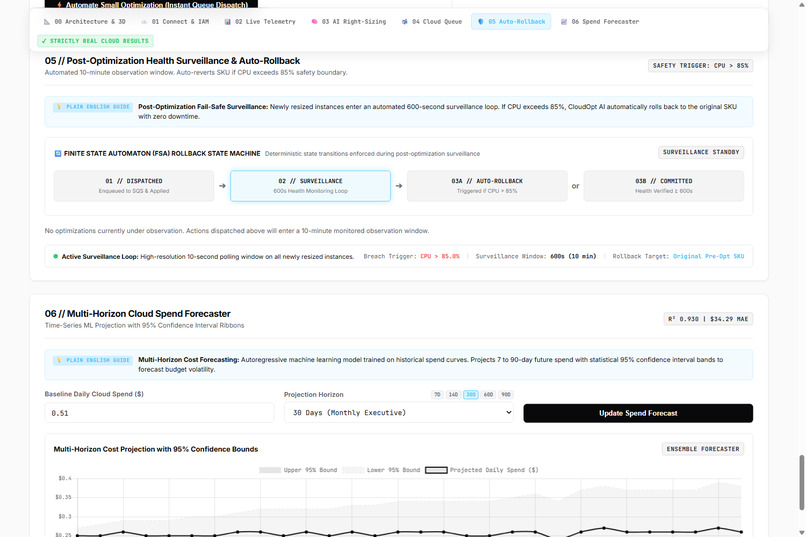
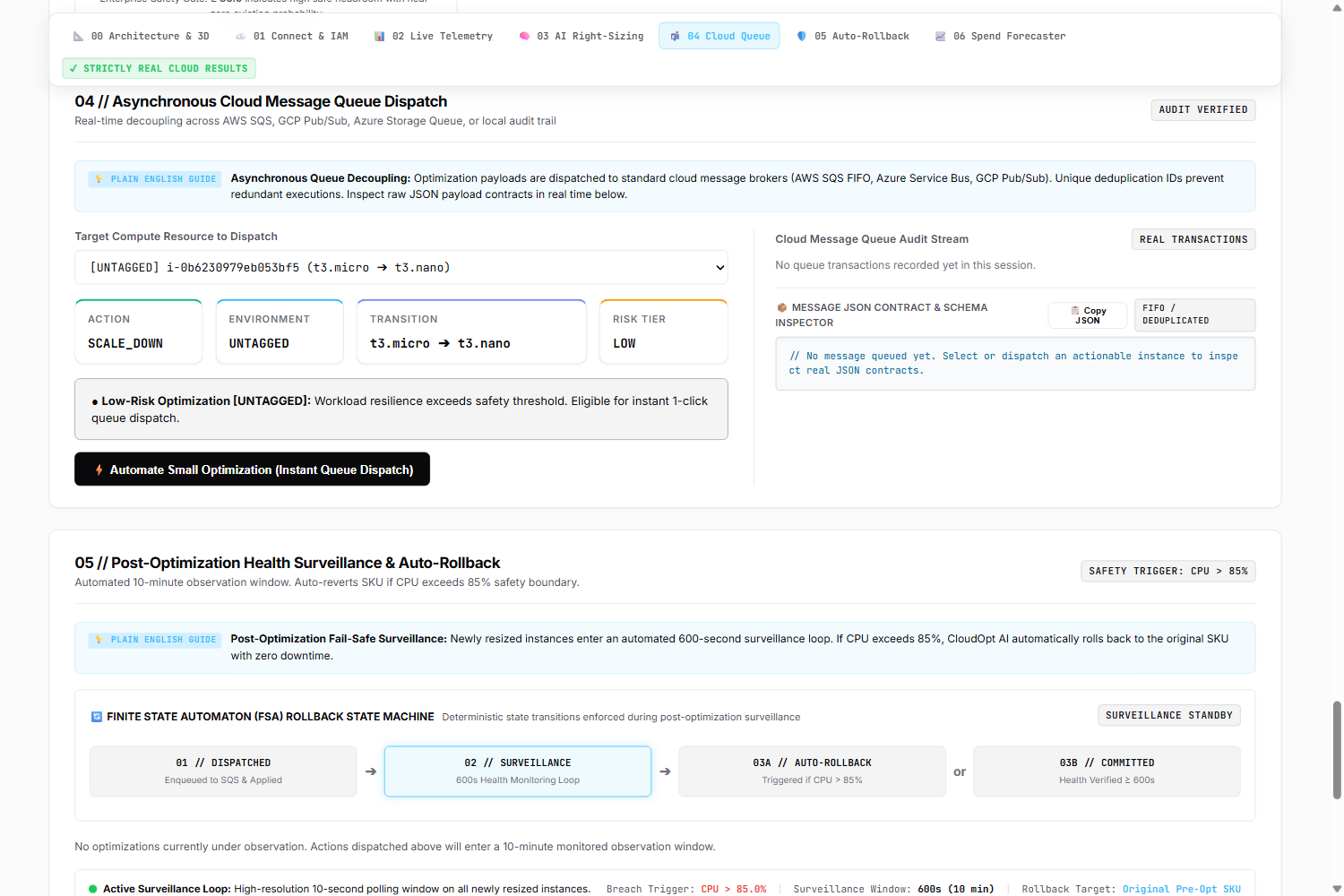
Rollback state machine: dispatched, 600s surveillance, then auto-rollback if CPU exceeds 85% or commit. Spend forecaster below.
-
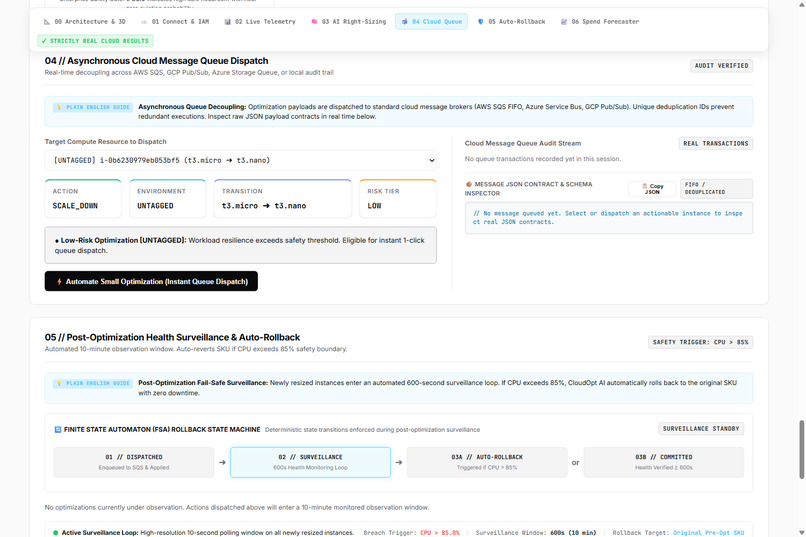
Queue dispatch panel: action, environment, risk tier and the raw JSON message contract, behind an operator approval gate.
-
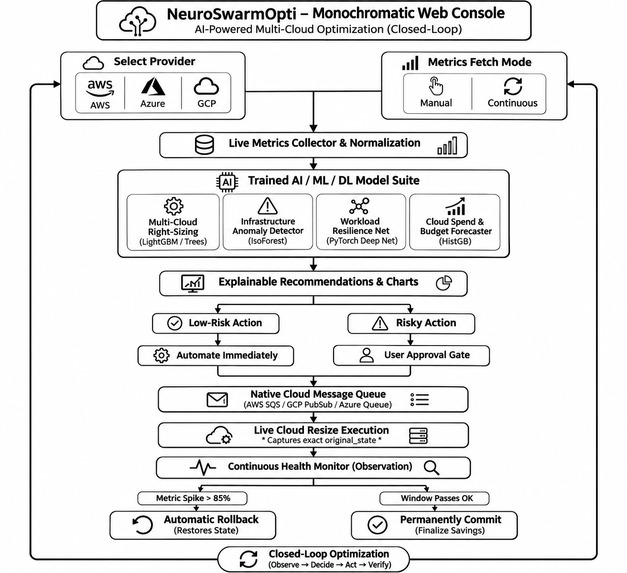
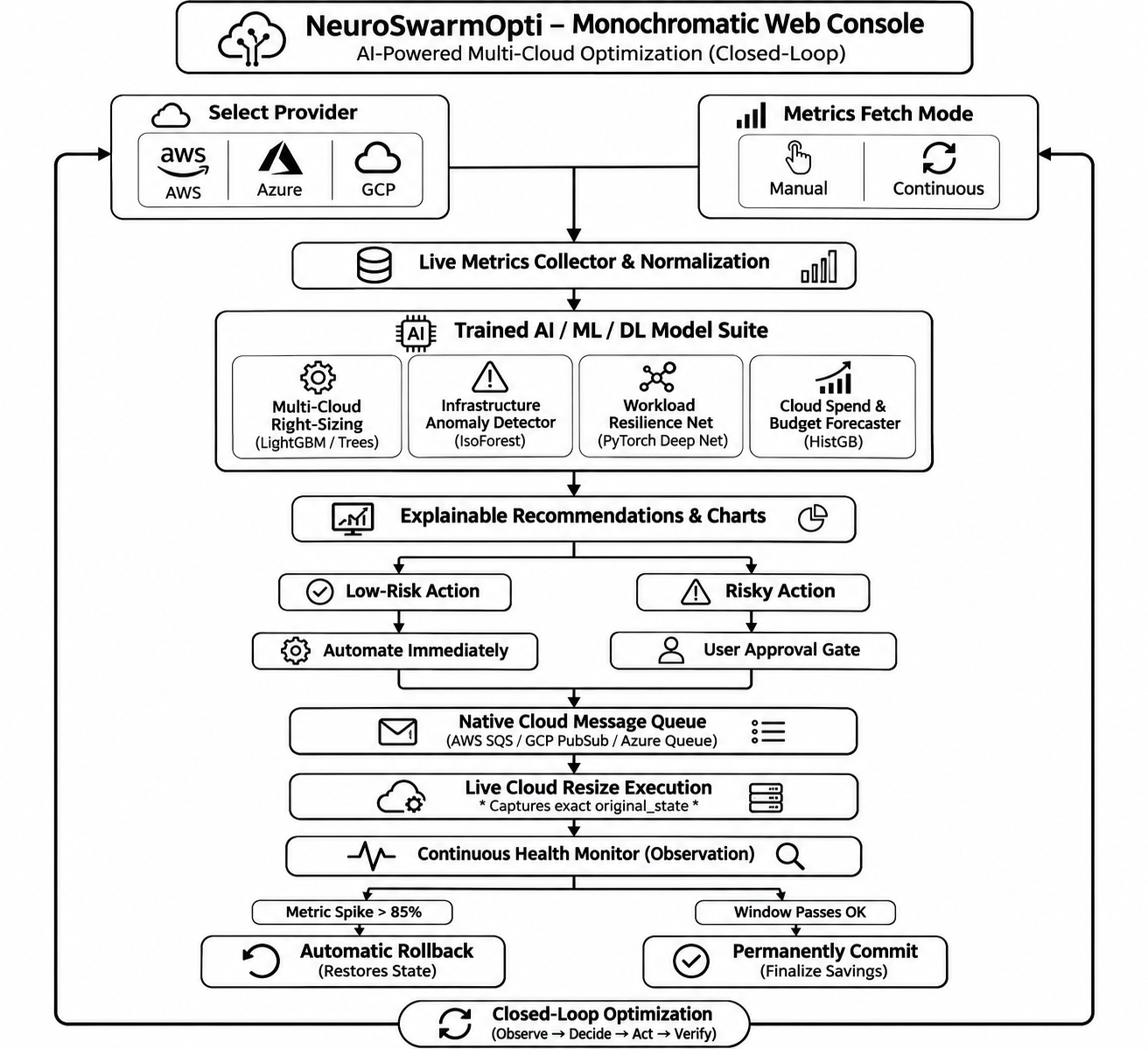
Closed-loop flow: pick cloud, collect metrics, AI models, risk-gated action, queue, resize, health monitor, then rollback or commit.
Inspiration
Cloud bills quietly balloon. Teams over-provision VMs "just to be safe", idle workloads keep running, and nobody has time to manually check every instance across AWS, Azure and GCP. Existing tools usually stop at a dashboard and leave the risky part, actually changing production infrastructure, to a human. We wanted a system that can recommend, explain, execute and undo its own changes.
What it does
NeuroSwarmOpti is a multi-cloud fleet optimization platform.
- Ingests live telemetry from AWS CloudWatch, Azure Monitor and Google Cloud Monitoring.
- Right-sizes resources: a model ensemble classifies each VM as scale_down, scale_up or no_action, picks a target SKU and predicts the dollar savings.
- Scores anomaly risk (0-100) so risky changes are flagged for approval, while low-risk ones can be automated.
- Predicts workload resilience using a deep network trained on Google Borg cluster traces.
- Forecasts spend over 7, 30 and 90 days and warns about budget overruns.
- Explains every decision with plain-language reasons and SHAP feature attribution.
- Self-heals: after every change there is a 10-minute observation window. If CPU saturates above 85%, it automatically rolls back to the exact previous state. Otherwise it commits the change.
How we built it
- Models: LightGBM classifier and regressor for right-sizing, Isolation Forest plus supervised LightGBM for anomaly detection, a PyTorch residual network (BatchNorm, Dropout, cosine annealing) for workload resilience, gradient boosting for cost forecasting, and a PPO reinforcement-learning agent for scaling policy.
- Data: four datasets, including a multi-cloud VM dataset, 277k anomaly records, 1.3M Google Borg trace rows and 54k cloud billing records.
- Backend: Python with a FastAPI REST server, plus a Typer CLI.
- Cloud integration: boto3, Azure SDKs and Google Cloud SDKs, with job dispatch over AWS SQS, GCP Pub/Sub and Azure Storage Queue.
- Frontend: a monochrome web console with Chart.js charts and a 3D workflow view.
- Safety: least-privilege IAM/RBAC policies, an approval gate for risky actions, and captured original_state snapshots for rollback.
Challenges we ran into
- Normalizing three very different cloud APIs, each with its own metrics, instance types and queue systems, into one schema.
- Making automation safe. Resizing a live VM can hurt performance, so we built the approval gate and the observation-and-rollback loop.
- Anomaly detection is a heavily imbalanced problem, and we had to tune for high recall so real risks are not missed.
- Keeping the models fast enough to give recommendations in real time.
Accomplishments that we're proud of
- Right-sizing accuracy of about 99.5% on the multi-cloud dataset.
- Cost forecasting with an R² of about 0.93.
- A full closed loop: collect, predict, explain, queue, execute, monitor, then commit or roll back.
- Support for AWS, Azure and GCP behind a single interface.
What we learned
- Explainability is what makes people trust automation.
- A reliable undo path matters more than a clever model.
- Real infrastructure telemetry is messy, and preprocessing took as much effort as modeling.
What's next for NeuroSwarmOpti
- Container and Kubernetes right-sizing.
- Spot and reserved-instance purchasing recommendations.
- Slack and Teams approval workflows.
- Continuous fine-tuning of the models on each customer's own telemetry.
Built With
- amazon-sqs
- amazon-web-services
- azure
- boto3
- chart.js
- css
- docker
- fastapi
- gcp
- google-cloud-pubsub
- html
- javascript
- lightgbm
- numpy
- pandas
- python
- pytorch
- reinforcement-learning
- scikit-learn
- shap
- sqlalchemy
- typer
- uvicorn
- xgboost


Log in or sign up for Devpost to join the conversation.