Inspiration
Navigating social spaces as an autistic person often feels like walking through a minefield of unspoken rules, sarcasm, and casual condescension. When someone throws an unexpected jab your way—whether it's a pointed remark about being too quiet, a backhanded compliment, or a sarcastic joke at your expense—it triggers an immediate rush of anxiety and mental overload. You freeze, you overthink, and by the time you figure out what to say, the moment has already passed, leaving you mentally exhausted. We built ShieldSense because neurodivergent individuals shouldn't have to carry the heavy cognitive burden of constantly decoding and defending against toxic social cues. We wanted a silent, autonomous companion on the wrist that handles the friction for you, serving up natural, effortless responses so you can protect your peace of mind and navigate social spaces on your own terms.
What it does
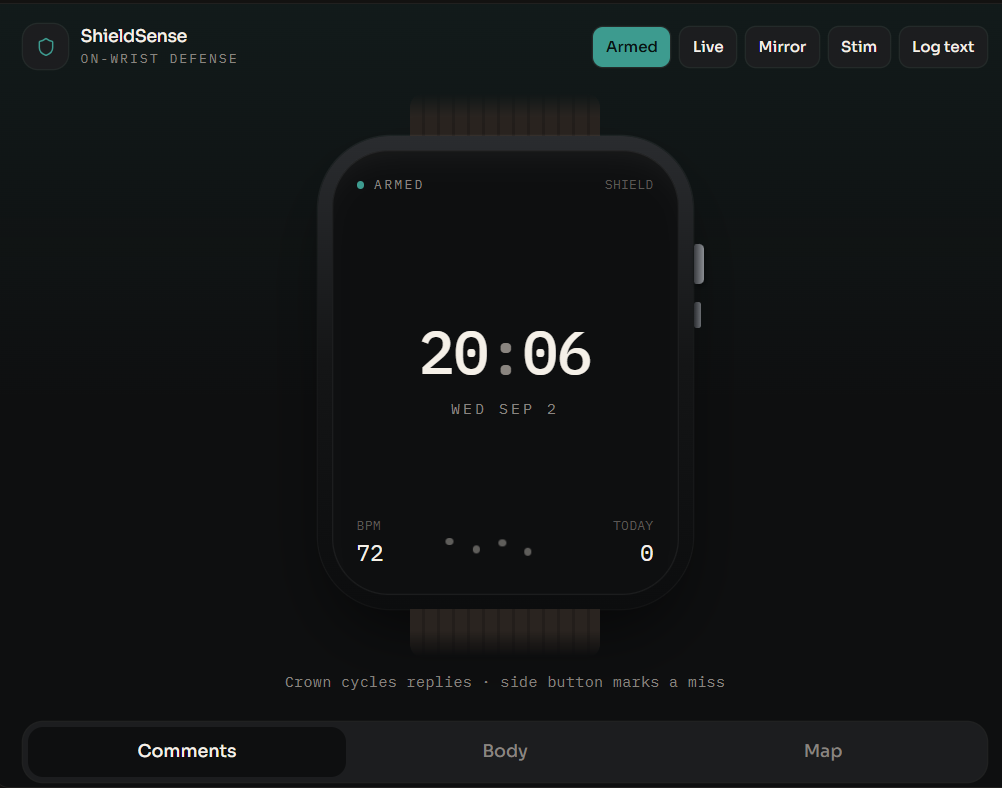
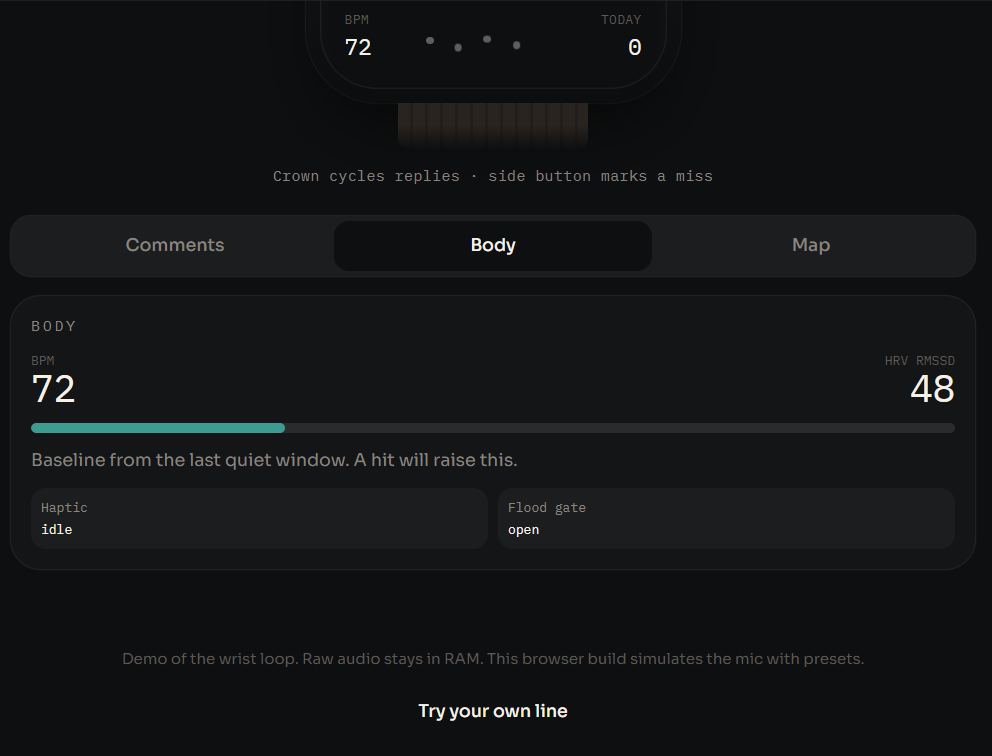
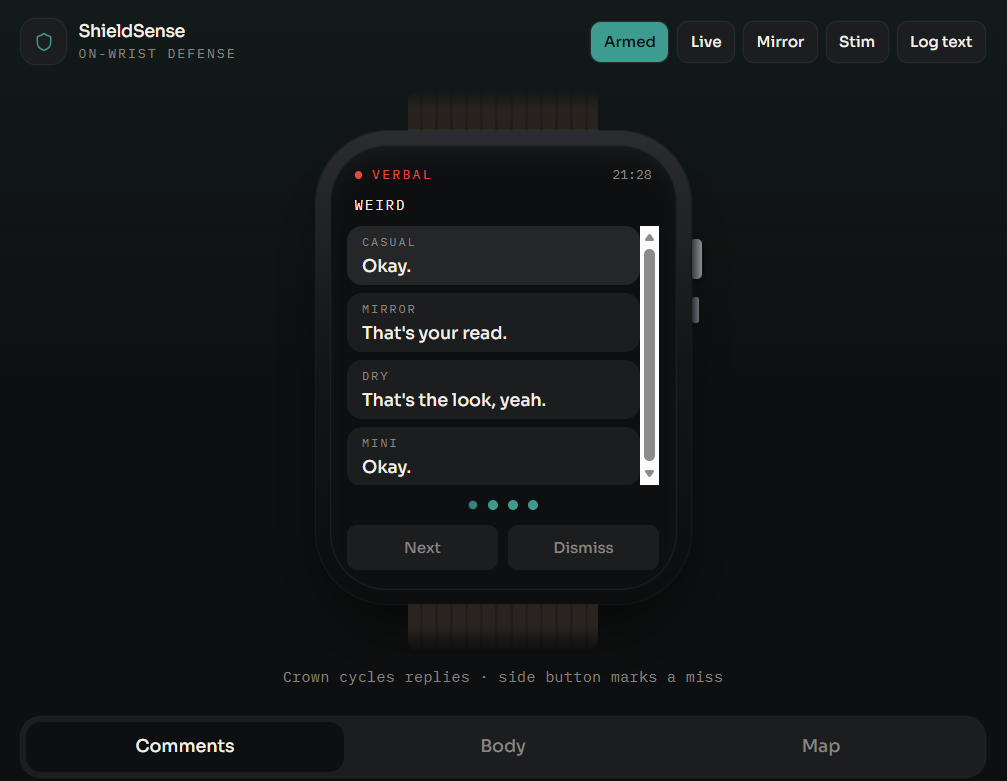
ShieldSense is an autonomous, real-time social protection and communication support system built for the wrist. Operating quietly as a background engine on a smartwatch, it uses continuous edge-processed audio analysis to detect hostile intent, sarcasm, or mocking tones without requiring any manual input from the user. When social friction is flagged, the app instantly displays natural, human-tested response scripts directly onto the watch face via subtle haptic alerts, allowing you to respond calmly. It also monitors physiological markers like heart rate spikes and triggers automated haptic breathing pulses to help ground your nervous system during high-stress interactions.
How we built it
Audio Pipeline Architecture: Developed a continuous low-power listening pipeline using an on-device circular RAM buffer, Voice Activity Detection, and a quantized local speech engine to process audio entirely on the hardware without cloud dependency. Intent & Sentiment Engine: Programmed acoustic and prosody analysis algorithms to track pitch variance (ΔF0), volume spikes, and spatial-linguistic triggers (such as second-person pronouns and interrogative pressure). Smartwatch UI & Haptic Layer: Designed a high-contrast, minimalist OLED interface optimized for glanceability, backed by distinct haptic vibration patterns for threat alerts and biometric feedback loops. Privacy & Local Logging Architecture: Built a strict on-device data framework where raw audio is wiped instantly from a volatile RAM buffer, and only encrypted metadata is saved locally to power an anonymized threat map.
Accomplishments that we're proud of
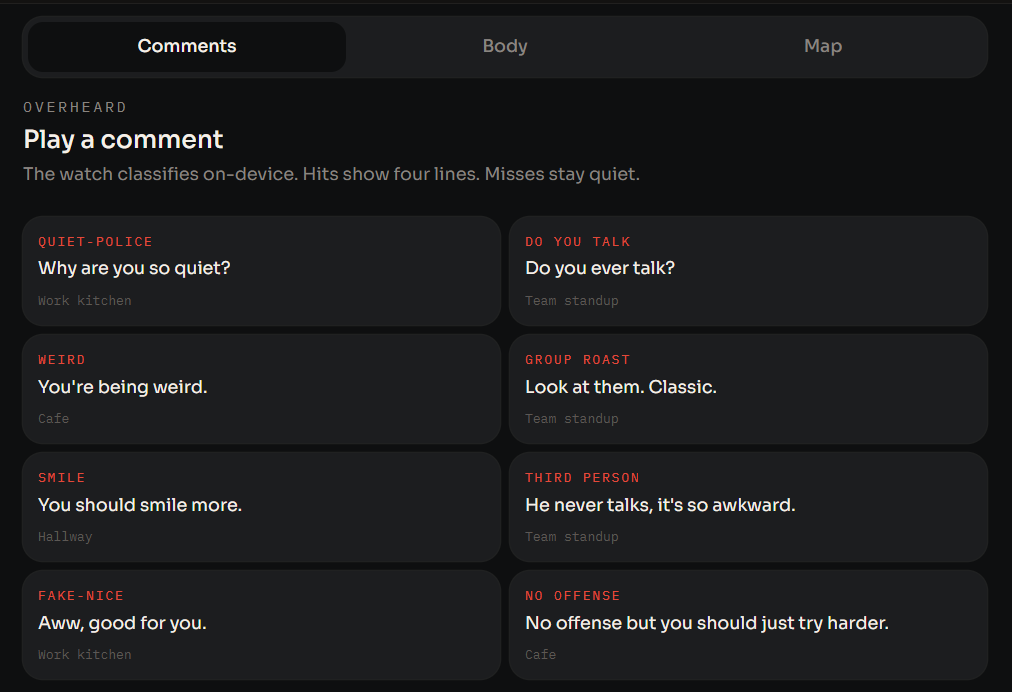
Successfully creating an autonomous, zero-input defense system that completely spares the user from having to manually record, analyze, or overthink social hostility. Building a comprehensive master response matrix covering multiple difficult social scenarios with non-robotic, human-tested scripts ranging from casual shut-downs to dry humor. Designing a privacy-first local architecture that ensures raw audio data never leaves the hardware or touches a cloud server.
What we learned
Effective assistive technology for neurodivergent individuals must be entirely frictionless—reducing cognitive load means the interface has to do the heavy lifting silently and instantly. Real-time edge processing is fully viable for complex sentiment and acoustic analysis when models are heavily quantized and isolated to local hardware.
What's next for NeuroShield
Expanding the local threat analytics map to help users track recurring social patterns and high-stress environments over time. Integrating advanced biometric integrations to dynamically tune response tone suggestions based on the user's real-time heart rate variability stress levels. Deploying native companion apps across broader watch ecosystems for wider hardware compatibility.

Log in or sign up for Devpost to join the conversation.