NeuroShield: Listening to the Signals We Often Overlook
Inspiration
Sometimes, the most important changes in a person's health happen quietly. They do not always begin with dramatic symptoms. Sometimes, they appear in small everyday activities that we rarely pay attention to.
Imagine an elderly relative who has always enjoyed communicating with family through text messages. They regularly send greetings, share stories and respond to messages with ease. Over time, however, something begins to change. Their responses become slower, typing takes longer, and simple interactions with their phone seem to require more effort.
At first, the family might assume it is simply age, tiredness or the normal challenges of using technology. Nobody thinks much about it. After all, who would imagine that the way someone types could potentially reveal something worth investigating?
This thought made me curious. I started asking myself:
What if everyday digital interactions could help us notice subtle behavioural changes that might otherwise go unnoticed?
As I explored this possibility, I became interested in research into keystroke dynamics and how changes in typing behaviour may be associated with motor and cognitive changes. I realised that the keyboard could potentially offer more than a way to communicate. It could also provide a window into behavioural patterns worth studying.
I wanted to explore this possibility while respecting something equally important: people's privacy.
That curiosity became the inspiration behind NeuroShield.
What It Does
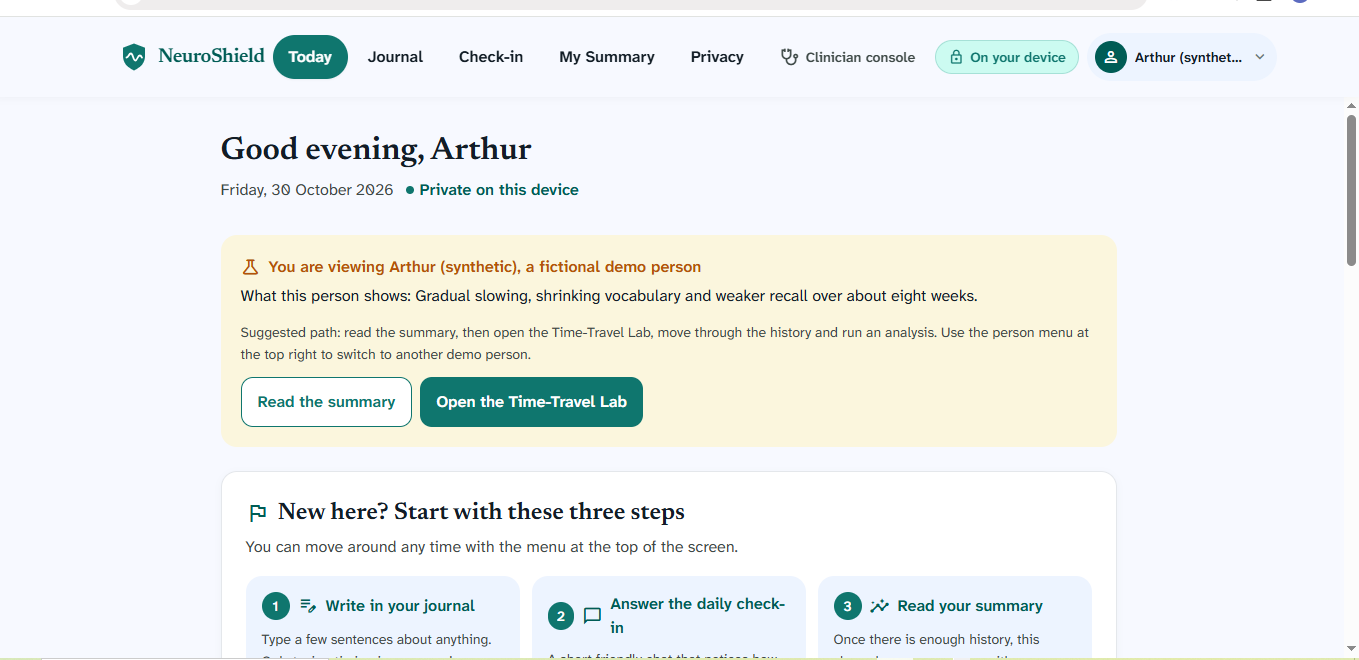
NeuroShield is a privacy-conscious, AI-powered screening-support platform that explores typing behaviour as a potential source of insights into changes in human behaviour.
Instead of analysing the actual words someone types, I designed the platform to focus on patterns associated with typing activity over time.
NeuroShield aims to help users:
- Examine typing-related behavioural patterns.
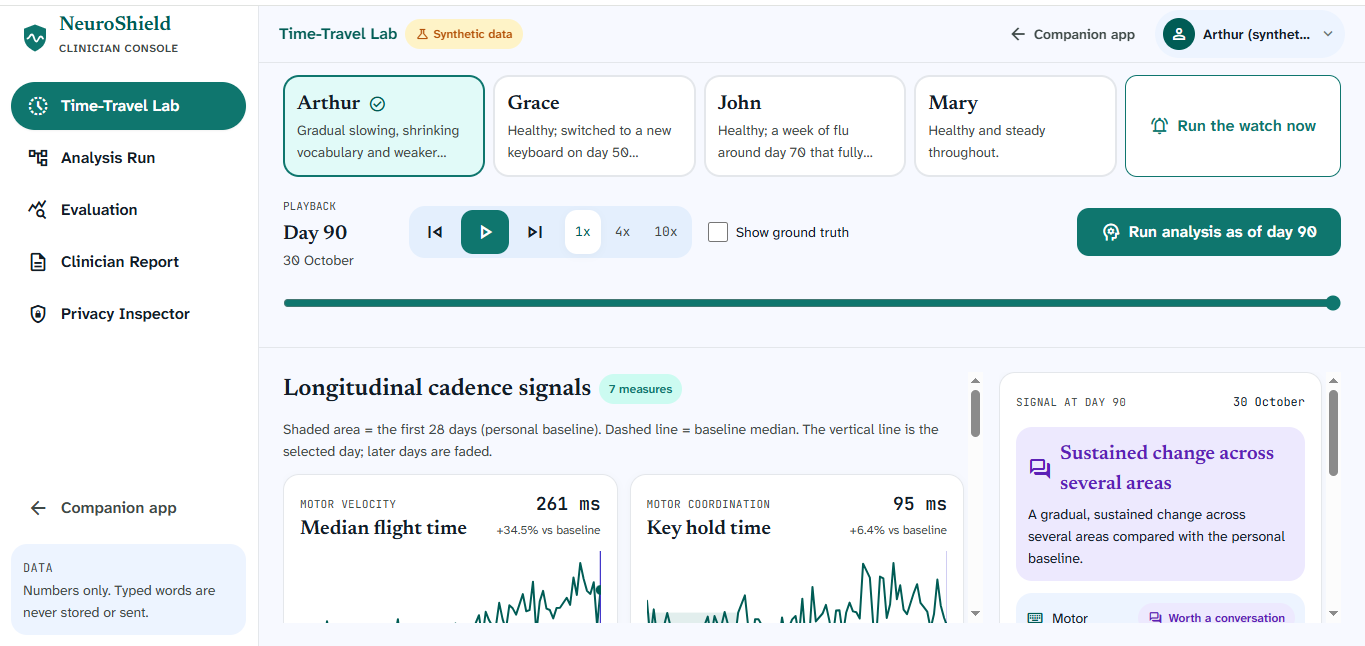
- Identify unusual changes that may deserve further attention.
- Interpret behavioural observations through AI-assisted insights.
- Generate structured reports that make findings easier to understand.
- Explore changes over time rather than relying on a single observation.
My central idea is simple: understand how someone types without needing to know what they type.
NeuroShield is an experimental screening-support platform, not a medical diagnostic system. Its insights do not replace professional medical assessment.
How I Built It
I built NeuroShield independently, bringing together modern web technologies, Python-based backend services and AI infrastructure.
The technology stack includes:
- React and Vite: For the frontend and user interface.
- Python and Flask: For backend application logic and API services.
- SQLite: For application data storage.
- LangChain and LangGraph: For AI-powered workflows and agent orchestration.
- Nebius Token Factory: For accessing AI models and powering AI-assisted interpretation.
- FastMCP: For organising specialised services through the Model Context Protocol (MCP).
I structured the application to separate different responsibilities, making it easier to maintain and extend.
I also explored specialised MCP services for biomarker-related processing, memory, reporting and evidence handling.
One of my biggest design considerations was privacy. I did not want to build another application that simply collects people's personal information. I wanted to explore how typing behaviour could be analysed without making the actual content of someone's messages the focus.
Challenges I Faced
Building NeuroShield alone was an interesting but demanding experience. I had to take responsibility for everything, from planning the architecture to writing code, integrating services, debugging and deployment.
Some of the biggest challenges I encountered included:
1. Turning a research idea into a practical application
The idea of analysing typing behaviour sounds simple, but transforming it into a meaningful software system required careful consideration of what behavioural patterns could be measured and how they should be interpreted.
2. Responsible use of AI
Because NeuroShield explores a health-related area, I had to think carefully about how AI-generated insights should be presented. I wanted to avoid unsupported medical claims or creating the impression that unusual typing patterns automatically indicate a medical condition.
3. System integration
Bringing together the React frontend, Flask backend, database, AI workflows and specialised MCP services required considerable debugging and problem-solving.
4. Deployment and resource limitations
Making the application accessible online while working with limited computing resources was another challenge. I had to consider performance, deployment configuration and the efficient use of external AI infrastructure.
5. Building something meaningful while working independently
Working alone meant that whenever something broke, I had to investigate it, understand the problem and find a solution myself. There were moments when things did not work as expected, but each challenge helped me understand the system better.
Accomplishments I'm Proud Of
What makes me proud of NeuroShield is that I managed to take an idea and turn it into a working web application.
Some of the accomplishments I value most include:
- Building the frontend and backend architecture independently.
- Integrating AI capabilities through Nebius Token Factory.
- Exploring agent-based workflows using LangChain and LangGraph.
- Structuring specialised services using MCP.
- Deploying NeuroShield as an accessible web application.
- Developing the project around privacy-conscious behavioural analysis rather than the collection of message content.
Beyond the technical achievements, I am proud that I challenged myself to explore a meaningful application of AI, one that goes beyond simply generating text or answering questions.
What I Learned
Building NeuroShield has taught me that meaningful AI innovation is not just about using powerful models. It is about identifying human challenges and asking how technology can responsibly help address them.
I gained practical experience in AI orchestration, backend architecture, MCP, system integration, debugging and deployment.
I also learned the importance of being honest about the limitations of AI, particularly when working in areas related to human health. Detecting an unusual pattern does not automatically mean that someone has a medical condition.
Perhaps my biggest lesson is that technology should support human judgement, not replace it.
What's Next for NeuroShield?
I see NeuroShield as an early step towards exploring how everyday digital interactions could contribute to health awareness.
My next priorities include:
- Conducting more extensive research and validation of typing-based behavioural indicators.
- Improving personal baseline tracking and longitudinal analysis.
- Exploring collaboration with healthcare professionals and researchers.
- Strengthening privacy, security and data protection.
- Improving the clarity and usefulness of generated reports.
- Exploring additional behavioural signals where ethically and scientifically appropriate.
My long-term vision is to develop a platform that makes behavioural changes easier to observe, understand and discuss while keeping people's privacy at the centre.
My Vision
I believe technology should not only understand what people type. It should also help us explore the meaningful patterns behind everyday human interactions.
Behind every typing pattern is a person. Behind every unusual change could be a question worth asking.
I built NeuroShield around one simple belief:
Sometimes, the smallest signals deserve our greatest attention.
Built With
- artificial-intelligence
- data
- docker
- fastmcp
- flask
- gunicorn
- javascript
- langchain
- langgraph
- machine-learning
- model-context-protocol-(mcp)
- nebius-token-factory
- nvidia-nemotron
- python
- react
- render
- sqlite
- tavily
- vite
- web-application