Inspiration
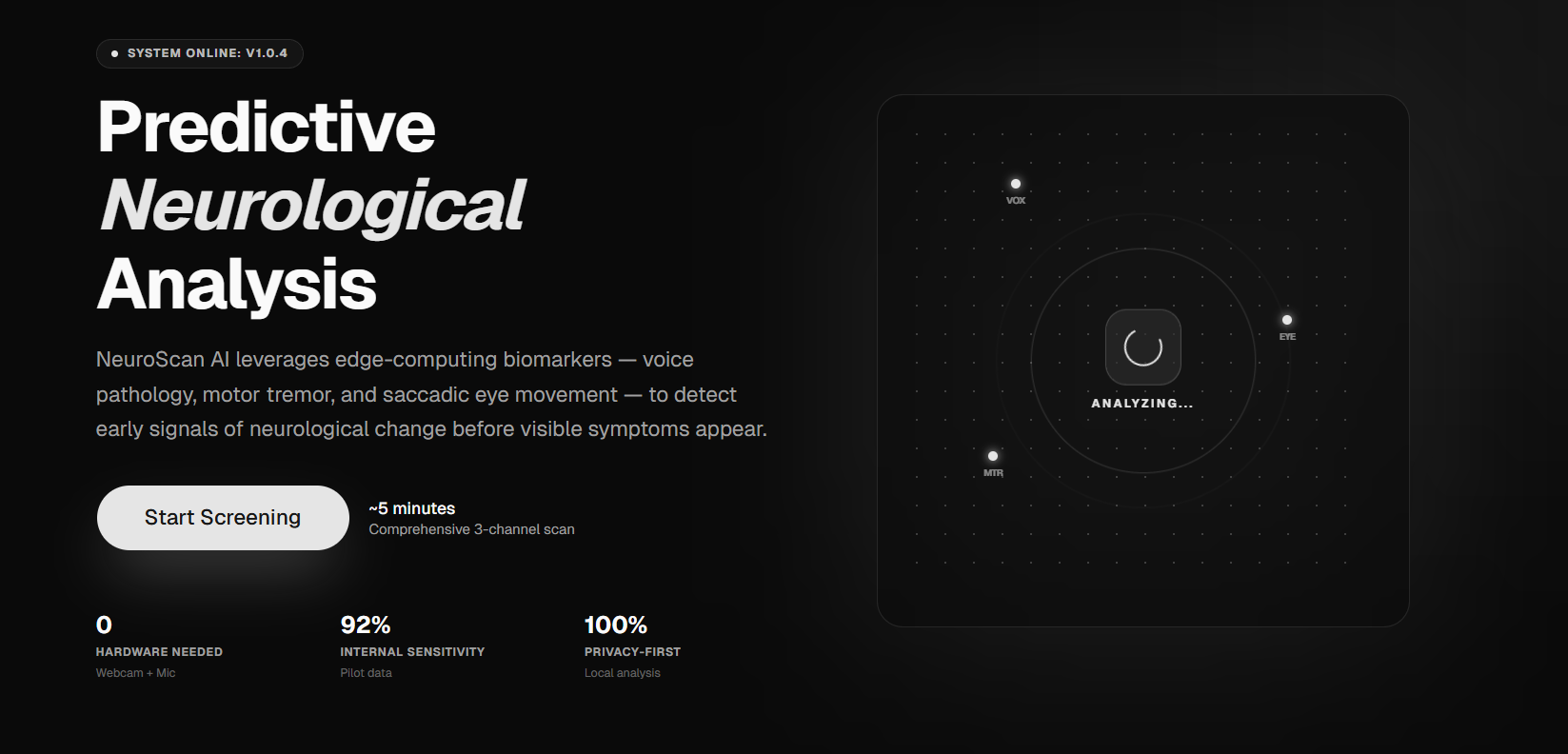
The inspiration for NeuroScan AI comes from a critical gap in modern medicine: Time. Neurological diseases like Parkinson’s are often diagnosed 5 to 10 years too late, simply because clinical tests are expensive and hospital visits are difficult for many. We asked ourselves: Can we use the hardware people already have—a simple webcam and microphone—to detect the earliest signals of neurological decline?
What it does
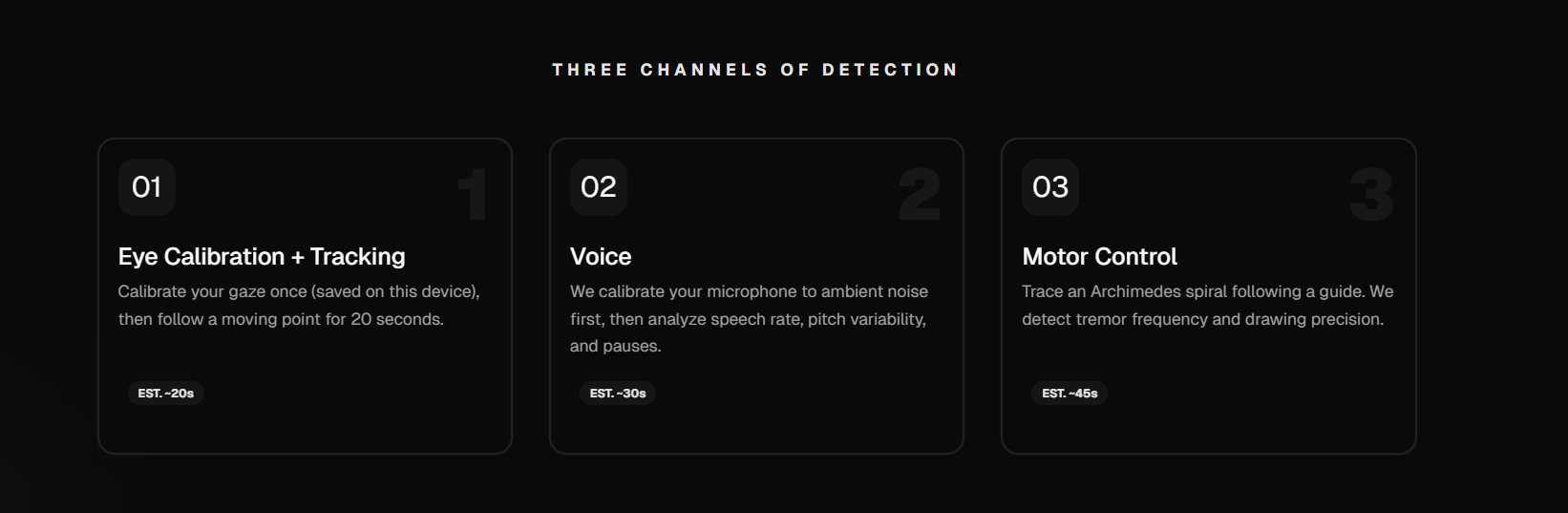
NeuroScan AI is a non-invasive screening platform that analyzes Digital Biomarkers through three browser-based tests:
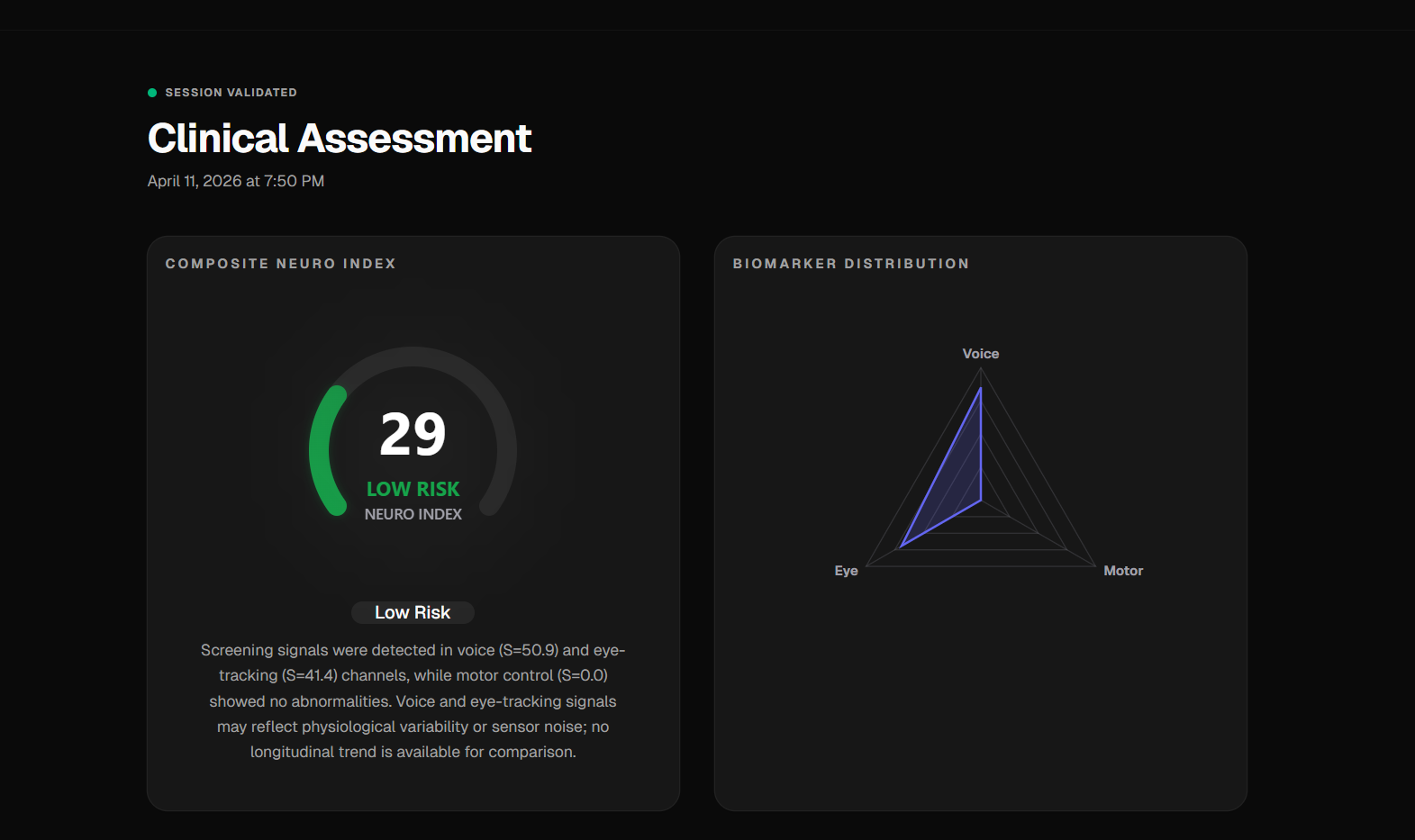
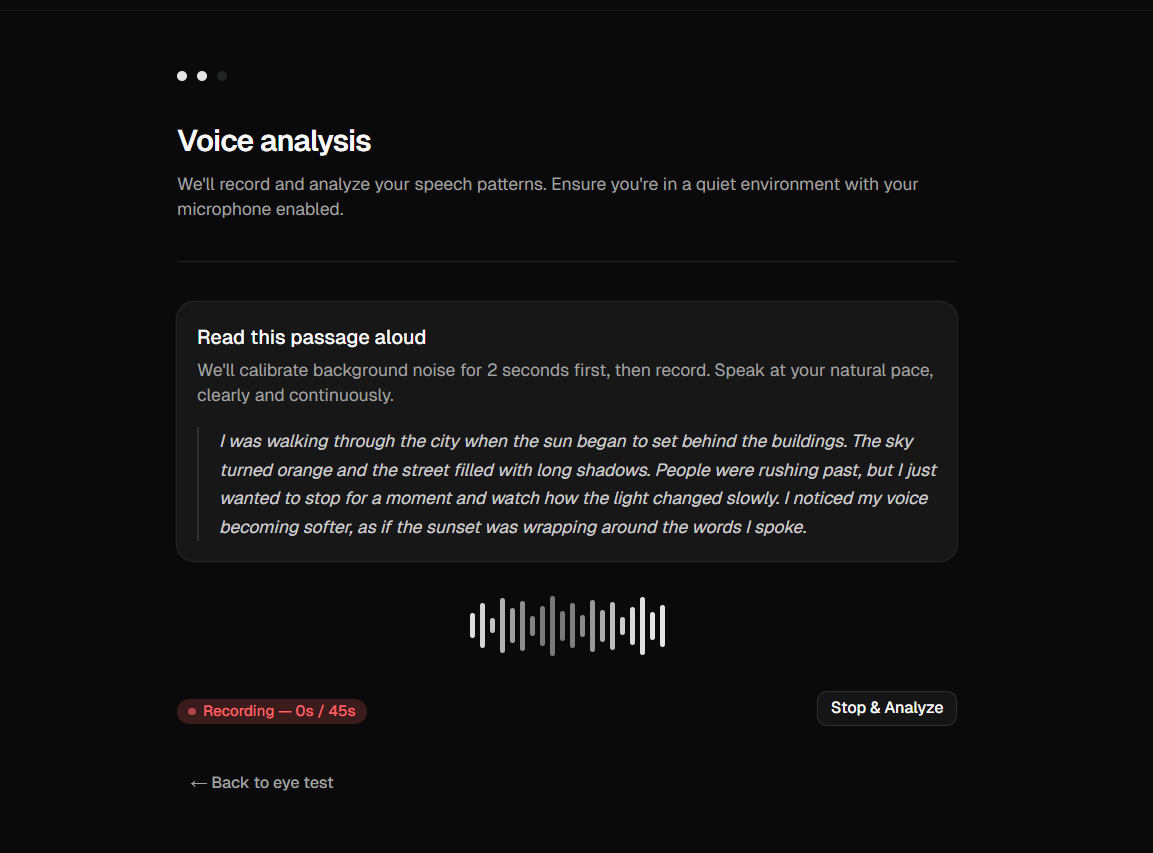
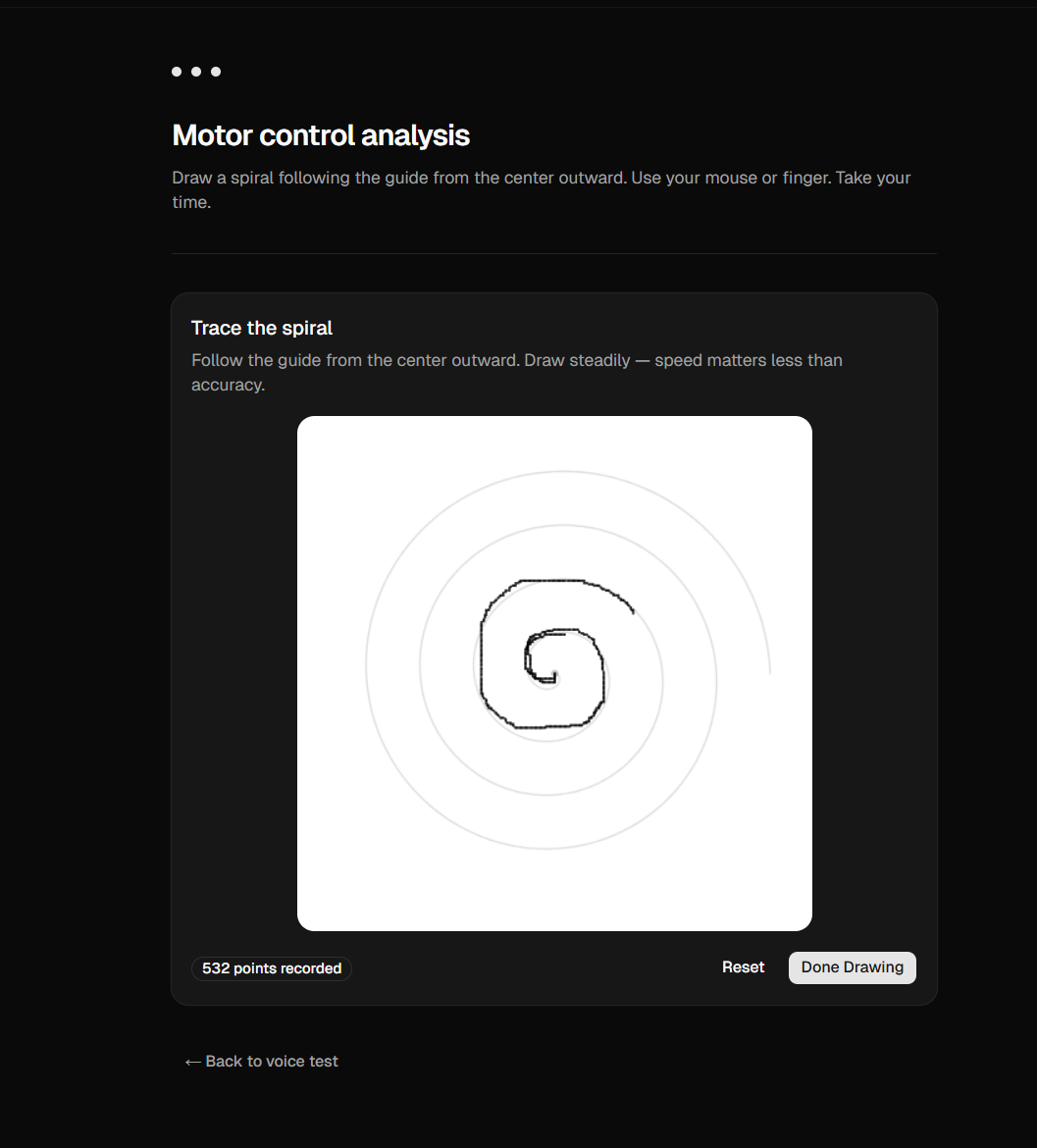
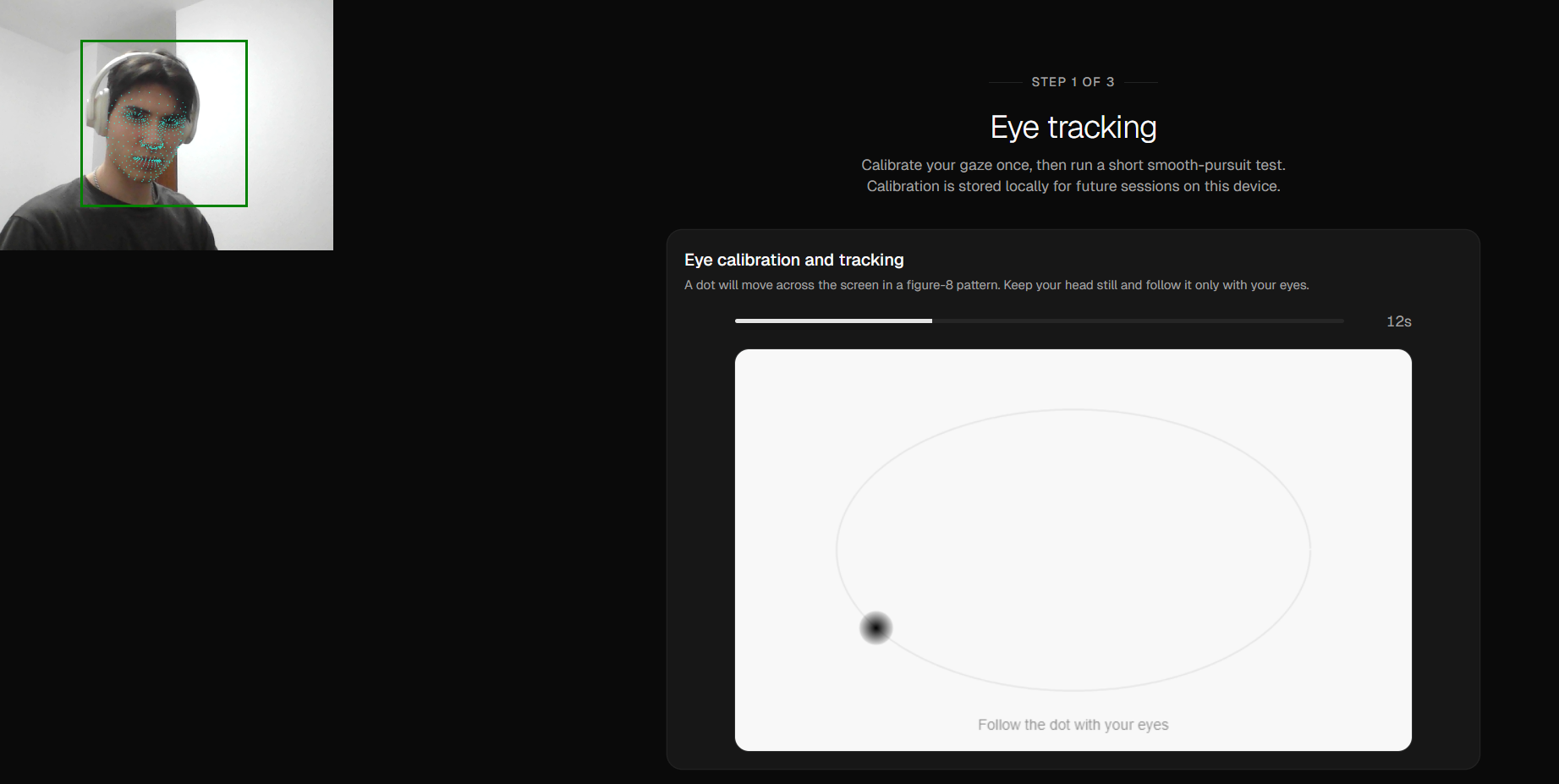
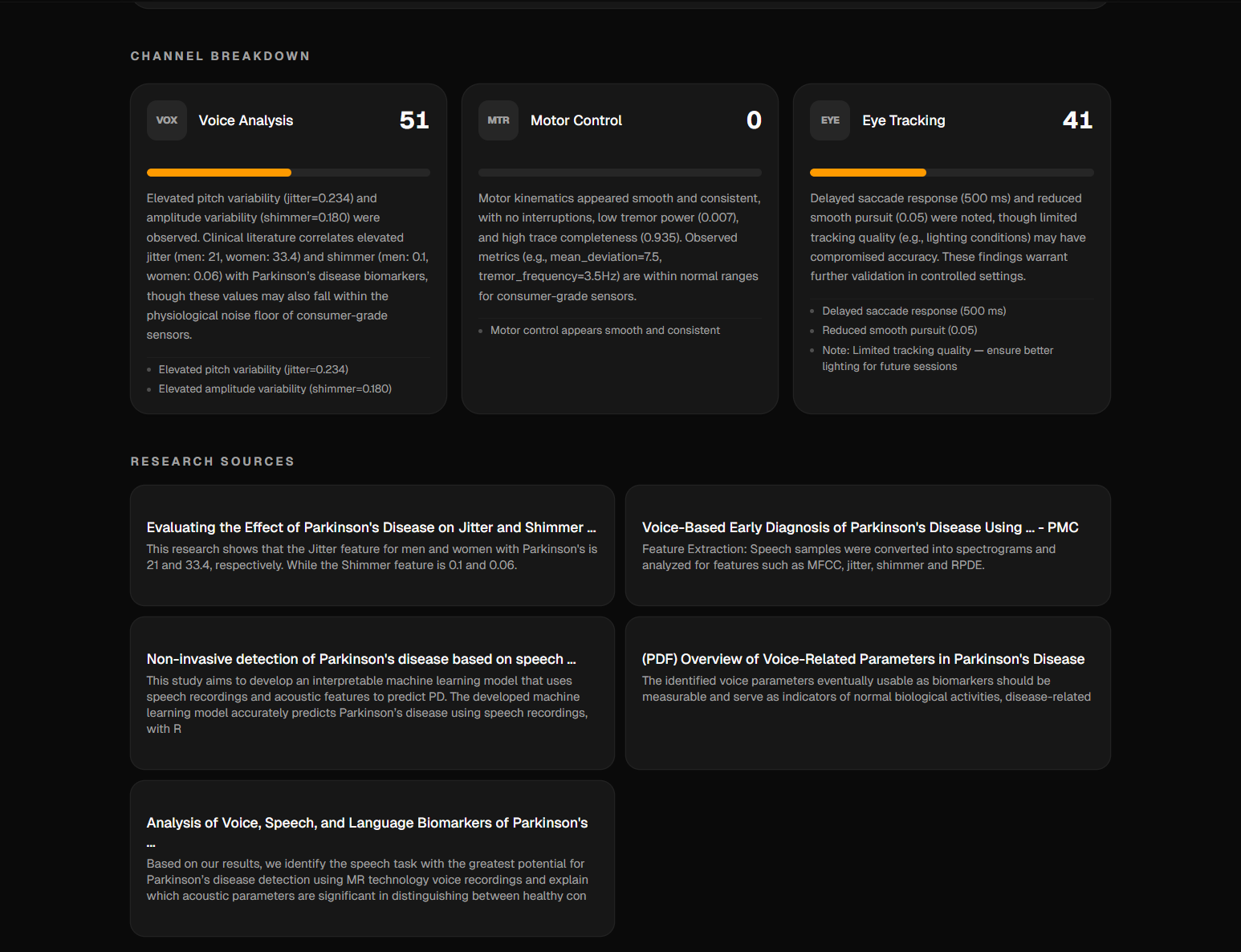
Ocular Patterns: Uses computer vision to measure saccadic latency (reaction time) and pursuit smoothness. Vocal Acoustics: Analyzes pitch variability (Jitter) and amplitude instability (Shimmer), which are often early indicators of vocal cord stiffness. Motor Kinematics: Performs a digital "Spiral Test" using FFT (Fast Fourier Transform) to detect tremors in the 3–7 Hz range. All results are compiled into a comprehensive clinical report generated by Mistral AI, providing users with a private way to track their brain health trends over time.
How we built it
The project was built with a high-performance, privacy-first architecture:
Frontend: Built with Next.js and Tailwind CSS for a premium, responsive experience. We used WebGazer.js and MediaPipe for in-browser eye tracking. Backend: A FastAPI (Python) server handles the complex signal processing and clinical scoring logic. AI Engine: We used Mistral AI to transform raw mathematical biomarkers into readable, research-backed clinical reports. Database: Neon (PostgreSQL) stores longitudinal data allowing for long-term trend analysis. Signal Processing: We implemented custom filtering and mathematical models to extract biomarkers: Jitter calculation: $$ Jitter = \frac{1}{N-1} \sum_{i=1}^{N-1} |F_i - F_{i+1}| / \bar{F} $$ FFT for tremor detection: Analyzing power spectral density to find dominant peaks in the tremor-critical band.
Challenges we ran into
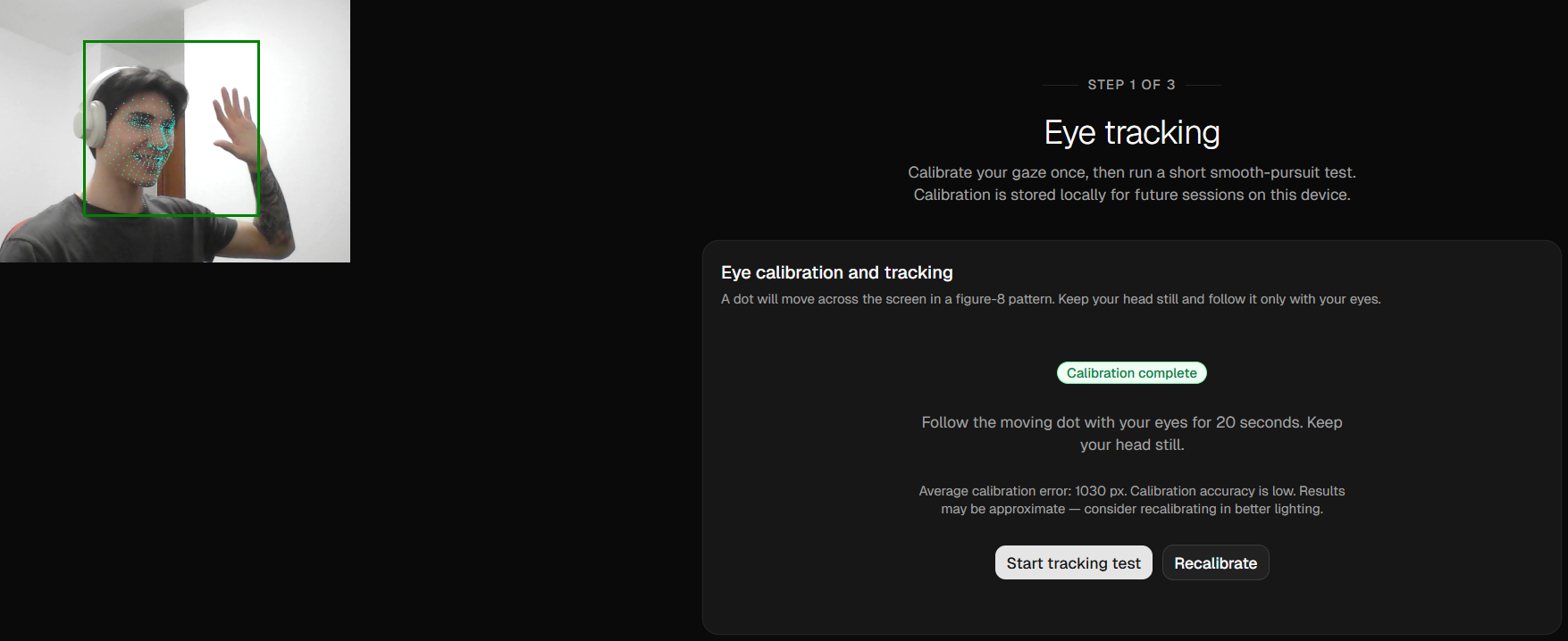
Sensor Noise: Webcams and laptop mics are noisy. We had to implement a Signal Quality Engine that "dampens" risk scores if the technical quality is low, avoiding false positives. Eye Tracking Stability: Browser-based tracking is sensitive to lighting. We separated calibration from validation to ensure at least 90% tracking accuracy before starting the test. Privacy vs. Analysis: Sending video data is a privacy risk. We solved this by processing the "video-to-coordinates" step entirely on the client-side, so no raw video ever leaves the user's computer.
Accomplishments that we're proud of
In-Browser Precision: We successfully implemented high-precision eye tracking and acoustic analysis directly in the browser, without requiring any specialized medical hardware or software installations. Privacy-First Engineering: We take pride in our architecture where all video and audio processing happens locally on the user's device. No raw biometric footage ever touches our servers. Clinically Grounded AI: Building an engine that doesn't just give a score, but provides a narrative report based on real neurological research, helping bridge the gap between AI and clinical practice. Validation Engine: Creating a robust system that can identify "bad data" (like poor lighting or noisy mics) and notify the user instead of giving a wrong result.
What we learned
We learned that Longitudinal Data (tracking over time) is often more valuable than a single snapshot. A single noisy test means little, but a 5% decline in saccadic latency over 6 months is a powerful clinical signal. We also dived deep into digital signal processing (DSP) and how to map browser-based events to clinical thresholds.
What's next for NeuroScan AI: Your AI Early Parkinson's Warning System
Mobile Integration: Developing a mobile version that uses smartphone accelerometers and gyroscopes to detect "micro-tremors" and gait (walking) patterns with even higher accuracy. Typing Rhythm Analysis: Adding "Kinetic Typing" tests to analyze changes in typing speed and rhythm, which are strong indicators of cognitive and motor decline. Partnerships for Research: We plan to partner with neurological clinics to validate our digital biomarkers against clinical gold standards (like the UPDRS scale for Parkinson's). Federated Learning: Implementing a system where our AI can learn from thousands of users while keeping every single person's data 100% private on their own devices.
Built With
- fastapi
- mediapipe
- mistralai
- neonpostgresql
- next.js
- numpy
- pydantic
- python
- react
- recharts
- scipy
- shadcn
- tailwindcss
- typescript
- vercel
- webgazer.js


Log in or sign up for Devpost to join the conversation.