NeuroScan AI
Inspiration
Neurological disorders such as Alzheimer's Disease and Mild Cognitive Impairment (MCI) are often diagnosed at advanced stages, reducing the effectiveness of treatment. We wanted to explore how Artificial Intelligence and medical imaging could assist clinicians by enabling faster, more accurate, and accessible early detection using brain MRI scans.
What it does
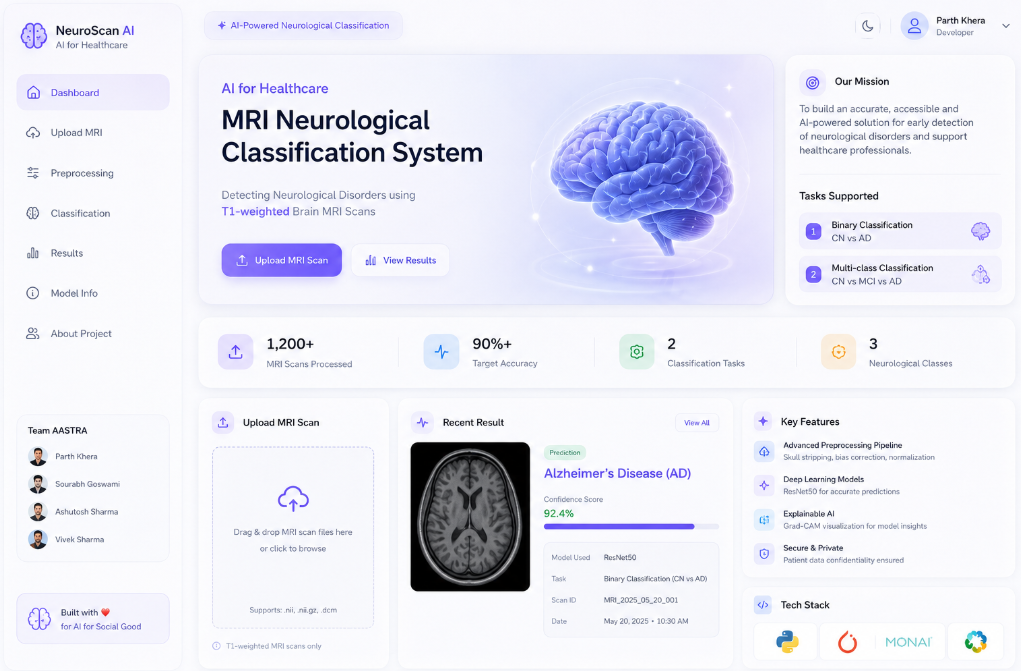
NeuroScan AI is an end-to-end deep learning pipeline that analyzes T1-weighted brain MRI scans to identify neurological disorders. The system preprocesses raw MRI data, performs binary (CN vs AD) and multi-class (CN vs MCI vs AD) classification, and provides predictions that can support clinicians during the screening process. It is designed as a clinical decision-support tool rather than a replacement for medical professionals.
How we built it
We built NeuroScan AI using Python, TensorFlow/PyTorch, OpenCV, NiBabel, MONAI, and other medical imaging libraries. MRI datasets underwent preprocessing steps including DICOM-to-NIfTI conversion, skull stripping, normalization, resizing, and data augmentation before model training. All experiments were executed on a Linux GPU server accessed securely through VPN and SSH, enabling efficient training and evaluation of deep learning models.
Challenges we ran into
Medical imaging datasets required extensive preprocessing before they could be used for training. Handling large MRI files, optimizing GPU resources, preventing overfitting, and ensuring reliable model performance across multiple classes were some of the biggest technical challenges. Understanding the complexities of medical data while maintaining an efficient AI pipeline was equally demanding.
Accomplishments that we're proud of
- Built a complete AI pipeline from raw MRI data to disease prediction.
- Successfully implemented both binary and multi-class neurological disorder classification.
- Developed a reproducible preprocessing workflow for medical imaging.
- Gained hands-on experience working with GPU-based deep learning environments and healthcare datasets.
- Demonstrated how AI can contribute to early neurological disease screening.
What we learned
This project taught us the complete workflow of AI in healthcare—from medical image preprocessing and dataset preparation to training, evaluating, and optimizing deep learning models. We also gained practical experience with Linux, GPU computing, remote development, medical imaging libraries, and the importance of data quality, model validation, and ethical AI in clinical applications.
What's next for NeuroScan AI
Our next goal is to improve model accuracy using advanced architectures such as Vision Transformers and ensemble learning. We also plan to expand support for additional neurological disorders, integrate explainable AI techniques like Grad-CAM for prediction visualization, develop a clinician-friendly web application, and validate the system on larger and more diverse MRI datasets to improve real-world reliability.