-
-
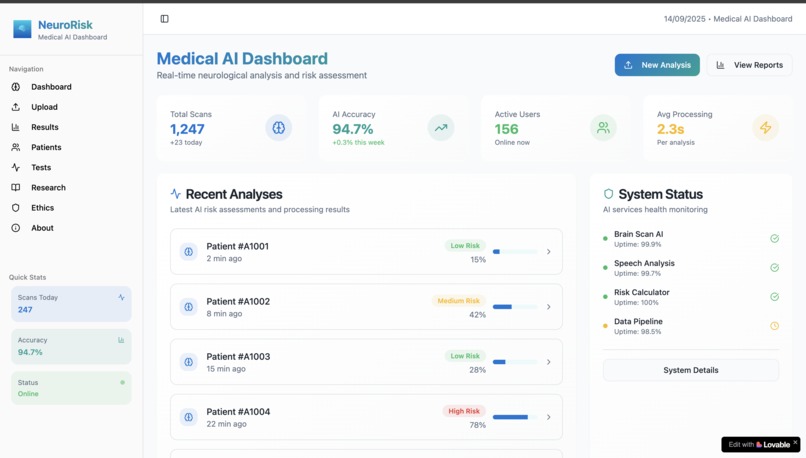
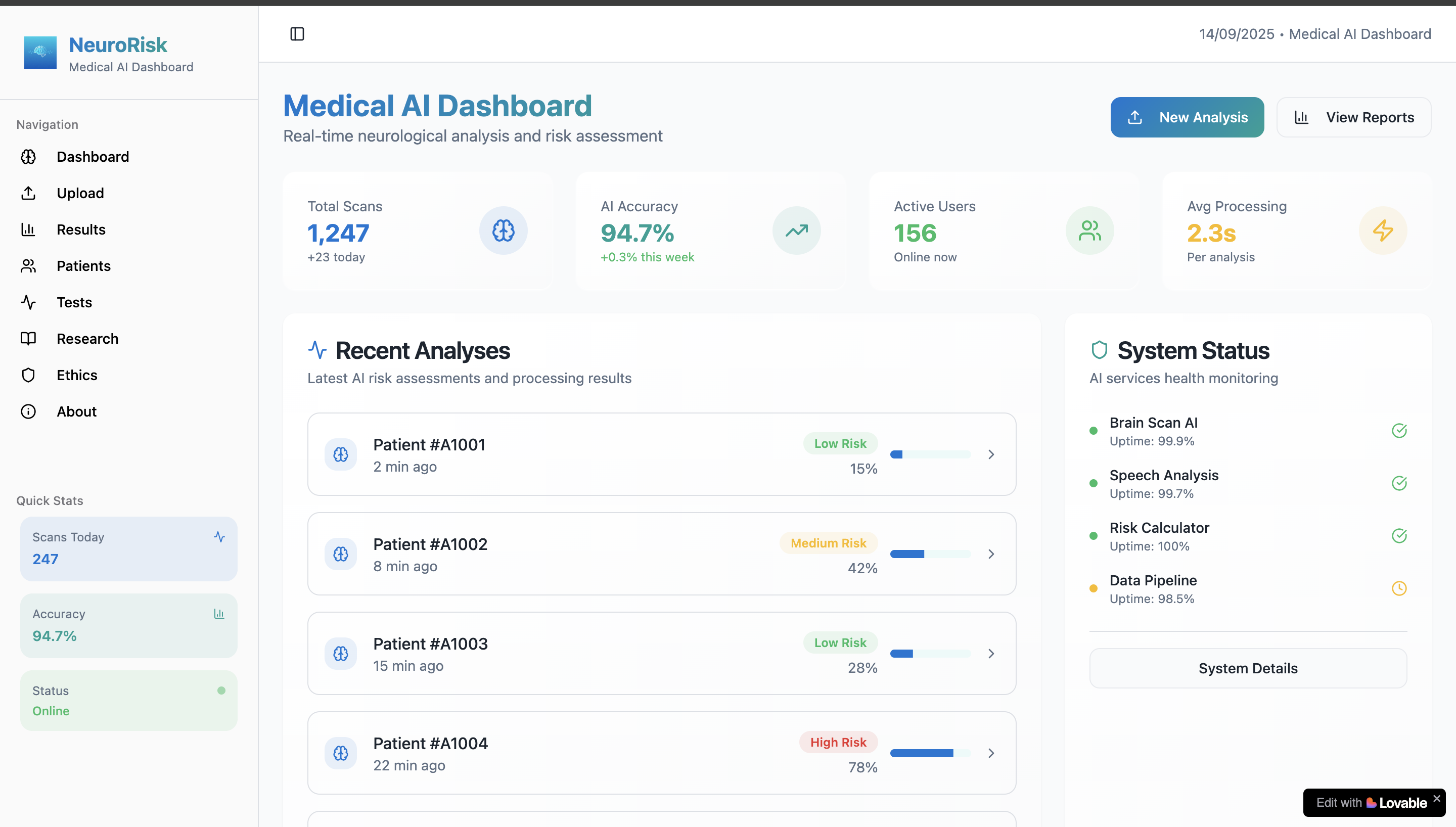
Welcome Page and Patient Analyses & Metrics
Inspiration
Neurodegenerative diseases are usually diagnosed late, when symptoms are aldready severe amongst many patients and senior citizens. We wanted to explore how AI could help with detecting early waning signs, giving patients and doctors more time to act and potentially improve quality of life.
What it does
Neurorisk is an AI dashboard that looks at data like speech patterns, EEgs, and fMRI results to flag early indicators or risk for these neurodegenerative diseases. It creates a score, highlights changes over time, and presents this information in a way that is easy for physicians, clinicians, and researchers to navigate and use.
How we built it
We used Lovable to build the AI Dashboard. Each team member focused on different aspects of the project based on their assigned or chosen roles, from data processing to =o design. Once we had everything planned, Lovable was responsible for inputting the information and setting up the interface. We gave it clear instructions on layout, formatting, and visualization, which allowed us to turn our ideas into a functional as well as a polished dashboard.
Challenges we ran into
- Making sense of messy and inconsistent data sets.
- Making the dashboard both useful for doctors and researchers.
- Working around the limits of simulated vs. real patient data.
Accomplishments that we're proud of
- Getting a working prototype that connects various data types.
- Catching early signs of speech and EEG changes with consistency.
What we learned
- How to bring neuroscience and AI in a practical way.
- The importance of interpretiability and design for medical tools or mockup tools.
- The prototype can be used both for algorithms but also how the data is shared.
What's next for NeuroRisk: Early Detection AI Dashboard
- Work with medical partners to test with real-world data.
- Improve the AI to track long-term progression.
- Build a detailed mobile version so that it is easier to access.
Built With
- loveable


Log in or sign up for Devpost to join the conversation.