-
-
“Bridging education gaps using AI-powered research assistance.
Inspiration
Access to reliable, structured knowledge is still unequal. While students in urban areas benefit from AI tools and high-speed internet, many learners in underserved regions struggle with scattered resources, outdated materials, and lack of guidance. Existing AI tools often provide answers but lack transparency, structured reasoning, and the ability to combine personal learning materials with real-time knowledge.
We were inspired to build a system that doesn’t just answer questions, but acts like a research assistant—capable of understanding documents, searching the web, and generating grounded, explainable insights. This aligns strongly with UN SDG 4: Quality Education, aiming to make learning more accessible, reliable, and intelligent for everyone.
What it does
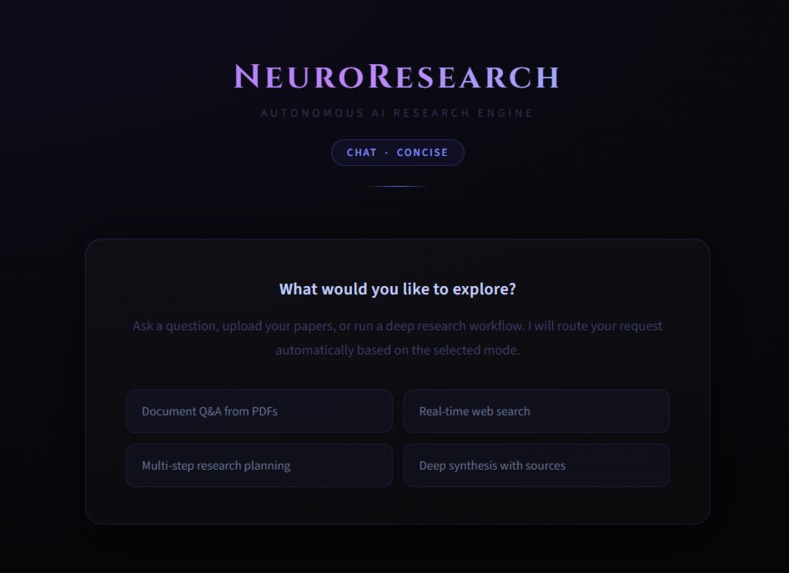
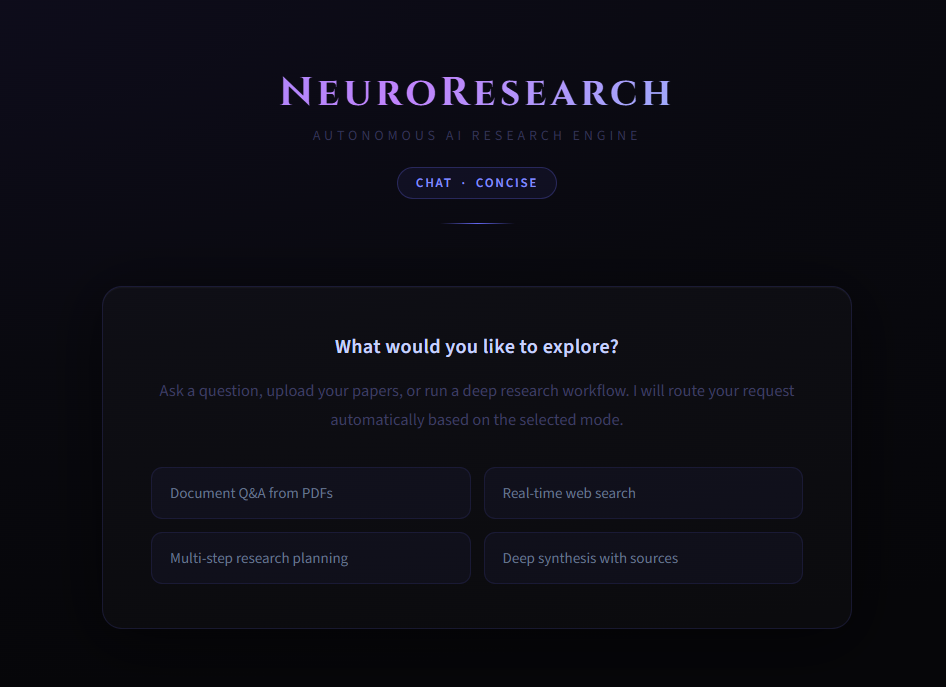
NeuroResearch is an Autonomous AI Research Engine that helps users perform deep, structured research using both local and global knowledge sources.
It allows users to:
Upload documents (PDF, TXT, Markdown) and extract knowledge
Ask questions and receive context-aware answers
Perform multi-step research with structured outputs
Access live web intelligence for up-to-date information
View source-backed responses for transparency
The system intelligently routes queries between:
Direct LLM responses
Retrieval-Augmented Generation (RAG)
Web search
Hybrid pipelines
This makes it more than a chatbot—it’s a full research workflow engine.
How we built it
We designed NeuroResearch with a modular and scalable architecture:
Frontend/UI: Streamlit for interactive chat, document upload, and mode selection
LLM Layer: OpenAI and Groq APIs with a unified wrapper for flexibility and fallback
Embeddings: Sentence-transformers for semantic understanding
Vector Store: FAISS (with NumPy fallback) for efficient similarity search
RAG Pipeline: Document chunking, embedding, and retrieval
Web Search Integration: Tavily API for real-time information
Query Router: Dynamically selects the best pipeline (LLM, RAG, Web, Hybrid)
Research Agent: Handles multi-step reasoning and structured outputs
This layered design ensures performance, flexibility, and reliability across different environments.
Challenges we ran into
Balancing accuracy vs speed: Combining RAG and web search without increasing latency
Handling API limitations: Managing rate limits and fallback between OpenAI and Groq
Cross-platform compatibility: Ensuring functionality on systems without FAISS support
Chunking and retrieval quality: Optimizing document splitting for meaningful context
Query routing complexity: Deciding when to use LLM, RAG, or web intelligently
Each challenge pushed us to improve system robustness and real-world usability.
Accomplishments that we're proud of
Built a hybrid AI system combining local documents and live web data
Implemented an intelligent query routing mechanism
Designed multi-mode research workflows (chat, research, deep research)
Enabled source attribution for transparency and trust
Created a production-ready modular architecture
Most importantly, we transformed a simple chatbot idea into a true AI research assistant.
What we learned
How to design and implement RAG-based systems at scale
The importance of grounded AI responses with sources
How to integrate multiple AI providers with fallback strategies
The role of system design in building reliable AI applications
How AI can be applied meaningfully to solve real-world problems
What's next for NeuroResearch - Autonomous AI Research Engine
We plan to expand NeuroResearch into a more impactful, globally accessible platform:
Multilingual support (including regional languages like Telugu)
Voice-based interaction for accessibility
Personalized learning paths and summaries
AI-generated quizzes and assessments
Scalable cloud deployment for wider reach
Fine-tuned models for domain-specific research (education, healthcare)
Our long-term vision is to evolve NeuroResearch into an AI-powered knowledge infrastructure that helps bridge global education gaps by 2030.


Log in or sign up for Devpost to join the conversation.