-
-
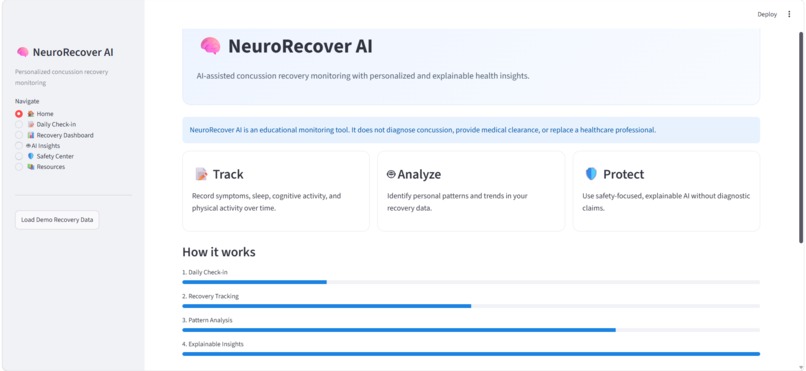
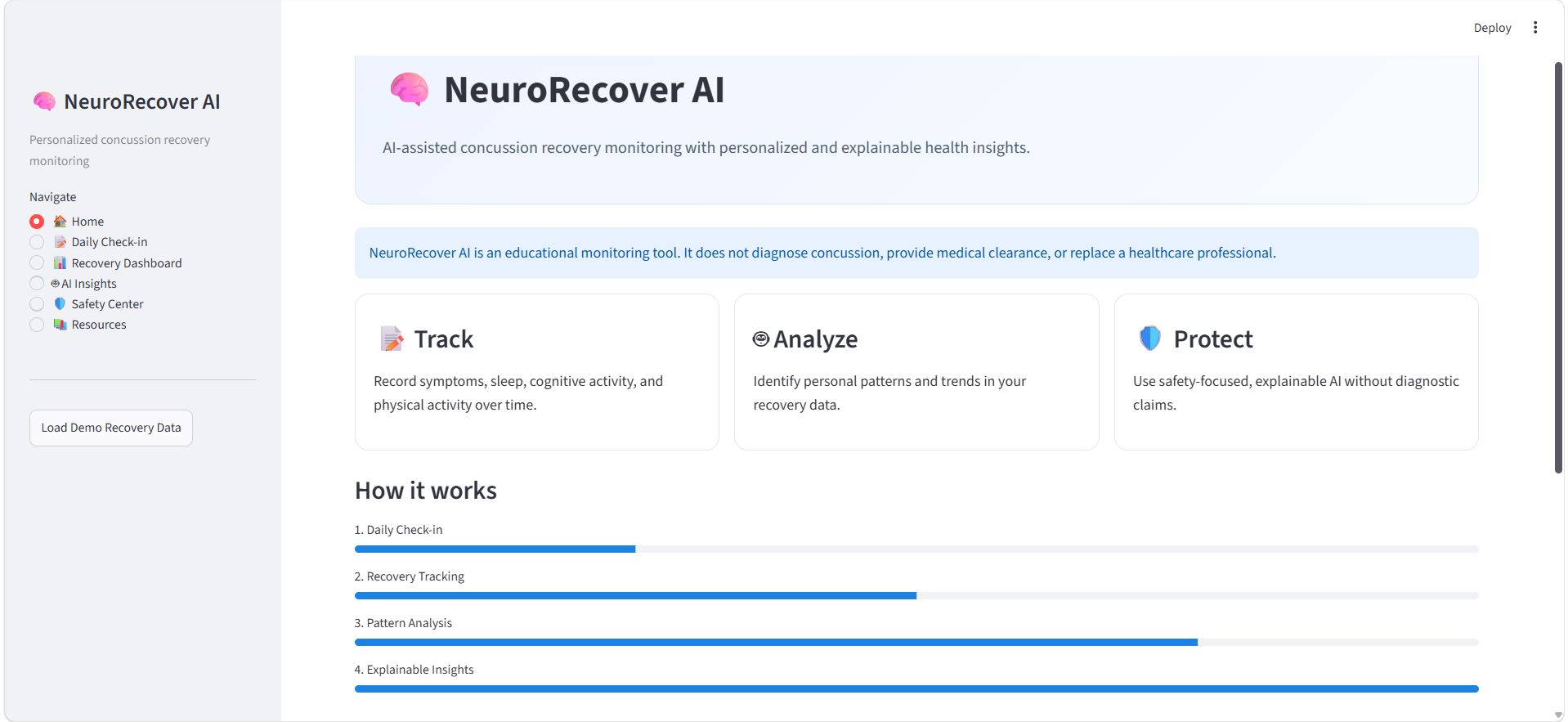
Home page
-
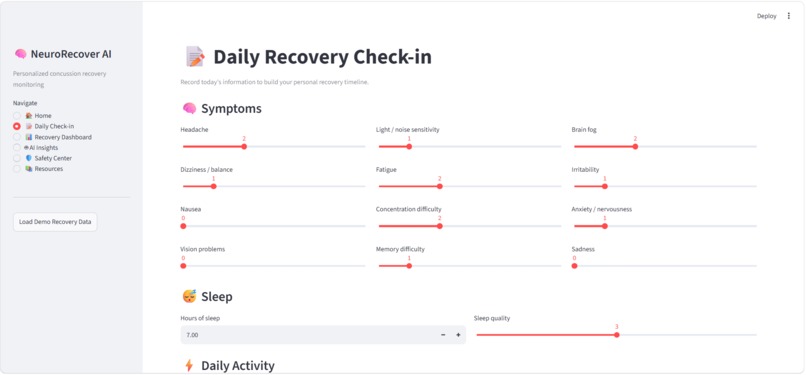
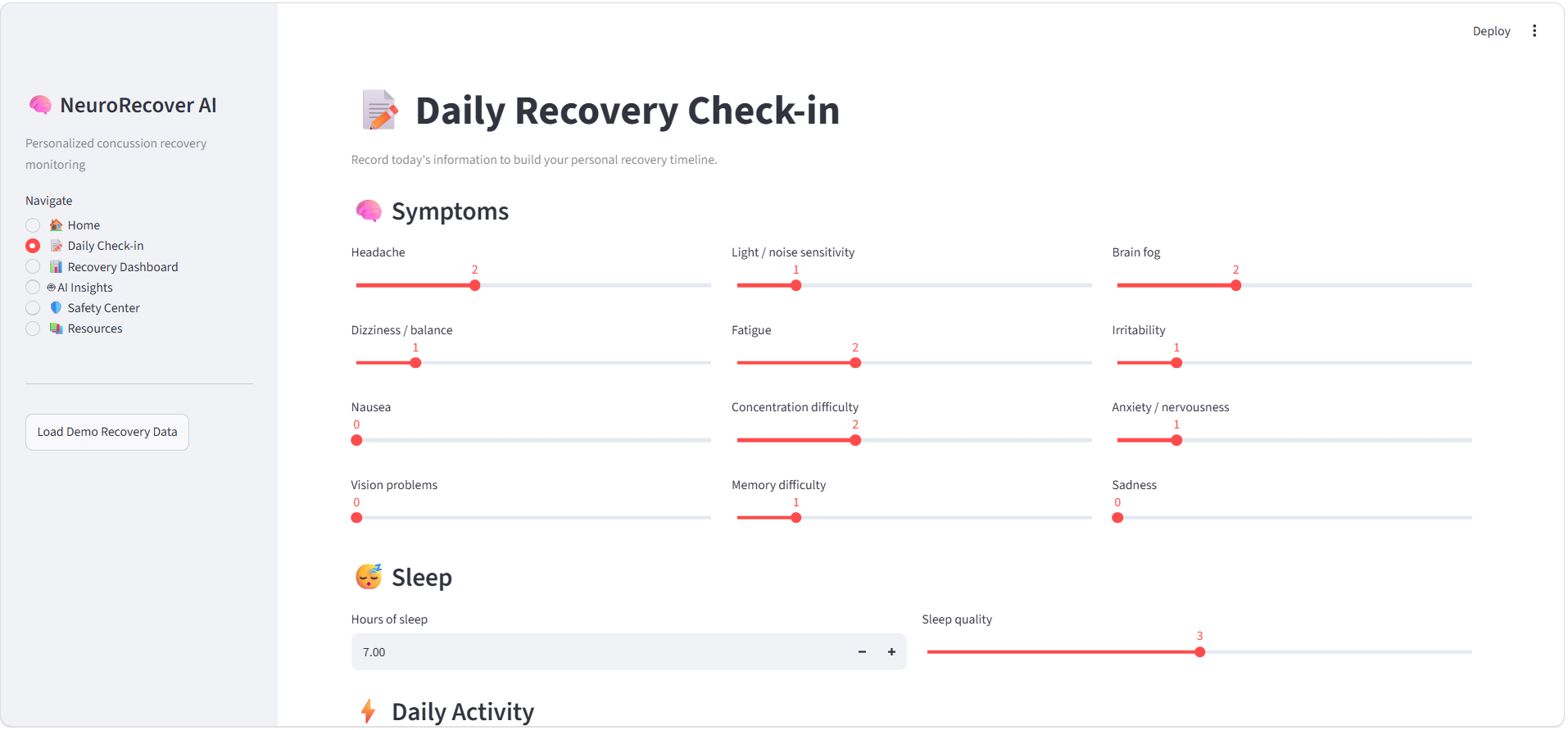
Daily Check-in
-
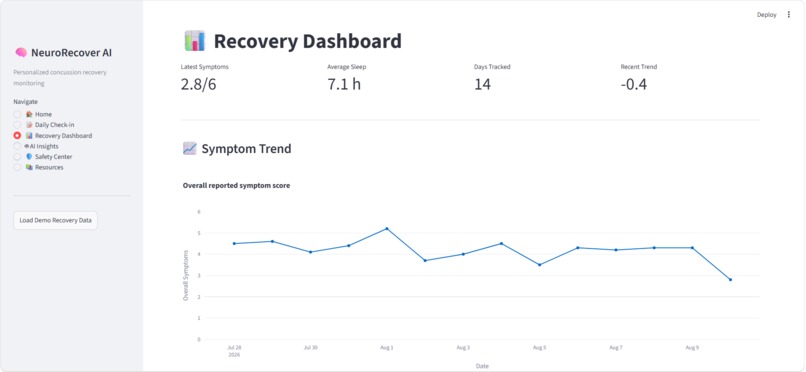
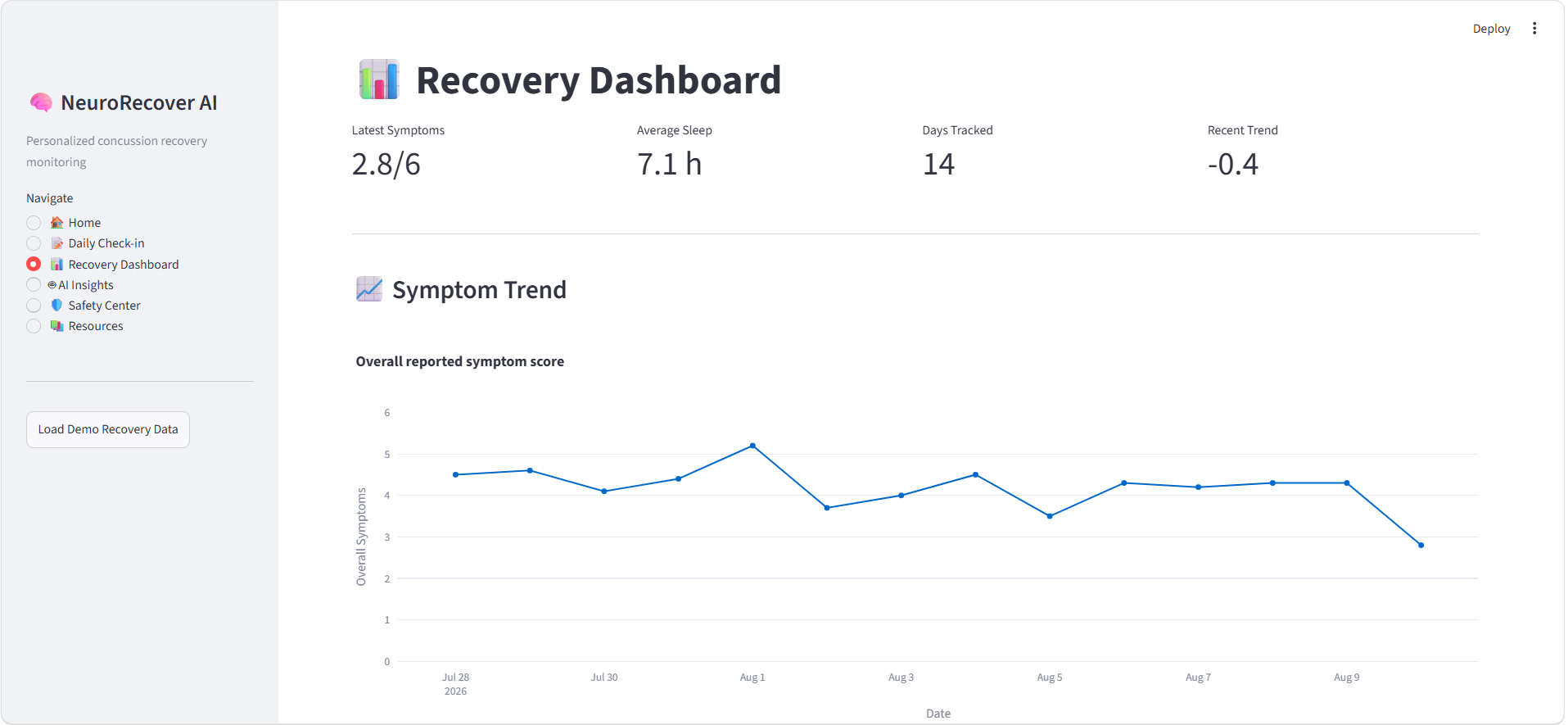
Recovery Dashboard
-
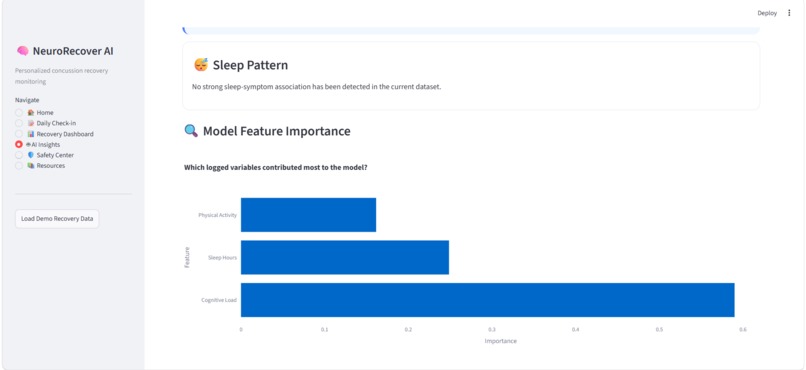
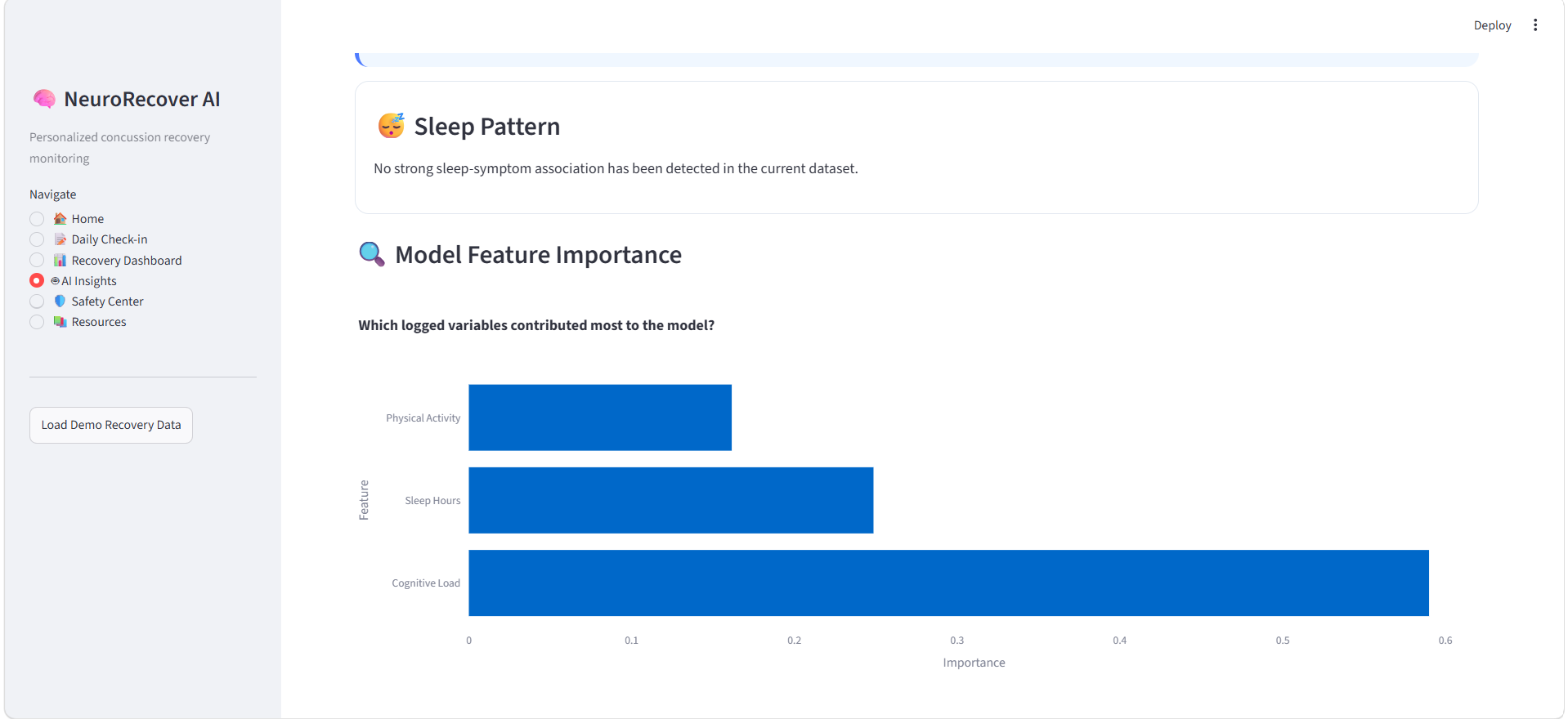
AI Insights
-
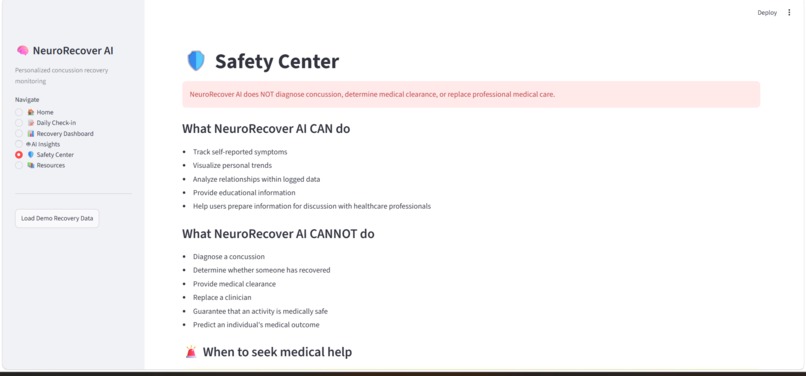
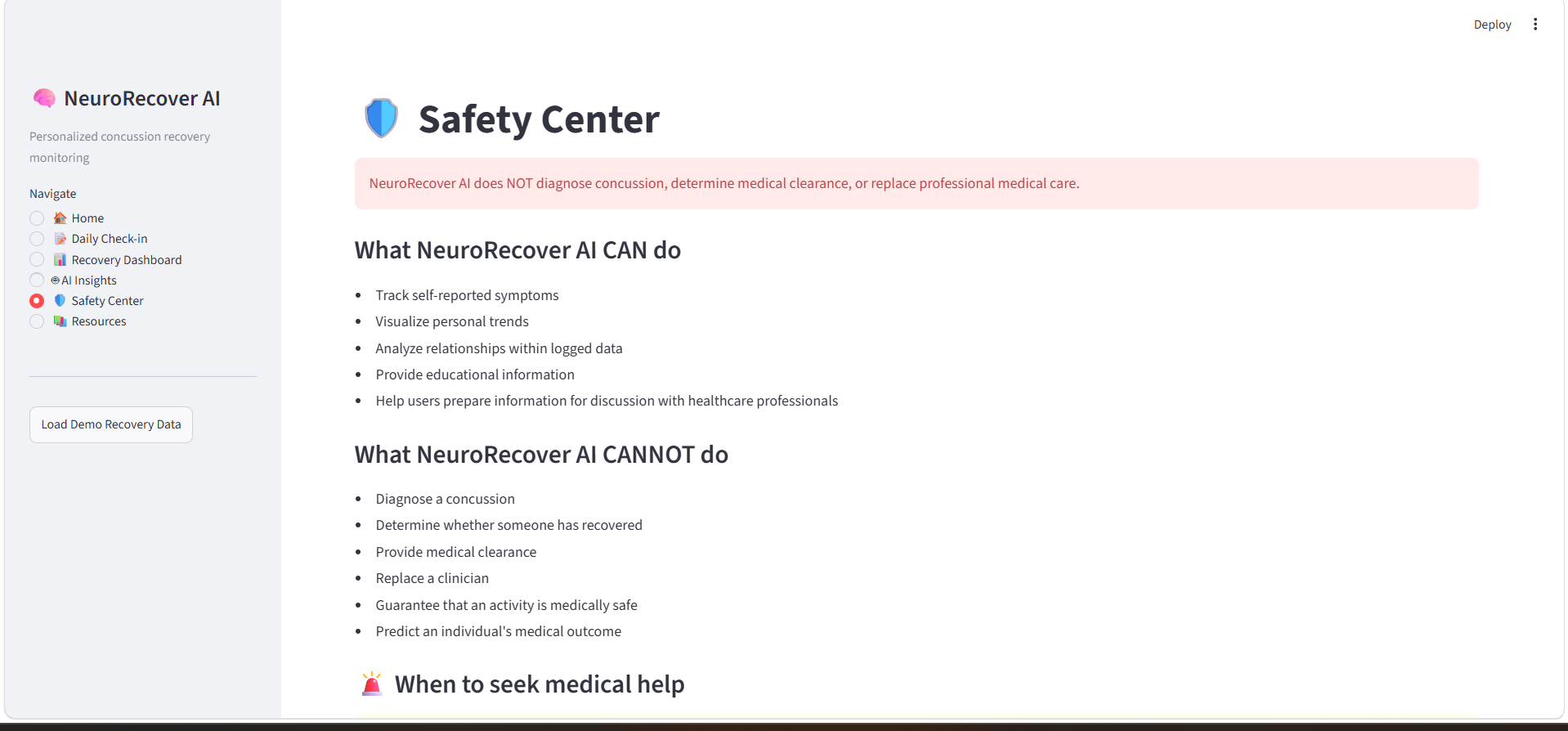
Safety Center
Inspiration
Concussion recovery can involve a combination of physical, cognitive, emotional, and sleep-related symptoms that may change over time. We were inspired by the idea of making recovery information easier to track and understand without turning AI into a replacement for healthcare professionals. We wanted to build a tool that helps users organize their own recovery information and identify personal patterns between symptoms, sleep, cognitive load, and physical activity. This led to NeuroRecover AI: an AI-assisted monitoring prototype focused on making recovery data more understandable, visual, and explainable while keeping safety and human oversight at the center.
What it does
NeuroRecover AI is a web-based concussion recovery monitoring prototype. Users can record self-reported symptoms including headache, dizziness, fatigue, concentration difficulty, memory difficulty, brain fog, and other recovery-related experiences. They can also track sleep, cognitive load, physical activity, and activity duration. The Recovery Dashboard transforms these records into interactive visualizations and longitudinal trends. The AI Insights section uses correlation analysis and a Random Forest regression model to explore relationships within the user's logged data and provide explainable patterns. The application also includes a Safety Center that clearly communicates the limitations of AI in healthcare. NeuroRecover AI does not diagnose concussion, predict clinical recovery, or provide medical clearance.
How we built it
We built NeuroRecover AI using Python and Streamlit, with Pandas and NumPy for data processing, Scikit-learn for machine learning, and Plotly for interactive visualizations. The application follows a simple workflow: Track → Analyze → Explain → Support. Users first enter recovery information through the Daily Check-in. The data is then visualized through the Recovery Dashboard. Statistical correlations are used to explore relationships between recovery variables, while a Random Forest regression model provides feature-importance analysis. We also designed a dedicated Safety Center to make the system's limitations, responsible-AI principles, and need for human oversight explicit. The project is hosted online through Streamlit Community Cloud and the complete source code is available on GitHub.
Challenges we ran into
One of our biggest challenges was designing an AI system for a health-related problem without making unsafe clinical claims. We had to carefully distinguish between identifying patterns in user-provided data and making medical conclusions. For example, a relationship between sleep and symptoms cannot be presented as proof that sleep causes a particular recovery outcome. Another challenge was making the machine-learning component understandable rather than treating it as a black box. We addressed this by including feature-importance visualization and explaining the variables used by the model. We also had to balance useful functionality with a simple interface that users could understand quickly.
Accomplishments that we're proud of
We are proud of building a complete working prototype that combines health tracking, data visualization, machine learning, explainability, and responsible-AI principles in one application. The project includes a functional daily check-in system, recovery dashboard, interactive symptom visualizations, AI-assisted pattern analysis, feature-importance analysis, and a dedicated safety center. We are especially proud that safety was treated as a core feature rather than an afterthought. NeuroRecover AI clearly avoids diagnosis and medical-clearance claims and keeps healthcare professionals in the decision-making loop. We also successfully deployed the application online and made the source code publicly available.
What we learned
We learned that building AI for healthcare requires more than simply training a machine-learning model. Responsible design, explainability, limitations, human oversight, and clear communication are equally important. We also learned how to combine user-facing data collection with machine-learning analysis and interactive visualization in a single Streamlit application. Most importantly, we learned that AI-generated patterns should be presented carefully. Correlation does not establish causation, and a prototype should never overstate what its data or model can actually support.
What's next for NeuroRecover AI
The next version of NeuroRecover AI could expand from a hackathon prototype into a more robust research-oriented platform. Future improvements could include secure user accounts, encrypted data storage, longitudinal personalized models, improved accessibility, clinician-facing summaries, stronger model validation using larger and clinically curated datasets, and integration with validated assessment frameworks. We would also like to conduct usability testing with appropriate participants and healthcare professionals before considering any clinical application. Our long-term vision is to build a responsible recovery-monitoring platform that helps people understand their health information while keeping clinical decisions firmly under professional human oversight.
Built With
- artificial
- machine
- numpy
- pandas
- plotly
- python
- scikit-learn
- streamlit

Log in or sign up for Devpost to join the conversation.