Inspiration
Children with ADHD often struggle in traditional learning environments because long lessons, reading-heavy materials, and distracting interfaces make it difficult to sustain attention and stay motivated. In Egypt and the MENA region, the problem is even greater due to limited access to specialized educational resources, Arabic-first tools, and affordable interventions.
We wanted to transform learning from a source of frustration into an engaging adventure. Our goal was to create an inclusive educational platform that combines game-based learning, artificial intelligence, and neurodiversity-aware design to help children with ADHD learn in a way that matches their cognitive needs.
What it does
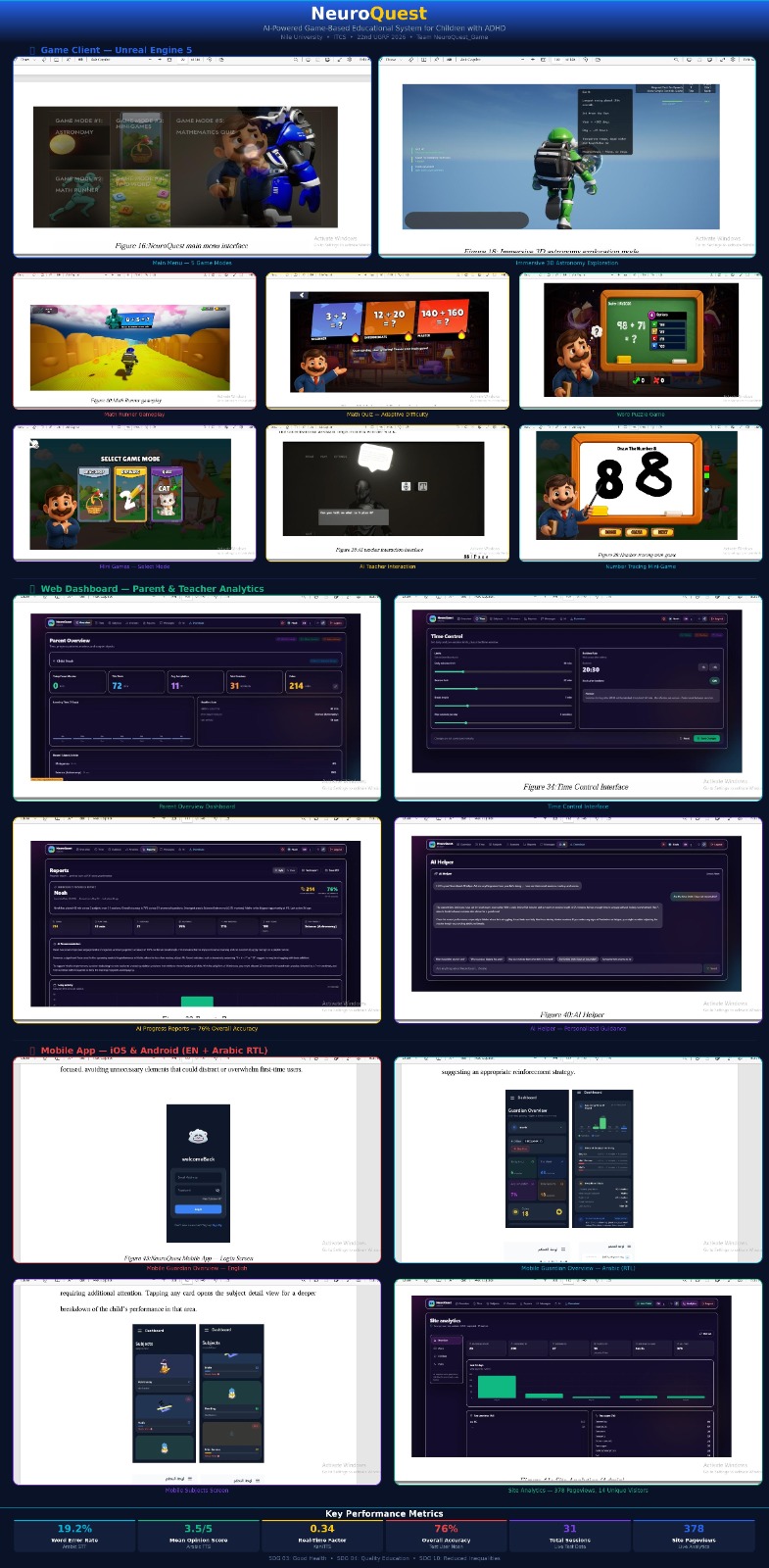
NeuroQuest AI is an AI-powered educational game designed specifically for children with ADHD. The platform delivers curriculum-aligned educational content through short, interactive, and rewarding activities that minimize cognitive overload and maximize engagement.
Key features include:
- AI-powered adaptive difficulty that adjusts challenges according to each child's performance and attention patterns.
- ADHD-friendly interface with predictable navigation, minimal distractions, and sensory-accessible design.
- Bilingual support with Arabic and English educational content.
- Offline-first desktop application that works without continuous internet access.
- Speech-to-Text (STT) and Text-to-Speech (TTS) capabilities for children who benefit from auditory learning.
- Parent and teacher dashboard that provides progress analytics, learning trends, and usage insights.
- Safe-use protocols including session limits, reminders for breaks, and parental controls.
How we built it
We developed NeuroQuest AI as an offline-first ecosystem consisting of two main components:
Game Client
- Unreal Engine 5 for the interactive educational game
- Adaptive learning engine for personalized difficulty adjustment
- Local data storage for offline functionality
- AI-assisted educational interactions
- Speech technologies for accessibility
Parent Dashboard
- Web-based analytics dashboard
- Progress reports and learning insights
- Usage monitoring and parental controls
- Data synchronization and reporting services
The AI continuously analyzes gameplay behavior and performance metrics to personalize learning experiences while maintaining privacy and safety.
Challenges we ran into
Building for neurodiverse learners required us to rethink traditional game design principles. Our biggest challenges included:
- Designing engaging experiences without introducing excessive stimulation or distractions.
- Balancing educational objectives with enjoyable gameplay.
- Creating adaptive learning algorithms that personalize experiences while remaining transparent and explainable.
- Supporting offline functionality while maintaining intelligent features.
- Designing interfaces that are accessible and comfortable for children with ADHD.
- Ensuring the system remains affordable and deployable in low-resource educational environments.
Accomplishments that we're proud of
- Built an AI-powered educational platform specifically designed for ADHD learners.
- Created an offline-first architecture suitable for regions with unreliable internet connectivity.
- Developed adaptive learning experiences that personalize educational content in real time.
- Integrated parent and teacher analytics to support data-driven educational decisions.
- Designed a culturally relevant, Arabic-first educational experience for an underserved population.
What we learned
This project taught us that inclusive AI is not only about building intelligent systems—it is about designing technology that understands human diversity. We learned the importance of responsible AI, human oversight, accessibility, and empathy-driven design. Most importantly, we discovered that educational technology can empower neurodiverse children when it adapts to their needs rather than expecting them to adapt to the technology.
What's next for NeuroQuest AI
Our future roadmap includes:
- Expanding educational content across additional subjects and grade levels.
- Enhancing AI personalization using longitudinal learning analytics.
- Conducting classroom pilots and user studies with students, teachers, and specialists.
- Integrating additional accessibility features and multilingual support.
- Scaling the platform to reach neurodiverse learners across Egypt, the MENA region, and beyond.
We envision NeuroQuest AI becoming an inclusive learning ecosystem where every child—regardless of attention challenges—can learn, grow, and succeed through personalized, engaging, and responsible AI-powered education.
Built With
- adaptive-learning-algorithms-speech-technologies:-text-to-speech-(tts)
- c#
- cloud-storage-services-tools:-git
- css-game-engine:-unreal-engine-5-frontend:-react
- express.js-database:-sqlite
- github
- html
- javascript
- languages:-c++
- next.js-backend:-node.js
- openai-apis
- postgresql-ai-&-ml:-python
- speech-to-text-(stt)-cloud-&-deployment:-rest-apis
- typescript

Log in or sign up for Devpost to join the conversation.