-
-
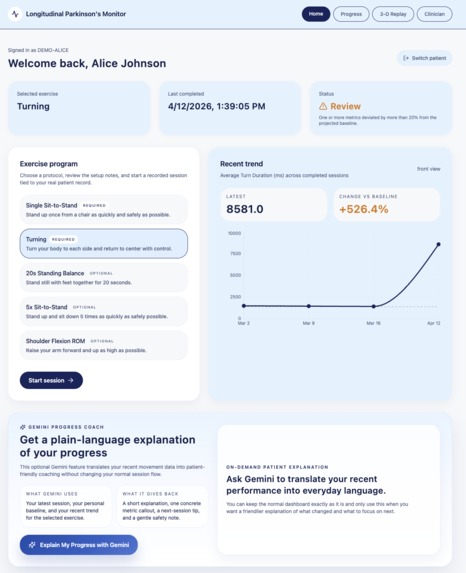
Patient Dashboard
-
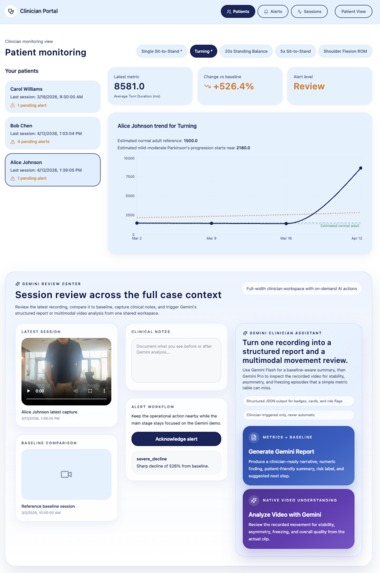
Clinician Dashboard
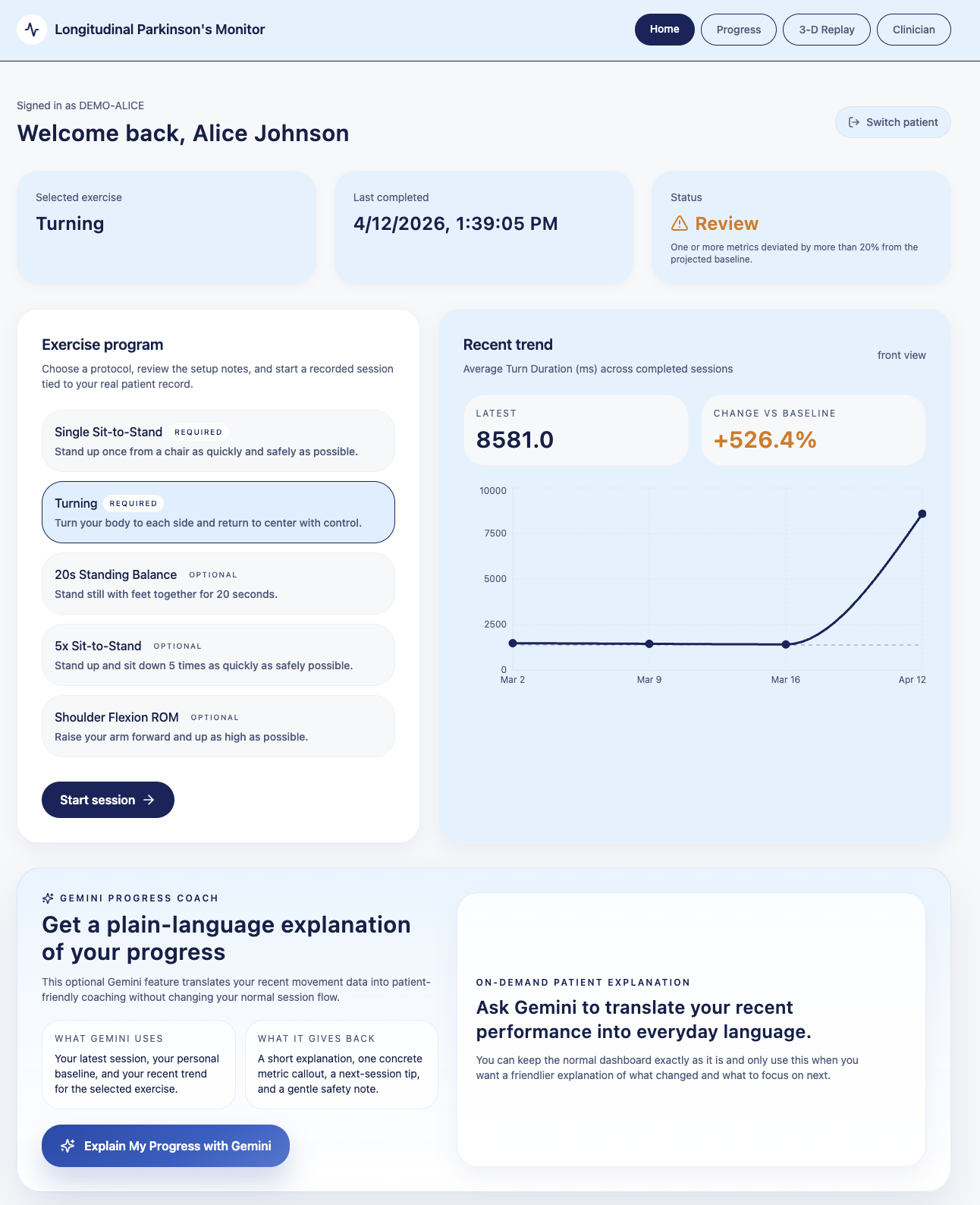
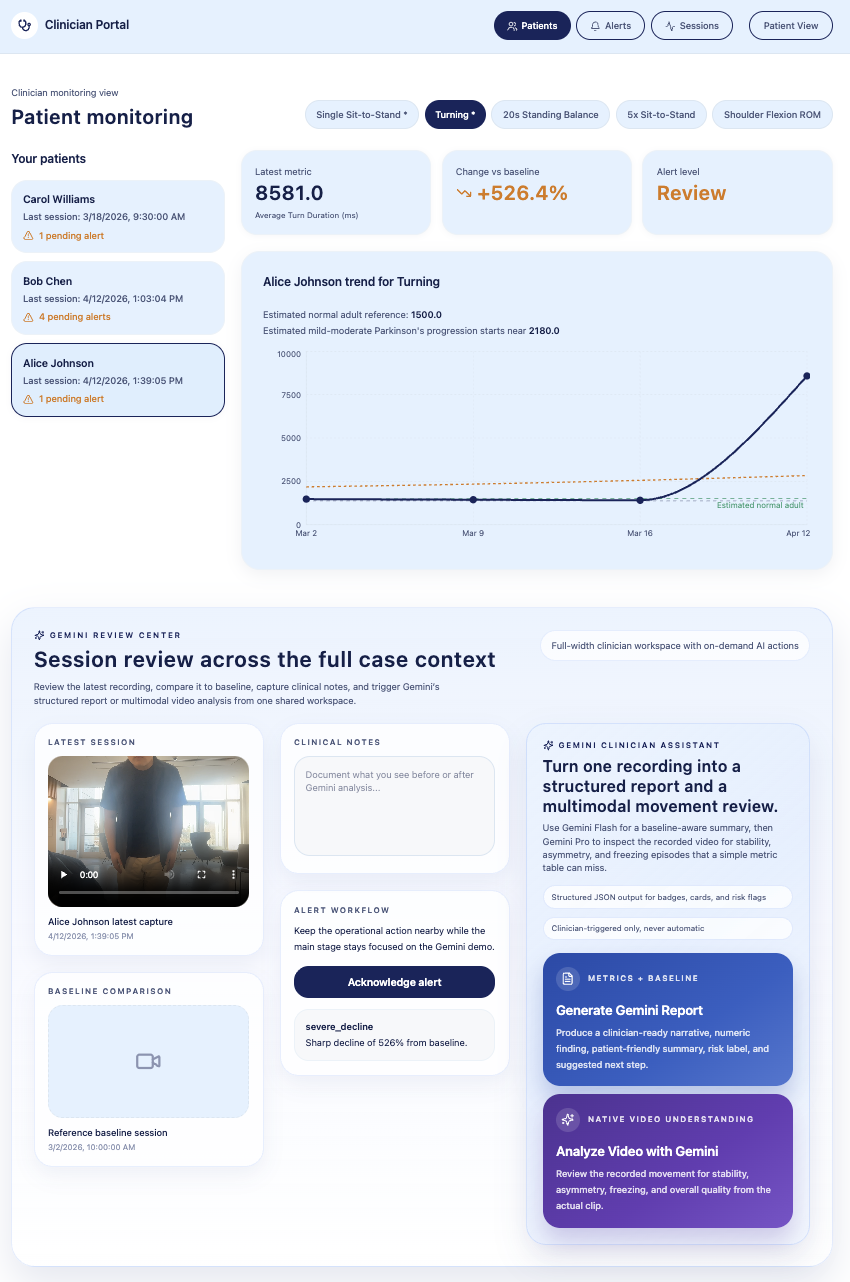
Inspiration
NeuroPrint was inspired by a major question relatively unanswered in Parkinson’s care: what happens when there are meaningful motor changes happen between clinic visits? Traditional evaluations are expensive, and usually capture only a short snapshot in a controlled environment. We wanted to build a system that could make monitoring more continuous, objective, and accessible from home while still giving clinicians data they could use in real treatment decisions.
What it does
NeuroPrint is a motion-monitoring platform for Parkinson’s patients that guides users through structured movement tasks, records their performance, and analyzes progression over time. Using computer vision, it tracks body movement, identifies when a protocol has been completed, and stores that session for later review. After several recordings, NeuroPrint models a patient’s expected trend and flags meaningful deviations so doctors can review anomalies or sudden changes.
How we built it
We built NeuroPrint as a full-stack application using FastAPI and SQLite on the backend and Vite, React, HTML, and CSS on the frontend. For motion tracking, we used MediaPipe to extract key body landmarks from video. We then analyzed landmark angles, distances, and timing to determine whether a patient completed the required action correctly.
To make the system easier to use independently, we added voiced movement guidance and position checks before recording begins. We also used linear regression to estimate the expected value of a patient’s performance after several sessions, giving us a simple baseline model. We also incorporated SMTP for clinician notifications and explored Gemini API as a fallback for higher-level video review. For reference and context, we looked at datasets such as the ReMAP Open Dataset and the MMU Visual-Based Dataset. We ran the open datasets against our protocol, and identified numerous anomalies/red alerts in which the motor change was especially drastic. In such cases, patients would have to wait months for the next checkup. This decreases the wait time drastically, and gives/ensures the patients a piece of mind.
Challenges we ran into
One of the biggest challenges was distinguishing actual symptom progression from bad recordings. If a patient was not properly positioned in frame, the result could look like worsening movement when it was really just a setup issue. This pushed us to improve our start-position checks and guidance system.
Another challenge was balancing model sophistication and reliability. Linear regression gave us a clear and explainable baseline, but we also discussed more advanced curve fitting for future versions. The problem is that with limited data and high variance, more complex models can quickly become unstable or misleading. Further, since we called on client side instead of hosting it ourselves, the amount of customization as well as reliability/accuracy was limited. This was not due to time constraints, but rather we did not have enough compute to process such a large model. In such case, we used Gemini as a fallback in order to explain unstable/misleading MediaPipe output.
We also had to solve a number of practical engineering issues, from synchronizing frontend and backend workflows to making the recording process simple enough for patients to use independently.
Accomplishments that we're proud of
We built a system that can guide the patient, automate recording, analyze motion, model progression, and present results in a clinician-friendly dashboard. The platform was able to distinguish between stable patients and patients with worsening symptoms in our trials. Most importantly, we created something that feels practical (and could potentially save lives).
What we learned
We learned that healthcare technology has to be more than technically accurate. It also has to be usable, interpretable, and reliable in imperfect real-world conditions. Small issues like framing, visibility, and timing can have a huge effect on computer vision systems, especially in health-related applications.
What's next for NeuroPrint
Next, we want to improve NeuroPrint’s progression modeling with more data and stronger calibration, potentially exploring curve fitting or more advanced time-series methods once variance is better controlled. We also want to expand the number of supported movement protocols, improve clinician alerting, and refine the dashboard for easier long-term patient review.
Beyond that, we see NeuroPrint growing into a more complete remote Parkinson’s monitoring platform, one that helps patients document progression more easily and helps clinicians intervene earlier with better, more objective data.

Log in or sign up for Devpost to join the conversation.