-
-
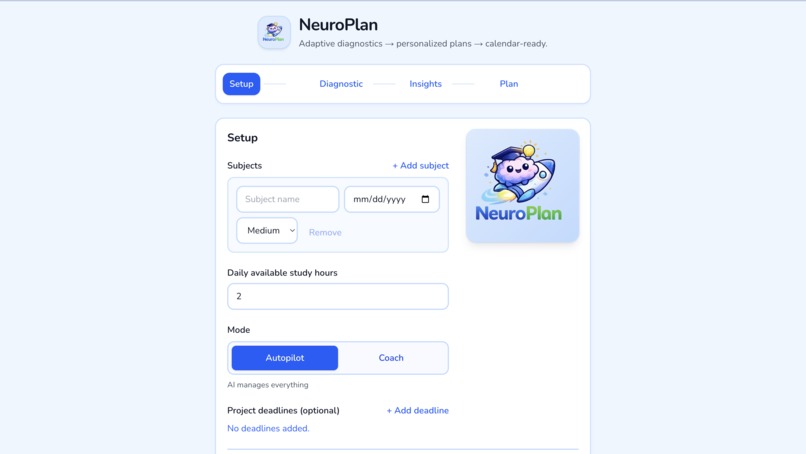
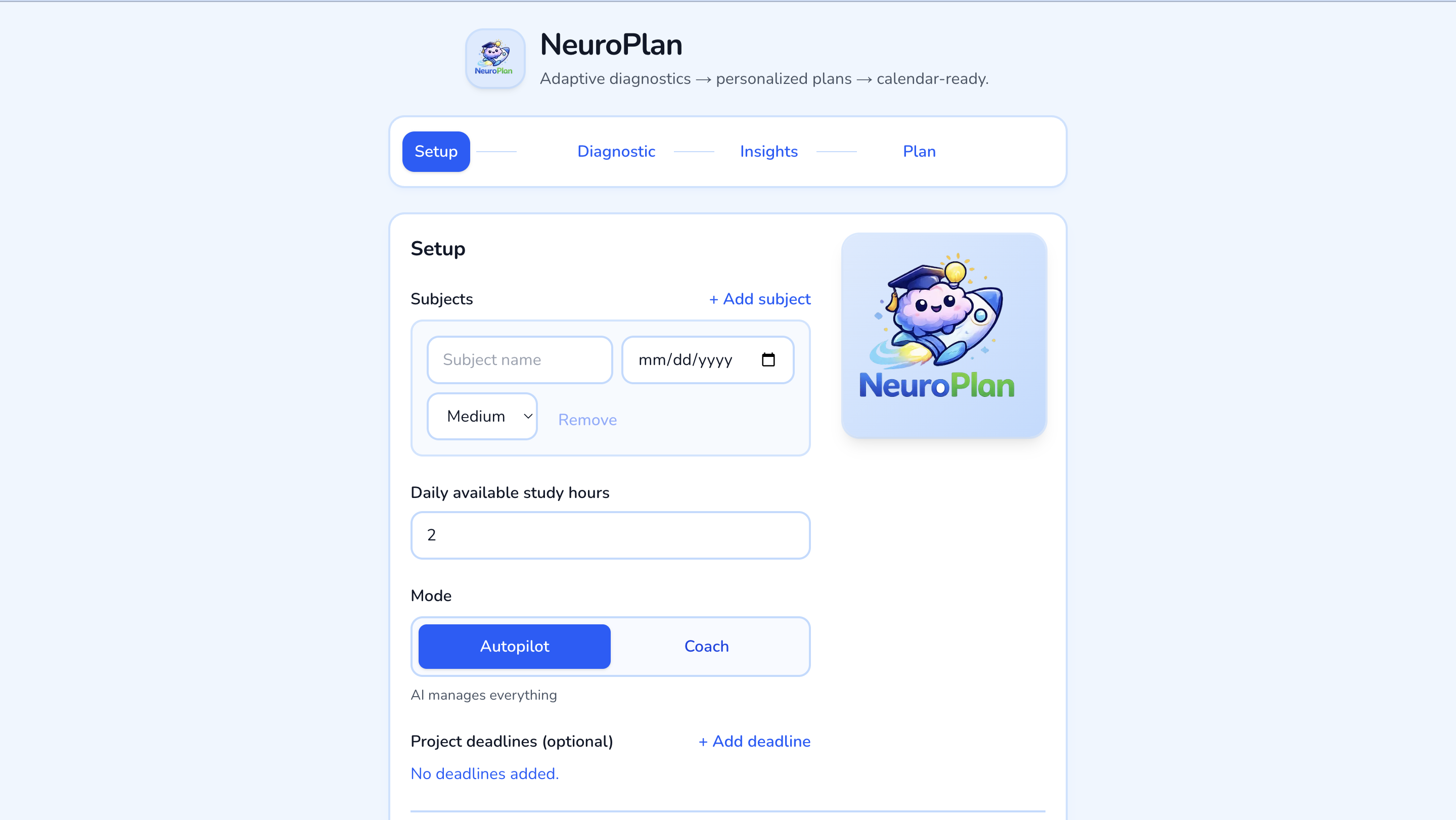
website_homepage
Inspiration: NeuroPlan started from a simple observation during exam season. Students spend hours creating detailed study plans. They divide chapters evenly. They organize their time carefully. Yet many still walk into exams feeling unsure. We realized the problem wasn’t a lack of effort. It was a lack of direction. Most study planners focus on time. But students don’t actually care about how many hours they studied. They care about one thing: “Will I improve?” We noticed that students often review topics they are already comfortable with, while avoiding the concepts they truly struggle with. Time spent does not equal understanding gained. So we asked ourselves:
What if a study planner could think like a tutor?
Instead of distributing time evenly, it would identify weaknesses and allocate effort strategically. That idea became NeuroPlan.
How We Built It: We designed NeuroPlan around three core components.
Diagnostic Intelligence We created a short 7-question diagnostic test to identify concept-level weaknesses. Students can answer normally, skip a question, or select “No idea.” We intentionally included these options because uncertainty is meaningful. A skipped question reveals more than a lucky guess. The system analyzes response patterns rather than just counting correct answers. It maps mistakes to specific concepts and estimates the student’s performance level.
Weakness-Based Prioritization Instead of treating all topics equally, NeuroPlan identifies high-impact weaknesses. If a student struggles with one specific concept that heavily affects exam performance, the system prioritizes it. Rather than reviewing ten chapters equally, the plan focuses on the few concepts that can generate the largest improvement. This shifts studying from being time-based to being impact-based.
Adaptive Study Scheduling Once weaknesses are identified, NeuroPlan generates a personalized 7-day study plan. The schedule reallocates time toward weaker areas while reducing time spent on already-mastered topics. As students complete tasks, the system updates predicted performance levels. This makes progress visible. Instead of wondering whether they improved, students can see measurable change.
Challenges We Faced: One of the biggest challenges we faced was ensuring reliable and structured AI output. Large language models are powerful, but they do not always return responses in the exact format requested. Since our system depends on structured JSON to generate diagnostics and study plans, even small deviations in formatting could break the application.
To solve this, we implemented strict schema validation using Zod, along with custom JSON extraction and sanitation logic. We also added retry and timeout mechanisms to handle malformed or delayed responses. This significantly improved system stability.
Another challenge was balancing generation speed and reliability. Model responses could take too long or occasionally time out, especially during the first request. We had to fine-tune token limits, temperature settings, and timeout configurations to maintain responsiveness without sacrificing structure or quality.
We also encountered complexity in designing meaningful plan outputs. Early versions of the study plan were too generic or repetitive. Refining the prompt structure to generate actionable, non-redundant tasks required several iterations and testing cycles.
Overall, the primary challenge was not building the interface, but building a reliable AI-driven system that could consistently produce structured, usable outputs under real constraints.
What We Learned: Through building NeuroPlan, we learned that students do not need more content. They need better prioritization. We learned that visible progress increases motivation. When students can see predicted improvement, studying feels purposeful instead of repetitive. Most importantly, we learned that academic performance is not just about working harder. It is about working strategically.
Final Reflection: NeuroPlan transforms uncertainty into clarity.
Instead of asking, “What should I study today?” students receive a clear answer.
Instead of studying randomly, they study deliberately.
Instead of managing time, NeuroPlan manages performance.
That shift in mindset is what inspired us and what drives the future of smarter learning.
Built With
- chatgpt
- cursor
- minimax-api
- next.js
- tailwindcss
- typescript
- vercel

Log in or sign up for Devpost to join the conversation.