Inspiration
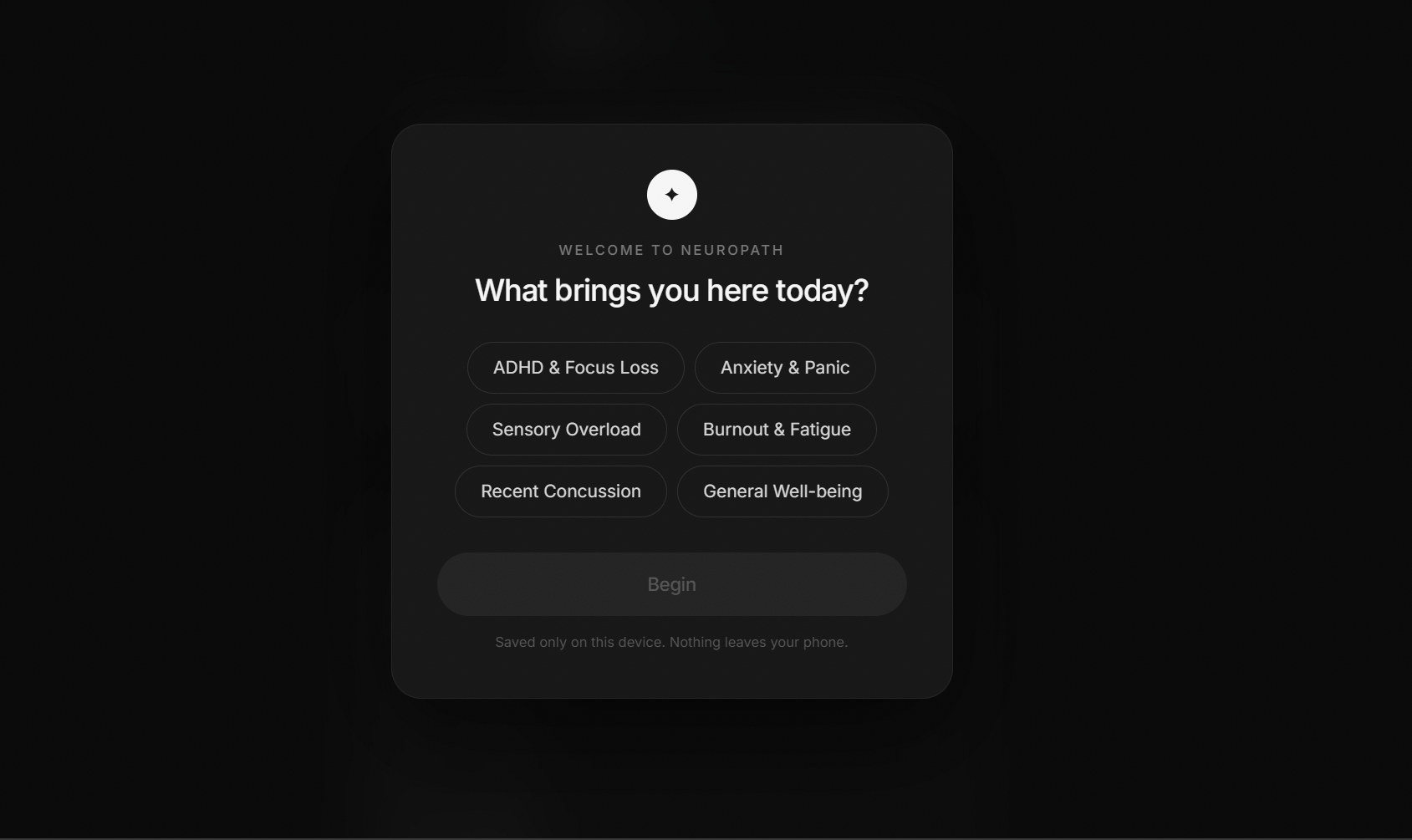
Standard mental health, ADHD, and concussion recovery apps are fundamentally flawed. They force patients experiencing brain fog, anxiety, or photophobia to navigate cluttered menus, multiple tabs, and complex settings. This causes the exact cognitive overload they are trying to cure. We wanted to build a clinical tool that requires absolute zero decision-making from the patient, wrapping medical-grade exercises in an ultra-premium, distraction-free aesthetic.
What it does
NeuroPath is an AI-driven neuro-recovery platform built around a strict "single-card focus" UI. The patient simply types how their head feels in plain English. From there, the app takes complete control:
AI Clinical Triage: Google's Gemini API processes the text and instantly diagnoses the severity of the symptoms.
Dynamic Environment: The app dynamically shifts its color palette (e.g., high-contrast dark amber for acute photophobia, deep blue for anxiety) based on the AI's JSON response.
Automated Acoustic Therapy: Gemini automatically prescribes and streams precise audio frequencies (like 108Hz delta waves or Pink Noise) invisibly using headless YouTube streaming, locking the controls so the user just listens.
Vestibular Saccadic Trainer: An eye-tracking exercise where the AI automatically sets the target speed based on the patient's reported dizziness.
Cognitive Anchoring: Includes a 5-4-3-2-1 Grounding protocol and an Executive Function Primer that asks the user to input just one single task to break mental paralysis.
How we built it
Frontend: We engineered the interface from scratch using Next.js 14, Tailwind CSS, and Framer Motion to build a glassmorphic, absolute dark-mode environment. Algorithmic UI: To prevent nausea in the Vestibular Saccadic Trainer, we implemented a dynamic velocity equation based on the AI symptom severity score V(S) = V_base * e^(-k * S) where k acts as our decay constant, ensuring the tracking balls slow down exponentially for highly symptomatic patients. Backend & AI: The clinical brain is powered by the Gemini API. To ensure this complex analysis did not freeze the user interface, we deployed our backend using a Render Web Service and Render Workflows. Hosting the AI logic on Render guarantees lightning-fast, non-blocking API routes.Audio Integration: We utilized react-player to handle headless YouTube streams, allowing us to serve high-quality frequency videos without bloating the application size .
Challenges we ran into
Maintaining the illusion of a single floating glass card was technically demanding. We had to overcome Next.js hydration conflicts, global CSS overrides, and nested scrollbar breaks to ensure the UI remained perfectly centered and responsive. Additionally, we had to heavily engineer our Gemini system prompt to guarantee it returned a strict, predictable JSON schema. If the AI hallucinated a color hex code or audio URL, the dynamic theming would break, so we had to build bulletproof fallback states.
Accomplishments that we're proud of
We successfully bridged the gap between medical accessibility and high-level web design. By enforcing a strict dark-mode architecture and removing manual user controls, we proved that clinical tools do not have to look clinical. We are also incredibly proud of flawlessly deploying the application to a live Render Web Service just hours before the submission deadline.
What we learned
We learned how to deeply integrate Google's Gemini API not just for natural language generation, but as a deterministic state machine to control a frontend application. We also mastered managing headless audio contexts in React and configuring robust cloud deployments using Render to ensure our AI routes never timed out in production.
What's next for NeuroPath
We plan to expand the acoustic therapy engine by replacing the YouTube streams with custom-produced binaural beats and frequencies engineered specifically in FL Studio for exact phase alignment. We also aim to integrate native webcam eye-tracking to give real-time feedback during the Vestibular Saccadic Training modules.
Built With
- framer-motion
- gemini
- next.js
- react
- render
- tailwind-css
- typescript

Log in or sign up for Devpost to join the conversation.