
Inspiration
I've tried a lot of AI self help apps, but many fall into one of two buckets: offering overly certain, overly prescriptive advice, OR endlessly reassuring and reaffirming the user's existing beliefs, eg AI sycophancy.
With Neuron, I was wary of building another AI companion that simply tells people what to do, offers excessive reassurance, or confidently interprets their life for them.
Crucially, Neuron does not prescribe solutions. Instead, the app encourages users to capture short thoughts throughout their day, identifies their true values and goals in life, and then helps them notice recurring patterns, emotions, and discrepancies between their true goals for their life and their current behavior. The user decides what those patterns mean and what, if anything, they want to do about them.
Neuron is inspired by principles from motivational interviewing: rather than pushing someone toward a predetermined answer, it reflects their own words back to them, directly citing their thought entries, highlights inconsistencies between their thoughts, behavior, values, and goals, and helps them formulate their own next steps.
This approach helps avoid psychological reactance, the tendency to resist an idea when it feels imposed on us. A decision is much more meaningful when it genuinely feels like your decision.
I wanted to build AI that increases self-awareness without replacing agency. At the end of the day, it is in the user's hands to change and improve their life.
What it does
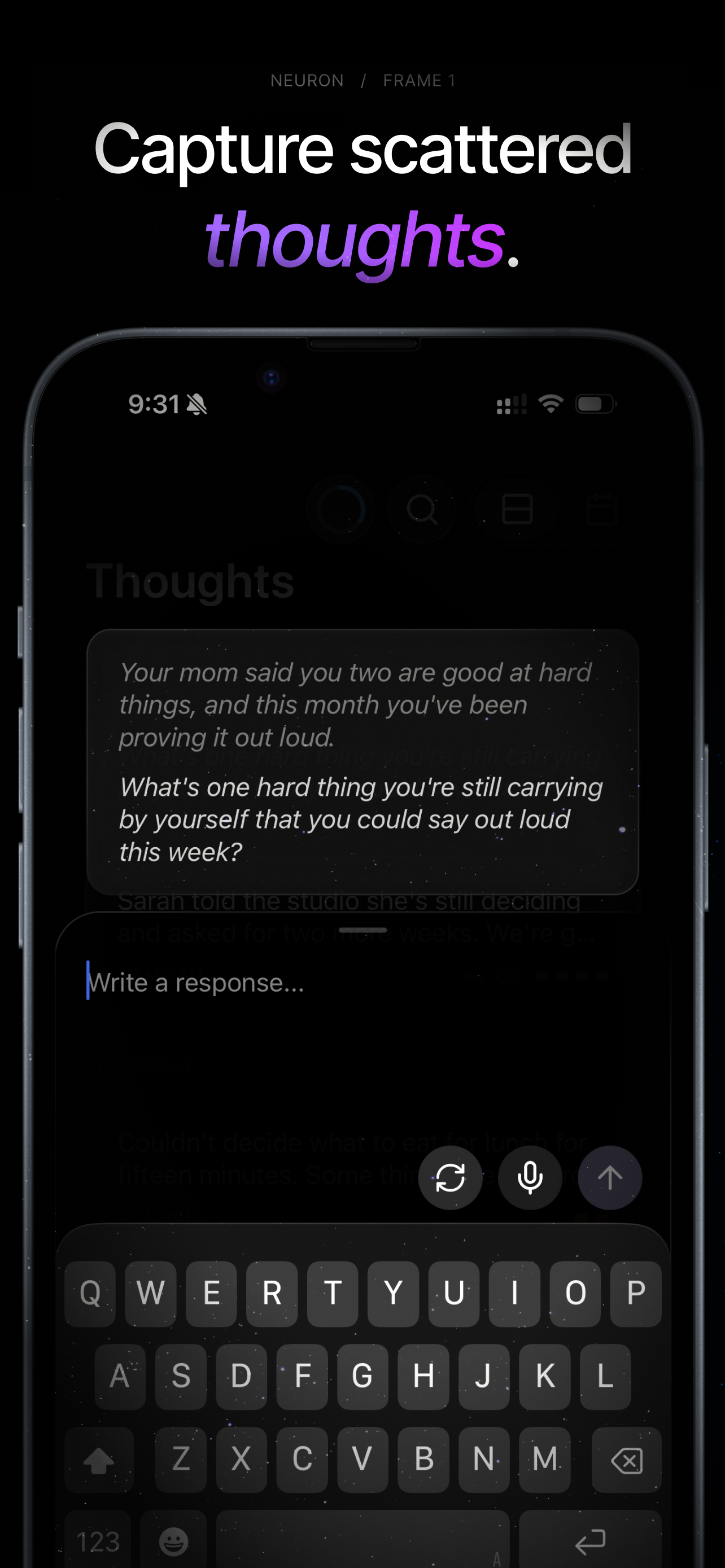
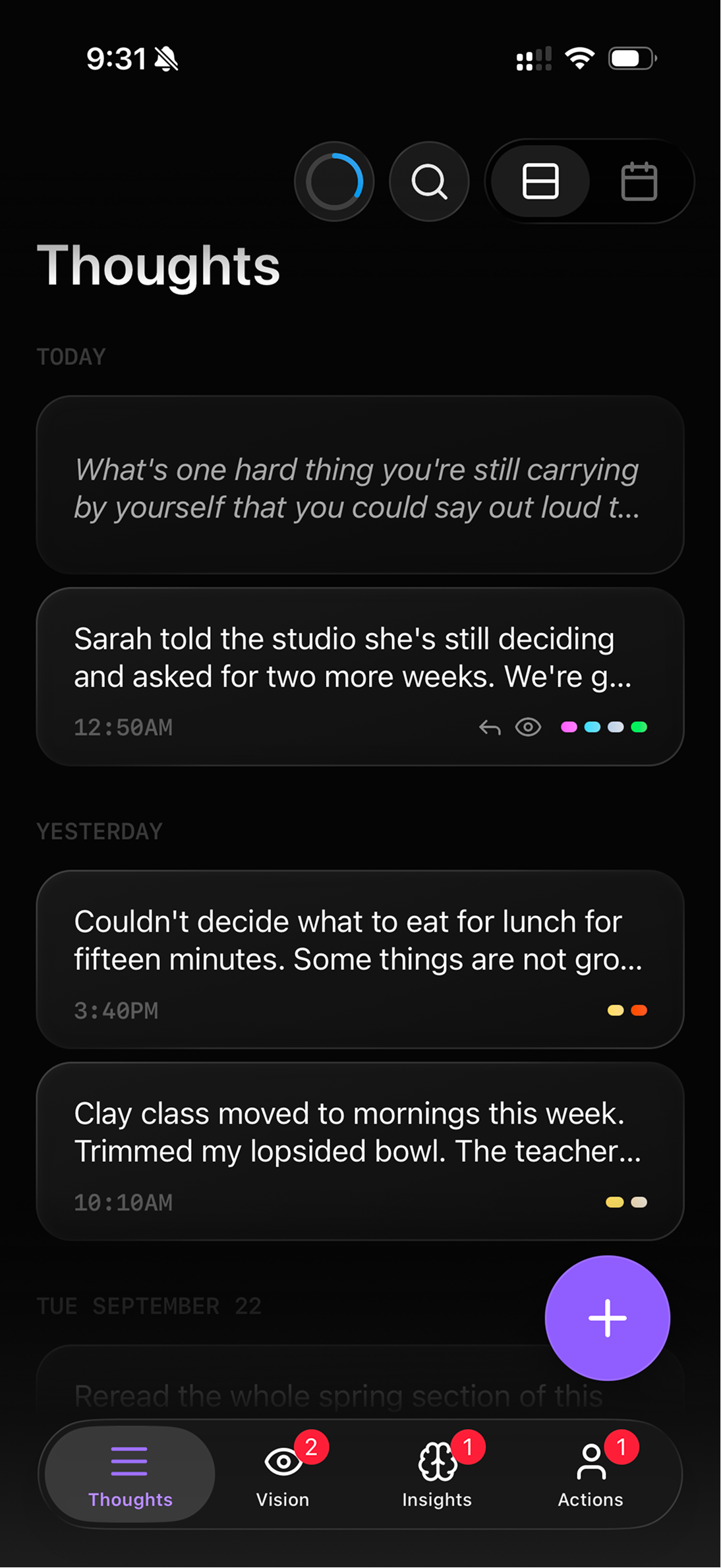
Neuron is an AI-guided journal designed around short thought snippets, rather than long-form diary entries.
Users can capture whatever is on their mind through text or voice. Over time, Neuron builds context across those thoughts: recurring subjects, emotional patterns, stated values, unresolved questions, and commitments the user has made.
As you write, Neuron can ask lightweight, personalized follow-up questions that encourage you to go a little deeper without interrupting the flow of journaling.
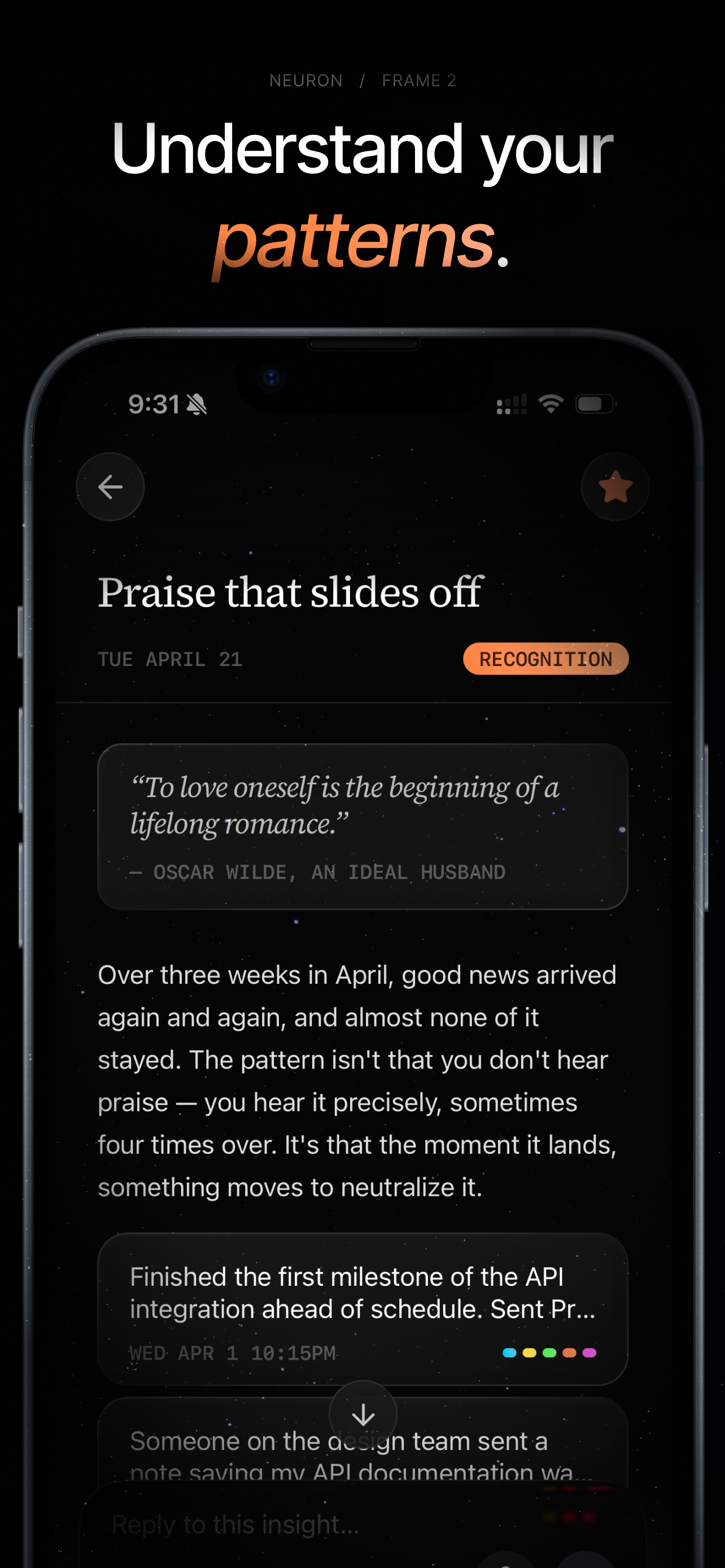
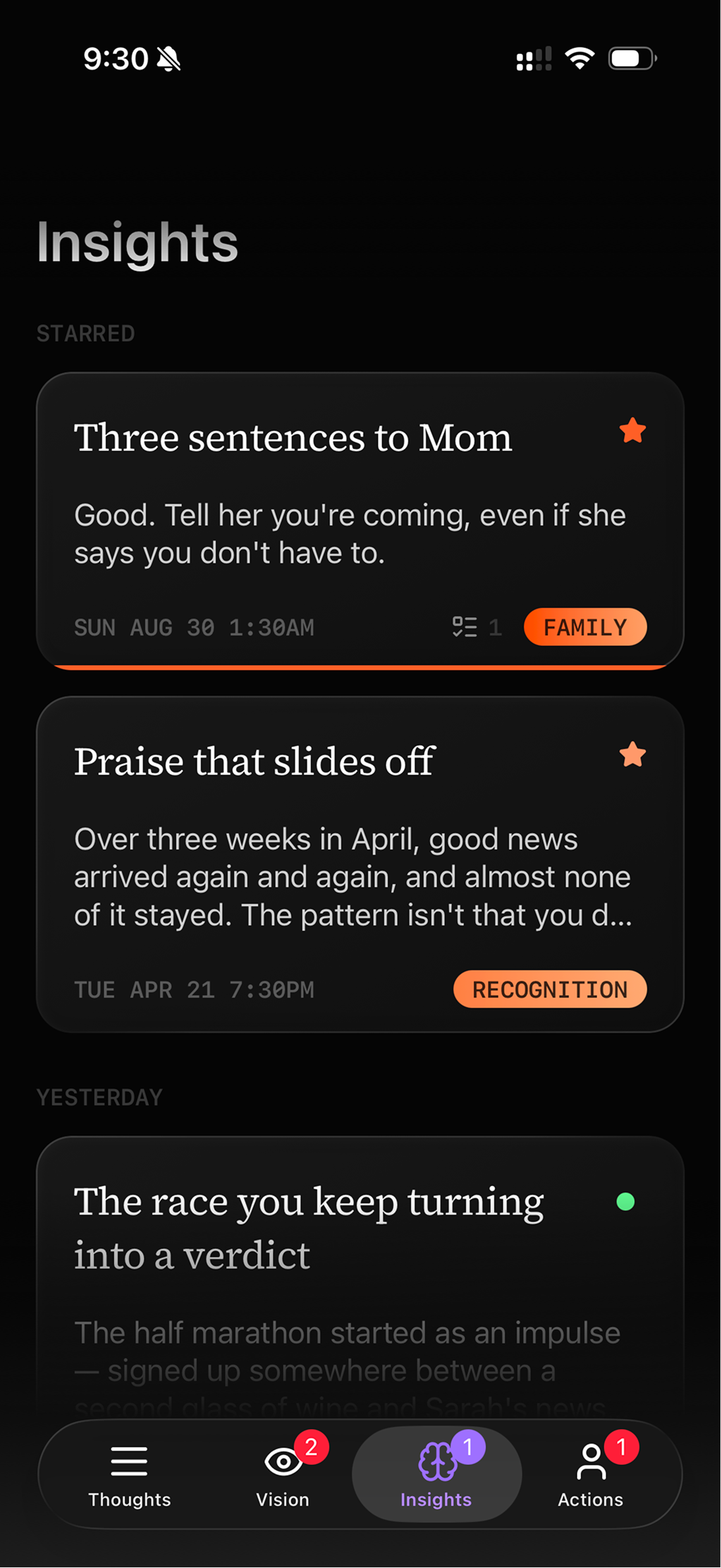
Its Insights look across your history for meaningful patterns and connections, then explain them using your own thoughts as evidence. Each insight can be explored conversationally, allowing you to think through what it means and, if you choose, decide what you want to do about it.
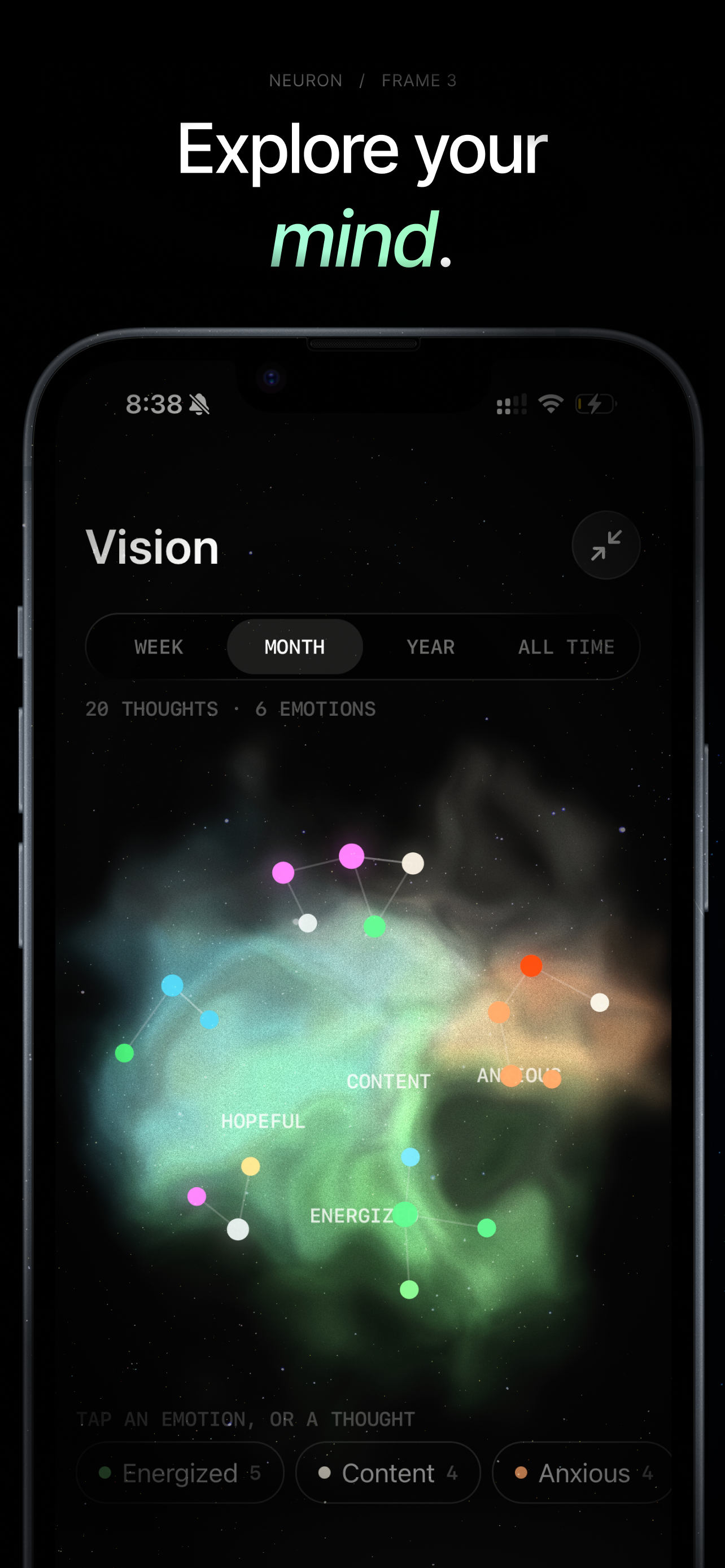
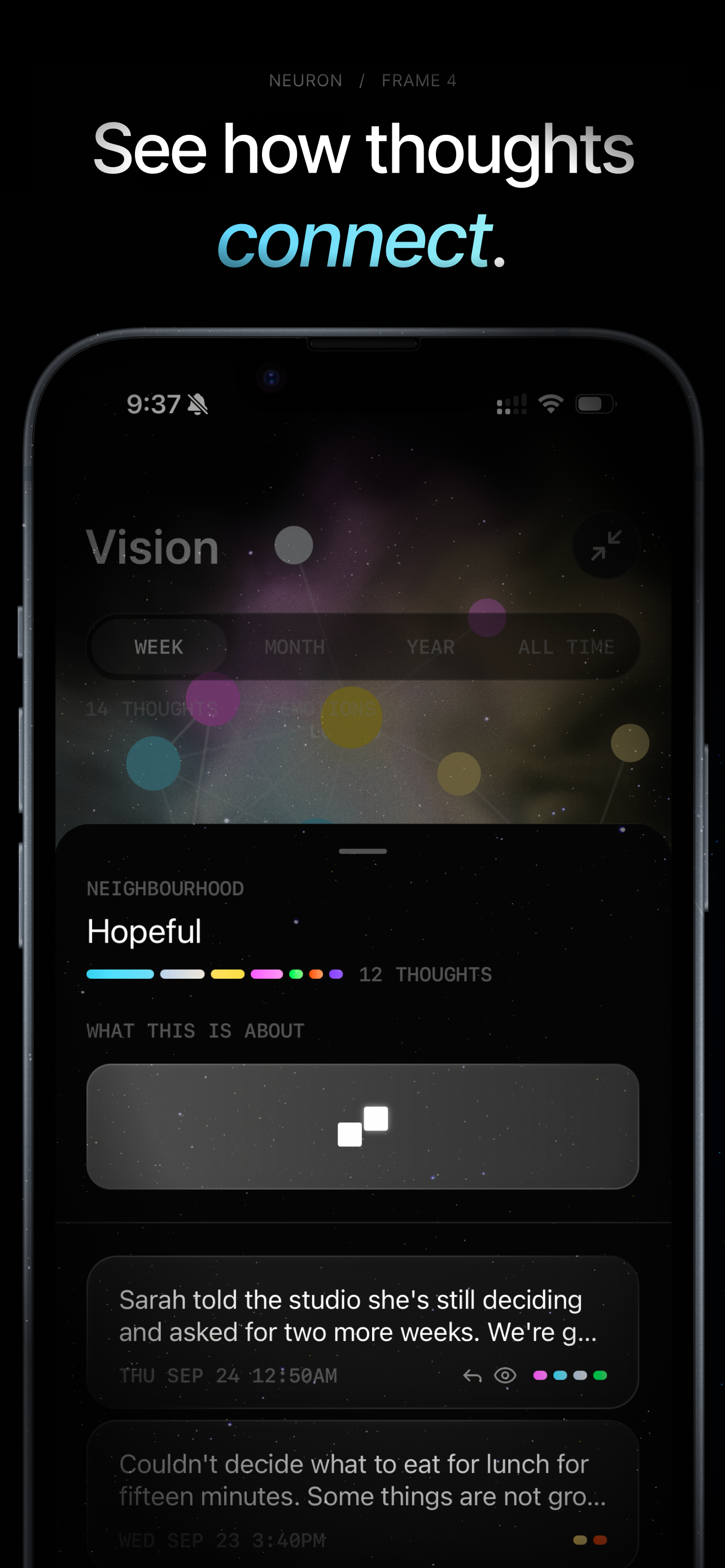
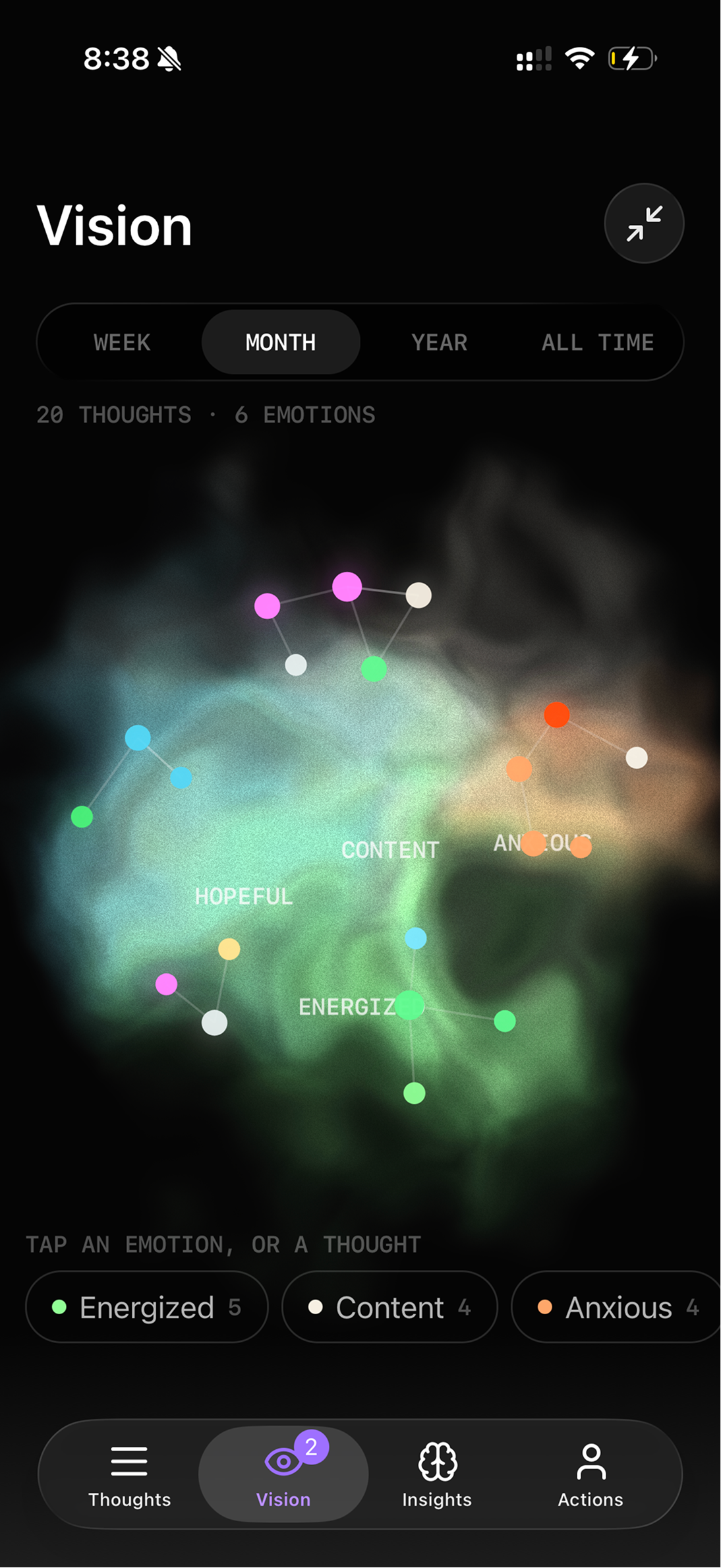
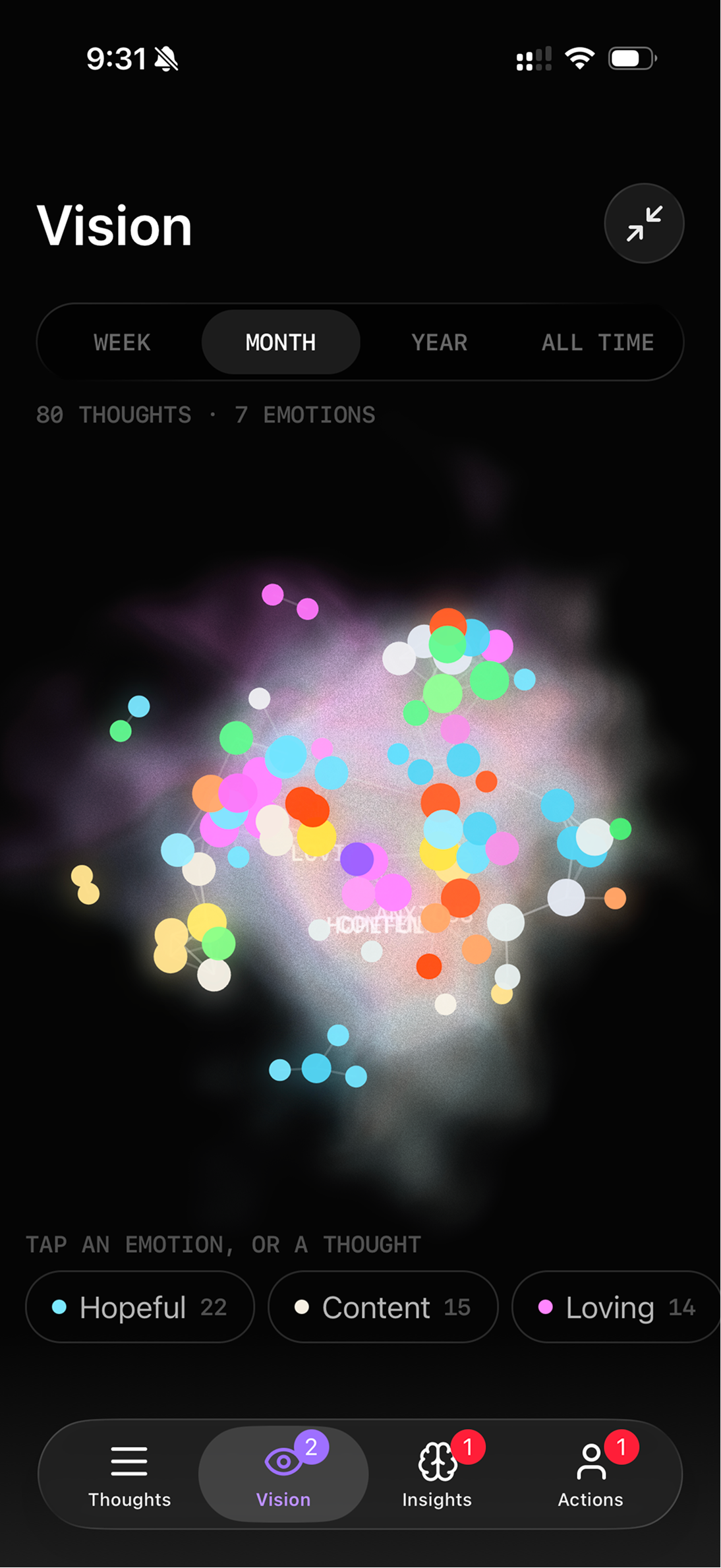
Mindcloud provides a visual representation of the people, subjects, emotions, and ideas occupying your mind.
Vision & Values helps surface the goals and principles expressed throughout your writing.
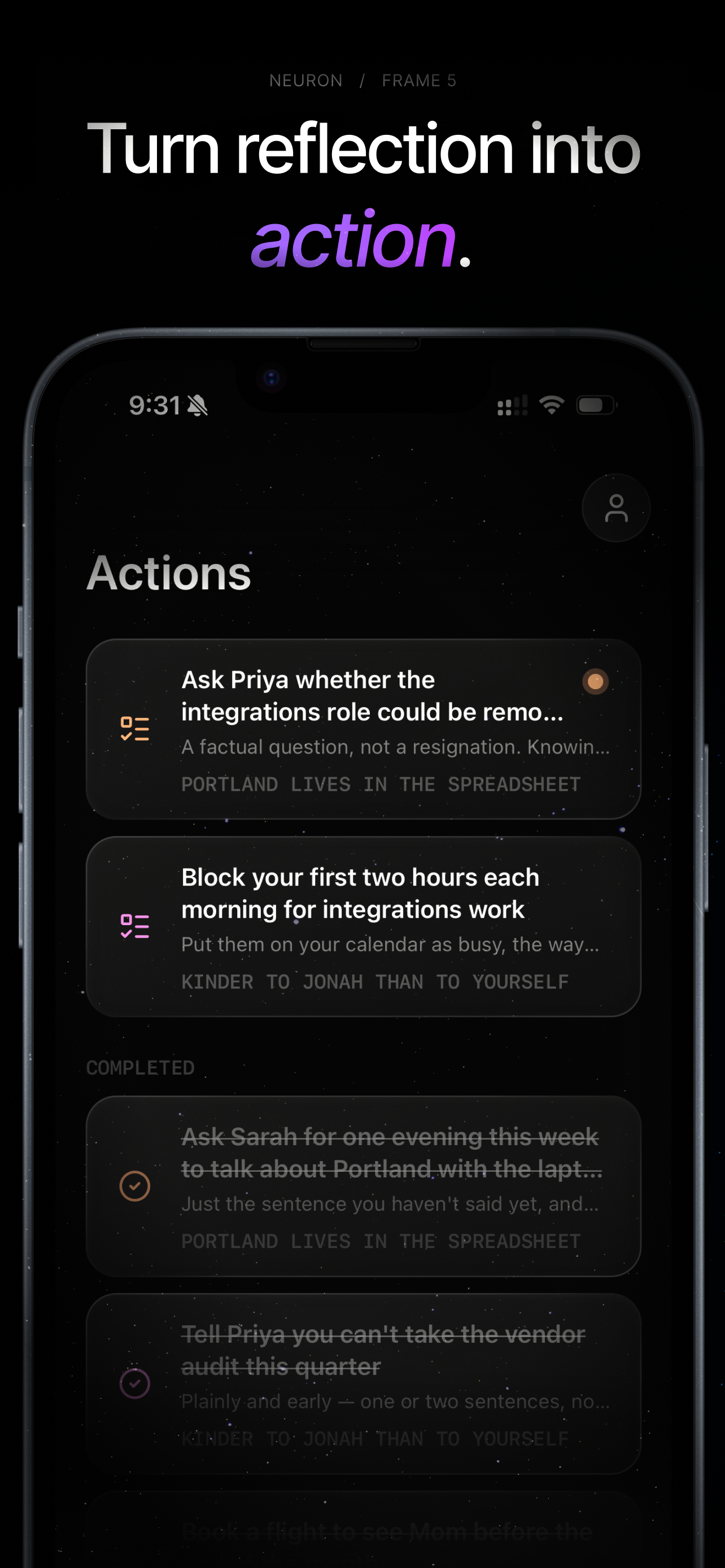
And when reflection turns into a decision, Neuron can help capture an action or experiment that the user themselves has chosen to try.
A core design rule runs through all of these features: Neuron expresses things in your own words.
Insights reference the user's actual thoughts and stated values rather than inventing a detached psychological profile. When it comes time to decide what to do next, Neuron can ask questions and surface discrepancies, but the decision remains with the user.
How we built it
Neuron started in Figma, and was heavily design-first, with a focus on intentional and restrained use of color, gradients, glow, shadow, vibrancy, animation, and so forth. The result is what we feel is a very premium, beautiful, and introspective product experience.
Before building the AI system, I spent a lot of time figuring out what interacting with it should actually feel like. I didn't want a conventional chatbot with a journal attached to it; I wanted the journal itself to remain the primary interface, with intelligence appearing naturally around the user's writing.
The mobile app is built with React Native, Expo, and TypeScript. Supabase and PostgreSQL provide authentication, data storage, and the backend foundation, while production services run on Fly.io.
A major part of the engineering work went into Neuron's context and retrieval system. Rather than treating every interaction as an isolated prompt, Neuron can retrieve relevant thoughts from the user's history, identify related subjects, reference previously stated values, and find the original writing behind an observation.
This makes it possible for an insight to draw on weeks or months of writing while remaining grounded in specific things the user actually said.
The AI system also separates different responsibilities, such as asking contextual questions, finding patterns, extracting values, and generating insights, so that each interaction can be more focused and constrained.
There are a number of analyses run at thought-entry time, which identify entities in the thought (like people, places, and topics), as well as emotional affect, goal-orientation of the thought, and so forth. From this we construct and maintain a graph of thought relationships that enrich the context used by the AI, and also form the foundation of the Mindcloud visualization.
Voice capture uses Apple's native speech recognition with continuous transcription, making speaking a thought nearly as lightweight as typing one.
Subscriptions are implemented with RevenueCat, authentication uses Sign in with Apple, and the production iOS app is built and distributed through Expo's EAS tooling.
Challenges we ran into
The hardest problem was not getting an LLM to generate an insightful response. It was teaching it when not to.
Early versions could easily become too eager: offering solutions before the user had asked for them, over-interpreting a single thought, asking too many questions, or providing the kind of excessive reassurance common in AI companion products.
A huge amount of the work went into restraint.
Neuron has to distinguish between something the user actually said and an inference the model is making. It has to retrieve enough historical context to notice a genuine pattern without forcing connections that are not there. And when it identifies a discrepancy, it needs to explore it without deciding on the user's behalf what the "correct" answer is.
Another challenge was making a sophisticated AI system feel fast and simple. Behind one small insight can be retrieval across a thought history, relationship discovery, value lookup, model inference, and persistence. None of that complexity should be visible to the user.
Finally, moving from a prototype to a real App Store product brought an entirely different class of problems: production authentication, subscription handling, deployment infrastructure, privacy, voice permissions, App Store requirements, and making edge cases feel intentional.
Accomplishments that we're proud of
The thing I'm most proud of here is that Neuron is already a product I have personally used for several months and found great benefit in. My goal is to create something that genuinely helps people.
I'm also incredibly proud of the UX, the visual cohesion between elements, and the sheer amount of tuning and iteration on visual minutiae like the color palette, gradient stops, animation timing - the list goes on.
I'm happy to have created an AI experience that is satisfying and productive.
What we learned
The biggest lesson was that building a good AI product is as much about defining boundaries as adding capabilities.
A model that can say more is not necessarily a better model experience.
For Neuron, the quality of an interaction often comes from what the system doesn't do: not jumping to a diagnosis, not pretending to know why someone feels something, not immediately proposing a five-step solution, and not turning every thought into a profound revelation.
I also learned how important retrieval and context are. The difference between a generic AI response and one that genuinely feels personal is often not a more powerful model. It is giving the model the right pieces of the user's history at the right time.
And I learned that AI interaction design goes far beyond chat. Some of Neuron's most important interactions are a single question, a visual connection, or a sentence surfaced at exactly the right moment.
What's next for Neuron
The next step is to put Neuron in the hands of more real users and learn which parts of the experience remain useful after weeks and months rather than just during a first session.
I want to continue improving Neuron's ability to recognize meaningful long-term patterns while becoming even more disciplined about uncertainty and restraint, and refining the UX even further.
There is also much more to explore around the relationships between thoughts: showing how subjects evolve over time, connecting decisions back to the thoughts that produced them, and making it possible to understand not only what is on your mind today, but how your thinking has changed.
Ultimately, the goal is simple: make capturing a thought almost effortless, then make the accumulated record of those thoughts increasingly valuable over time without taking ownership of the user's decisions away from them.
Built With
- anthropic-claude
- docker
- expo.io
- figma
- fly.io
- google-gemini
- hono
- langchain
- langgraph
- nativewind
- node.js
- openai
- pgvector
- postgresql
- react-native
- revenuecat
- skia
- supabase
- swift
- swiftui
- tailwind-css
- tanstack-query
- typescript
- widgetkit
- zustand

Log in or sign up for Devpost to join the conversation.