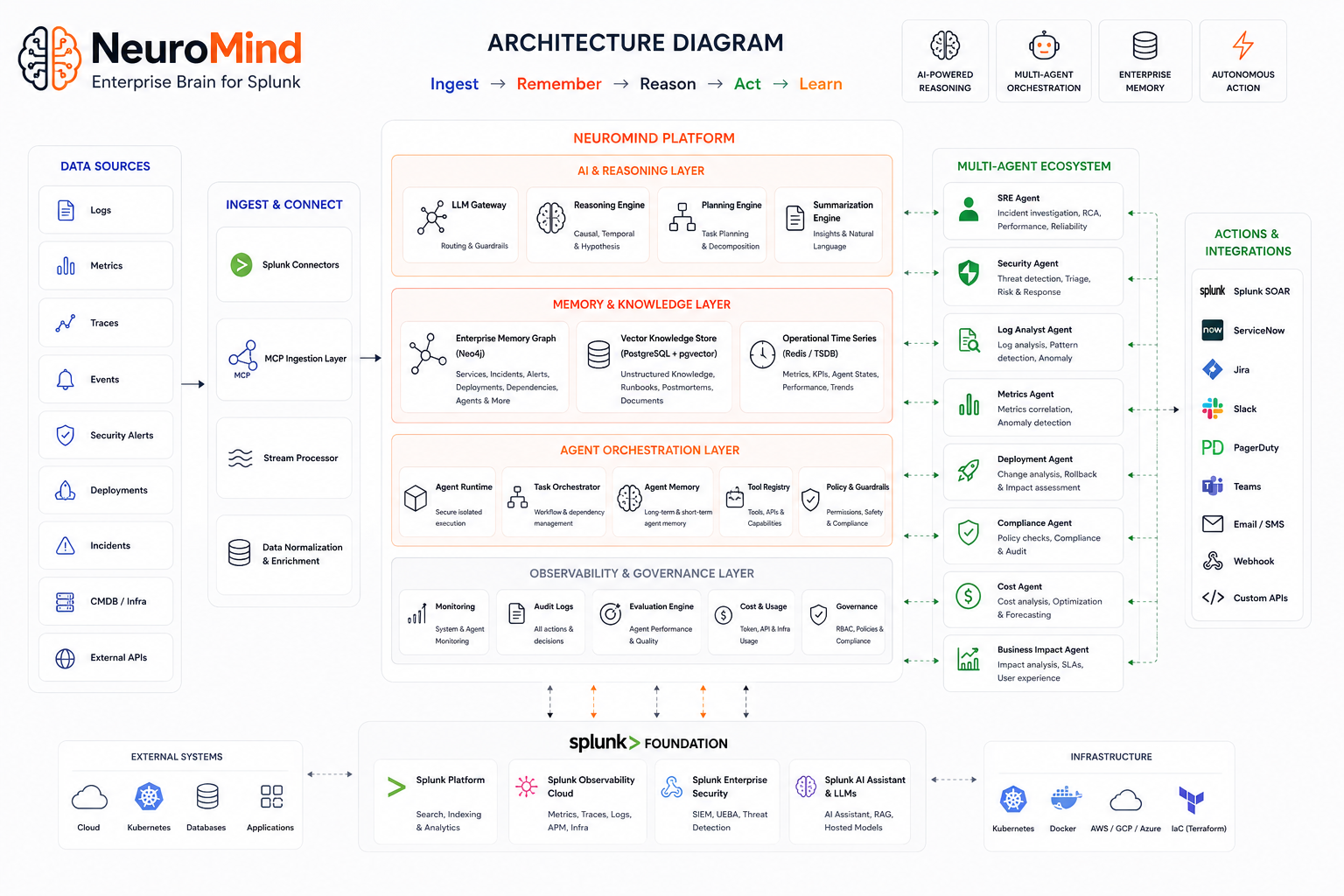
NeuroMind — The Autonomous Enterprise Brain for Agentic Operations
Inspiration
Today's enterprises are drowning in dashboards, alerts, and fragmented data. Despite having powerful observability and security tools, engineers still spend countless hours manually correlating logs, metrics, traces, deployments, and incidents to answer a simple question:
Why is this happening, and what should we do next?
We realized the problem isn't a lack of data — it's a lack of organizational memory and autonomous reasoning.
We envisioned a future where Splunk evolves from a monitoring platform into an Enterprise Brain that can remember, reason, learn, and act autonomously.
Inspired by the concepts behind multi-agent systems, enterprise knowledge graphs, AI copilots, and autonomous operations, we built NeuroMind.
What it does
NeuroMind is an Enterprise Brain + Agent Operating System built on Splunk.
It transforms enterprise operations from reactive monitoring into proactive autonomous decision-making.
Instead of showing another dashboard, NeuroMind:
- Investigates incidents automatically
- Launches specialized AI agents
- Correlates logs, metrics, traces, deployments, and security events
- Builds causal reasoning chains
- Identifies root causes
- Generates remediation plans
- Learns from every incident
- Stores organizational knowledge for future investigations
Key Capabilities
🧠 Enterprise Memory Graph
A living knowledge graph that continuously learns relationships between:
- Services
- Incidents
- Deployments
- Infrastructure
- Databases
- Security events
- AI agents
🤖 Multi-Agent Orchestration
Specialized AI agents collaborate together:
- SRE Agent
- Security Agent
- Log Analyst Agent
- Metrics Agent
- Deployment Agent
- Compliance Agent
- Cost Agent
- Business Impact Agent
🚨 Autonomous Incident Commander
When an incident occurs, NeuroMind automatically:
- Creates an incident room
- Launches AI agents
- Builds hypothesis trees
- Identifies root causes
- Generates remediation steps
🔒 Security Intelligence
NeuroMind performs:
- Blast radius analysis
- Threat correlation
- MITRE ATT&CK mapping
- Attack timeline generation
📚 Organizational Learning Engine
Every incident becomes knowledge.
Future incidents benefit from previous learnings.
How we built it
Frontend
- Next.js 15
- React
- TypeScript
- Tailwind CSS
- shadcn/ui
- Framer Motion
- React Flow
- Recharts
Backend
- FastAPI
- Python
- LangGraph
- LangChain
Data Layer
- PostgreSQL
- Neo4j
- Redis
AI Layer
- OpenAI models
- Anthropic Claude
- Splunk Hosted Models
Splunk Integrations
- Splunk MCP Server
- Splunk AI Assistant
- Splunk Enterprise Security
- Splunk Observability Cloud
- Splunk SOAR
- Splunk Search APIs
We designed NeuroMind around a central concept:
Search → Remember → Reason → Learn → Act
instead of traditional
Search → Alert → Human Investigation
Challenges we ran into
Building an Enterprise Brain introduced several challenges.
Designing true multi-agent collaboration
We wanted agents to be more than API wrappers. Each agent needed a unique responsibility, context, and ability to collaborate with other agents.
Building organizational memory
Creating relationships between services, incidents, deployments, and historical learnings required designing a dynamic knowledge graph.
Balancing complexity and usability
Powerful systems can easily become overwhelming. We spent significant effort making complex AI reasoning understandable to humans.
Avoiding dashboard overload
Instead of adding more charts, we focused on building actionable intelligence.
Creating explainable AI
Users need to trust AI decisions. Every recommendation includes transparent reasoning paths.
Accomplishments that we're proud of
🏆 Building an Enterprise Brain
We moved beyond AI copilots and built a system that continuously learns and reasons over enterprise operations.
🏆 Creating a living memory graph
NeuroMind doesn't just store data; it builds organizational memory.
🏆 Autonomous incident management
AI agents can investigate incidents before engineers even join the call.
🏆 Unified security and observability
We combined traditionally separate workflows into one intelligent platform.
🏆 Human-centered AI
Every insight is explainable, visual, and actionable.
What we learned
Building NeuroMind taught us that the future of enterprise software isn't more dashboards.
It's autonomous systems.
Organizations don't need more alerts.
They need systems that can:
- Understand context
- Learn from history
- Explain decisions
- Coordinate actions
- Continuously improve
We also learned that organizational memory may become one of the most valuable assets for future enterprises.
What's next for NeuroMind
We're just getting started.
🚀 Persistent Enterprise Memory
Allow NeuroMind to learn continuously across months and years of organizational activity.
🚀 Predictive Operations
Move from incident response to incident prevention.
🚀 Digital Twin Integration
Build a live AI-generated twin of the enterprise to simulate failures before they happen.
🚀 AI Workforce Management
Manage thousands of AI agents securely at enterprise scale.
🚀 Autonomous Remediation
Enable safe one-click and eventually fully autonomous remediation workflows.
🚀 Cross-Enterprise Collaboration
Allow organizations to share anonymized learnings to collectively improve resilience.
Our vision is simple:
Transform Splunk from a monitoring platform into an autonomous Enterprise Brain that remembers everything, reasons over everything, and helps enterprises operate themselves.
NeuroMind: Learn. Reason. Act.
Built With
- anthropic-claude
- fastapi
- framer-motion
- langchain
- langgraph
- neo4j
- next.js-15
- openai-gpt
- postgresql
- python
- react
- react-flow
- recharts
- redis
- shadcn/ui
- splunk-ai-assistant
- splunk-enterprise-security
- splunk-hosted-models
- splunk-mcp-server
- splunk-observability-cloud
- splunk-search-apis
- splunk-soar
- tailwind-css
- typescript
- vercel

Log in or sign up for Devpost to join the conversation.