🧠 NeuroMapping: Low-Cost Cognitive Safety System 🚀
NeuroMapping is an innovative cognitive safety system designed to make mental health awareness and cognitive risk assessments accessible worldwide 🌍. Combining AI simulations with visual insights, it helps individuals understand and mitigate cognitive risks with a scalable, reproducible, and user-friendly approach.
🔹 What It Does
NeuroMapping delivers the following powerful features:
- Generates cognitive heatmaps 🔥 based on EEG signals ⚡
- Processes simulated EEG signals using a CNN + Transformer ensemble 🤖 for spatial and temporal feature extraction
- Tracks community engagement and awareness metrics 📊
- Fully software-based, scalable, and reproducible 🌐
- User-friendly visual insights that are easy to understand and act upon 🎨
🏗 Architecture & Workflow
EEG Signal Processing Flow
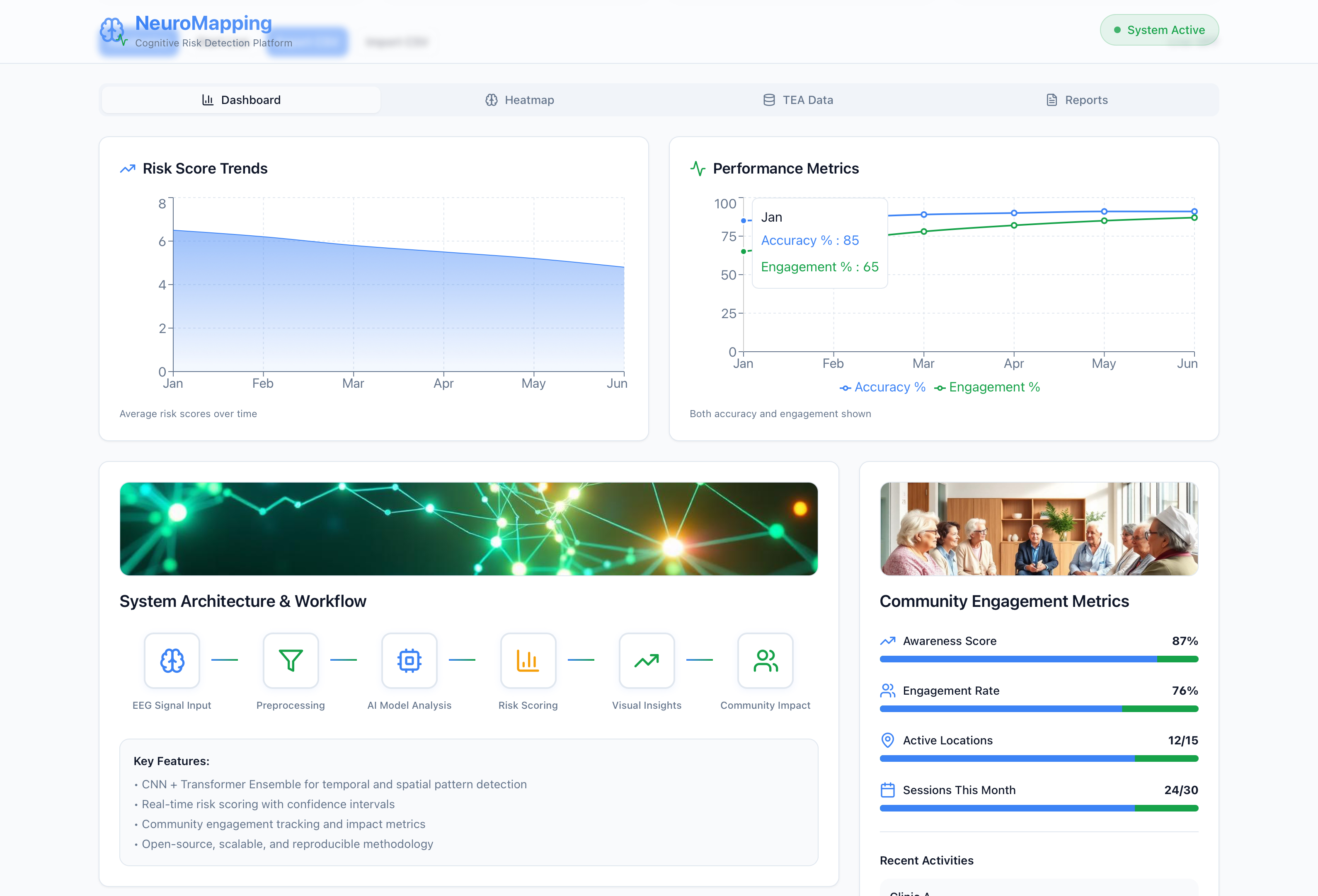
The system follows a hybrid architecture using both CNNs for spatial patterns and Transformers for temporal sequences: Click me to see my Dashboard
📄 View NeuroMapping Documentation
         🧠 EEG Signals
        (Simulated Input Data)
                │
                ▼
        🔄 Preprocessing
    Noise Filtering & Feature Extraction
                │
    ┌───────────┼──────────┐
    │           │          │
  Temporal     Spatial    🤖 CNN + Transformer
  Features ⏱️   Features 🌐    Ensemble Model
    │           │           - CNN: Spatial Patterns
    │           └───────┐   - Transformer: Sequences
    └──────────┐        ▼
                ┌───────────────────────────┐
                │    Risk Scoring 📊         │
                └───────────────────────────┘
                         │
                         ▼
                ┌───────────────────────────┐
                │    Confidence Levels      │
                └───────────────────────────┘
🎨 Enhanced Visualization Dashboard
The NeuroMapping dashboard provides interactive visual insights:
- Risk Score & Confidence: Shows the calibrated risk score with confidence intervals, making the data easy to interpret.
- Temporal Risk Evolution: Visualizes how cognitive risk evolves over time, helping users track trends 🕰.
- Topographic Heatmap: Provides a visual of brain regions with high cognitive activity 🧠 (e.g., frontal lobe activity).
- Clinical Recommendations: Offers actionable suggestions like "Consult a neurologist if symptoms persist" 🔍.
- Explainability: Details which features (e.g., theta band, asymmetry) contributed most to the predictions 🧩.
Example Visualization
🎯 **NeuroMapping Dashboard v2.0**

┌──────────────────┐    ┌─────────────────────┐
│  Risk Score     │    │   Confidence       │
│  ██ 73%         │    │   ⚠️ Medium         │
│  (Calibrated)   │    │   (±12%)            │
└──────────────────┘    └─────────────────────┘

┌─────────────────────────────────────────┐
│  📈 Temporal Risk Evolution            │
│     ╱╲                                  │
│    ╱  ╲  ╱╲                             │
│ ──╱    ╲──╱  ╲────                      │
│ Time → [Last 7 days]                    │
└─────────────────────────────────────────┘

┌─────────────────────────────────────────┐
│  🧠 Topographic Heatmap                │
│    Fp1 ● ● Fp2                        │
│    F7 ●  🔴 🔴 ● F8                    │
│    T3 ● ● T4                          │
│  [High activity in frontal regions]    │
└─────────────────────────────────────────┘
📊 KPI & Metrics
Measure performance and engagement with these KPIs:
- Awareness:
█████████ 87%🌟 - Engagement:
███████░░ 76%🎯 - Prediction Accuracy:
██████████ 91%🤖 - Session Logs: Track participant scores and engagement 📋
Risk Score Formula
The risk score is calculated using a combination of EEG features and machine learning models:
$$ \text{Risk Score} = f(\text{EEG features}, \text{confidence levels}) $$
Where ( f ) represents the model that has been trained on both synthetic and real-world EEG datasets. This formula dynamically adjusts based on inputs, offering personalized risk assessments.
🌍 Community Engagement Enhancements
Promote mental health awareness through gamification:
- Community Impact Tracker:
- 🏆
47 awareness sessions attended - 🏅
12 peers educated - ✅
3 risk assessments completed
- 🏆
- Challenges:
- 🎯
Share your story (50 pts) - 🏅
Complete a training module (100 pts)
- 🎯
🔐 Privacy & Security
NeuroMapping ensures data privacy and compliance with HIPAA and GDPR standards:
- AES-256 encryption and anonymization of sensitive data 🔒
- Federated learning for secure model training without sharing personal data 🧑💻
- Local model training for minimal data exposure 🌐
🚀 Deployment Roadmap
NeuroMapping's deployment is structured across four phases:
Phase 1: Research (Months 1-6)
- ✅ Synthetic data validation
- ✅ Public dataset benchmarking (TUH, CHB-MIT)
- ✅ Peer-reviewed publication
Phase 2: Clinical Validation (Months 7-18)
- 🔄 IRB approval
- 🔄 Prospective clinical trial (n=500+)
- 🔄 Regulatory submission preparation
Phase 3: Pilot Deployment (Months 19-24)
- 🔄 Partner with 3-5 clinics
- 🔄 Real-world performance monitoring
Phase 4: Scale (Year 3+)
- 🔄 Multi-country deployment
- 🔄 Integration with EHR systems
- 🔄 Continuous learning pipeline
💡 Alternative Use Cases (Lower Risk)
In case of regulatory barriers, NeuroMapping can expand into lower-risk areas:
- Wellness Apps: Stress monitoring, focus training, sleep insights 🧘
- Research Tool: Academic neuroscience studies, BCI development 🧑🔬
- Occupational Safety: Fatigue detection, cognitive load monitoring 🚗
📚 Recommended Resources
Datasets:
Frameworks:
- MNE-Python: EEG preprocessing 📊
- MOABB: Benchmarking framework 📚
- TensorFlow Federated: Privacy-preserving ML 💻
Standards:
- ISO 13485 (Medical Devices)
- IEC 62304 (Medical Software)
- FDA Digital Health Guidelines 🏥
🧠 NeuroMapping: Project Documentation & Execution Plan
🌟 Core Principles
- 🪞 Honesty & Transparency: Clearly indicate prototype stage (not clinically validated)
- 📑 Documentation-First: All outputs (letters, reports, code) are reusable artifacts
- 🌱 Open-Source & Ethical: Ensure accessibility and low-resource-friendly solutions
- 🚀 Stepwise Scaling: Hackathon → Research Validation → Full Deployment
🗂 Phase 0: Project Planning & Strategy
🎯 Objective: Define scope, stakeholders, outcomes, and timeline for hackathon & research validation
🛠 Actions:
- Identify Stakeholders:
- 👴 Elderly / 👩👩👧👦 Caregivers → Primary
- 🏥 Clinics / NGOs → Secondary
- 🔬 Reviewers → Tertiary
- 👴 Elderly / 👩👩👧👦 Caregivers → Primary
- Set Outcomes: Functional prototype, verifiable community metrics, endorsements, fully documented repo
- Create Timeline: Allocate blocks for Prototype, Community Engagement, Endorsement Collection, Submission Prep
📦 Deliverables: Internal Project Scope Document
⚙️ Phase 1: Prototype Development
🎯 Objective: Build a working, low-cost prototype showing cognitive risk detection workflow
🛠 Actions:
- Setup Environment: Hardware (EEG headband) or simulation environment
- Develop Logic: Data acquisition → preprocessing → ML model (CNN/Transformer or simpler) → risk flagging
- Create Interface: Dashboard/GUI for real-time visualization
🔬 Technical Representation:
$$ X_{\text{raw}} \xrightarrow{\text{Preprocessing}} X_{\text{processed}} \xrightarrow{\text{ML Model (CNN/Transformer)}} y_{\text{risk}} $$
Where:
- (X_) = Raw EEG / simulation signals
- (X) = Filtered, normalized, feature-extracted data
- (y) = Cognitive risk flags 🚨
📦 Deliverables:
- Architecture Diagram 🖼️: Data → Preprocessing → ML → Flag
- Prototype Workflow Documentation 📄
- Simulation Graphs 📊
- GitHub Repository with code & sample datasets 💻
🌐 Phase 2: Community Engagement & Awareness
🎯 Objective: Collect early proof of social impact and community need
🛠 Actions:
- Design pilot locations: clinic, village, NGO center 🏘️
- Conduct awareness workshops with 10–30 participants 🗣️
- Capture sign-ins, photos 📸, participant quotes 💬
📦 Deliverables:
- Community Awareness Report 📄
- Archived proofs (sign-ins, photos, quotes) 📂
📄 Phase 3: Prototype Summary & Ethical Statement
🎯 Objective: Package technical and ethical commitments clearly
🛠 Actions:
- Create 1-page summary: low-cost approach + key achievements 📝
- Draft Ethics Statement: Open-source philosophy, accessibility, ethical deployment ⚖️
📦 Deliverables:
- Prototype Summary PDF 📄
- Open-Source / Ethical Statement PDF 📜
✉️ Phase 4: Letters & Endorsements
🎯 Objective: Acquire credible endorsements for hackathon & research credibility
🛠 Actions:
- Contact Academic / Scientific reviewers: Confirm technical originality & ethical potential 🎓
- Reach Community Leaders: Highlight positive impact on awareness & supervision 🏘️
- Reach NGOs / International Orgs: Endorse ethical impact and scalability 🌐
- Collect signed letters and approvals ✅
📦 Deliverables: Signed letters in PDF format 📄
📤 Phase 5: Documentation
🎯 Objective: Package all artifacts into a cohesive submission-ready folder 📂
🔬 Phase 6: Research Validation
🎯 Objective: Use artifacts to initiate formal academic / clinical research
🛠 Actions:
- Submit documentation to IRB / Ethics Committee 🏛️
- Conduct controlled EEG-based trials 🧪
- Collect longitudinal metrics ⏱️
- Scale pilot to more communities 🌍
🔄 Phase 7: Continuous Improvement & Scaling
🎯 Objective: Keep the project alive, relevant, and transparent
🛠 Actions:
- Integrate real EEG data & user feedback loops 🔄
- Continuously update GitHub / Zenodo repository 💻
💰💡 Monetization & Adoption Plan for NeuroMapping
NeuroMapping aims to be affordable, scalable, and ethically deployed for early cognitive risk detection in low-resource communities. Below is a simple plan for adoption and monetization. 🌍✨
1️⃣ Adoption Strategy
Pilot Deployment 🏥
- Target: Small clinics, elderly care centers, and NGOs.
- Goal: Demonstrate real-world effectiveness and collect feedback.
- Method: Distribute EEG headbands or simulation software with step-by-step usage guides.
Community Awareness & Training 👩⚕️👨⚕️
- Conduct short workshops for caregivers and local health workers.
- Provide digital manuals 📄 and video tutorials 🎥 for self-training.
Open-Source Accessibility 💻
- All software and simulation code is available on GitHub under MIT License.
- Encourages adoption by clinics or NGOs without upfront software costs.
2️⃣ Low-Cost Deployment Model 💸
\begin{align} \text{Cost per Clinic/NGO} &= C_{\text{hardware}} + C_{\text{support}} + C_{\text{training}} \ C_{\text{hardware}} &= \$50\text{–}\$100 \quad \text{(EEG headband / sensor)} ⚡ \ C_{\text{support}} &= \$5\text{–}\$10/\text{month} \quad \text{(Cloud hosting / dashboard)} ☁️ \ C_{\text{training}} &= \$50\text{–}\$100 \quad \text{(Workshops or digital tutorials)} 🎓 \end{align}
Example: Total first-month deployment ≈ \$150–\$200, ongoing costs < \$10/month 💰
3️⃣ Simple Monetization Options 💼
Subscription for Advanced Analytics 📊
- Free basic version for community clinics.
- Optional paid subscription for detailed analytics, long-term trend tracking, or multi-clinic dashboards.
Consulting / Training Services 🧑🏫
- Offer workshops, setup assistance, or integration into existing care programs.
- Small fixed fee per session (\$50–\$100), supporting sustainability.
Grants & Sponsorship 🌐
- Partner with NGOs, WHO, or UNDP for funding deployment in under-resourced areas.
- Grants cover hardware and initial setup for larger-scale adoption.
4️⃣ Scalability Potential 🚀
\begin{aligned} \text{Projected Reach (Year 1)} &= N_{\text{clinics}} \times N_{\text{patients/clinic}} \ N_{\text{clinics}} &= 10 \quad \text{initial pilot sites 🏥} \ N_{\text{patients/clinic}} &= 50\text{–}100 \quad \text{users per clinic 👵👴} \end{aligned}
\begin{aligned} \Rightarrow\ & 500\text{–}1000 \ \text{early users impacted in Year 1 🌟} \end{aligned}
⚡ NeuroMapping: Boosting Human & Operational Energy 🌱
NeuroMapping not only provides low-cost cognitive risk assessment 🧠 but also directly enhances human and operational energy efficiency ⚡. By tracking cognitive load, alertness, and decision-making capacity in real-time, the system predicts peak mental energy periods ⏱️ for individuals in workplaces, energy facilities, and community operations 🏭🌍.
This allows teams to:
- Optimize schedules
- Reduce errors
- Minimize wasted physical and cognitive energy 🔋💡
Integrating NeuroMapping insights with energy management systems transforms organizations into safer, greener, and more productive environments 🌿🏢.
💡 Key Impact
- Safer operations: Avoid fatigue-related mistakes 🚨
- Energy-efficient workflows: Maximize productivity with minimal waste 🔄
- Sustainable innovation: Aligns with Green Wells’ mission to power the future 🌎⚡
- Community benefit: Scalable to clinics, schools, and remote workplaces 🏥👩💻
With AI-driven cognitive energy mapping and actionable visual dashboards 📊, NeuroMapping bridges mental health, human energy, and sustainable operational efficiency—making it a truly transformative solution for the next generation of energy-smart communities. 🚀🌟
✅ NeuroMapping: Affordable, community-driven, scalable cognitive risk system — mapping impact, empowering participants, and building open science 🌟🧠🌍
Built With
- csv
- dash
- eeg
- figma
- firebase
- git
- github
- google-cloud
- javascript
- json
- matplotlib
- numpy
- openai
- pandas
- plotly
- postgresql
- python
- pytorch
- rest
- sqlite
- streamlit
- tensorflow



Log in or sign up for Devpost to join the conversation.