-
-
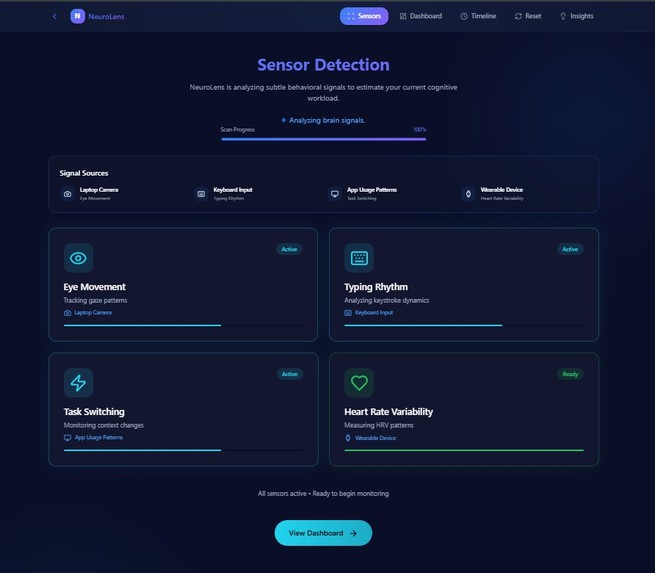
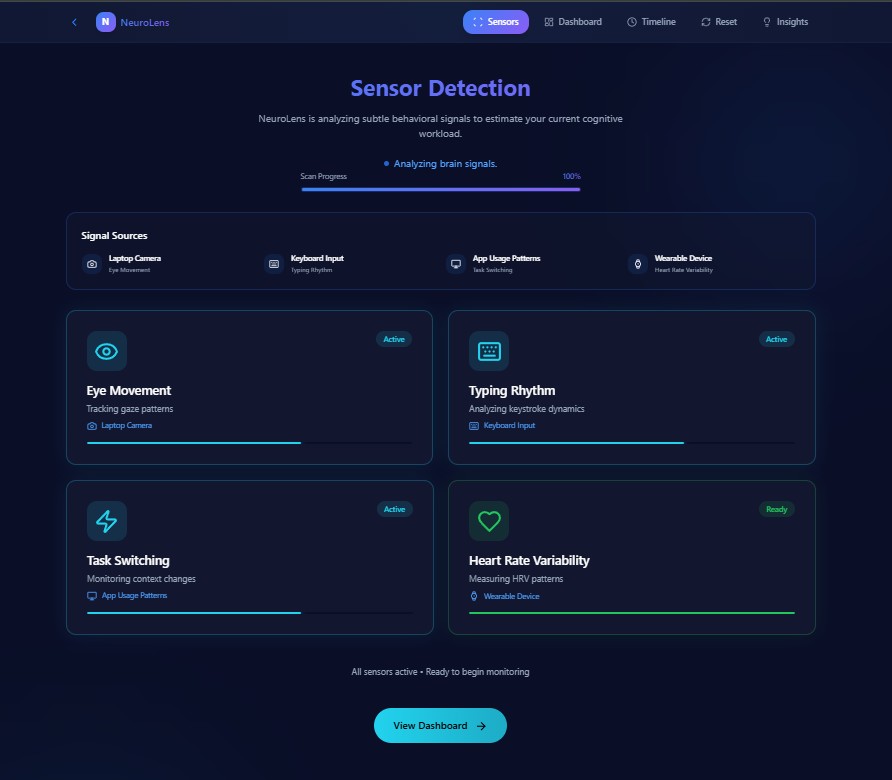
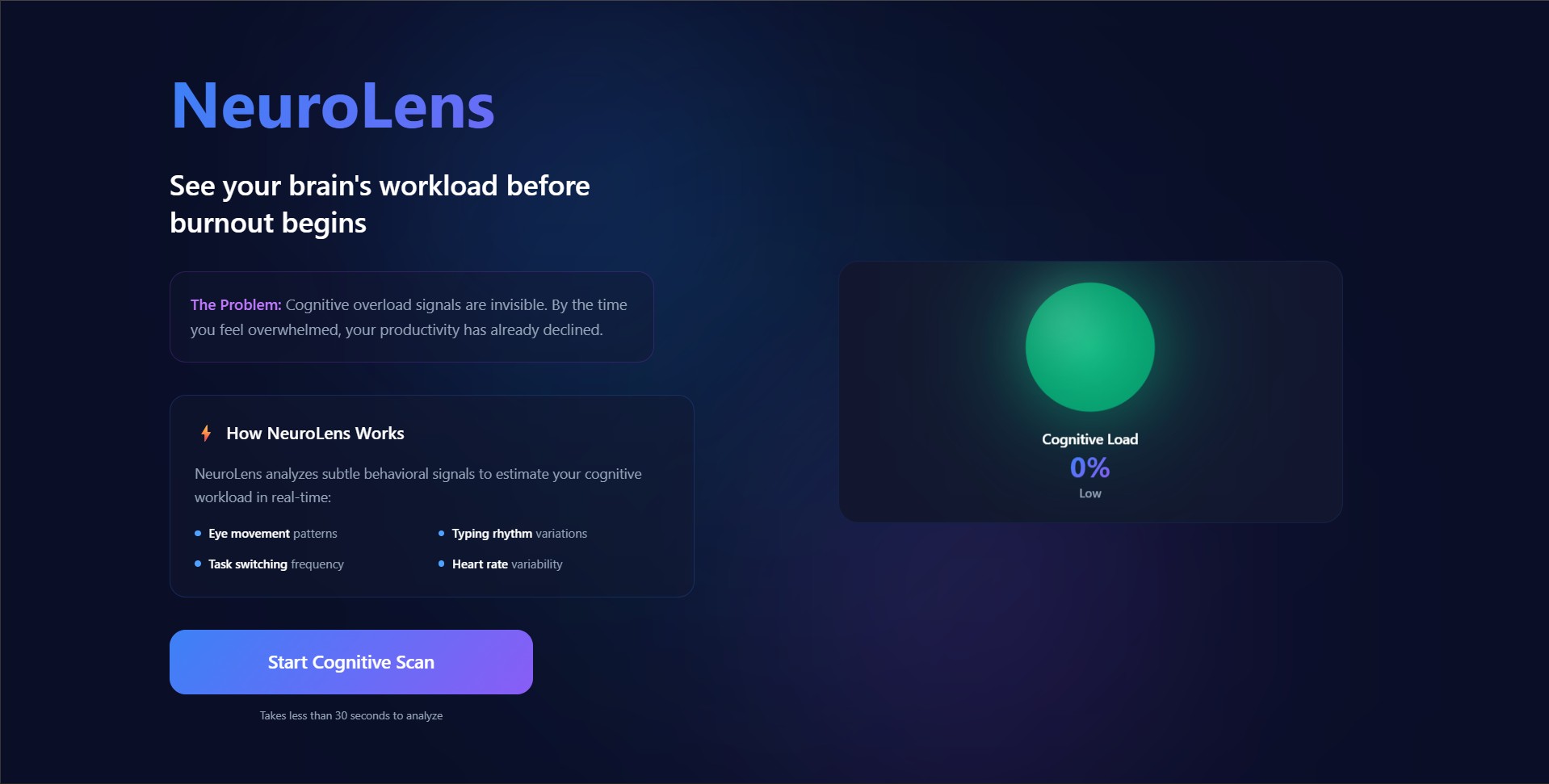
During the scan, NeuroLens detects multiple behavioral signals including eye movement, typing rhythm, task switching,heart rate variability.
-
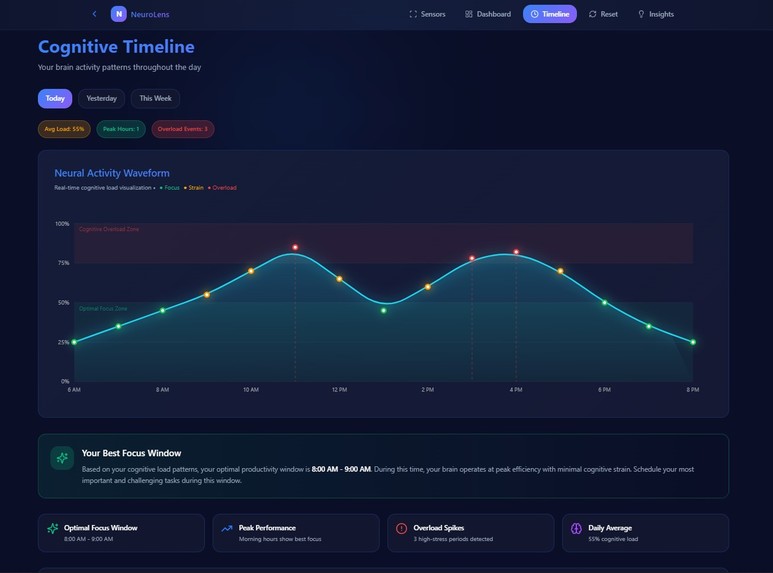
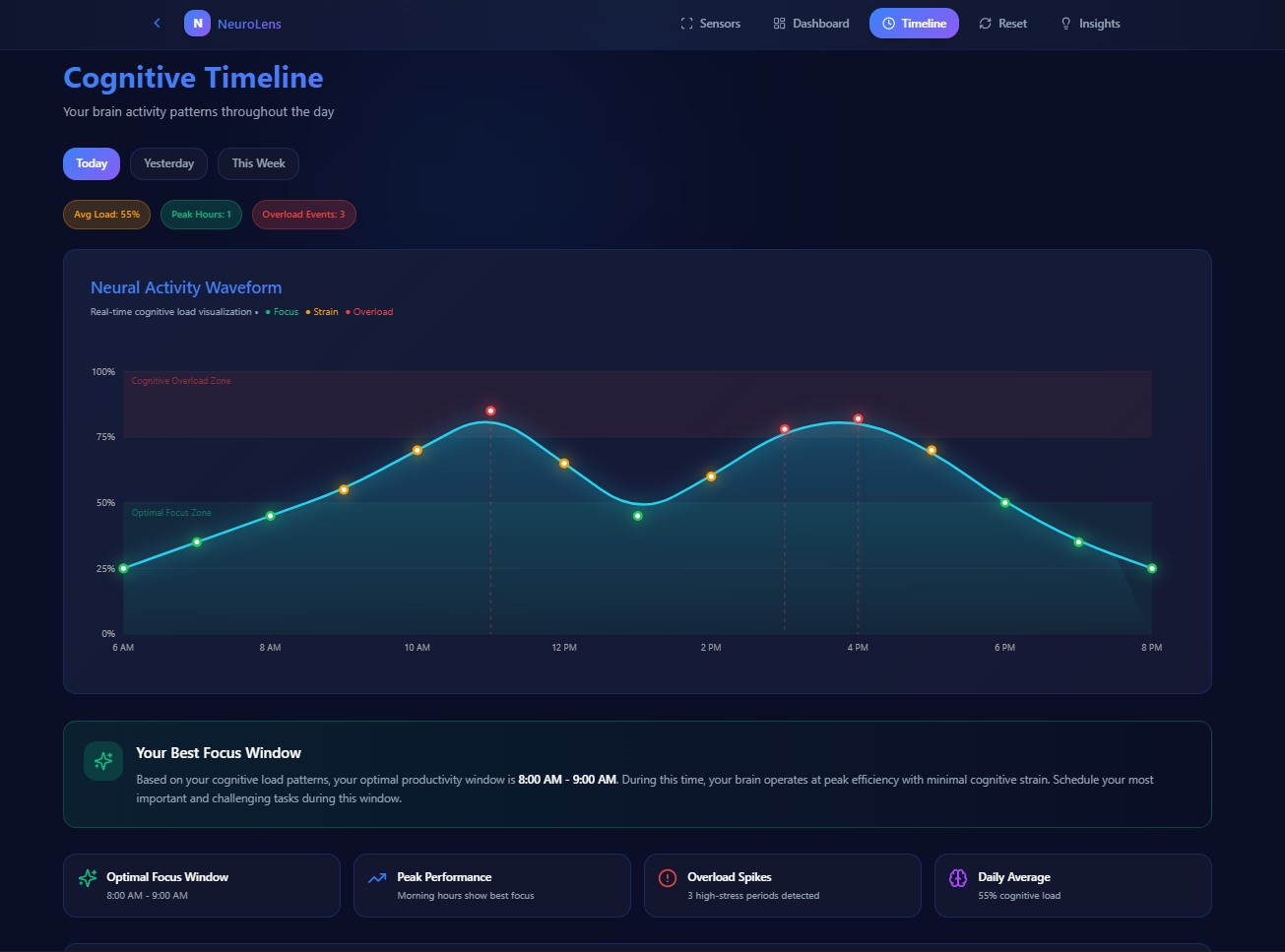
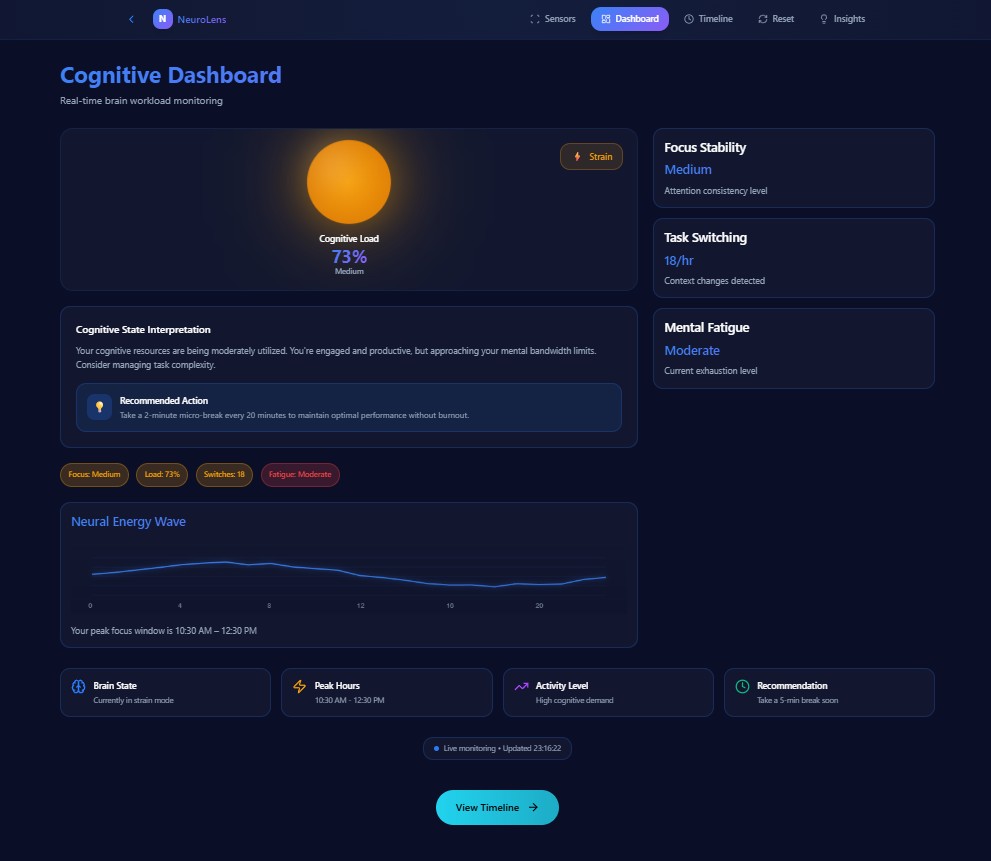
It shows how cognitive load changes throughout the day. Users can identify their best focus windows and detect periods of cognitive overload
-
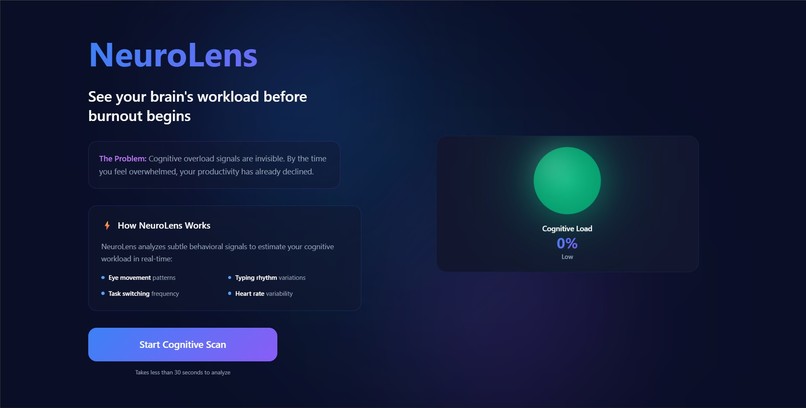
It is a NeuroLens landing screen.Users can start cognitive scan that analyzes behavioral signals to estimate their current brain workload.
-
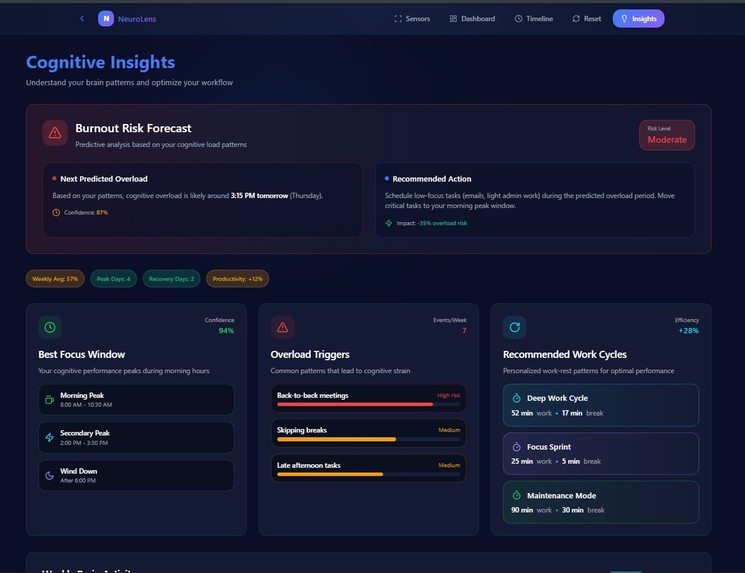
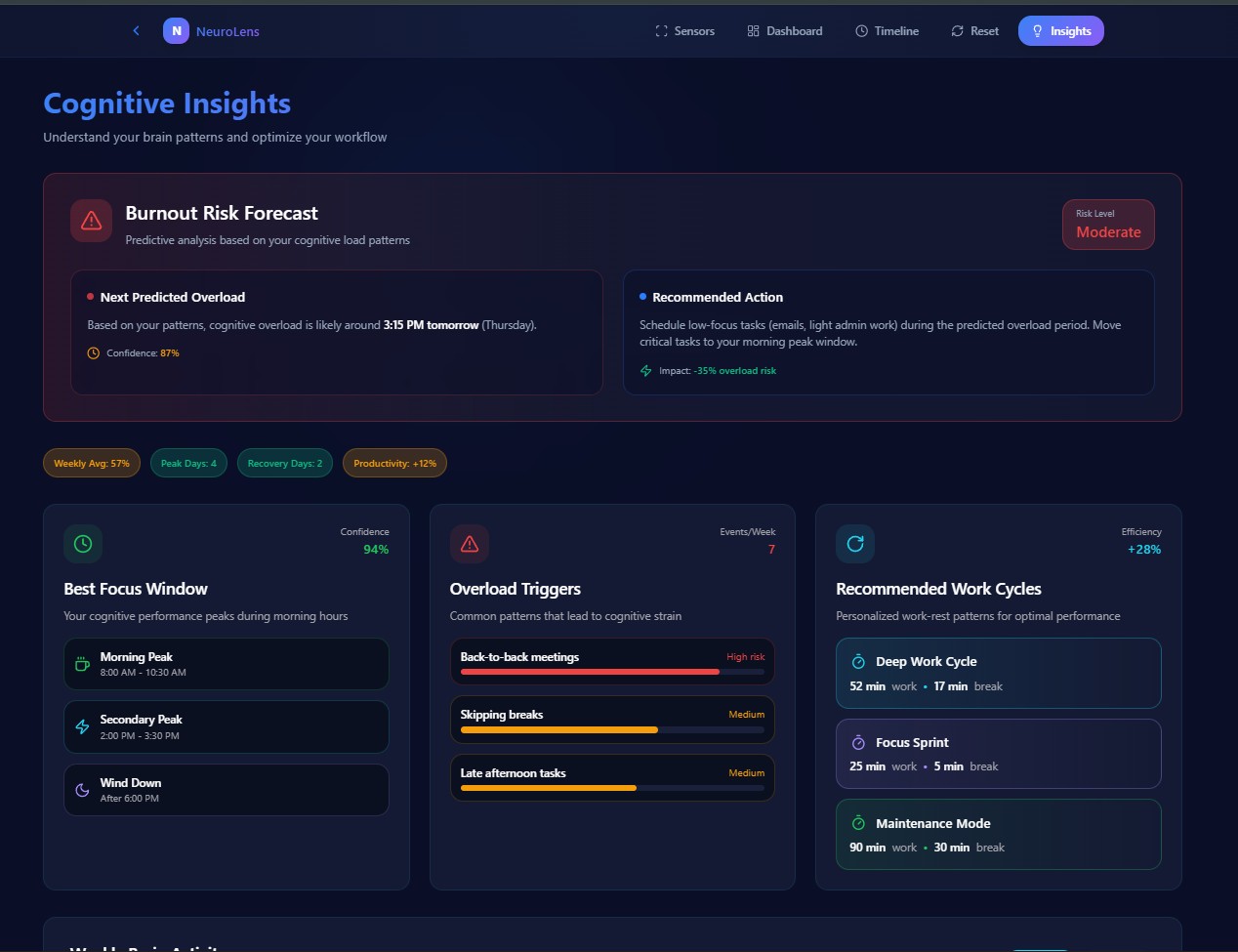
Finally, the insights screen provides deeper analytics such as productivity trends and cognitive health scores.
-
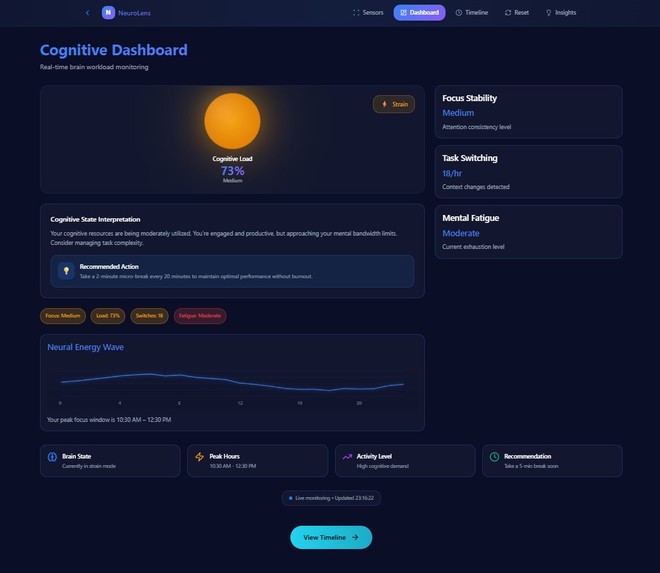
Brain Orb shows realtime cognitive load. Visualization helps users understand whether their brain is focused, balanced, or overloaded state.
-
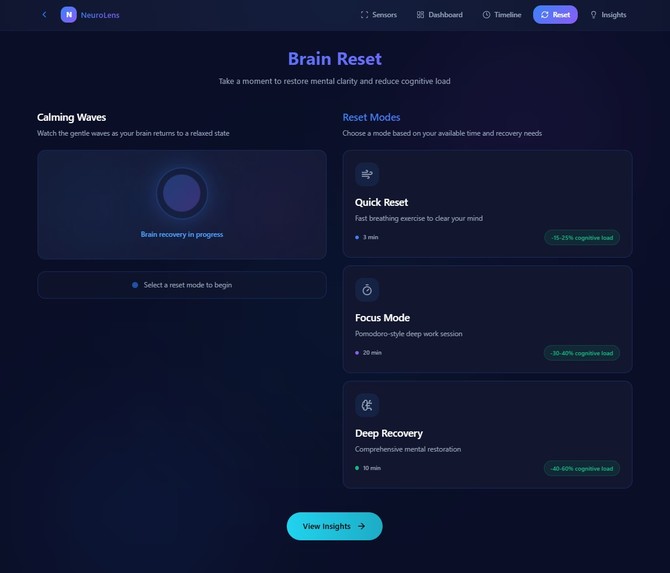
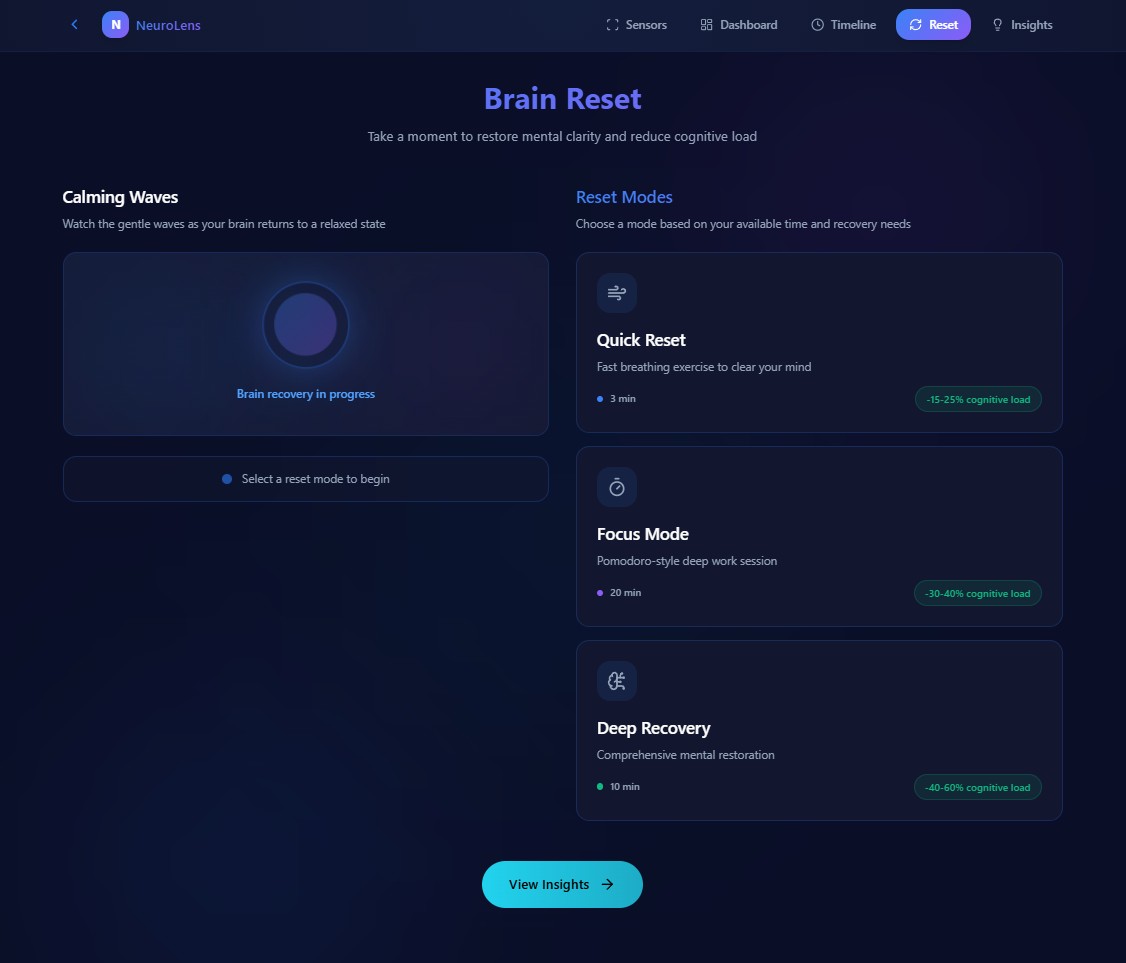
If cognitive load becomes too high,it provides brain reset modes.This guided resets help users restore mental balancereduce cognitive strain
Inspiration
I work in the IT sector, and honestly — this idea came from my own life. After spending entire days in front of a laptop, I'd reach a point where I just couldn't think clearly anymore. Not tired in a physical sense, but mentally drained in a way that was hard to explain or even notice until it had already hit me. And I realized — if I'm feeling this, so are millions of other corporate workers doing the same thing every day.
We track everything except the thing that matters most in a knowledge-work world: our brain. That gap is what pushed us to build NeuroLens.
What it does
NeuroLens is a speculative real-time cognitive load tracker that makes your brain's invisible mental signals visible.
It analyzes subtle behavioral signals from everyday devices:
- Eye movement — blink rate and gaze drift
- Typing rhythm — speed, pauses, and error patterns
- Task switching frequency — how often attention shifts
- Heart rate variability (HRV) — a physiological marker of mental stress
These signals feed into an AI model that estimates cognitive effort in real time, represented as a *Cognitive Load Score *— a value between 0 and 100:
$$\text{CLS} = w_1 \cdot E + w_2 \cdot T + w_3 \cdot S + w_4 \cdot H$$
Where \( E \) = eye signal index, \( T \) = typing rhythm score, \( S \) = task-switch rate, \( H \) = HRV index, and \( w_i \) are learned weights.
Users can:
- Scan their current cognitive state
- Visualize load through an intuitive brain orb dashboard
- Track focus patterns across the day on a timeline
- Reset with guided brain recovery modes
- Predict future overload risks via their personal AI Brain Twin
How we built it
This was our first hackathon ever, and we had under 24 hours to go from idea to prototype. We kept our stack lean — Figma for the core prototype and interaction flows, and Canva for visual assets and presentation design. Most of our time went into getting the user experience right: how do you show someone their cognitive load in a way that feels helpful and not overwhelming? We split our focus between mapping out the signal-to-insight pipeline conceptually and making sure every screen in the prototype told a clear, intuitive story.
Challenges we ran into
The biggest challenge wasn't technical — it was design. We scrapped our first dashboard concept entirely because it felt cluttered and too data-heavy. It looked like a medical report, not a tool someone would actually want to use every day. Starting over mid-hackathon with the clock ticking was stressful, but it pushed us toward the brain orb visualization — something simpler and more human. On top of that, being first-time hackathon participants meant we were figuring out the process while building the product. Scoping what was realistic in under 24 hours was a challenge in itself.
Accomplishments that we're proud of
Honestly, just shipping something coherent in under 24 hours as first-time hackathon participants feels like a win. But beyond that — we're proud that NeuroLens actually tells a complete story. From the moment a user opens the app to the AI Brain Twin prediction, every screen has a purpose. We're also proud that the core insight behind the product is personal and real. This wasn't a random idea — it came from a genuine frustration that a lot of people in the IT and corporate world will immediately recognize.
What we learned
- Behavioral signals like typing rhythm and task-switching are surprisingly strong proxies for cognitive state — and already measurable with existing hardware
- Good UX for health data must balance information density with emotional safety
- The line between a helpful tool and an anxiety machine is thin — design ethics matter enormously in this space
- Speculative design is a powerful way to explore what should exist, not just what currently exists
What's next for NeuroLens
- Pilot study — Partner with researchers to validate behavioral signal proxies against ground-truth cognitive load measures
- Mobile MVP — Build a lightweight version using smartphone camera (eye tracking) and keyboard telemetry
- AI Brain Twin v1 — Train personalized models on longitudinal user data to surface real focus predictions
- Workplace integration — Explore B2B applications in high-burnout environments such as healthcare, education, and software engineering
- Privacy-first architecture — All signal processing on-device, zero raw data leaving the user's hardware
Built With
- datavisualizations
- figmamake
- figmaslides
- lucideicons
- react
- tailwindcss
- typescript


Log in or sign up for Devpost to join the conversation.