-
-
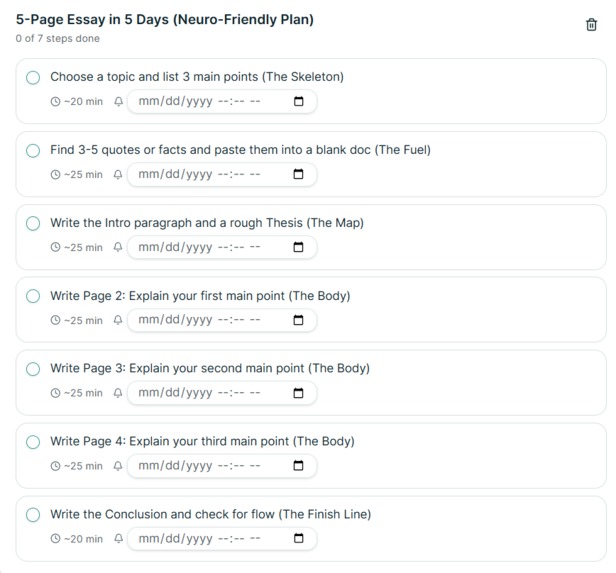
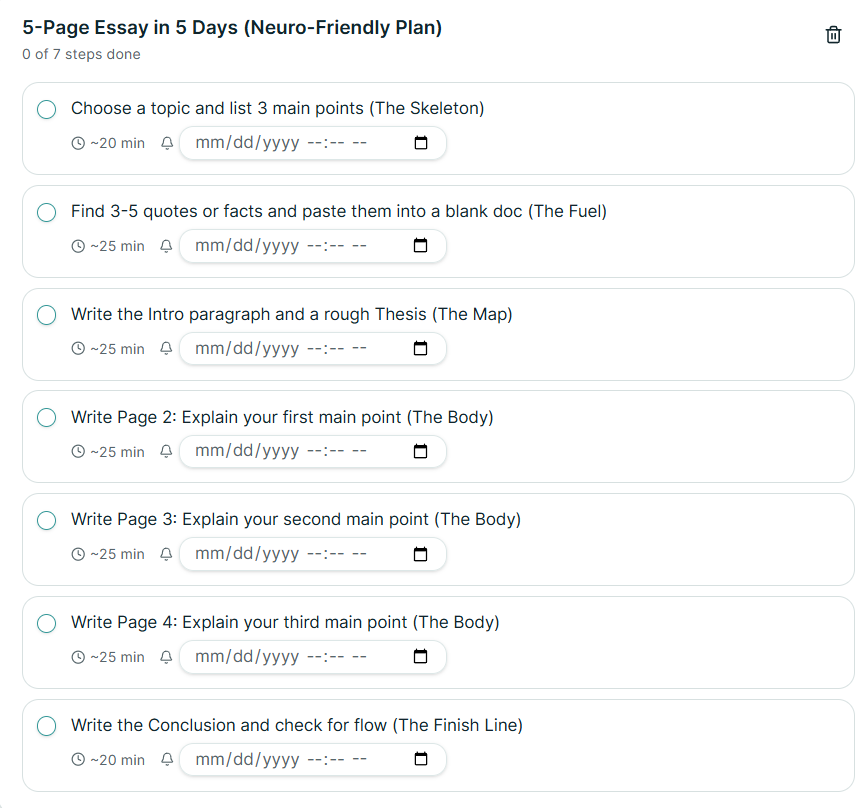
Planner - Big Tasks Broken Down
-
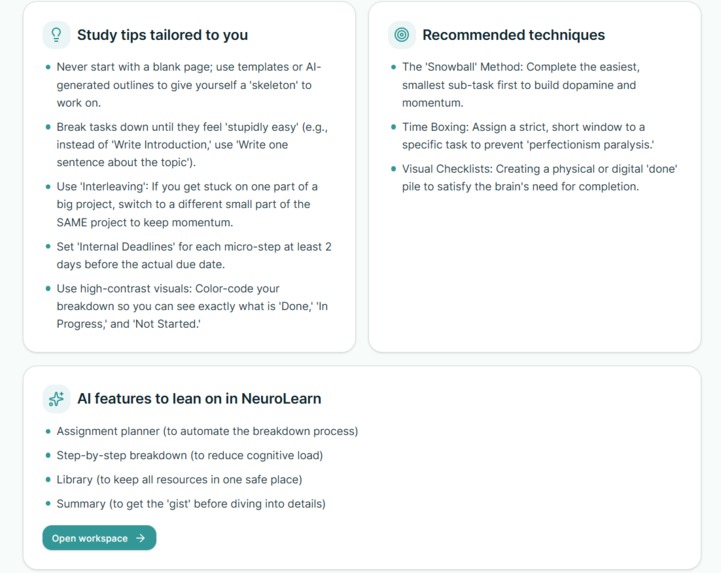
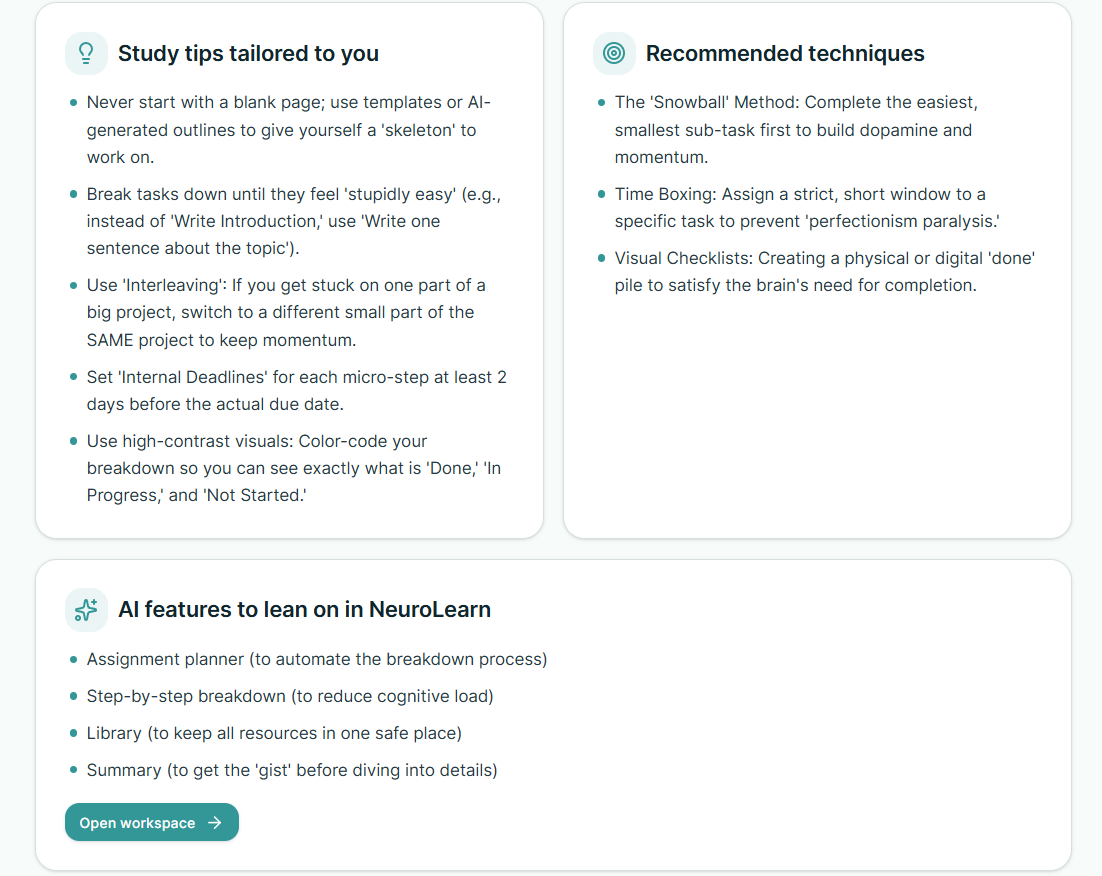
Study Strategies
-
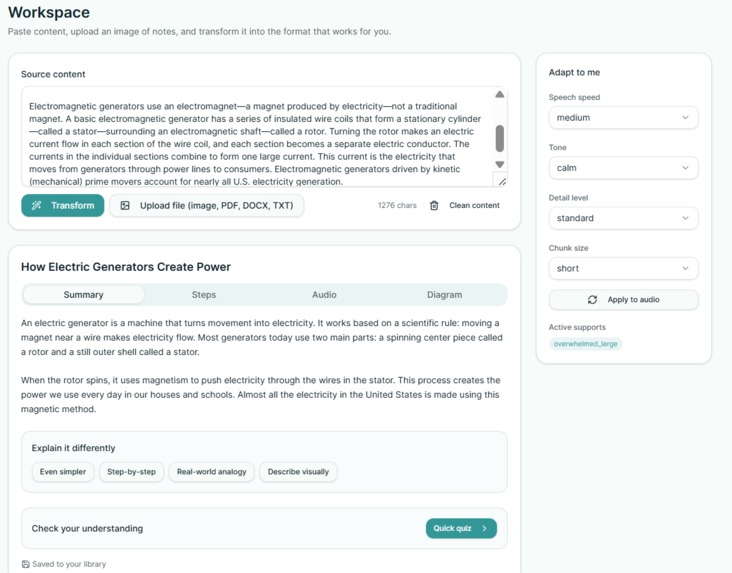
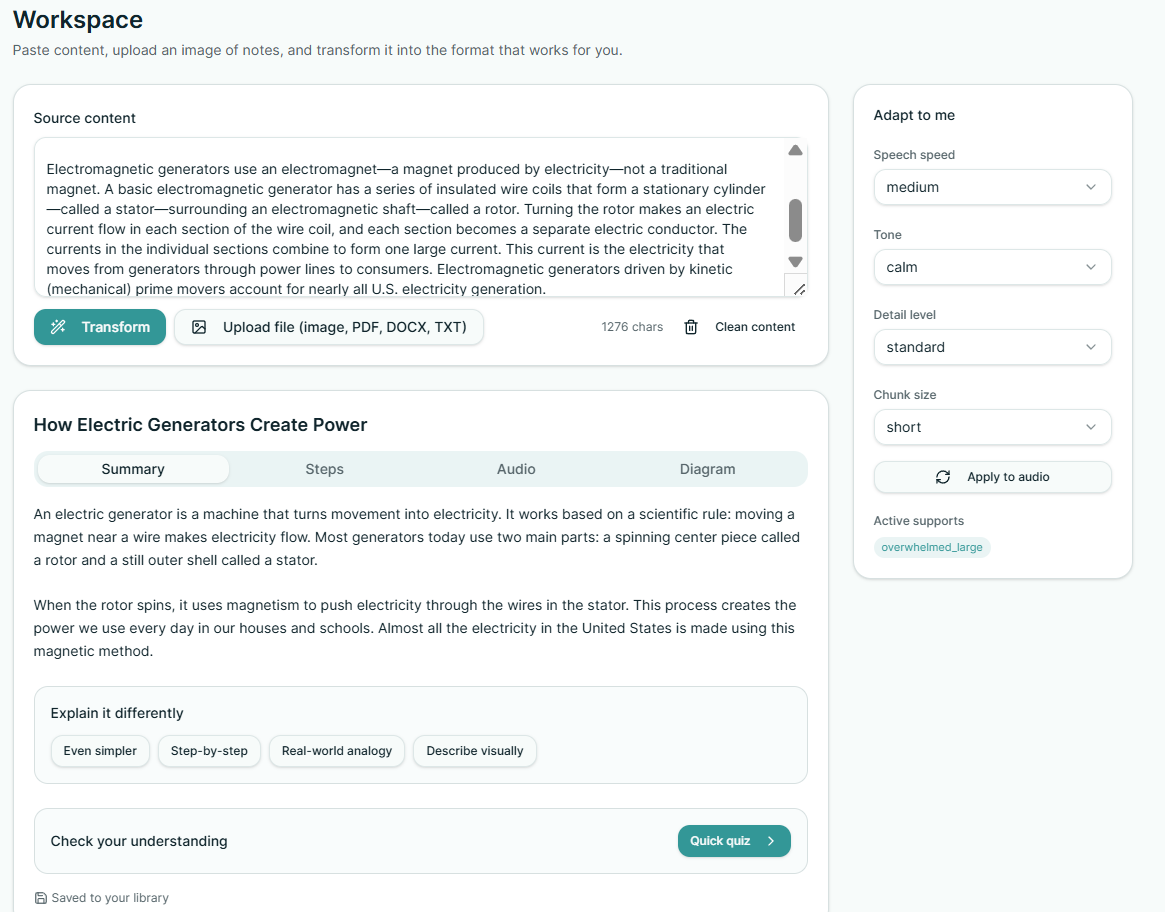
Workspace - Summary
-
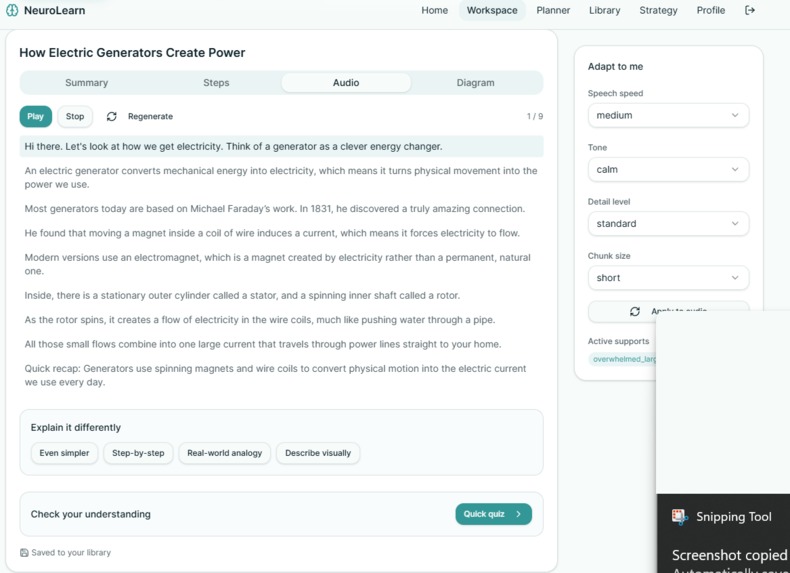
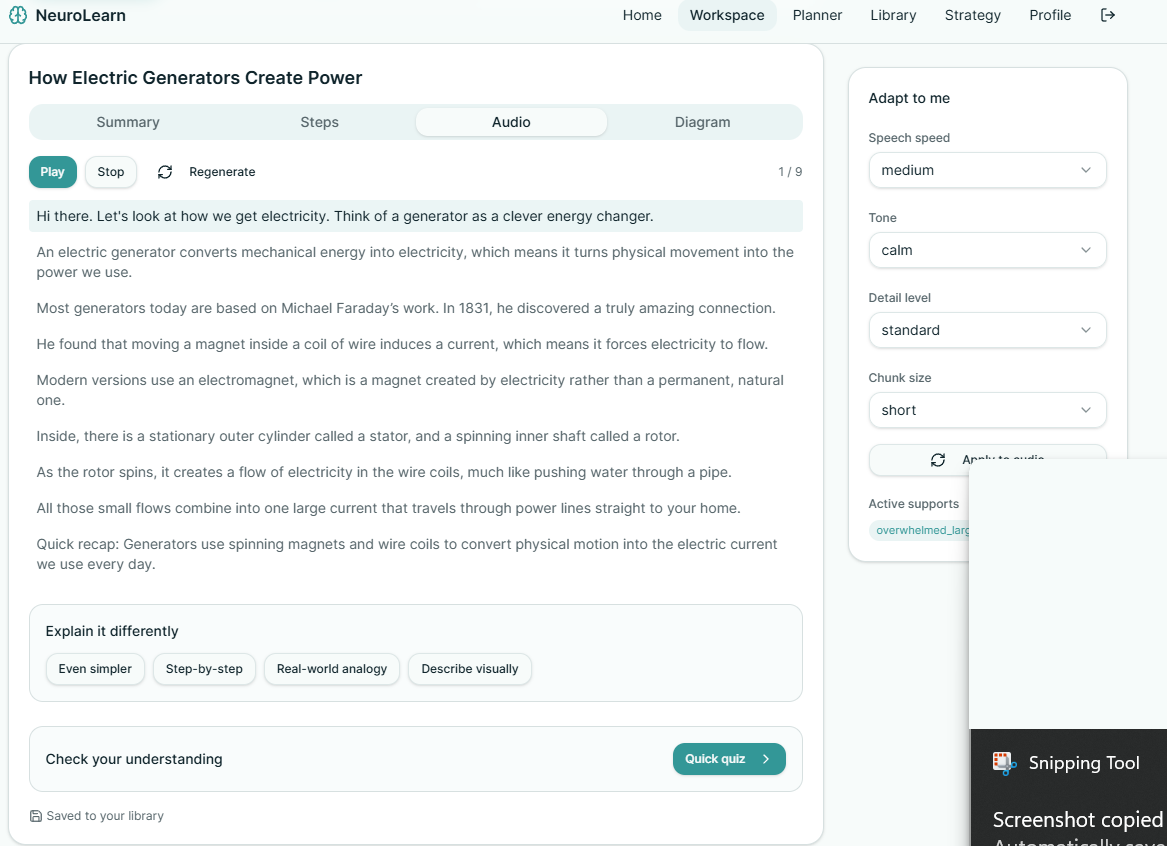
Workspace - Audio
-
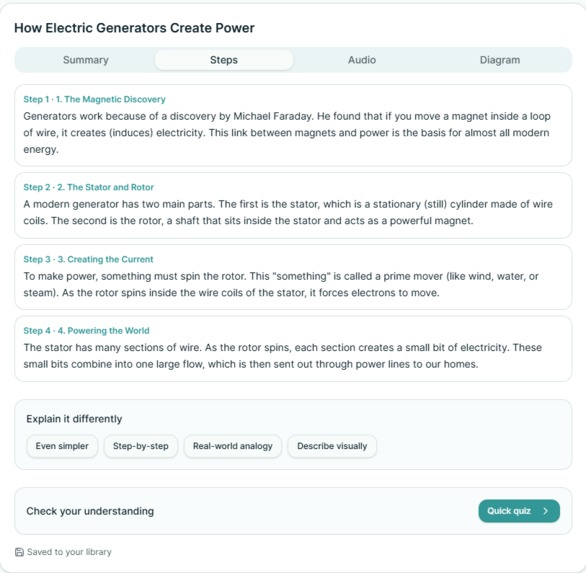
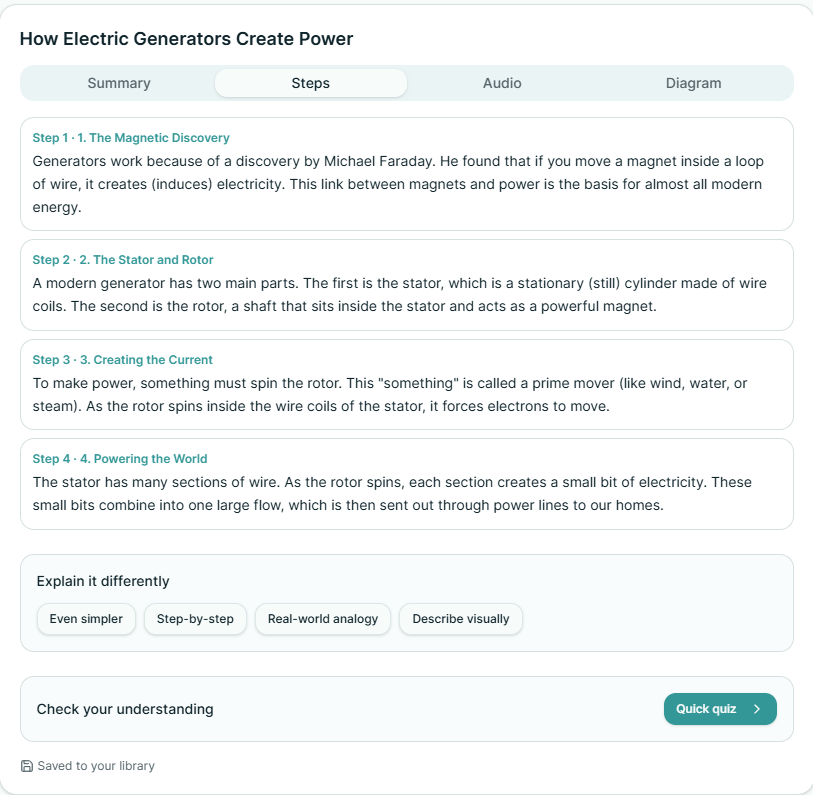
Workspace - Steps
-
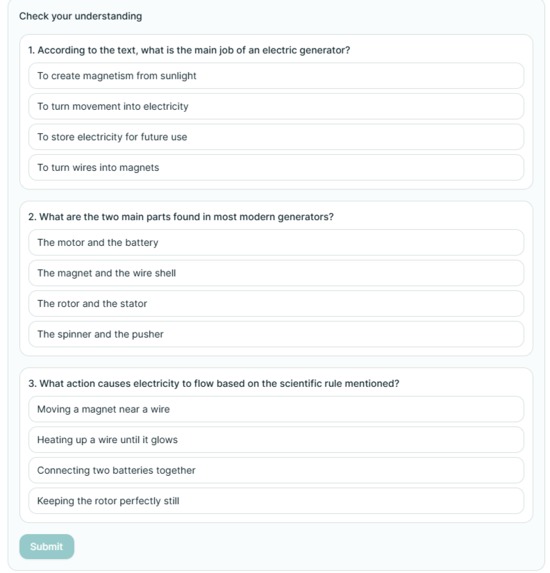
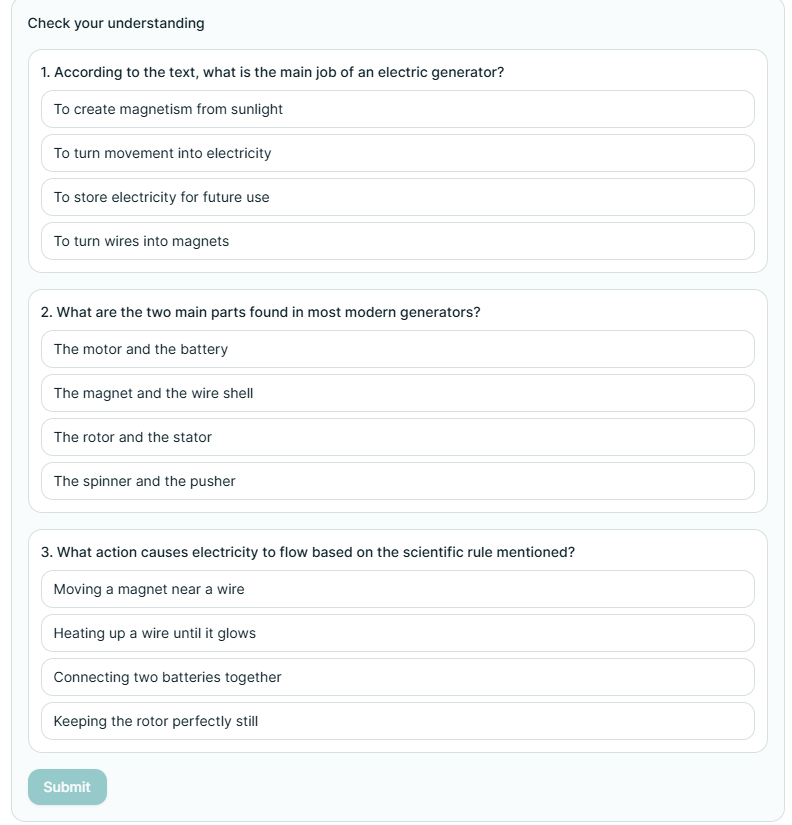
Workspace - Short Quiz for Knowledge check
-
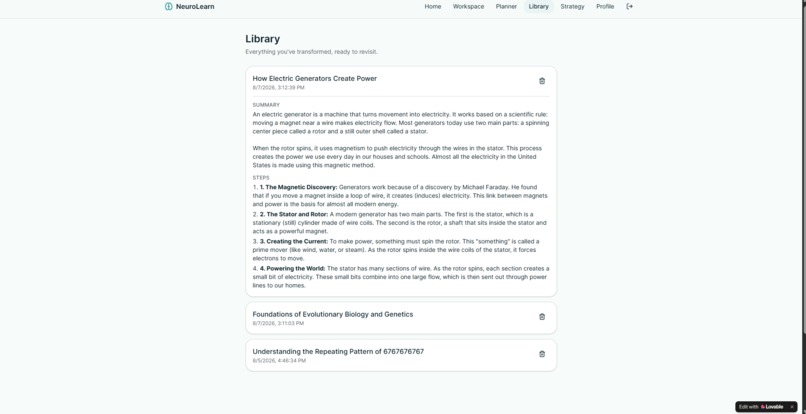
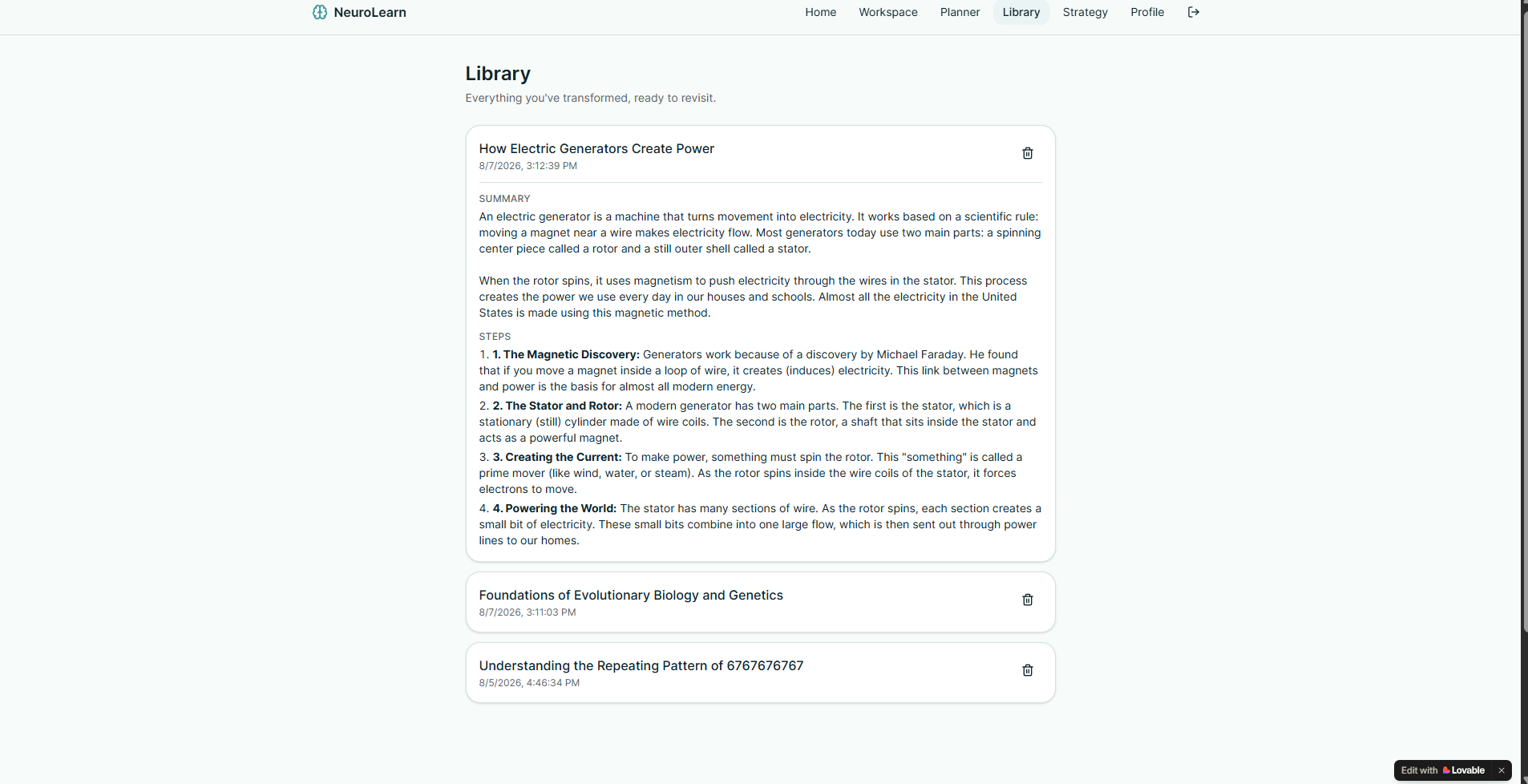
Library
Inspiration
Reading has always been hard for me — especially long, dense text. Getting through a big assignment or a multi-step task often means losing my place halfway through, or feeling overwhelmed before I even start. Being diagnosed with ADHD helped me understand that this wasn't about effort; it was about how my attention, working memory, and processing speed work differently. Scheduling has been just as hard for me as reading. When I look at a large assignment or a complex project as one big thing, I lose track of where to even begin, and that overwhelm often means I just don't start at all. I needed a way to take something big and turn it into small, doable steps I could actually act on — so alongside the reading and comprehension tools, I built an AI-powered scheduling feature into NeuroLearn. It takes a large assignment or project and breaks it down into manageable steps with a clear order and pace, so instead of staring at one overwhelming task, I can just focus on the next small thing in front of me. Around the time these ideas were forming, I started learning about AI and vibecoding, and it opened up a new possibility for me: instead of waiting for a tool that fit the way I learn, I could describe what I needed and actually build it myself. That idea became NeuroLearn, but it was never something I could have built alone. My teammate has been part of this from the very beginning — brainstorming which features would genuinely help, testing the app alongside me to catch what wasn't working, and reaching out to other neurodivergent users to gather their feedback and perspectives. Their care and persistence shaped this project just as much as my own experience did. What started as a personal need became something we built together, in the hope that it can help other neurodivergent learners feel a little less alone in how they learn.
What it does
NeuroLearn is an AI learning tool that first understands your preferences and needs, then uses that information to tell you the best study strategies that work for you. NeuroLearn helps neurodivergent learners engage with academic work in the way that works best for their brain, across two connected areas. For reading and comprehension, it converts any input — text, image, PDF, or Docx — into multiple accessible formats: warm conversational audio with built-in pauses and word definitions, bite-sized step-by-step breakdowns, auto-generated visual diagrams and concept maps, and jargon-free plain-language summaries. For task management, it takes large or multi-step assignments and projects and breaks them into small, sequenced, doable steps, helping users overcome the overwhelm that often makes it hard to even begin. The app also personalizes itself over time, based on feedback about what helps versus what overwhelms a given user, tuning both its explanations and its scheduling to each person's pace and focus style.
How we built it
We built NeuroLearn using a vibecoding workflow with Lovable. Instead of writing code line by line, we focused on shaping the product itself, describing the functionality we needed, defining the interface and interaction style we wanted, and letting Lovable generate the underlying implementation. From there, we tested the live app ourselves, hunting for bugs and rough edges, and prompted Lovable to fix them. As we used the product, new ideas kept surfacing, and we fed those back in as follow-up prompts, creating a tight loop of building, testing, and refining. Our role was to drive the product vision, user experience decisions, and quality testing, while Lovable handled the code generation; this allowed us to move fast from idea to working prototype without getting stuck in implementation details.
Challenges we ran into
One of our biggest challenges was learning to work with AI and vibecoding tools in the first place. Neither of us came in with much prior coding experience, and we weren't familiar with the technical frameworks or terminology behind web development. We had strong original ideas for what we wanted to build, but turning those ideas into a working prototype meant learning an entirely new workflow: how to describe functionality clearly enough for the AI to build it, how to test and interpret what came back, and how to iterate effectively when something didn't work as expected. A lot of new knowledge had to be picked up in the middle of building, not before it, which meant we were constantly learning while also trying to make progress. Another challenge was finding enough neurodivergent users to test the product with. Since NeuroLearn is designed specifically around neurodivergent learning needs, meaningful feedback from that community was essential, but reaching a large enough group of neurodivergent testers in the time we had was difficult, and it limited how broadly we could validate our design choices before submission.
Accomplishments that we're proud of
We're proud that we went from having no real coding background to actually shipping a working prototype. Learning vibecoding from scratch was intimidating at first. However, we picked it up quickly enough to build not one but two real, usable features: an AI tool that transforms dense text into audio, step-by-step breakdowns, diagrams, and plain-language summaries, and a second tool that takes a large assignment or project and breaks it into small, doable steps. Seeing both pieces come together into something that actually works, rather than just staying an idea, felt like a real milestone for us. We're also proud that this project stayed rooted in a real, personal need the whole way through. NeuroLearn wasn't built around a hypothetical user — it was built around a specific set of struggles with reading and getting started on big work, and every feature we added was tested against whether it actually helped with that. Even with limited time to reach neurodivergent testers, the feedback we did get shaped real changes in the app, and that back-and-forth between building and listening is something we're proud we made time for. Most of all, we're proud that something born out of a personal difficulty turned into a tool we believe could genuinely help other people who learn the way we do.
What we learned
Going into this project, neither of us had much coding experience, so one of the biggest things we learned was how to actually work with AI through vibecoding — how to describe what we wanted clearly enough for the AI to build it well, how to test what came back, and how to keep refining through an iterative back-and-forth rather than expecting it to be right the first time. It changed how we think about building software: we learned that you don't need to know how to write code to bring a real idea to life, as long as you're clear about the problem you're solving and willing to keep testing and adjusting. We also learned a lot about our own experience by trying to build for it directly. Putting words to specific struggles — like losing track partway through a long reading passage, or freezing up when a project feels too big to start — helped us understand our own learning patterns more clearly, and turn that understanding into concrete product decisions rather than just frustration. And working with even a small group of neurodivergent testers reminded us that everyone's needs look a little different, which pushed us to make NeuroLearn adaptable rather than one-size-fits-all. Finally, we learned how much stronger a project becomes when it's built by two people rather than one. Splitting the work between brainstorming, testing, and gathering outside feedback let us move faster and catch things the other might have missed, and made the whole process feel less overwhelming than tackling it alone.
What's next for NeuroLearn
Right now, NeuroLearn is a clear first version, and we're aware of its real limitations. Parsing images and PDFs into usable text isn't fully reliable yet, and our user database and personalized profile system are still fairly basic — we haven't yet found a right way to learn an individual's specific learning habits well enough to tailor tools to them over time. The sign-up flow had experienced state-related bugs and didn’t work reliably with email verification. We simplified the registration process by eliminating the email verification. However, it would incur potential security issues. A more reliable and secure sign-up system needs to be implemented and tested. Our task-breakdown feature also struggles when an assignment or project is vague or spans a long time period, since it currently works best with clearly defined, shorter-term tasks. Fixing these gaps is our immediate priority. In addition to the current bugs and limitations, we want to explore NeurolLearn’s potential. Based on early user feedback, our next step is to evolve NeuroLearn from a static, developer-designed tool into a dynamic, Socratic-style guided learning system — one that helps neurodivergent users think and learn for themselves rather than simply handing them answers, summaries, or pre-broken-down steps. This means layering a guided-learning approach on top of our current pipeline: using AI to ask questions, prompt reasoning, and adapt to each user's individual background and situation, rather than only generating fixed outputs. We also want to build tools that extend this support beyond the individual learner to the teachers and parents who interact with neurodivergent learners daily, giving them AI-assisted ways to teach and communicate more effectively in the moment. Finally, we want to open NeuroLearn to the broader neurodivergent community itself — creating a shared space where parents, educators, and neurodivergent individuals can contribute their own successful communication and teaching methods, which we can then translate into new AI prompting strategies or interaction patterns within the tool. In short: move from one team's static solution to a living, community-informed system that grows more effective and more personalized over time.
Built With
- gemini
- google-oauth
- lovable
- lovable-ai-gateway
- mcp
- openai
- postgresql
- react
- tanstack-start
- typescript
- vite7


