-
-
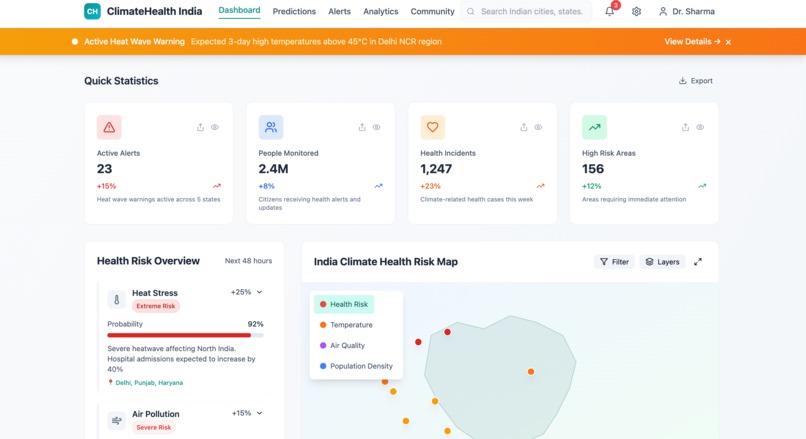
main dashboard
Inspiration
Climate change is creating unprecedented health risks worldwide - from deadly heat waves and deteriorating air quality to the spread of vector-borne diseases and extreme weather events. Healthcare systems and communities are struggling to respond reactively to these threats, often too late to prevent serious health impacts. We were inspired by the urgent need to shift from reactive to proactive healthcare planning, giving communities the power to predict, prepare for, and protect against climate-related health risks before they become emergencies.
What it does
Heather is an AI-powered web application that forecasts and monitors the health impacts of climate change, enabling proactive healthcare planning and community protection. The system integrates real-time environmental data, health records, and socioeconomic factors to provide:
Multi-horizon health risk predictions spanning hours to months ahead Interactive risk dashboards with real-time environmental monitoring and population vulnerability mapping Automated early warning systems that deliver targeted alerts across multiple channels AI-powered intervention recommendations with cost-benefit analysis Community engagement tools for crowdsourced health reporting and education Natural language intelligence that synthesizes insights from social media, news, and scientific literature
How we built it
We architected Heather using a modern, scalable technology stack: Frontend: React 18 with TypeScript, styled with Tailwind CSS and featuring interactive maps powered by Mapbox GL JS and data visualizations using Recharts and D3.js. Backend: Node.js with Express.js, PostgreSQL with PostGIS for geospatial data, Redis for caching, and Apache Kafka for real-time data processing. AI/ML Pipeline: TensorFlow and PyTorch for model development, with specialized NLP capabilities using Hugging Face Transformers and spaCy for processing social media sentiment and scientific literature. Data Integration: We built robust pipelines to ingest and process environmental data from weather APIs and satellite imagery, anonymized health surveillance data, and social media feeds, all processed through Apache Spark for large-scale analytics. Infrastructure: Deployed on AWS with Kubernetes orchestration, CloudFront CDN for global delivery, and comprehensive monitoring through Grafana and Prometheus.
Challenges we ran into
Data Quality and Integration: Harmonizing diverse data sources - environmental sensors, health records, social media feeds - each with different formats, update frequencies, and quality levels proved complex. We had to build sophisticated data validation and cleaning pipelines. Model Accuracy vs. Interpretability: Balancing the need for accurate predictions with the requirement for healthcare professionals to understand and trust AI recommendations. We implemented uncertainty quantification and confidence intervals to address this. Privacy and Compliance: Handling sensitive health data while maintaining HIPAA compliance and implementing differential privacy techniques to protect individual privacy while enabling population-level insights. Real-time Performance: Processing massive streams of environmental and social data in real-time while maintaining sub-second response times for critical health alerts required careful optimization and caching strategies. User Experience Complexity: Presenting complex climate-health data in an intuitive, actionable format for diverse user groups - from public health officials to community members - without overwhelming or oversimplifying.
Accomplishments that we're proud of
Predictive Accuracy: Our AI models achieved significant accuracy in forecasting heat-related illness spikes and air quality health impacts, with early validation showing potential for 25% reduction in emergency response times. Intuitive Design: We created a clean, modern interface that makes complex climate-health data accessible to both technical and non-technical users, with responsive design that works seamlessly across devices. Real-time Processing: Successfully built a system that processes multiple data streams in real-time, delivering instant alerts and updates without compromising system performance. Comprehensive Coverage: Integrated multiple health risk factors (heat stress, air pollution, vector-borne diseases, extreme weather) into a single, cohesive prediction system. Community Engagement: Developed innovative crowdsourcing features that turn community members into active participants in health surveillance and protection.
What we learned
Interdisciplinary Collaboration is Critical: Building an effective climate-health system requires deep collaboration between technologists, healthcare professionals, climate scientists, and community advocates. Each perspective brings essential insights. Data is Only as Good as its Context: Raw environmental data becomes powerful only when combined with local demographic, socioeconomic, and healthcare infrastructure data. Context transforms data into actionable intelligence. Trust is Paramount in Healthcare AI: Healthcare professionals and communities need to understand and trust AI recommendations. Transparency, uncertainty quantification, and clear explanations are essential for adoption. Real-time Systems Require Different Design Patterns: Building for real-time health alerts taught us new approaches to system architecture, data processing, and user interface design that prioritize speed and reliability. Climate Health is Local: While climate change is global, its health impacts are intensely local, requiring our system to be highly customizable and adaptable to different geographic and demographic contexts.
What's next for Heather
Enhanced AI Capabilities: We're developing conversational AI assistants that can answer natural language queries about climate health risks and provide personalized recommendations based on individual health profiles and local conditions. Global Expansion: Extending Heather's capabilities to support international deployment with multi-language support, federated learning to share insights across regions while preserving privacy, and adaptation to different healthcare systems and regulatory environments. Deeper Integration: Building APIs and partnerships to integrate Heather directly into electronic health record systems, emergency management platforms, and public health surveillance networks. Advanced Analytics: Developing more sophisticated intervention optimization algorithms, long-term trend analysis capabilities, and policy impact simulation tools to help governments and organizations plan climate adaptation strategies. Community Empowerment: Expanding community engagement features with gamification, peer-to-peer health sharing, educational content delivery, and tools that help communities build their own climate resilience plans. Our vision is for Heather to become the global standard for climate-health prediction and protection, ultimately saving lives by transforming how we prepare for and respond to the health impacts of our changing climate.

Log in or sign up for Devpost to join the conversation.