-
-
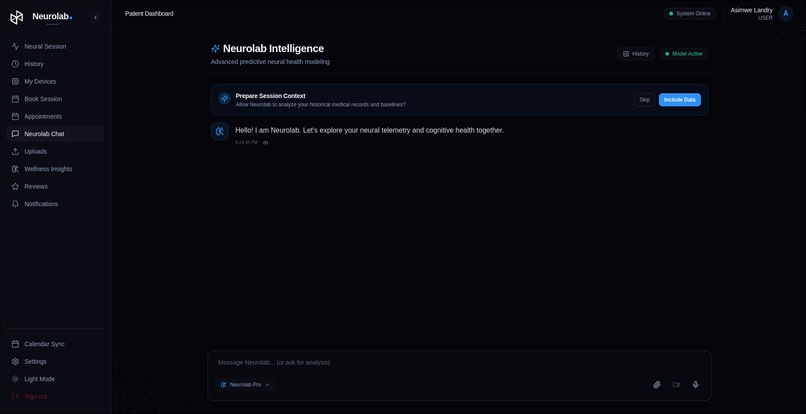
Chat module
-
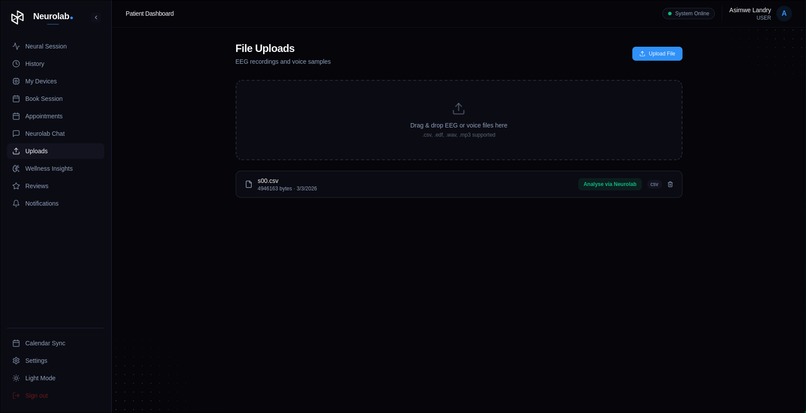
Analysis from file
Inspiration
NeuroLab was born at the intersection of professional observation and personal struggle. I was deeply moved by the stories of trauma faced by a friend’s colleagues after conflict missions—conditions that remained untreated due to Rwanda’s slow and expensive diagnostic landscape. Simultaneously, my personal experience with bipolar tendencies and insomnia highlighted a glaring gap in healthcare: we treat the most complex organ in the universe with "guesswork." Inspired by the 2026 F1 transition to high-stakes energy telemetry, I realized we needed the same "Engine Dashboard" for the human brain.
What it does
NeuroLab is a neural platform that translates complex brain activity into actionable health insights. It bridges the gap between "Physical Input" and "Neural Intent" by harvesting EEG and EMG signals. The platform allows for real-time monitoring of cognitive states, potentially identifying triggers for mental health episodes or stress spikes before they manifest physically. It turns a "black box" diagnostic process into a transparent, live data stream for both patients and clinicians.
How we built it
During this 48-hour sprint, we prioritized speed and memory efficiency:
- Frontend: Built with React + Vite for a lightweight, near-instant UI. We implemented SWR to handle data fetching and caching, ensuring the dashboard remained fluid even under heavy data loads.
- Intelligence: We utilized TensorFlow for our AI model, leveraging its robust library of algorithms to process raw neural signals.
- Backend: A Node.js architecture served as our data orchestrator, managing high-frequency signal packets from the hardware.
- Signal Processing: To isolate intent from noise, we applied a Fast Fourier Transform (FFT) to decompose the signal into its constituent frequencies:
$$X(k) = \sum_{n=0}^{N-1} x(n) \cdot e^{-i 2\pi kn / N}$$
Challenges we ran into
The "Wall" was three-fold.
- Data Scarcity: Finding high-quality, diverse neural datasets for training in a limited timeframe was nearly impossible, forcing us to innovate in how we normalized our local data.
- Computational Constraints: High-performance AI training hits a cost ceiling quickly when you're aiming for medical-grade precision.
- The Human Element: Balancing the roles of a Student and CEO during a 48-hour hackathon while leading a diverse team through high-pressure technical pivots.
Accomplishments that we're proud of
We successfully moved beyond "simulated data." Seeing clean, live neural signals printed on our dashboard was a game-changer. We managed to create a system where we could tweak the AI model's sensitivity based on live feedback—a "Level Up" that is usually impossible when working blindly with theoretical data. We also successfully integrated a diverse team of different genders and ideologies into a single, high-speed engineering unit.
What we learned
We learned that the brain is a symphony, not a monolith. By observing how different stimuli influence specific neural regions, we gained a deep technical understanding of brain performance. On a leadership level, I learned that managing a team with the same ambition but different perspectives is the ultimate "force multiplier" in a hackathon setting.
What's next for NeuroLab
The hackathon is just the "Qualifying Session." Moving forward, we plan to refine our AI models with larger, more diverse datasets from the Kigali clinical pilot. We are also looking into optimizing our backend for even lower latency to support real-time surgical or emergency diagnostics. Our goal remains clear: making sure no "Human Engine" is left behind in the race for health equity.
Built With
- fastfouriertransform
- google-cloud
- groq
- mongodb
- node.js
- react
- render
- swr
- tensorflow
- vercel
- vite


Log in or sign up for Devpost to join the conversation.