-
-
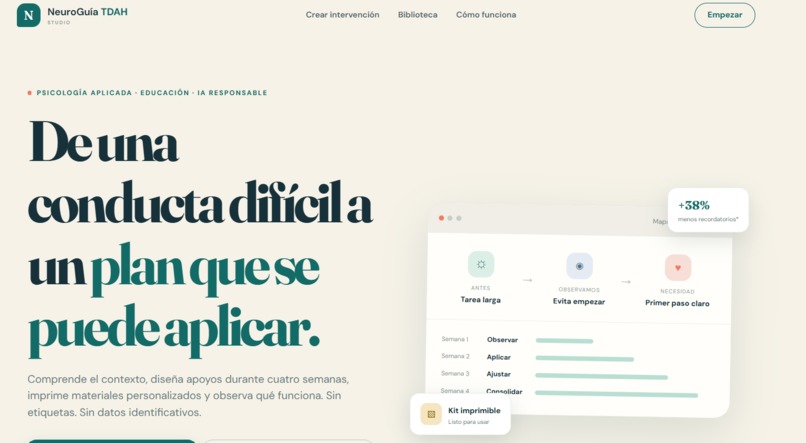
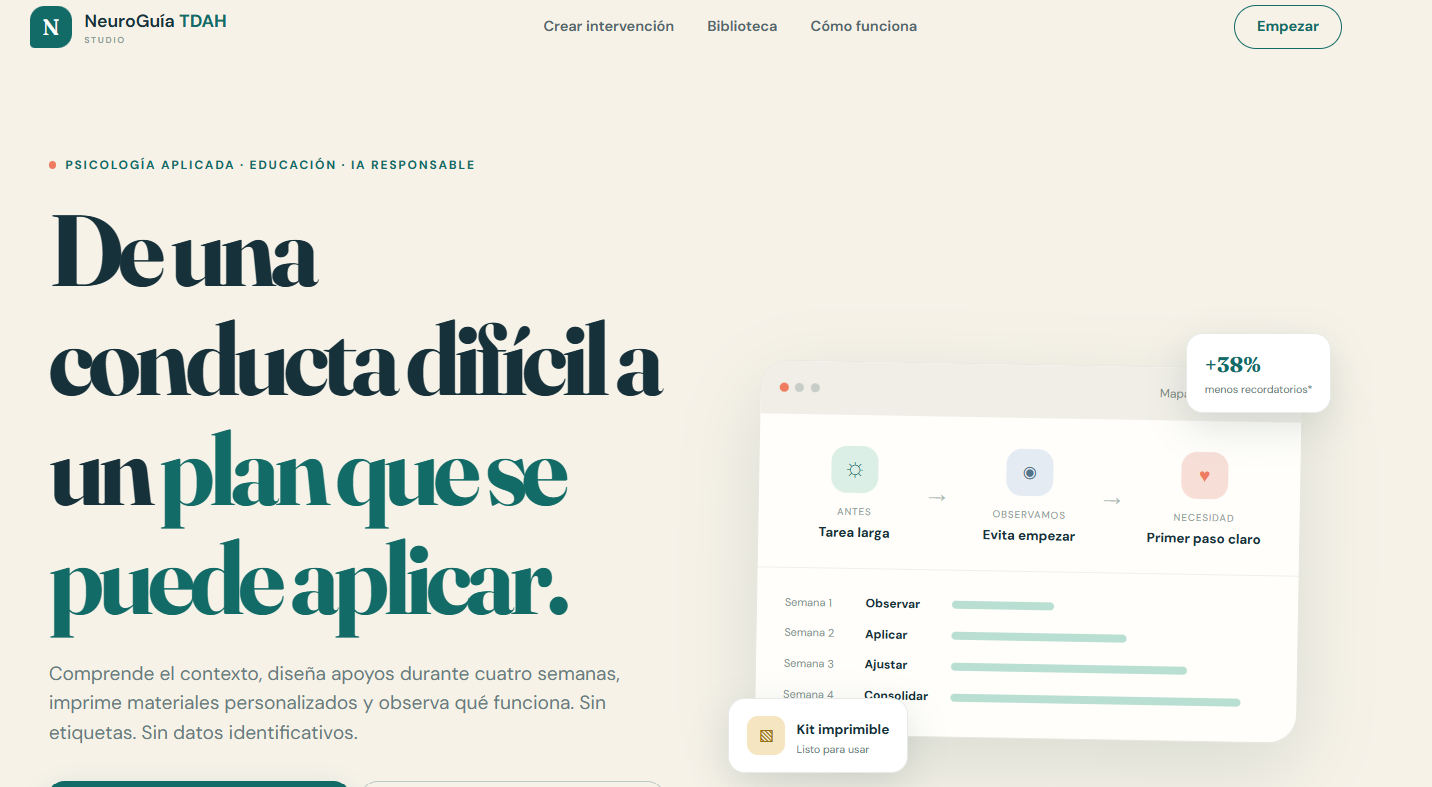
NeuroGuía TDAH turns everyday challenges into practical four-week support plans.
-
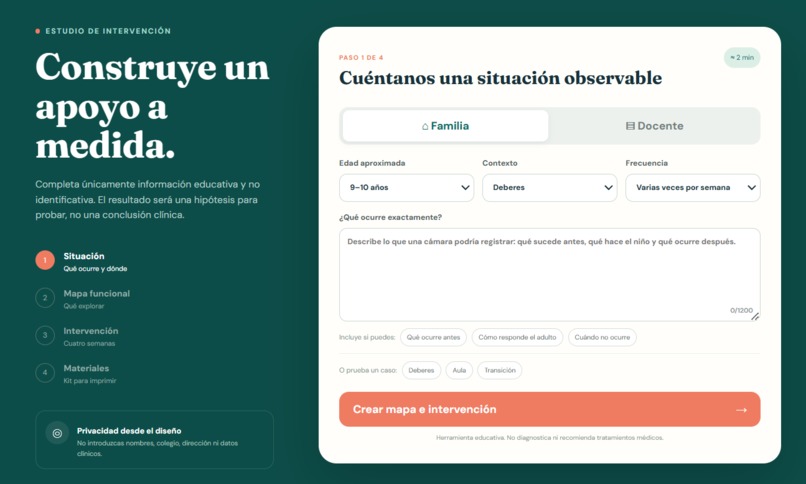
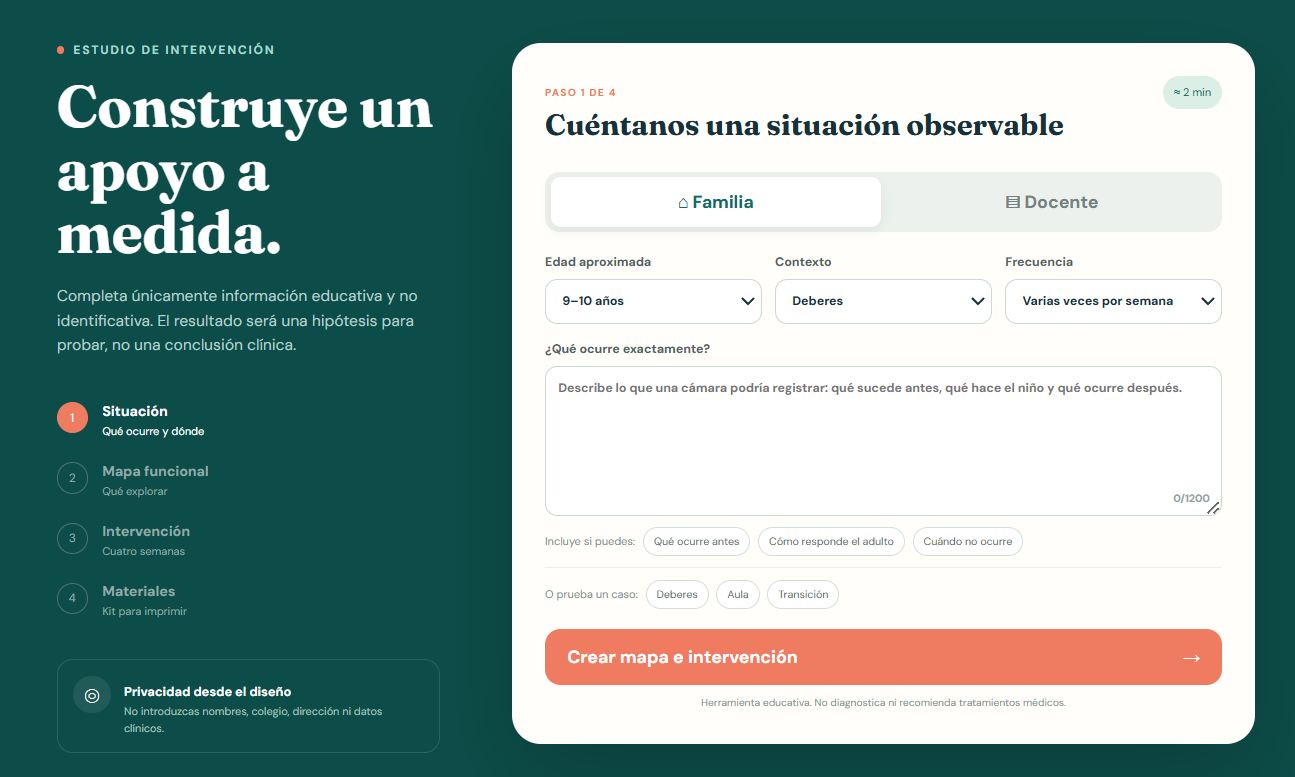
Teachers and families describe an observable, non-identifying situation.
-
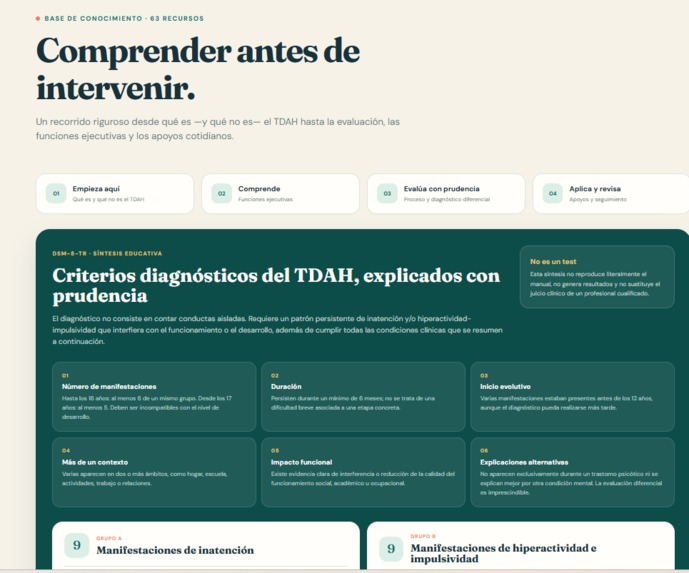
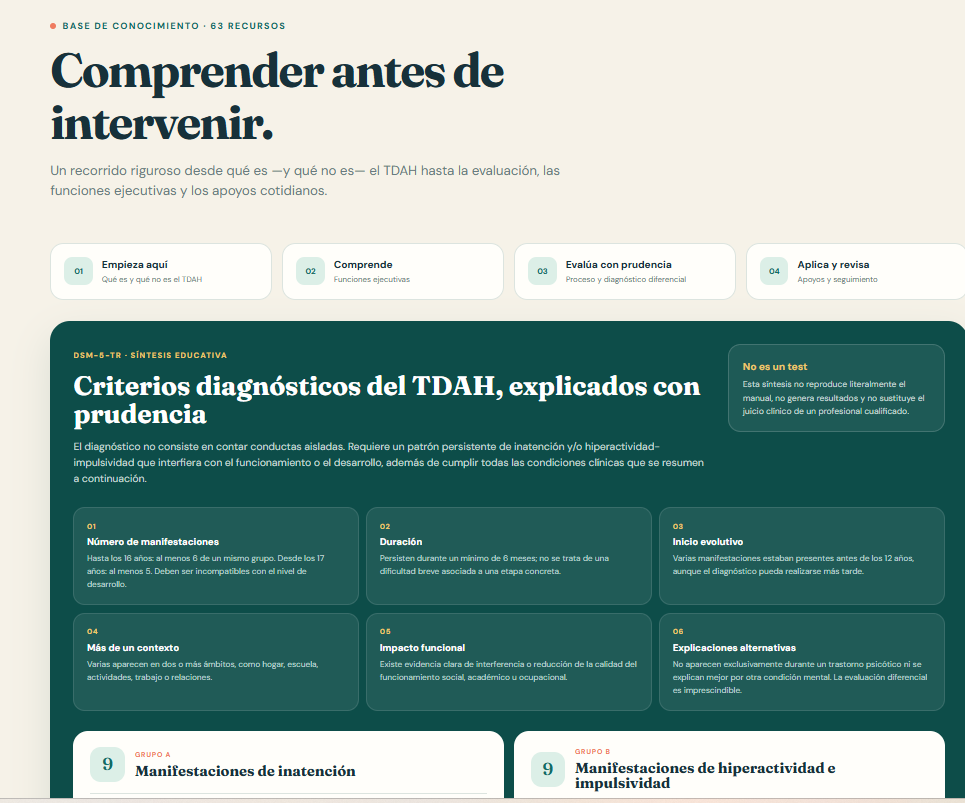
A 63-resource knowledge base explains ADHD and DSM-5-TR boundaries.
-
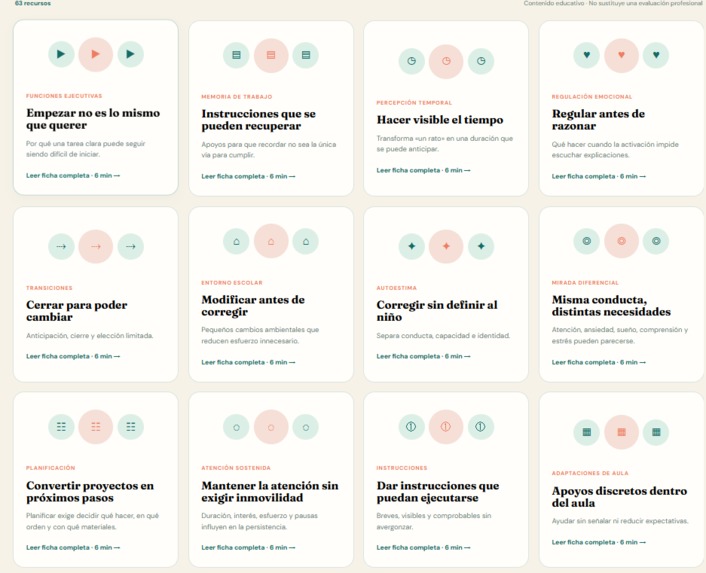
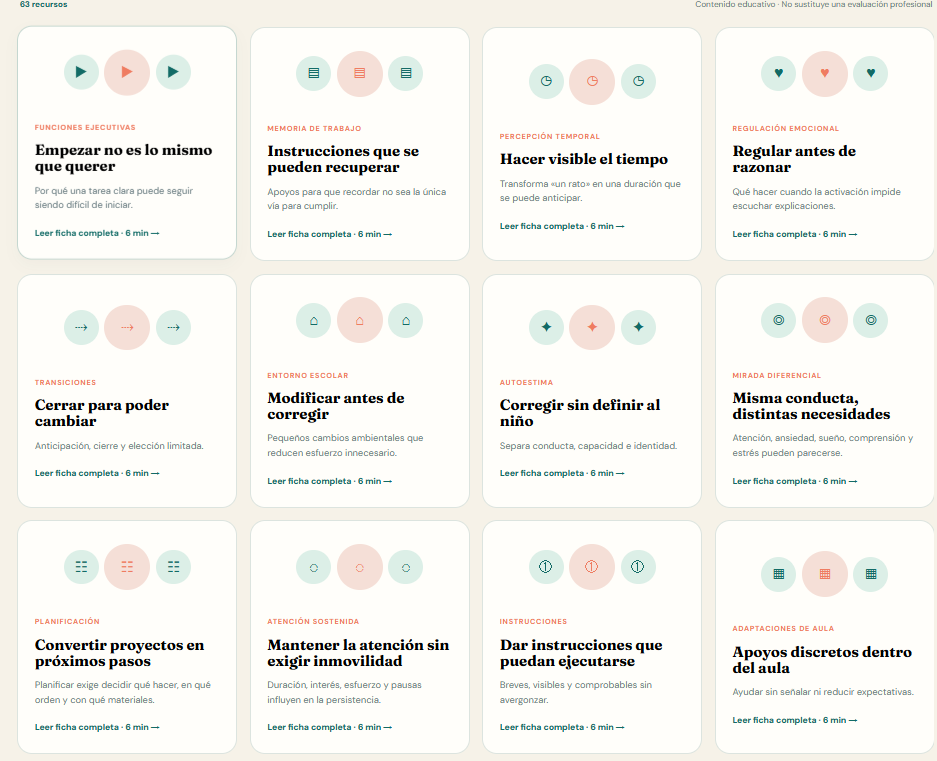
Micro-lessons translate executive-function knowledge into everyday support.
-
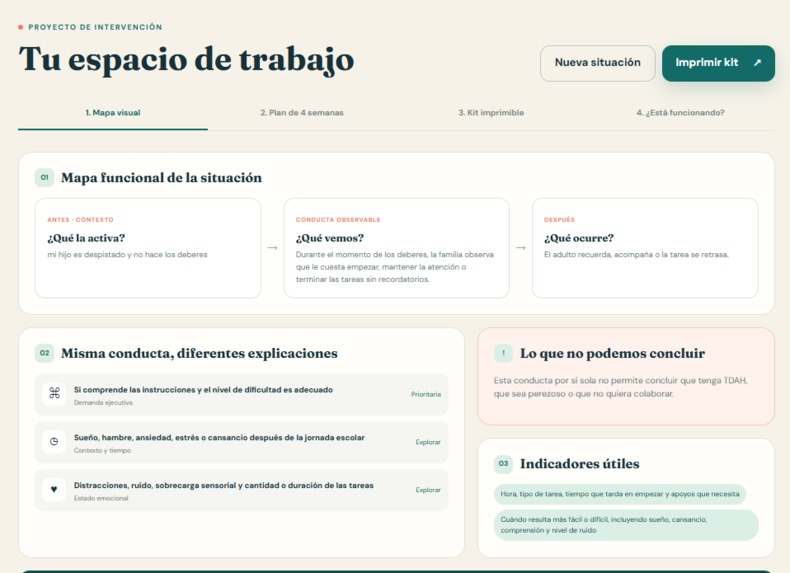
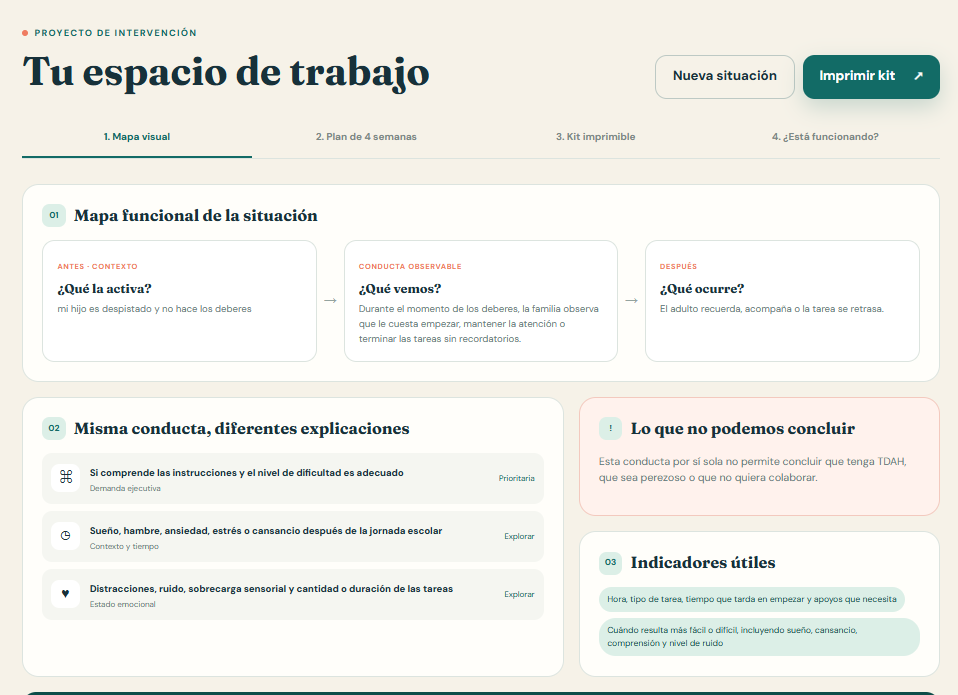
GPT-5.6 builds a cautious functional map without making a diagnosis.
-
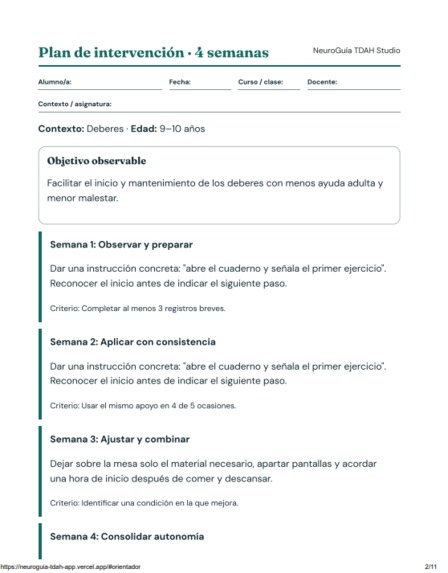
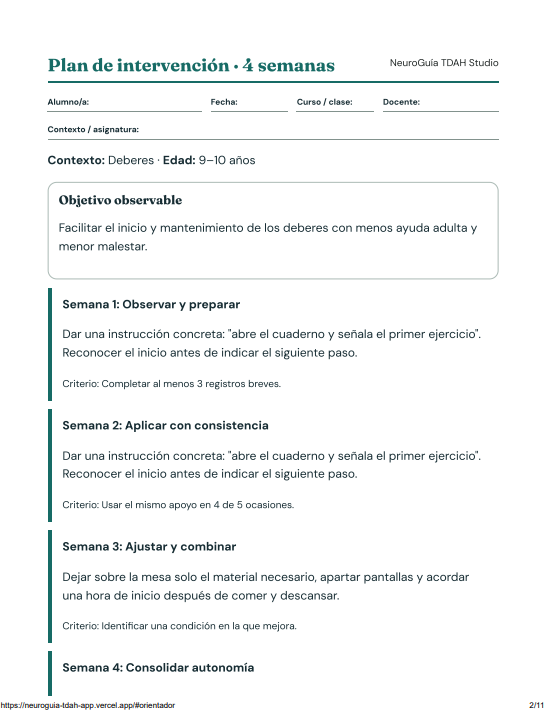
A personalized four-week plan includes actions, review criteria and classroom fields.
-
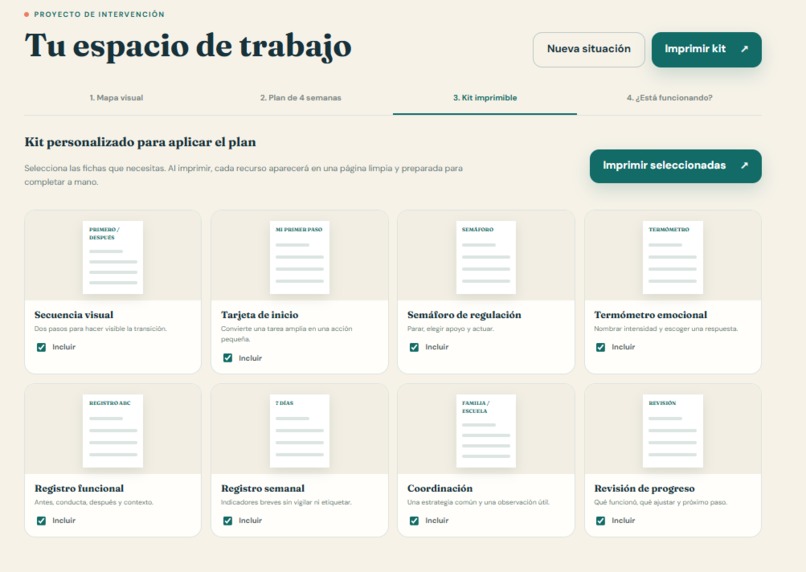
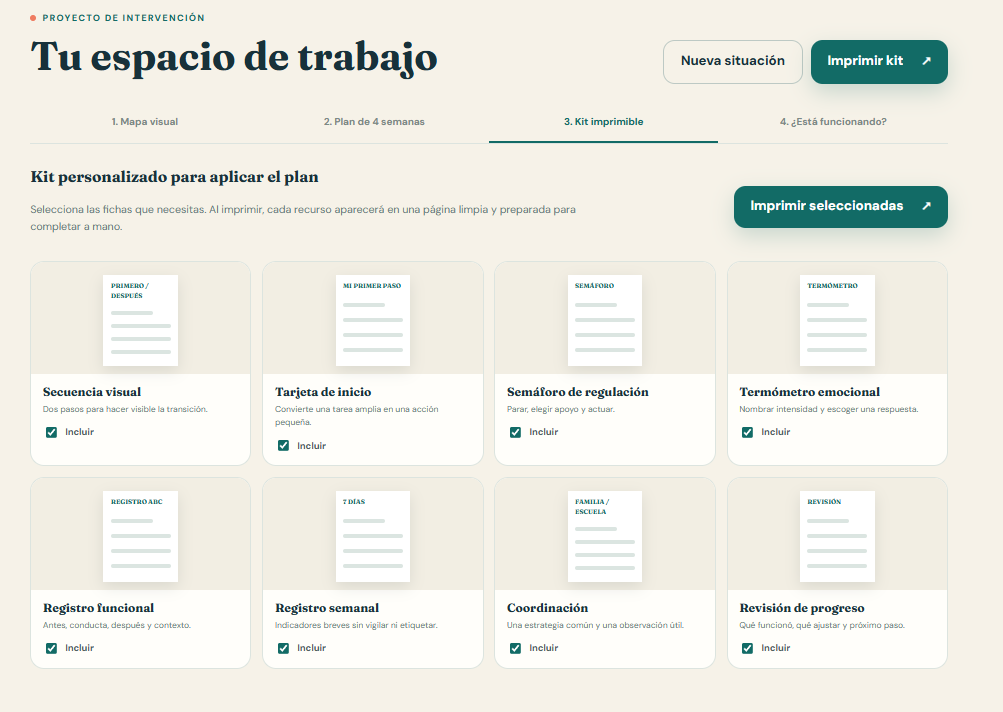
Eight printable tools support routines, regulation, tracking and home-school coordination.
Inspiration
I am a psychologist and hold a doctorate in Health Psychology. I created NeuroGuía TDAH after identifying a recurring problem: teachers and families want to support children with ADHD, but useful knowledge is fragmented across clinical explanations, generic advice and disconnected printable materials.
Observable difficulties are also frequently interpreted as laziness, disobedience or lack of interest. Similar behaviour may instead involve comprehension, anxiety, sleep, learning, sensory overload, stress or contextual demands.
NeuroGuía was created to bridge the gap between psychological knowledge and practical everyday action without diagnosing, labelling or blaming the child. The final product was shaped by my own professional review of every iteration. I asked for deeper knowledge cards, meaningful multi-child follow-up, exportable backups, DSM-5-TR context and more useful printable resources. These decisions transformed the first simple prototype into the application submitted today.
What it does
NeuroGuía TDAH is an educational application for teachers and families supporting children aged 6 to 12. It turns an observable situation into a structured intervention workflow:
- Describe what is happening without using diagnostic labels.
- Separate observation from interpretation.
- Explore relevant contextual and executive-function demands.
- Receive bounded educational guidance from GPT-5.6.
- Select supports to use before, during and after the situation.
- Build a structured four-week action plan.
- Download personalized printable materials.
- Record a baseline and compare it with the support phase.
- Decide whether to maintain, adapt or discontinue a strategy.
The application supports independent profiles for multiple children, grouped by class when needed. Each profile retains separate plans, observations and results. Users can export a complete restorable JSON backup and a CSV summary compatible with spreadsheets.
The professional library contains 63 in-depth resources covering ADHD foundations, executive functions, assessment, educational intervention, school, family, emotional regulation and differential considerations. It also contains an educational explanation of the DSM-5-TR criteria without turning them into an automated diagnostic test.
Eight printable worksheets include fields for the child, date, class, teacher and context. Three fictional demonstration cases allow judges to test the entire product without entering personal data or consuming API credits.
How we built it
The application uses a lightweight web architecture:
- Responsive browser interface built with HTML, CSS and JavaScript.
- Node.js and Express for local development.
- Vercel serverless functions for production.
- OpenAI Responses API with GPT-5.6.
- A controlled JSON response contract for reliable rendering.
localStoragefor anonymous profiles and observations.- Deterministic browser code for plans, printables, charts, backups and exports.
- Automated tests using the Node.js test runner.
- GitHub for version control and Vercel for continuous deployment.
The OpenAI API key remains on the server and is never exposed to the browser.
How GPT-5.6 is used
GPT-5.6 receives a non-identifying description of an educational or family situation. It returns seven controlled fields:
- A neutral observation.
- What cannot be concluded from the situation.
- Alternative or contextual factors to explore.
- Three educational strategies with actions and explanations.
- Indicators for follow-up.
- Guidance on when to request professional help.
- An educational or urgent safety classification.
The safety prompt prevents diagnosis, medication recommendations and requests for identifying information. Situations involving self-harm, abuse, violence, acute medical symptoms or immediate danger are directed toward urgent local support rather than an ordinary educational plan.
The model is used only where contextual reasoning adds value. Profile management, validation, resources, backups, calculations and privacy rules remain deterministic.
How Codex accelerated development
Codex was the primary development agent throughout the project, not a one-time code generator. It helped:
- Convert the initial psychological concept into a working architecture.
- Design the structured GPT-5.6 JSON contract and safety prompt.
- Build the interface, intervention workflow and four-week plan.
- Implement multiple independent child profiles and class organization.
- Create printable resources, tracking visualizations and data exports.
- Expand the professional knowledge base and DSM-5-TR educational content.
- Respond to product feedback by enriching micro-lessons, removing low-value features and redesigning the follow-up experience.
- Diagnose deployment and interaction errors.
- Create automated tests and verify edge cases.
- Keep GitHub and Vercel synchronized through successive iterations.
- Produce setup, testing, architecture and privacy documentation.
This allowed professional-domain decisions and software implementation to evolve together during Build Week.
Challenges and key decisions
The main challenge was using generative AI in a sensitive educational and psychological context without presenting speculation as diagnosis.
We addressed this through several deliberate decisions:
- Behaviour before labels.
- Observation separated from interpretation.
- AI constrained by a structured contract.
- No automatic ADHD score.
- Anonymous local profiles instead of centralized student accounts.
- Follow-up designed to learn what works, not to monitor the child.
- Exportable data controlled by the user.
- Fully functional demonstration cases when the API is unavailable.
Another challenge was supporting teachers with many students. NeuroGuía therefore avoids an artificial 30-student limit and provides independent records, class grouping, backup restoration and spreadsheet export.
What makes it different
NeuroGuía is neither a generic chatbot nor a static ADHD resource library. It combines professional psychological knowledge, contextual AI guidance, printable classroom and home resources, structured planning, multi-child organization and meaningful follow-up in one coherent workflow.
Its novelty lies in connecting the complete decision cycle:
observable situation → cautious interpretation → practical support → measurable plan → follow-up → informed adjustment
Potential impact
NeuroGuía addresses a real audience with a specific problem. It can help teachers and families:
- Reduce blame and premature conclusions.
- Choose more individualized supports.
- Coordinate home and school strategies.
- Save preparation time.
- Evaluate whether an intervention is genuinely helping.
- Recognize when professional assessment may be needed.
The goal is simple: help adults understand better so they can intervene more consistently, responsibly and compassionately.
What we learned
We learned that responsible educational AI works best when it does not attempt to automate every decision. The strongest product combines model reasoning with deterministic tools, professional boundaries, privacy by minimization and human review.
What's next
Future development will include multilingual content, collaborative home-school plans, more accessibility options, additional validated educational resources and optional encrypted synchronization controlled by the user.
Built With
- api
- codex
- css3
- express.js
- github
- gpt-5.6
- html5
- javascript
- json
- localstorage
- node.js
- openai
- responses
- serverless
- vercel


Log in or sign up for Devpost to join the conversation.