Inspiration
The brain has always fascinated me—it is humanity’s most complex organ, and yet we only intervene once it starts failing. Diseases like Alzheimer’s and dementia creep in silently, decades before any symptoms appear. I asked myself: why wait for the damage to happen? What if I could anticipate cognitive decline years in advance and intervene proactively? What if I could create a system that listens to the brain in real time, deciphers its hidden signals, and translates them into actionable strategies for lifelong cognitive resilience?
That question ignited the creation of NeuroGuard. I envisioned a platform that goes beyond standard wellness apps: a system that doesn’t just monitor sleep or activity, but actually predicts neurological risk, integrates neurophysiological, biochemical, and lifestyle data, and empowers me to optimize my brain every single day. It became more than a project—it became a personal mission to redefine preventive neuroscience.
What it does
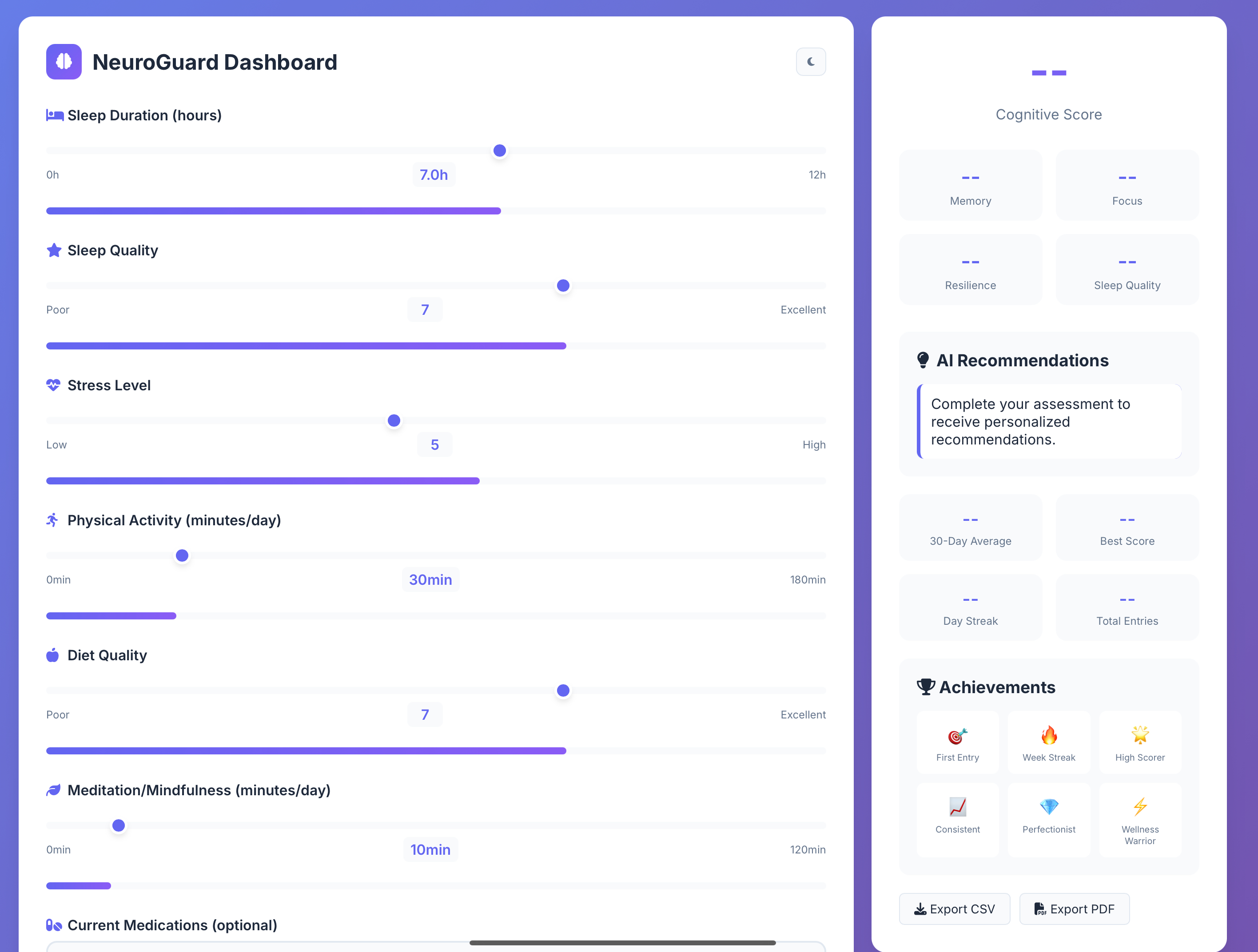
NeuroGuard is my AI-powered predictive platform that tracks and integrates everything that impacts the brain:
I continuously monitor EEG activity, capturing delta, theta, alpha, beta, and gamma waves. I map sleep architecture in detail, quantifying REM, NREM stages, deep sleep, spindles, and sleep efficiency. I track stress biomarkers like heart rate variability (HRV) and cortisol rhythms to understand the brain’s hormonal environment. I incorporate lifestyle data—exercise patterns, diet, cognitive training, and social engagement—to see how behavior influences neurophysiology. I account for medications like SSRIs (Sertraline), L-Dopa, corticosteroids (Prednisolone), and their acute and chronic effects on brain health.
Using all this data, NeuroGuard produces a Neurohealth Score, estimates long-term cognitive risk, and generates personalized, hyper-specific interventions. It can tell me when my REM sleep is dropping due to medication, when chronic stress is silently increasing my risk, or how lifestyle changes affect neural connectivity. Essentially, NeuroGuard doesn’t just report data—it predicts outcomes and guides decisions that could prevent disease decades before symptoms appear.
How I built it
I started by combining massive public datasets, including PhysioNet EEG recordings and OpenNeuro fMRI datasets of memory tasks, with a curated gold-standard dataset that I created. In my dataset, I recorded emotional and analytical memory encoding and recall, correlating these events with sleep EEG and subsequent performance tests. This allowed me to train models on real, labeled human brain activity with precise ground truth.
I extracted EEG spectral power across delta, theta, alpha, beta, and gamma bands, calculated coherence between brain regions, and quantified sleep spindles and K-complexes. I mapped HRV patterns and integrated biochemical markers like cortisol rhythms. I designed a hybrid spatio-temporal CNN-Transformer model capable of analyzing multimodal time-series data, predicting subtle deviations in neural activity indicative of future cognitive decline.
To make my system interpretable, I integrated explainable AI techniques such as SHAP and Layer-wise Relevance Propagation (LRP). This allowed me to see exactly which EEG patterns, sleep stage anomalies, stress spikes, or medication interactions were driving the predictions. I built a continuous feedback loop so that every new data point adjusts the interventions and recommendations in real time, personalizing the system to my evolving brain profile.
Challenges I ran into
Integrating EEG, hormonal, lifestyle, and pharmacological data into a single predictive framework was far more complex than I anticipated. Ensuring the AI’s outputs were trustworthy required iterating models hundreds of times and validating them against real-world physiological outcomes. Designing a system that works continuously, but unobtrusively, demanded careful attention to usability—EEG headbands, cortisol tests, and wearables can easily overwhelm a user. Predicting early-stage cognitive decline with limited longitudinal datasets forced me to innovate with synthetic data augmentation, transfer learning, and rigorous cross-validation.
There were moments when the technical challenges felt insurmountable. Aligning high-frequency EEG data with slow-changing lifestyle and biochemical signals required precise synchronization algorithms. Modeling complex drug interactions and their long-term cognitive effects demanded extensive literature review and custom algorithmic modeling. Each problem pushed me to think creatively, merging neuroscience, AI, and personal experimentation into one coherent framework.
Accomplishments I’m proud of
I successfully built a continuous, multimodal predictive model for cognitive decline, a first-of-its-kind system. I developed actionable interventions that translate complex neuroscience into daily decisions. I achieved explainable AI outputs that allow me to understand why particular behaviors, sleep patterns, or medications increase or decrease cognitive risk. I integrated EEG, sleep architecture, stress, lifestyle, and pharmacological data into a single coherent system.
Moreover, NeuroGuard demonstrated the feasibility of real-time, personalized predictive neuroscience. It shows that we can move from reactive medicine to proactive brain optimization, and that continuous AI monitoring can meaningfully guide behavior to prevent disease decades before it manifests.
What I learned
I learned that the brain communicates through waves, rhythms, and complex interactions—not just numbers. I discovered that lifestyle, stress, and medication interact dynamically with neurophysiological patterns, and that capturing these interactions is critical for accurate predictions. I realized that early interventions matter far more than reactive treatments: prevention is exponentially more effective than repair. I also learned that translating complex scientific principles into actionable daily interventions is difficult but profoundly rewarding—it’s where theory meets impact.
Finally, I discovered that predictive neuroscience is not just a technical challenge but a human one: the insights are only valuable if they can be acted upon, integrated seamlessly into daily life, and understood by the user.
What's next for NeuroGuard: Predictive AI for Lifelong Brain Health
I plan to expand my datasets with longitudinal EEG, sleep, stress, and lifestyle tracking to improve predictive accuracy and model reliability. I will integrate non-invasive cortisol monitoring and additional biomarkers to refine early detection of stress-mediated cognitive decline. I aim to create a clinician dashboard, enabling physicians to leverage my predictive models for personalized guidance and early intervention.
I will test and validate interventions across diverse populations to ensure the system works universally. Ultimately, my goal is to create a digital twin of the brain—an intelligent, continuous companion that predicts, protects, and optimizes cognitive health for life. NeuroGuard is not just an app or a project; it’s a revolution in how I—and potentially everyone—understand, monitor, and safeguard the brain.



Log in or sign up for Devpost to join the conversation.