-
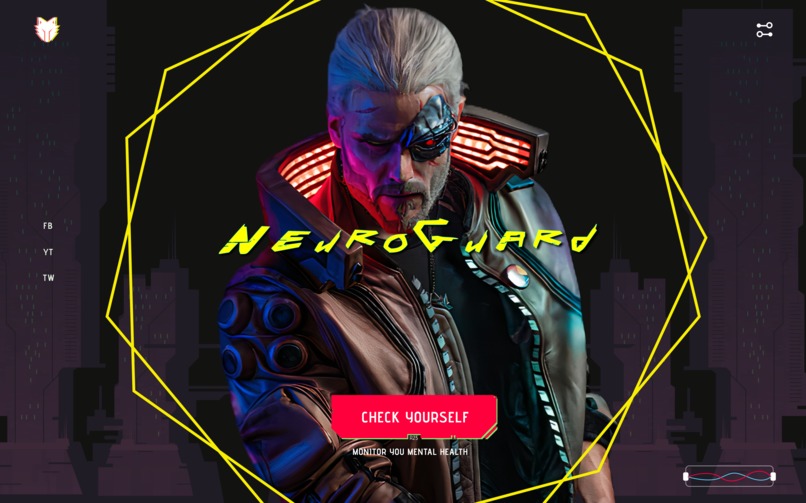
Landing
Group Name and Participants
SLON.
- Kamronbek Khusainov,
- Dmytro Dudarenko,
- Thomas Palmer.
Inspiration
In 2080, the world is a neon-lit, hyper-connected jungle. Everyone is plugged into the grid, and the lines between the real world and the digital one have blurred beyond recognition. But as cybernetic enhancements and neural implants become the norm, the human mind is still vulnerable to mental overload.
We were inspired by the concept of digital burnout and the overwhelming pressure that technology places on our mental well-being. Drawing inspiration from Cyberpunk 2077 - where mind-hacking and implants play a key role - we wanted to create a solution that wasn’t just another productivity app. NeuroGuard isn’t about optimising efficiency. It’s about protecting your mind in a world designed to exploit it.
What it does
NeuroGuard is a real-time cognitive load defense system that continuously monitors your mental health amidst the chaos of a digitised world. Using advanced machine learning, it calculates your mental state (0-100) based on user input from "chip" and behavioural patterns, allowing you to understand when you’re nearing burnout before it spirals out of control.
The system also integrates with Google Gemini, providing context-aware suggestions to reduce cognitive overload, such as taking a break, stretching, or reducing screen time. It’s a personal digital guardian that helps you stay mentally sharp in a world where your attention is always being hijacked.
How we built it
We built NeuroGuard using a combination of modern technologies and machine learning models.
- Frontend: The interface is sleek and minimal, created using HTML, CSS, and JavaScript, with a clean, intuitive, and futuristic design.
- Backend: Powered by Flask (Python), the app uses a RandomForestRegressor model from scikit-learn to predict mental state based on the data from the chip (like time slept, safety feeling, physical activities etc.).
- AI Integration: We integrated the Google Gemini API to offer personalised suggestions and recommendations when cognitive overload is detected.
- Database: MySQL is used to store historical data and track long-term mental state trends, giving the user insights into how their cognitive load evolves over time.
Challenges we ran into
- Balancing User Privacy vs. Data Use: One of our biggest challenges was designing NeuroGuard to prioritise user privacy while still gathering enough data to be useful. We wanted to ensure that the system could run locally, without relying on massive cloud storage, and kept user data fully encrypted and anonymous.
- Integrating Gemini AI: We were excited to integrate Google Gemini for AI-powered suggestions, but dealing with context-aware prompts in a meaningful and non-intrusive way was tricky. We had to ensure that the suggestions felt natural and useful without overwhelming the user.
Accomplishments that we're proud of
- Predicting Mental States: One of the most exciting accomplishments was creating a machine learning model that accurately predicts a user’s mental state using the data from the chip. NeuroGuard can predict mental overload before the user even realises they’re approaching burnout.
- Real-time Interventions: Another accomplishment was developing the Gemini-powered intervention system, which provides real-time suggestions to help users avoid stress-induced crashes. Being able to offer actionable, intelligent advice based on a user’s data feels like we’re giving them a personal mental health assistant.
- Privacy-first Approach: We are proud of building a system that protects user privacy. NeuroGuard stores data locally, and AI suggestions are optional. We’ve made sure that users are always in control of their mental data.
What we learned
- ML for Mental Well-being: We discovered how powerful machine learning models can be in assessing mental states and predicting burnout, even from seemingly trivial data points like time slept or based on the week of the day. The subtlety of this kind of analysis was both challenging and rewarding.
- User Empathy and UX: Designing a mental health tool that isn’t intrusive but actually feels supportive required a deep understanding of user empathy. We learned that mental health solutions need to be non-judgmental and personal, not just functional.
- Balancing Complexity and Simplicity: We learned how to balance the technical complexity of machine learning with the simplicity needed for the user interface. NeuroGuard had to be both sophisticated and user-friendly—something we’re very proud of achieving.
What's next for NeuroGuard
- AI-Powered Wellness Plans: The next major step for NeuroGuard is to develop personalised wellness plans based on long-term data. Imagine the system suggesting a custom routine to improve your mental well-being, from mindfulness exercises to ideal screen time limits.
- Mobile and Wearable Integration: We’re planning to extend NeuroGuard to mobile apps and wearables (like smart glasses or even neural interfaces), so users can monitor their mental state across all devices in their life.
- Community Insights: We want to build a community feature where users can anonymously share their mental wellness data (in an anonymised and aggregated form) to learn from each other. This could help people realise they’re not alone in their struggles.
- Expanding the AI Features: We’ll enhance the Gemini-powered suggestions and explore adding more advanced features, like neural feedback loops or integrating biofeedback data to further personalise interventions.

Log in or sign up for Devpost to join the conversation.