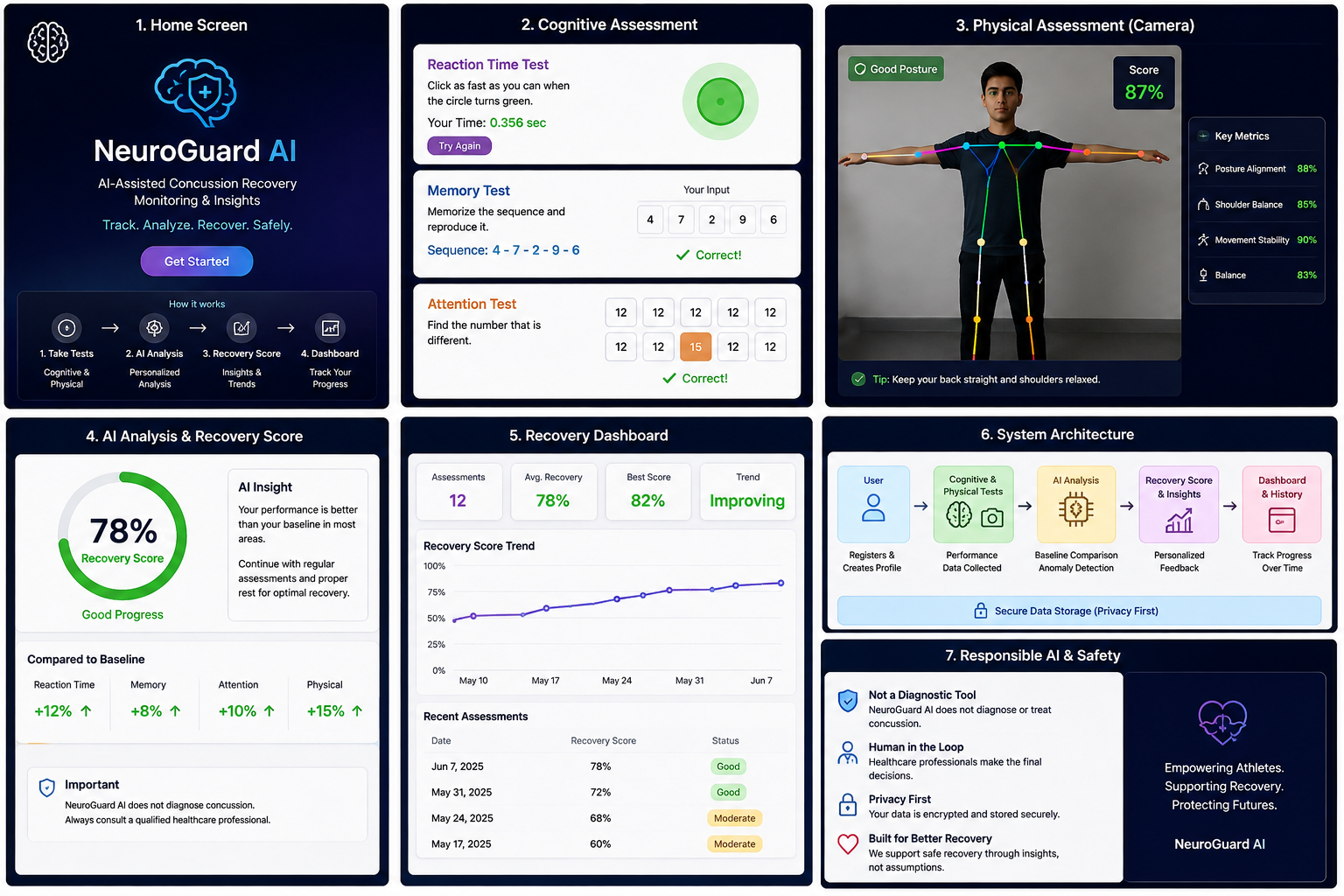
Inspiration Concussion recovery is not the same for everyone. We were inspired by the need for a simple and accessible way to monitor changes in cognitive and physical performance during recovery. We wanted to use AI to make recovery tracking more personalized rather than relying only on occasional assessments.
What it does NeuroGuard AI provides short cognitive and physical assessments to track recovery over time. It monitors factors such as reaction time, memory, attention, balance, and movement. AI analyzes the user's performance against their personal baseline and highlights unusual changes, helping users better understand their recovery progress.
NeuroGuard AI is a monitoring and support tool, not a medical diagnosis system. How we built it We built NeuroGuard AI as a software-based healthcare platform combining: AI/ML for personalized baseline and anomaly detection Cognitive tests for memory, attention, and reaction time
Camera-based analysis for selected physical/balance assessments Recovery dashboard for visualizing progress
Data tracking to compare current performance with previous sessions Safety-focused alerts when significant changes are detected Challenges we ran into One major challenge was designing assessments that are simple enough for anyone to use while still producing meaningful data. We also had to consider differences between individuals, avoid making unsafe medical claims, and determine how AI could identify meaningful changes without replacing professional medical evaluation.
Accomplishments that we're proud of We are proud of creating a concept that combines AI, cognitive assessment, physical monitoring, and personalized recovery tracking in one accessible platform. We also focused on responsible AI by positioning NeuroGuard as a recovery-support tool rather than a diagnostic replacement for healthcare professionals.
What we learned We learned that healthcare AI is not just about building an accurate model. Safety, personalization, accessibility, privacy, explainability, and user experience are equally important. We also learned how personal baselines can make AI-based monitoring more meaningful than applying the same threshold to everyone. What's next for NeuroGuard AI Our next steps are to improve the AI model with larger and more diverse datasets, strengthen camera-based movement analysis, add more clinically informed recovery assessments, improve accessibility, and explore integration with wearable devices. In the future, NeuroGuard AI could provide healthcare professionals with clearer longitudinal recovery data while keeping medical decisions under professional supervision.


Log in or sign up for Devpost to join the conversation.