-
-
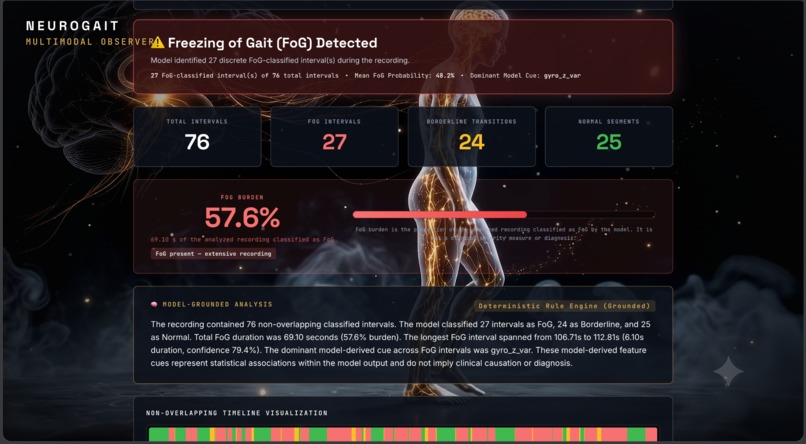
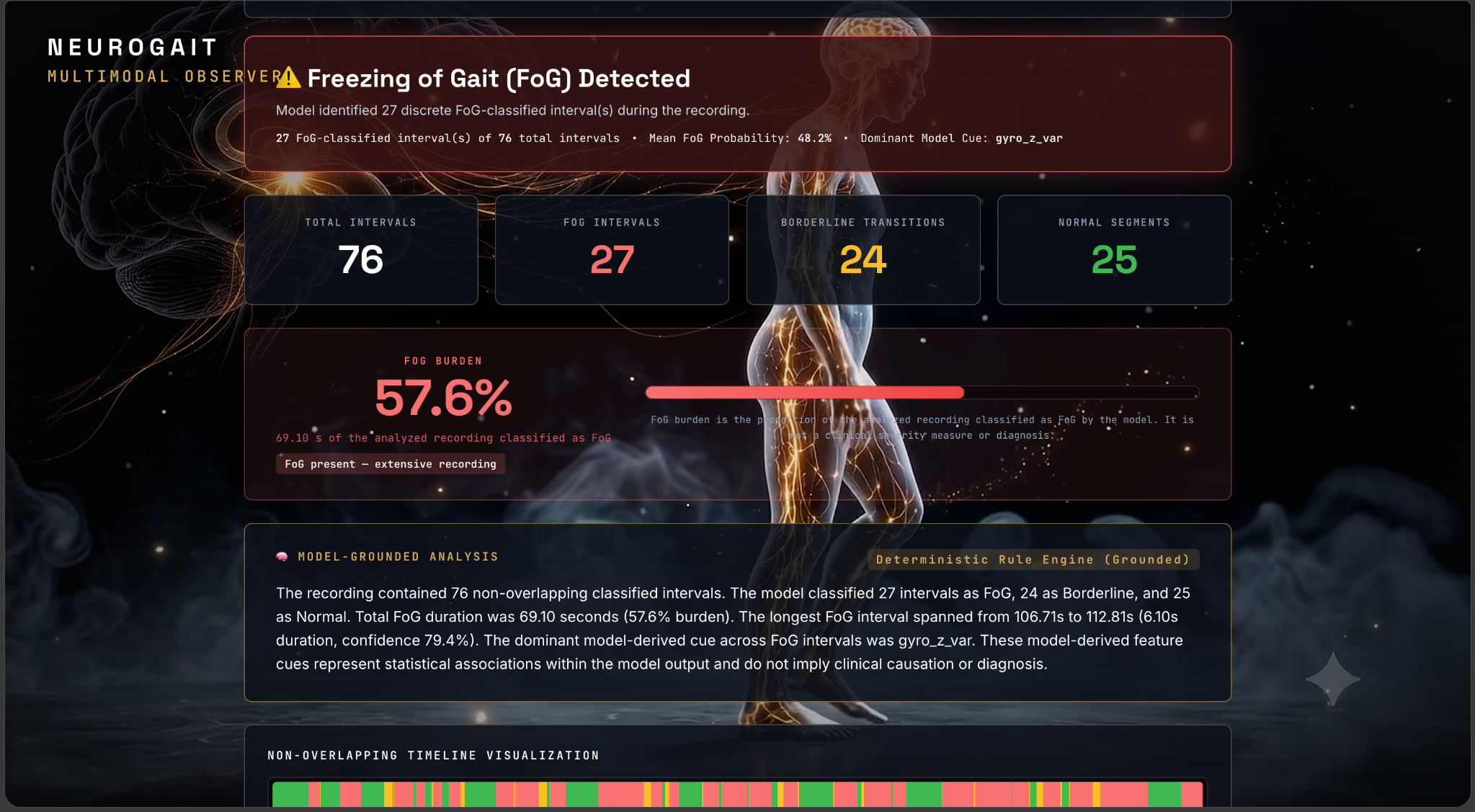
Final Analysis after uploading video and IMU data. (Takes 5 mins to load)
Inspiration
Theme: Healthcare & Wellbeing (with a bit of Product Design and Social Impact)
You can learn a surprising amount about a person just by watching them walk. For people with Parkinson's disease, one of the most frustrating and dangerous changes is Freezing of Gait (FOG): the sudden moment when your feet simply won't move, even though you want to keep walking. Studies suggest that around 40% of people with Parkinson's experience it, and the number climbs to roughly 7 in 10 for people who have lived with the disease for a decade or more. FOG is linked to falls, injuries and a loss of independence.
What struck us is how hard it is to catch. Freezing is unpredictable, and it often doesn't happen during a short clinic appointment, so doctors can miss it entirely. Diaries depend on memory and opinion. Motion-capture labs are accurate, but they're expensive and nowhere near where people actually live.
So we asked ourselves: what if we could measure how someone walks, objectively, outside the lab? That question became NeuroGait.
What it does
NeuroGait is a clinical support and research tool that detects and analyzes Freezing of Gait episodes in people with Parkinson's disease.
While someone walks, it combines pose data from video with motion data from wearable IMU sensors. From that, it measures things like walking pattern, pace, step characteristics, symmetry and joint movement. The result is a clear view for clinicians showing when FOG happened, and how the person's movement changed before, during and after each episode.
It's designed for neurologists, physiotherapists, care-home clinical staff and researchers.
Here's what we think makes it different:
- Two sources, not one. Video and sensors cover each other's blind spots.
- The full picture around an episode, not just a flag that something happened. That helps clinicians understand triggers and how treatment is working.
- Results people can read. Clinicians see measurable gait metrics, not a mysterious score from a black box.
- Built with real life in mind, not just controlled lab conditions.
To be clear, NeuroGait does not diagnose Parkinson's disease and doesn't replace a clinician's judgement. It's there to give them better information.
How we built it
We built NeuroGait around two complementary ways of capturing movement:
- Computer vision picks up body posture and joint positions from video of someone walking.
- IMU sensors capture motion details that video can miss, like when the camera angle is awkward or part of the body is hidden.
From there, the process is straightforward. We record a walk with a camera and sensors, line up the two data streams in time, and pull out gait features such as pace, step characteristics, symmetry and joint motion. A machine learning model then looks for movement patterns associated with FOG, and the results are turned into a report that clinicians can review and interpret themselves.
Challenges we ran into
Everyone walks differently. Age, height, speed, camera position, sensor placement and personal habits all change the data. The hard part was making sure the features we measure stay meaningful across all of that variation.
Bringing video and sensors together. The two sources see movement from different angles, and getting them to sync up and tell a consistent story took careful work.
Respecting the medical side. Spotting a movement pattern linked to FOG is very different from making a diagnosis. That pushed us to focus on giving clinicians measurable information to support their decisions, not to make decisions for them.
Privacy. Video of patients is sensitive. We're designing around consent, secure storage and, where possible, working from de-identified pose data rather than raw footage.
Accomplishments that we're proud of
We're proud that we took something as ordinary as the way a person walks and turned it into measurable information that can help study Freezing of Gait.
We're also proud that NeuroGait doesn't depend on a single source of data. Combining video and IMU sensors makes it sturdier than either would be alone.
Most of all, we're proud that we chose a real healthcare problem and aimed for something genuinely useful for FOG monitoring and clinical research, rather than just showing off another machine learning model.
What we learned
Building for healthcare taught us that a model producing an output is only a small part of the job. The quality of the data, the features you choose to measure, how you present the results and being honest about the technology's limits all matter just as much.
We also learned that clinicians need results they can understand. An AI prediction on its own isn't enough, so we focused on gait measurements that healthcare professionals can look at, question and interpret.
What's next for NeuroGait
Our next step is to test NeuroGait with people with Parkinson's disease in residential care settings, once we have the necessary clinical and ethical approvals.
Here's the plan:
- Collect data. Record IMU and video data during normal walking.
- Label and validate. Have clinicians identify real FOG episodes so we have a trustworthy dataset.
- Improve the model. Retrain and test it on that real-world data, including variation in age, height, speed, camera position and sensor placement.
- Run a clinical pilot. See how useful the reports are to clinicians and refine them based on their feedback.
To do this, we'll need IMU sensors, cameras, a clinical partner with ethics approval, clinician time for labelling, and computing power for analysis.
Our hope is that this leads to objective data on how often FOG happens and in what situations, a growing real-world dataset, and a solid foundation for long-term FOG monitoring and better-informed treatment decisions.

Log in or sign up for Devpost to join the conversation.