Inspiration
Today’s AI is powerful, but it’s reactive.
Even the most advanced agents still require us to actively type prompts. We must tell the system what we want, how we feel, and when we need help.
But humans don’t operate through prompts. Our cognitive state changes continuously.
Mind+ was inspired by a question:
What if AI could understand your brain state in real time and respond before you ask?
What it does
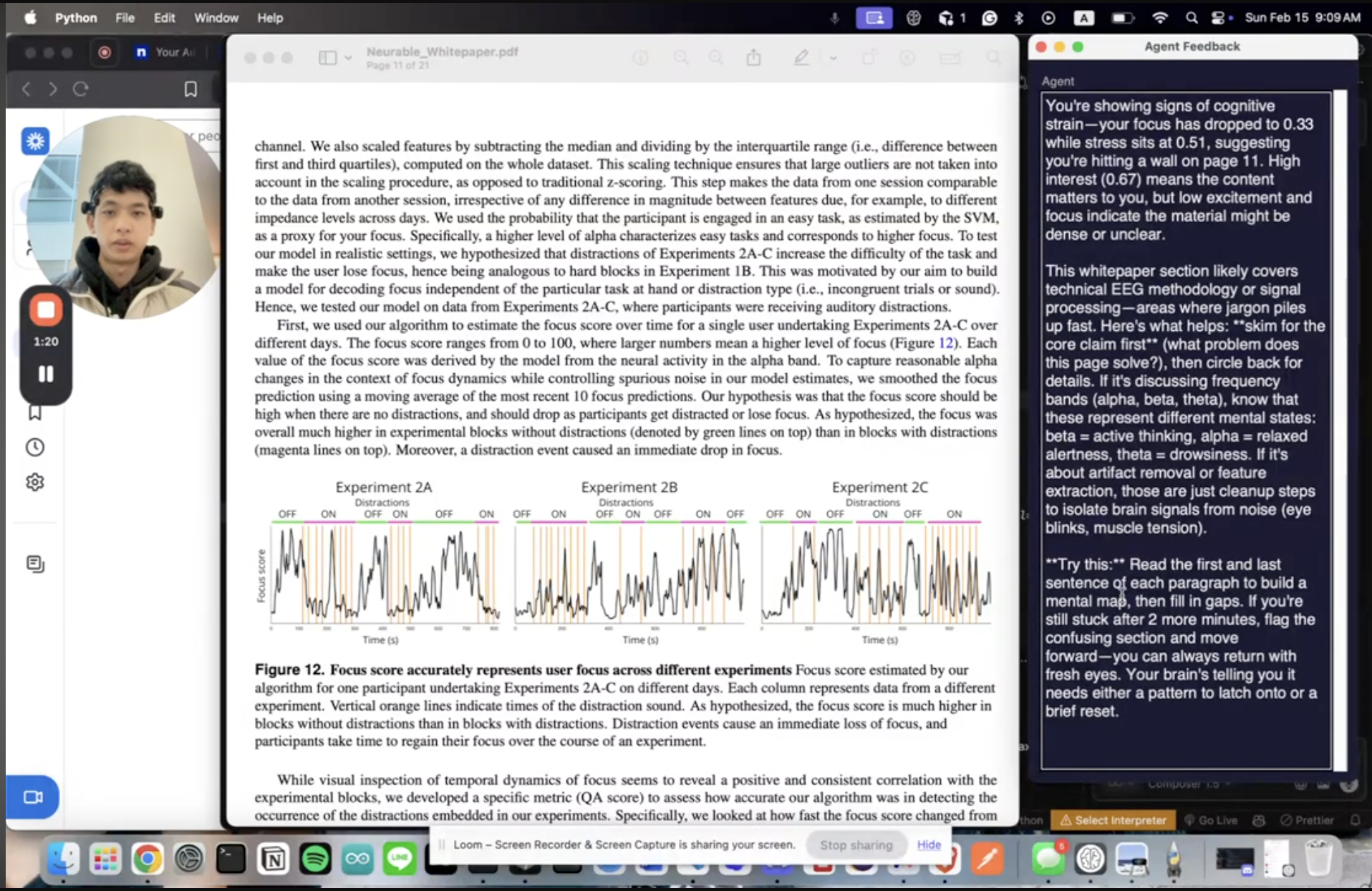
Mind+ monitors your brain activity in real time using an Emotiv EEG headset to understand whether you are truly engaged or mentally drifting.
When studying or reading difficult material, we often think we’re focusing. But in reality, our minds start wandering.
NeuroFocus can detect:
When you are in deep focus
When your attention starts to drift
When cognitive load becomes too high
When the material may be too abstract or overwhelming
Instead of waiting for you to realize you’re distracted, the system can:
Gently alert you when your focus drops
Suggest a break before burnout
Offer clarification when cognitive strain increases
Activate an AI agent to assist automatically
And this isn’t limited to studying.
Because it integrates with your computer environment, NeuroFocus works across:
Coding
Reading research papers
Gaming
Writing
Any digital task
Your brain becomes an input device.
Instead of manually prompting AI, your mental state becomes the signal.
How we built it
We used an Emotiv EEG headset to collect real-time mental state data and streamed it to a Jetson Nano for processing. The Jetson runs our pipeline inside Docker, and we exposed the service remotely using ngrok so the system can work from anywhere with low setup friction. In parallel, we built a lightweight computer-context layer that actively monitors the window/app the user is currently working in, so the system understands what task the user is doing without needing manual input. Finally, we connected these two signals, brain state + on-screen context, into a Claude-based agent, which can decide when to proactively engage (e.g., when focus drops, when distraction rises, or when the task becomes cognitively demanding) instead of relying on the user to type prompts.
Challenges we ran into
A core challenge was making the agent safe + useful with the exact signals we get from the Emotiv Cortex API. Cortex gives us high-level performance metrics like attention, engagement, excitement, stress, and relaxation (plus EEG power bands/motion), but mapping those labels to “what the user needs right now” is not straightforward. For example, a drop in focus could mean mind-wandering, fatigue, or simply switching tasks; a rise in stress might mean productive struggle or frustration; and high engagement doesn’t always mean the user is learning effectively. This ambiguity made it hard to design reliable triggers and avoid false positives.
Privacy was another big issue because our system combines brain-state metrics with computer context (the active window/app). Even if we only track window titles, it can still reveal sensitive behavior, so we had to minimize what data is logged and carefully control what is passed to the agent.
Finally, we tested multiple agent setups. We originally tried running the agent locally using Ollama for maximum privacy, but the on-device models weren’t consistently strong enough to give helpful, context-aware support from signals like attention/stress/relaxation in real time. That’s why we moved to a Claude-based agent, so interventions (explanations, reframes, break suggestions, “ask a guiding question”) are actually high-quality instead of generic.
Accomplishments that we're proud of
We’re proud that the system worked better than we expected in a real usage setting: we successfully streamed Emotiv Cortex mental-state metrics (like attention, engagement, stress, and relaxation) into our Jetson Nano processing pipeline and used them to trigger meaningful agent behaviors in real time. We also demonstrated a new interaction pattern for AI agents. Instead of constantly typing prompts, the agent can respond based on your cognitive state, plus what you’re doing on your computer. Finally, we built an end-to-end demo where we used brain commands to drive a complete pipeline that can order food, proving this isn’t just a visualization project, it’s a full neuroadaptive agent workflow.
What we learned
We learned that building neuroadaptive systems is less about raw EEG data and more about interpretation and restraint. Even though the Emotiv Cortex API gives clean high-level metrics like attention, engagement, stress, and relaxation, those labels don’t directly translate into user intent. Brain-state signals are probabilistic, personal, and context-dependent, so designing reliable triggers requires calibration and thoughtful thresholds, not blind automation.
We also learned that proactive AI must be carefully timed. Just because focus drops doesn’t mean the agent should interrupt immediately. The hardest problem wasn’t signal processing; it was designing interventions that feel supportive instead of intrusive.
Finally, we learned that model capability matters. Running everything locally sounds ideal for privacy, but real-time cognitive assistance requires strong reasoning. Choosing the right balance between privacy, performance, and usability is critical when building brain-integrated AI systems.
What's next for Mind+
Our next step is turning Mind+ from a hackathon prototype into a usable, everyday product. While the Emotiv headset is powerful, it’s too bulky and impractical for daily life. We’re now working on a lightweight, low-channel EEG design that can capture core mental-state signals related to attention and cognitive drift. Even if it’s not as powerful as a full multi-channel system, our goal is to make it “good enough” for real-world use, portable, comfortable, and affordable.
We’re also focusing on improving personalization, refining state-detection models, and making the neuroadaptive agent feel natural and seamless. Long term, we want Mind+ to become a practical brain–computer interface layer that integrates directly into everyday workflows, not just a demo, but a real cognitive companion.
Built With
- agent
- alotoftoken
- brain
- brain-command
- brain-state
- claude
- coffee
- docker
- eeg
- emotiv
- jetson-nano
- ngrok
- python


Log in or sign up for Devpost to join the conversation.