-
-
Title
-
Impact & Niche
-
Analysis Pipeline
Inspiration
Damage to motor pathways in the brain, spinal cord, or peripheral nerves can result in complete or partial paralysis, often arising from conditions such as stroke, cerebral palsy, multiple sclerosis, or traumatic brain/spinal cord injury. Neuroplasticity refers to the brain’s ability to reorganize its circuitry by strengthening active neural connections, pruning unused ones, and forming new neural pathways, enabling functional recovery after injury. Rehabilitation therefore emphasizes task-specific repetition to help rebuild motor function, yet early-stage neuroplasticity progress remains largely invisible, offering patients and clinicians little real-time, tangible feedback. This gap presents an opportunity for innovative AI-driven solutions that can visualize recovery and personalize rehabilitation, motivating individuals to remain engaged in their early rehabilitation efforts. Our vision is clear, providing a tool for patients and healthcare professionals to quantify motor recovery.
What NeuroFlex does
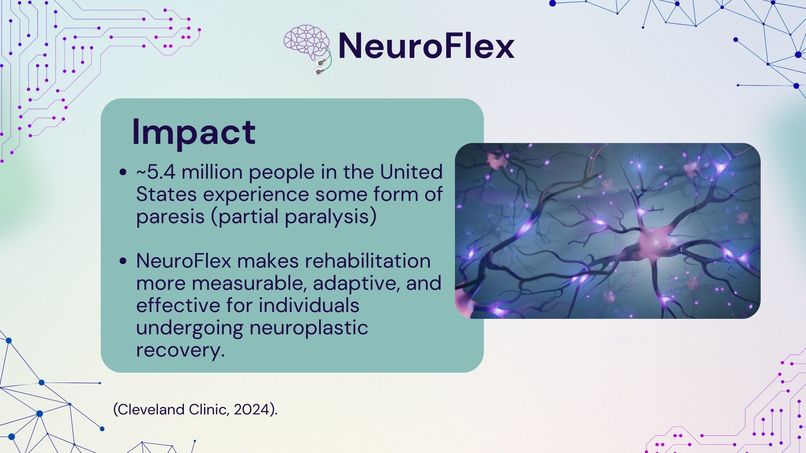
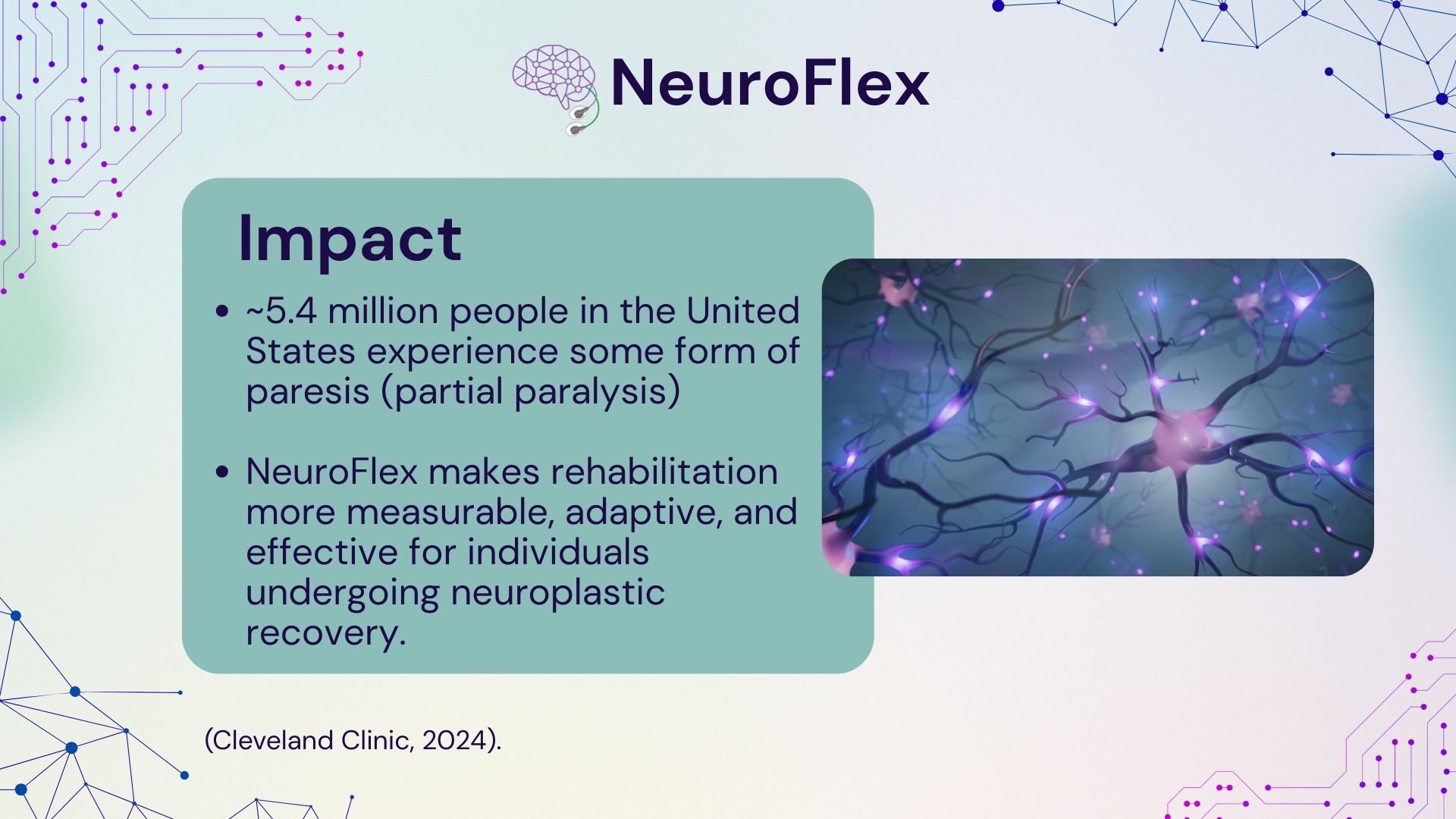
NeuroFlex makes rehabilitation more measurable, adaptive, and effective for individuals recovering from paresis.
- Provides users with real-time feedback on the timing and strength of their brain and muscle activation using entirely noninvasive measurements.
- Integrates EEG-based technology with EMG (muscle electrical activity) biofeedback. The model generates a coordination metric that quantifies how effectively muscle activation aligns with the user’s intended movement.
- Makes neuroplasticity visible and measurable* via a similarity score that changes over time. This is especially valuable during early rehabilitation (after the first month) and during **plateau phases, when improvements are often subtle and difficult to detect using conventional methods.
- Allows both users and clinicians to track recovery over time.
- AI-driven insights. The model recommends personalized rehabilitation exercises and visualization strategies based on the user’s current progress. Users can select the tone and personality of the system’s feedback.
- Provides guidance during relapse for the most optimal approaches on returning to a previous state.
How we built it
We utilized a BCI system connecting an OpenBCI headband EEG and EMG electrode to an OpenBCI Ganglion board, allowing measurements of brain and muscle activity simultaneously. These signals were transmitted via Bluetooth to our laptop through the BrainFlow API. For demonstration, we focused on fist clenching and relaxation of the right hand.
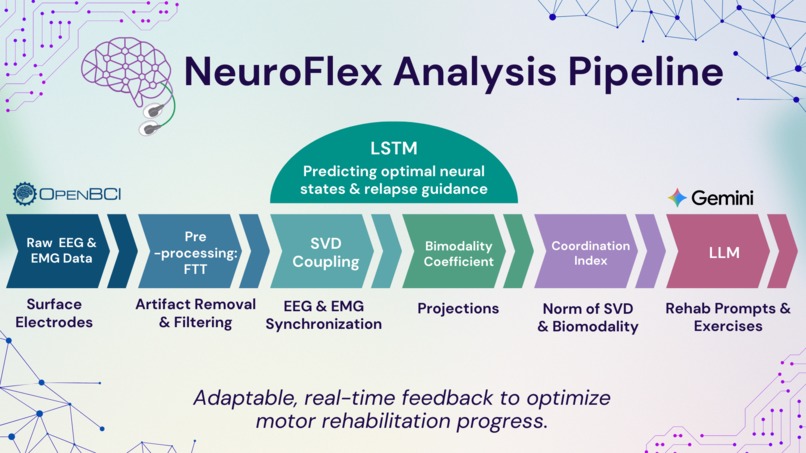
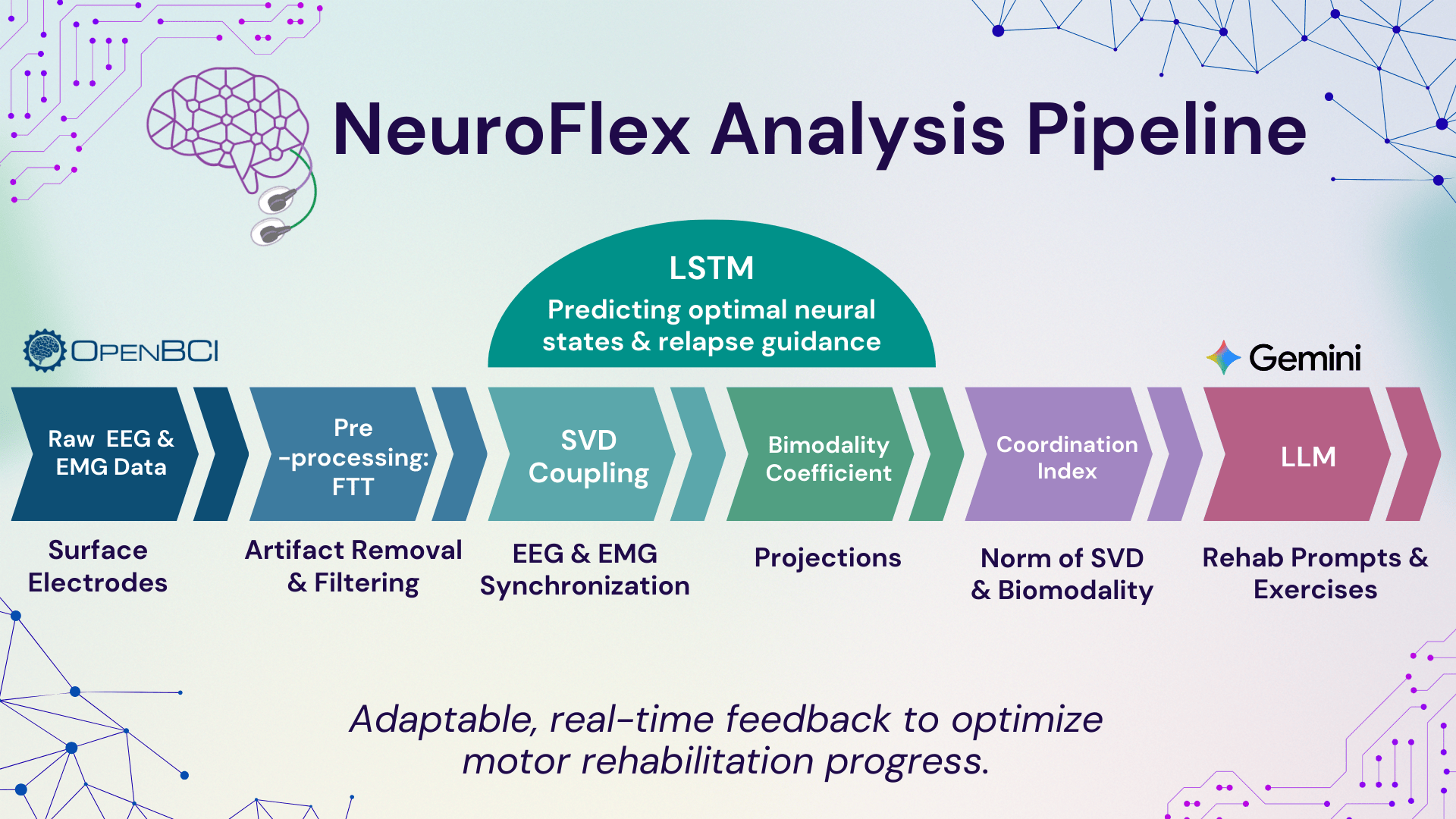
Our platform, NeuroFlex, processes these signals through several steps. First, it calibrates a baseline by recording one minute of resting activity, which is used to remove background noise. The data is then filtered through a fast Fourier transform (FFT) to eliminate artifacts such as eye blinks and sweat interference, converted into frequency components, and downsampled to improve efficiency while preserving meaningful signals.
To quantify recovery progress, we created a coordination index that measures how well EEG and EMG signals are synchronized during movement through singular value decomposition (SVD) coupling, projecting each point onto the mode of movement for the bimodality coefficient, then taking the norm of the coupling and bimodality metrics, with respect to the highest observed coordination value. These attempts are stored and ranked, with greater emphasis on recent performance to reflect ongoing neuroplastic changes.
Using dynamic time warping of signals from previous attempts, we produce a similarity score that quantifies changes in brain-muscle coordination over time. The UI built using pyqtgraph highlights the user's five best recent attempts, considering both performance and recency to reveal meaningful trends in neuroplastic recovery.
We also trained a Long Short-Term Memory (LSTM) model on sequences of past coordination data. This model predicts the user’s target coordination state and provides personalized feedback, displayed on our UI, to help them reach or regain their best performance.
To enable increased functionality and enhance user experience, we utilized a series of context-dependent prompts pushed to a Gemini-based API. These prompts are designed to encourage the user to continue along promising paths and to introduce novel ideas when progress stalls. By adapting to each individual’s progress, NeuroFlex optimizes rehabilitation by making recovery measurable, personalized, and actionable.
Challenges we ran into
Surface electrode technology enables noninvasive collection of neural and muscle activity data, however, it presents challenges due to weaker and lower-resolution signals compared to invasive methods, especially when compounded with hardware limitations. As OpenBCI systems rely on complete hardware integration, missing the specific signal transmission dongle for the Ganglion board was a significant barrier that we overcame by transmitting our signals to a BrainFlow python API instead of the OpenBCI GUI, whose strict protocol misinterpreted our data.
Accomplishments that we're proud of
NeuroFlex’s core innovation lies in its interdisciplinary pipeline that integrates EEG and EMG biofeedback into a unified coordination metric, transforming neuroplasticity into a clear, measurable signal. Despite significant hardware challenges, we successfully designed and built a fully functional system, from signal acquisition to real-time analysis and user feedback. Our platform includes an interactive UI that visualizes brain and muscle signals, displays similarity scores to quantify progress, and provides real-time prompts and feedback to guide rehabilitation. This demonstrates not only the analytical feasibility of our approach, but also its practical usability as a complete rehabilitation tool. Most of all, we are especially proud of our team’s perseverance, creative problem-solving, and collaborative effort.
What we learned
From dozens of iterations to troubleshoot hardware constraints to integrating multi-stream inputs, we translated a conceptual framework combining classical statistical methods, neural signal tracking, and AI into a robust, user-centered system.
What's next for NeuroFlex: Neuroplastic Rehabilitation
NeuroFlex represents a step toward more accessible, intelligent rehabilitation by combining noninvasive sensing with AI-driven feedback and personalized recommendations. Our next steps include validating the system with improved hardware integration, increasing EEG electrode density to capture activity across more brain regions, and scaling channel capacity to enable more robust independent component analysis and signal separation.


Log in or sign up for Devpost to join the conversation.