Inspiration
Alzheimer’s often goes undetected until it is too late for meaningful intervention, especially in low‑resource settings. Seeing how much impact earlier screening could have inspired NeuroEarly as a student‑friendly, clinically useful AI project.
What it does
NeuroEarly uses tabular biomedical data to predict early Alzheimer’s risk and approximate progression stage for each person. It produces an explainable risk score plus visual explanations that show which lifestyle, clinical, and demographic factors drive the prediction.
How we built it
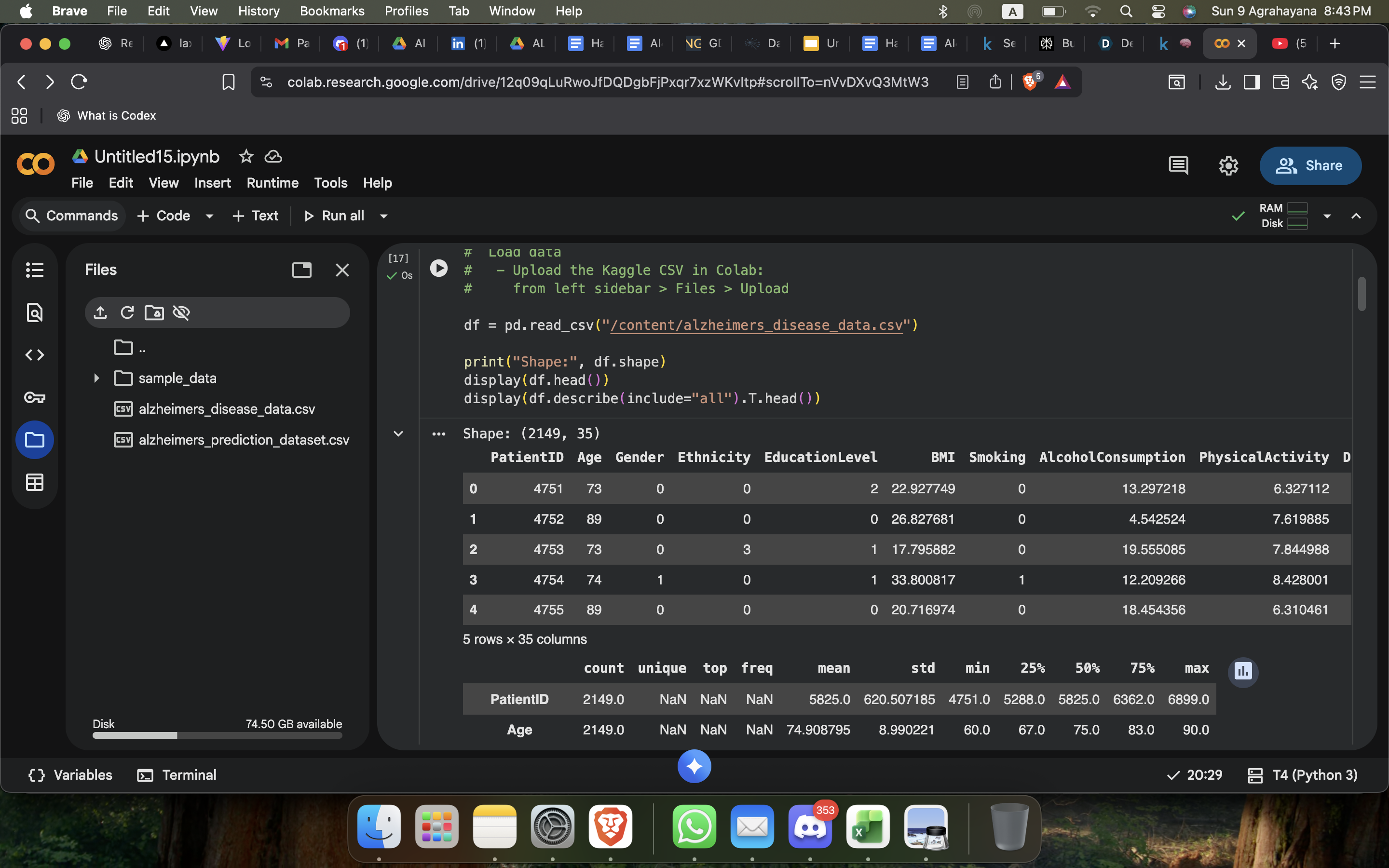
We worked in Google Colab, training models on the official Hack4Health dataset and a second global Alzheimer’s cohort. After cleaning and encoding the data, we compared logistic regression to a tuned XGBoost model and wrapped everything in a reproducible notebook with clear evaluation plots and SHAP visualizations.
Challenges we ran into
Major challenges were handling missing and imbalanced medical data, aligning different feature sets across the two datasets, and avoiding overfitting while tuning XGBoost. Making the explanations intuitive for non‑technical clinicians also required several iterations of visualization and wording.
Accomplishments that we're proud of
We’re proud that NeuroEarly uses only open data and commodity hardware yet reaches strong performance with transparent explanations. Validating the model on two independent cohorts and turning that into a clear, patient‑centric story for clinicians felt like a big step beyond a typical ML homework project.
What we learned
We learned that most of the real work in clinical ML is data cleaning, careful evaluation, and interpretability—not just picking a fancy model. We also saw how design choices (metrics, calibration, explanations) directly affect whether clinicians can trust and use an AI system.
What's next for NeuroEarly: Global AI Screening for Alzheimer’s Risk
Next, we want to extend NeuroEarly with multimodal inputs such as speech or imaging features and test it on more diverse populations. We also plan to build a simple web dashboard so clinicians and researchers can explore risk scores and explanations without touching code.

Log in or sign up for Devpost to join the conversation.