-
-
NeuroDOOM poster
-
NeuroDOOM poster
-
Schema
-

Snapshot
-

Snapshot


Inspiration
NeuroDOOM grows out of my long-term obsession with what I call Strange Computing – exploring non-standard forms of computation such as quantum processes, biological networks and telepathy instead of classic silicon chips.
I was also deeply inspired by the legendary 90s video game DOOM and its hacker folklore: the challenge to make it run on anything – calculators, pregnancy tests, even inside DOOM itself. I wanted to ask: what if the next platform isn’t a device, but a living human brain organoid biocomputer? At the same time, I’m concerned by the Greely Dilemma around organoid intelligence (OI): if a brain organoid in a dish somehow suffers, how would we even know? NeuroDOOM is my way to shine a light on the ethics of using human brain organoids in hybrid human–machine systems, by translating an iconic game about demons into a new arena: Knee-Deep in the Alive.
How I built it
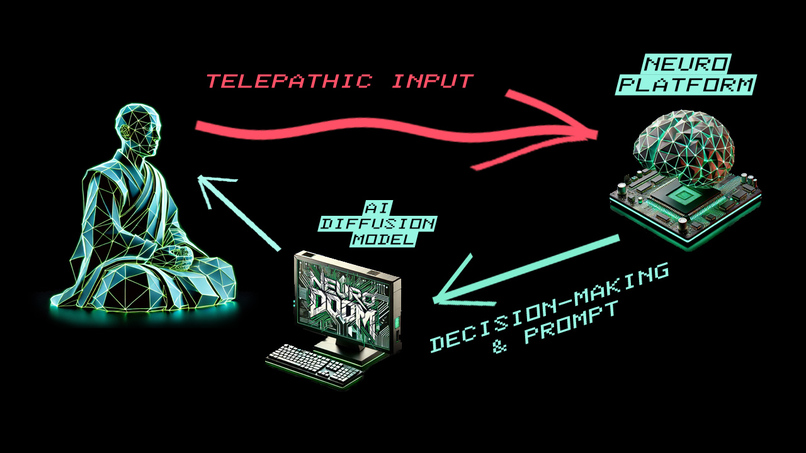
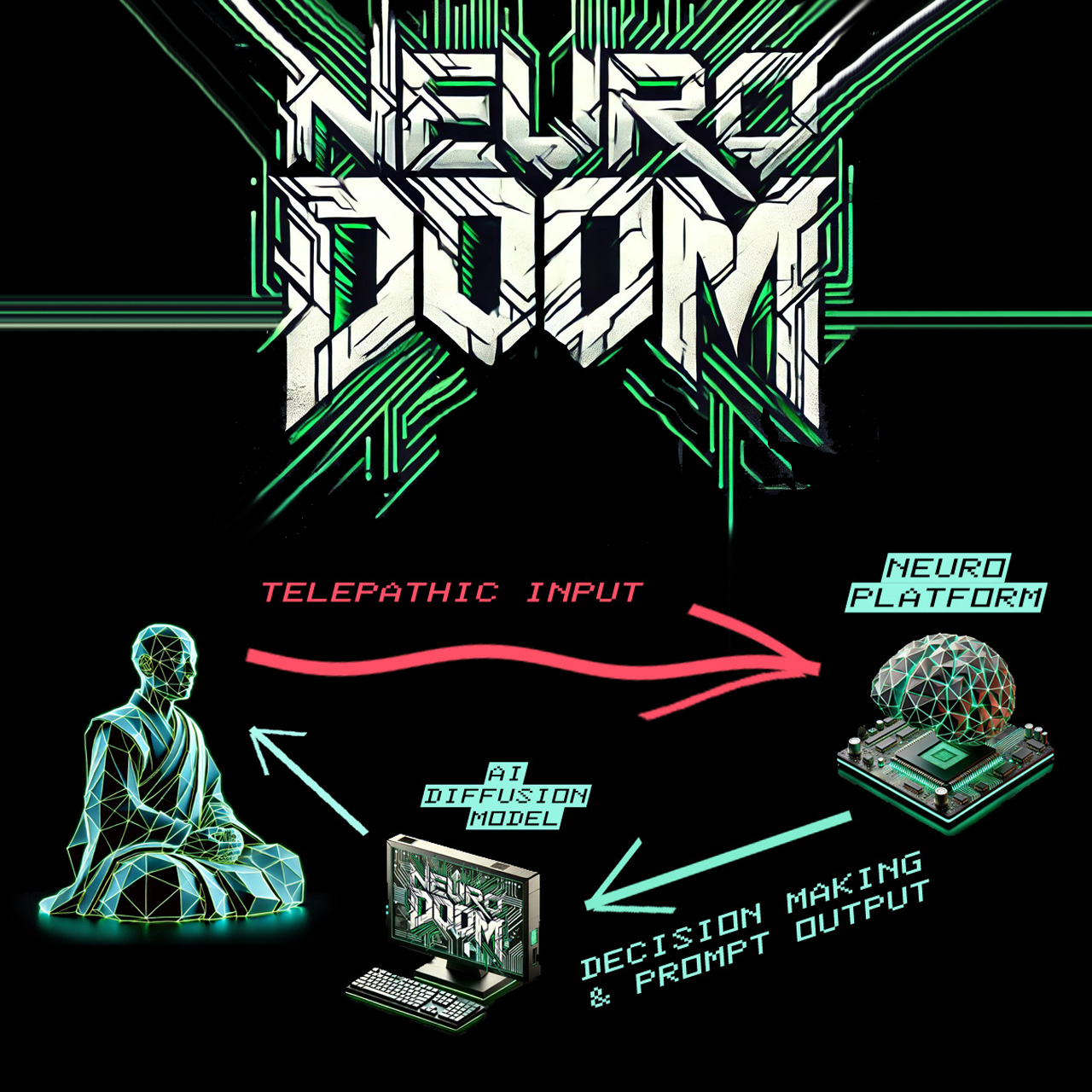
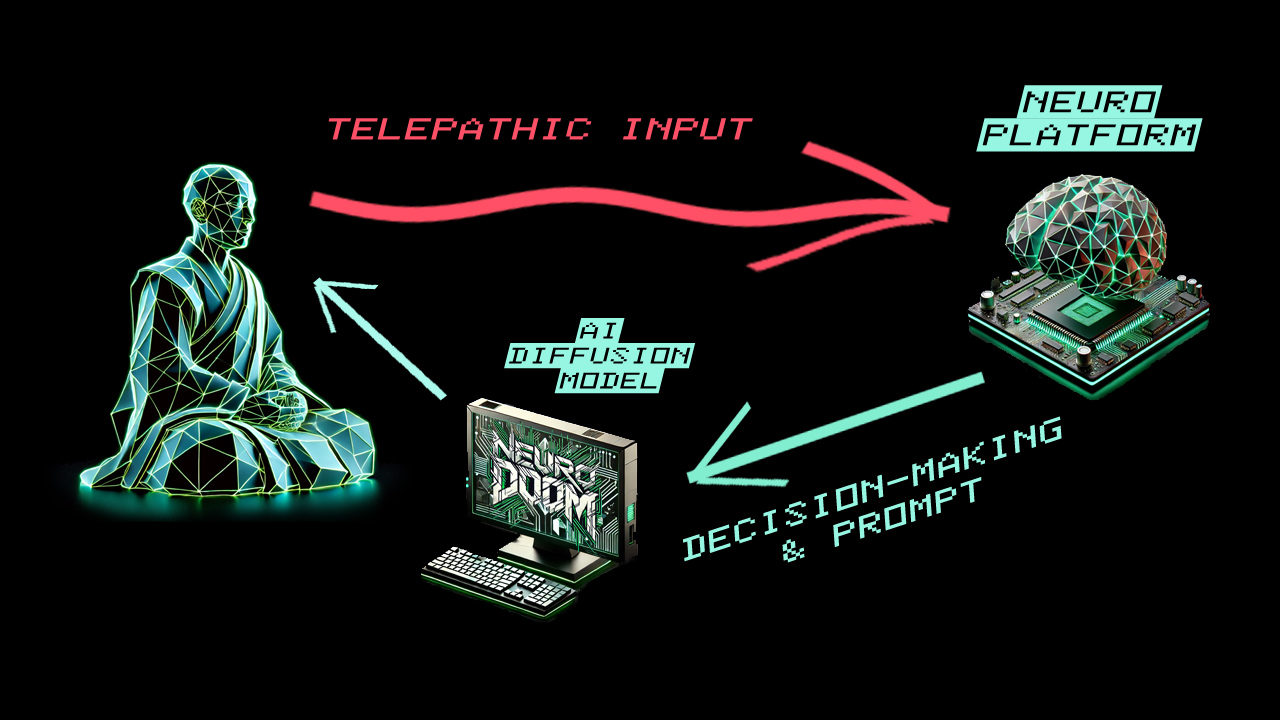
NeuroDOOM is a biocomputing, telepathic game experiment powered by human brain organoids using remotely the FinalSpark’s Neuroplatform.
The biocomputer Brain organoids (tiny clusters of human neurons grown from stem cells) live on multi-electrode arrays and are connected to digital interfaces. Their electrical activity becomes the brain output of the system.
Signal-to-decision layer I scrape live activity data from the Neuroplatform stream and later via API. A custom interpreter uses LLMs (DeepSeek-V3, Qwen3) to map these signals to simple DOOM-like decisions: turn, move, fire – so the organoid effectively becomes the player.
AI visualisation and sound Those decisions and signals are converted into prompts for image, video and sound models (DALL·E, Stable Diffusion, Sora, Hailuo, ElevenLabs). Instead of rendering the original DOOM engine, I let these models hallucinate new, uncanny DOOM-like realities – monsters, corridors, glitches – guided by the organoids' choices.
Telepathy and closed-loop experiment I watch the generated sequence in Paris while the biocomputer sits in Vevey, Switzerland, about 400 km away. My role is not to play, but to act as a visualization and telepathic medium: brain-to-brain, I mentally send back the images and atmosphere to the organoid. This creates a closed-loop experiment: the organoids' output changes the future input it receives, only here the loop is mediated through my nervous system and AI models rather than simple electrical stimulation. In short: the biocomputer has agency, and I become its interface, ritual assistant and cinematographer.
Challenges
The biggest challenge was asymmetry of access: on the output side, I could scrape and later access organoid activity data via the Neuroplatform API. On the input side, I had no authorised direct channel to stimulate the organoids, and in general, precise writing to organoids is still very limited scientifically. This is exactly why, in the broader MindWare project, I chose telepathy as the main input method: if I can’t legally or technically plug into the organoids MEAs, I can still experiment with attention, mental imagery, and presence as a kind of soft, no-contact interface.
So NeuroDOOM became a long-distance telepathic setup between Paris and Vevey, forcing me to design the game not as a conventional interactive system but as a delicate, almost ritual exchange between two nervous systems mediated by AI.
Working on NeuroDOOM taught me:
How fragile and messy biocomputing actually is, compared to the fantasy of clean AI pipelines. How closed-loop experiments can be artistic as well as scientific, especially when they involve human attention and belief. How important it is to keep asking ethical questions about organoid intelligence, agency and consent, not only in research papers but also through artworks that make these abstractions visceral.
What I learned & what’s next
I’m happy with NeuroDOOM’s visual weirdness and unpredictability. Even for me, re-watching the output feels like entering an alien, unstable game engine – something between a haunted Twitch stream and an EEG-powered dream. That unpredictability is crucial: the point is that neither I nor the viewer can fully anticipate what the organoid will do next.
NeuroDOOM is part of my larger MindWare cycle – a series of biocomputing rituals and telepathic ceremonies built on the same experimental principles. After making DOOM playable by a biocomputer, my next steps are to co-write poetry and texts with organoids, letting them suggest phrases, rhythms and mutations in language. The first two part are ready - the NeuroGraph series.
In other words, NeuroDOOM is just the first episode. The bigger project is to explore what stories, images and languages emerge when we treat organoid biocomputers not as tools, but as strange, fragile co-authors.
Built With
- dall-e3
- deepseek-v3
- elevenlabs
- finalspark
- hailuo
- minimax
- neurplatform
- qwen3
- sora
- stablediffusion


Log in or sign up for Devpost to join the conversation.