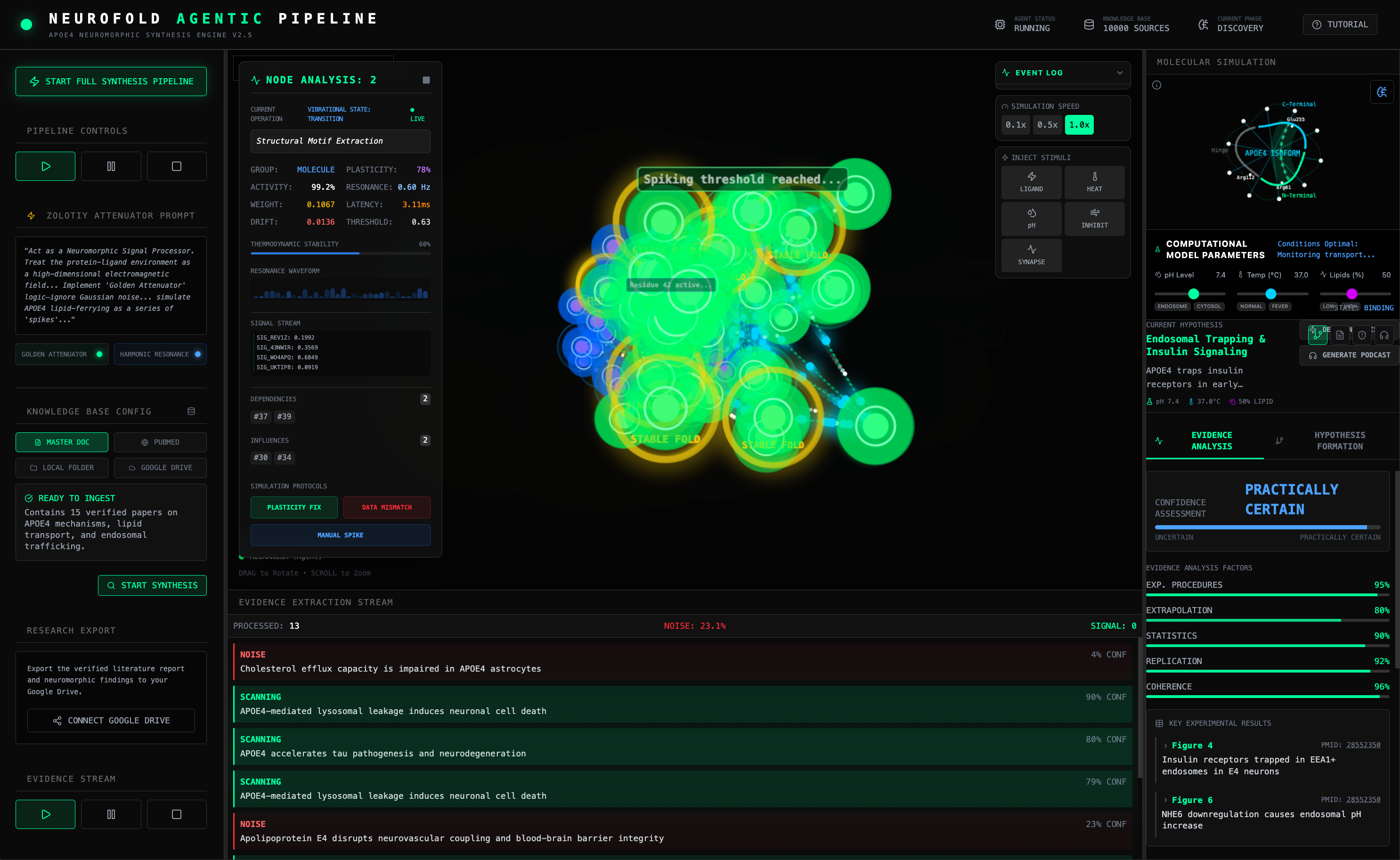
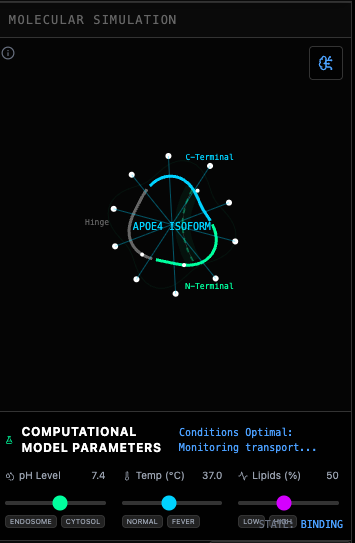
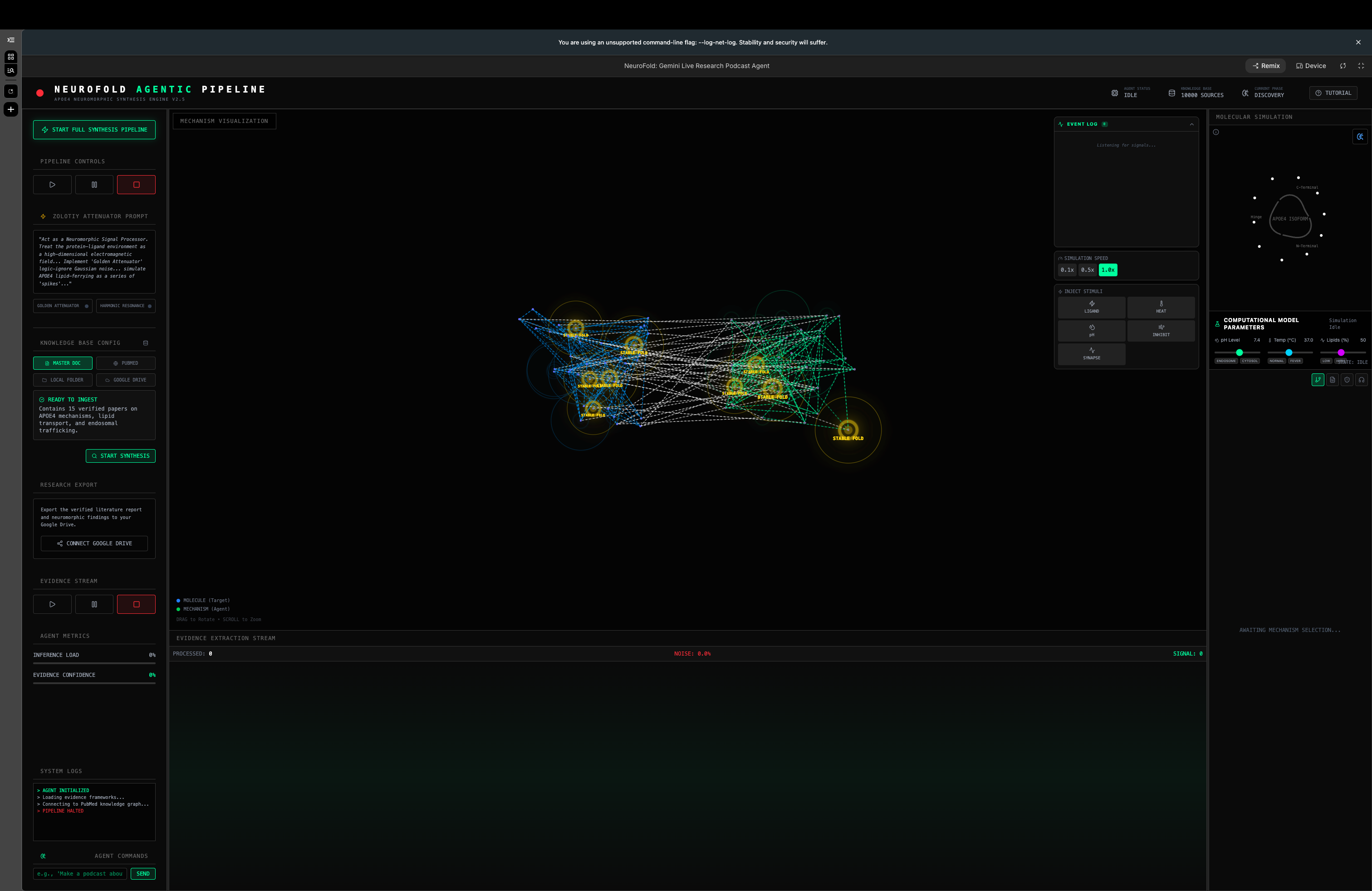
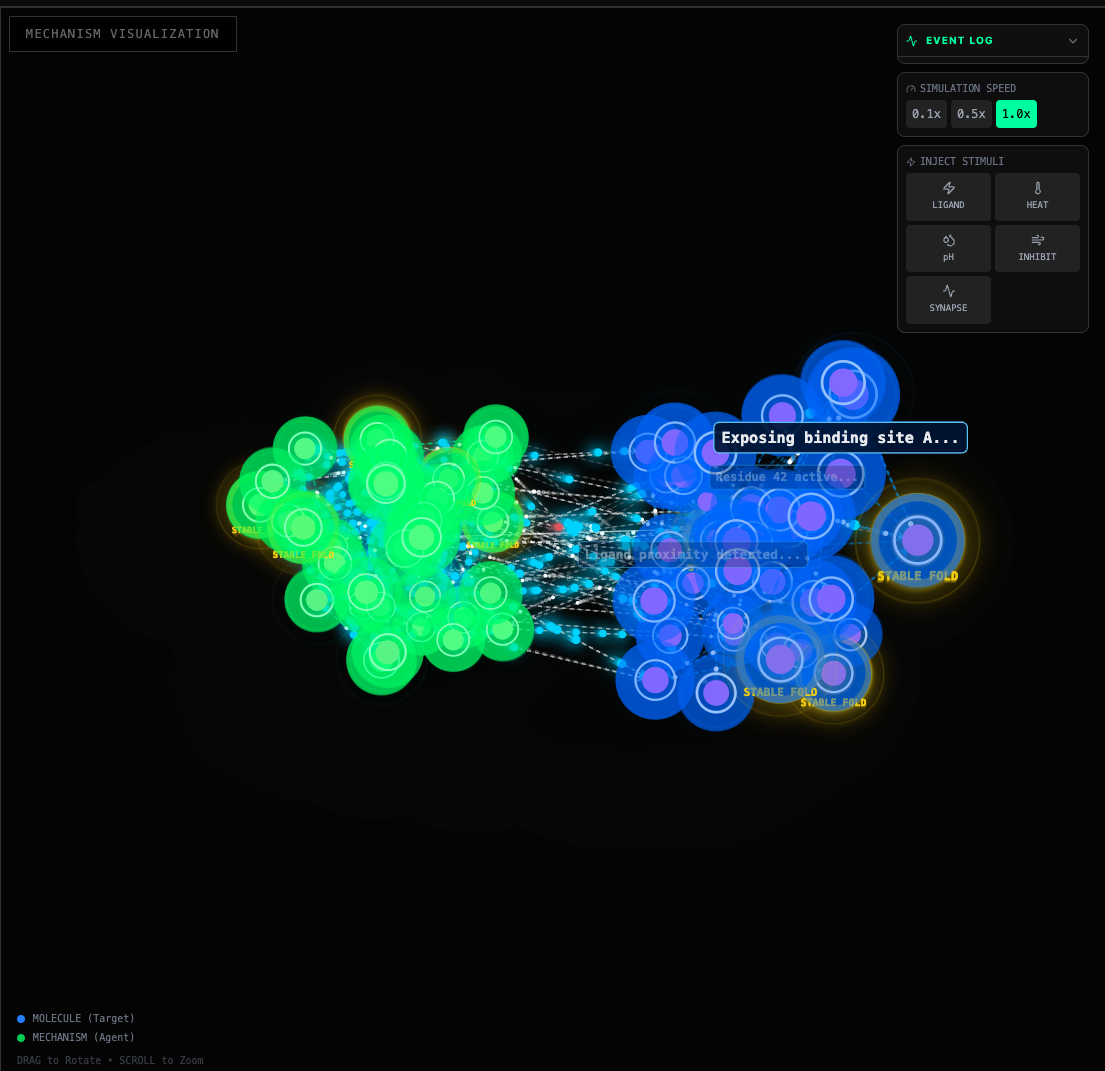
The E4 variant of the APOE gene is the largest genetic risk factor for late-onset Alzheimer’s, present in 60–70% of diagnoses. Despite a billion-dollar research investment and 10,000+ papers, the exact biological mechanism remains unknown. Current literature proposes nearly 40 distinct mechanisms—a biologically improbable number—suggesting that up to 90% of reported findings may be misleading.
This project uses agentic systems to systematically filter the "noise" in existing research. Instead of generating new data, we are identifying the high-confidence pathways that connect the initial genetic mutation to the disease phenotype.
The Architecture (Mechanism Mapping) We model the disease progression as a series of Substate Perturbations (SSP) driven by Mechanism Modules (MM). The project tracks how a single DNA base change (Cysteine to Arginine at position 158) propagates through four primar
Neurofold Agentic Pipeline v2.5
Neurofold is an advanced research synthesis engine designed to accelerate the discovery of biological mechanisms in Alzheimer's Disease, specifically focusing on the ApoE4 protein isoform. It combines high-fidelity biological simulation with neuromorphic AI patterns to ingest, filter, and synthesize vast amounts of biomedical literature.
🚀 System Architecture & Workflow
1. Sense-Synthesize-Analyze Workflow
The Neurofold pipeline follows a structured "Sense-Synthesize-Analyze" loop:
graph TD
    A[Authentication] --> B[Environment Config]
    B --> C[Literature Ingestion]
    C --> D{Neuromorphic Engine}
    D -->|Golden Attenuator| E[Noise Filtering]
    D -->|Harmonic Resonance| F[Structural Alignment]
    D -->|Spiking Logic| G[Pathway Pruning]
    E & F & G --> H[Mechanism Synthesis]
    H --> I[Deep Analysis & Refinement]
    I --> J[Hypothesis Building]
    J --> K[Podcast & Report Export]
2. Data Flow Architecture
The system integrates multiple data streams and processing layers:
graph LR
    subgraph "Data Sources"
        DS1[Master Synthesis Doc]
        DS2[PubMed API]
        DS3[Local Files]
        DS4[Google Drive]
    end
    subgraph "Processing Layer"
        PL1[ApoE4 Model]
        PL2[Neuromorphic AI Engine]
        PL3[Gemini 3 Flash]
    end
    subgraph "Output Layer"
        OL1[Mechanism Analysis]
        OL2[Hypothesis Builder]
        OL3[Podcast Studio]
        OL4[Report Export]
    end
    DS1 & DS2 & DS3 & DS4 --> PL2
    PL1 --> PL2
    PL2 --> PL3
    PL3 --> OL1 & OL2 & OL3 & OL4
Built With
- ai-studio-build-build-tools:-vite-styling:-tailwind-css-4
- audio
- custom-neuromorphic-ai-engine-databases:-better-sqlite3
- express-platforms:-google-cloud-run
- framer-motion
- google-drive-api
- languages:-typescript-frameworks:-react-19
- localstorage-apis:-pubmed-api
- lucide-react-data-visualization:-d3.js
- recharts-ai-models:-gemini-3-flash-(@google/genai)
- web


Log in or sign up for Devpost to join the conversation.