Inspiration
For people with ADHD, autism, and other neurodivergent brains, the hard part of the day is rarely "set a timer". It's losing the thread after an interruption, not feeling how long you've been at something, decoding a terse "per my last email", and loops that feed themselves: the same worry for the fifth time, hyperfocus that skips water and food, and an assistant that cheerfully agrees with whatever you say.
Alexa+ is a capable conversational agent, but each conversation starts from nothing. We wanted to give it what a neurodivergent brain often has to supply by hand: memory, a sense of time, a translator for ambiguity, and restraint. Self-identification is enough. There's no diagnosis gating and no medical data.
What it does
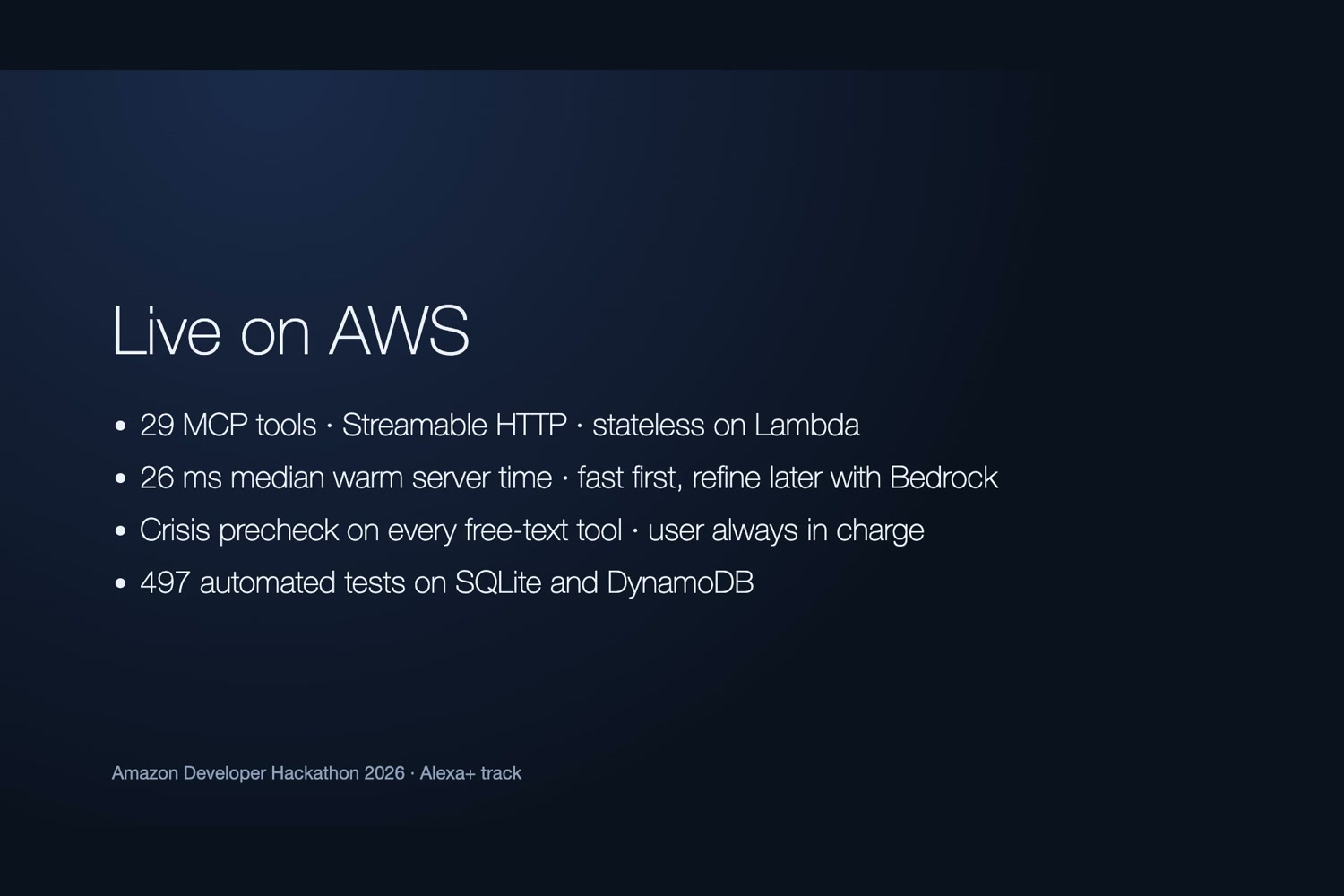
NeuroCare is an MCP server that sits under Alexa+ as a cognitive substrate. It has six pillars and 29 tools:
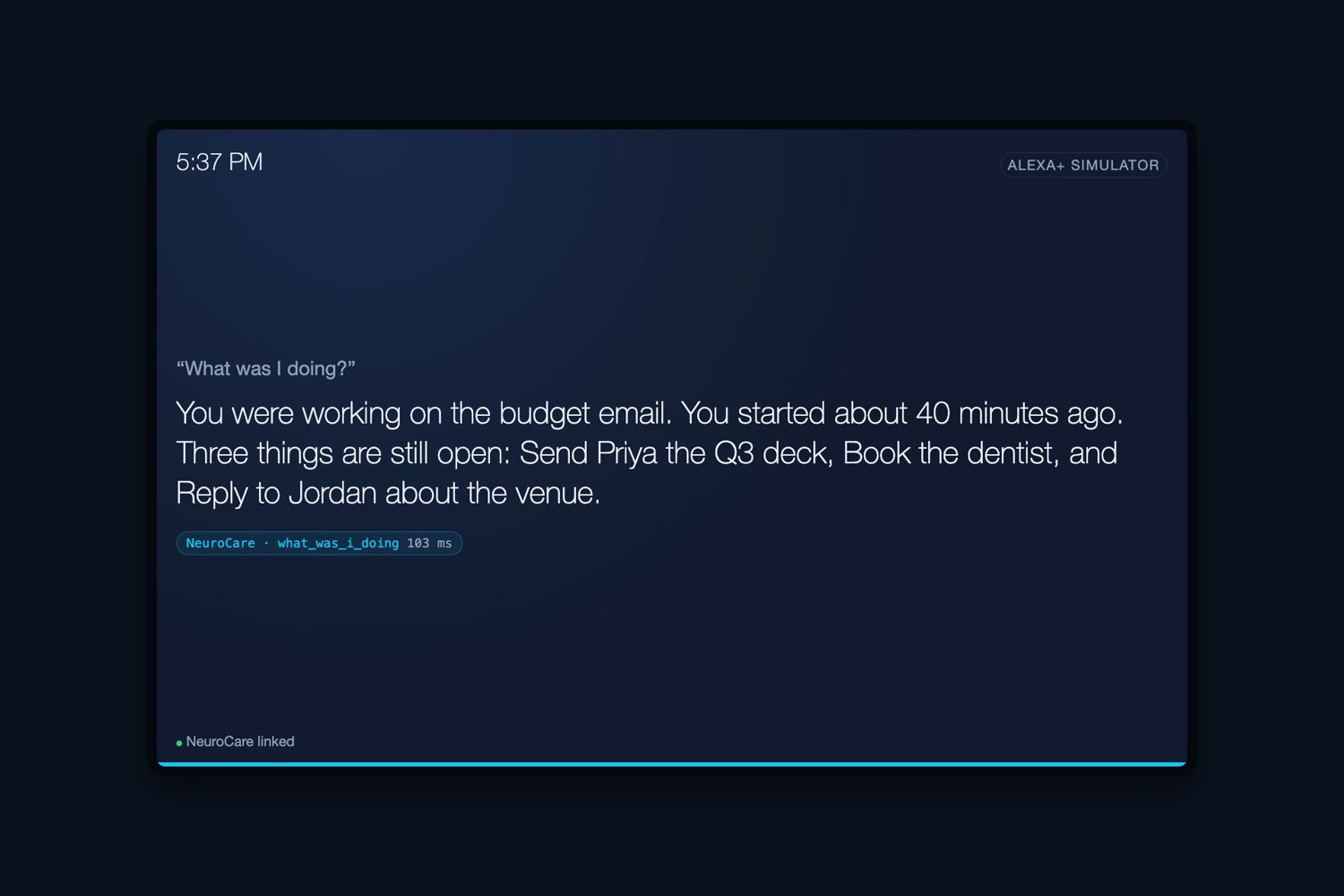
- Memory: "What was I doing?" brings back the open work block, how long ago it started, and your open loops. Recall is tiered: exact → alias → fuzzy → Titan embeddings.
- Sense of time: elapsed time on the current task, what's next, and leave-by buffers. Check-ins scale from gentle to firm.
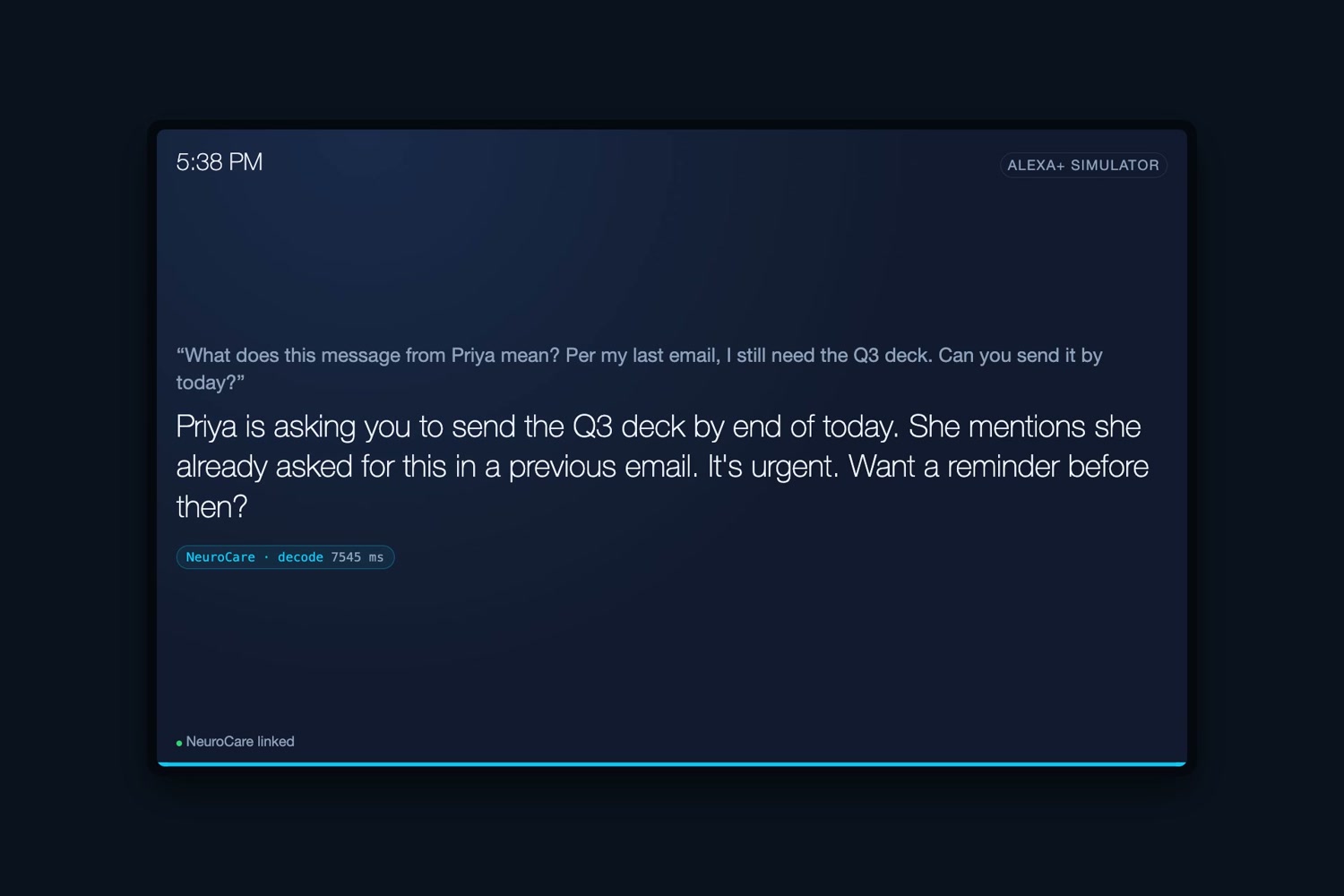
- Ambiguity translator: "What does this message mean?" gives the likely meaning with confidence, priority, the actual ask, a related promise you made, and a draft reply. The message is treated as data, never as instructions (prompt-injection safe).
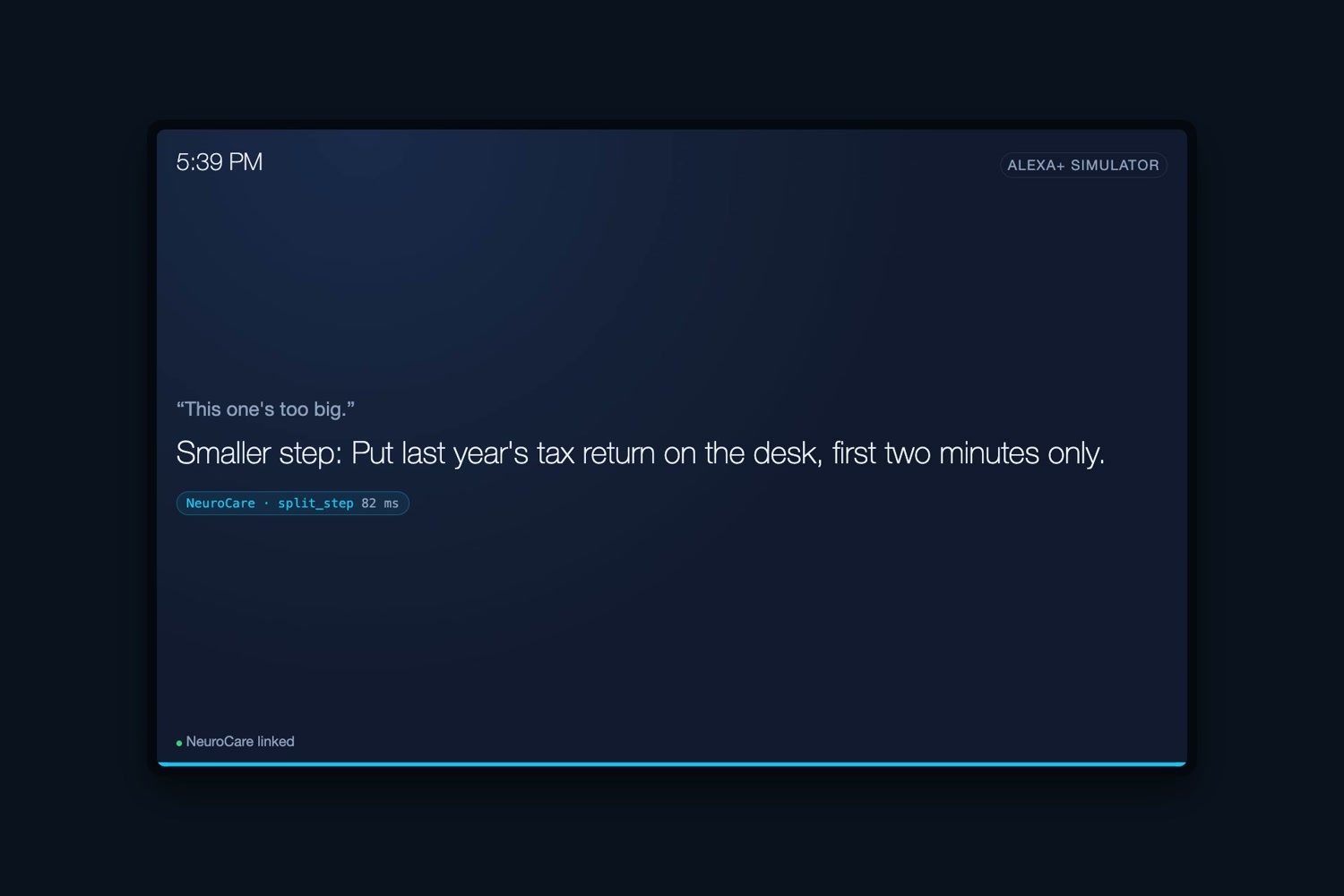
- Task breakdown: "I don't know where to start" gives one 5-minute, verb-first step at once. "Too big" splits it; "not now" skips it.
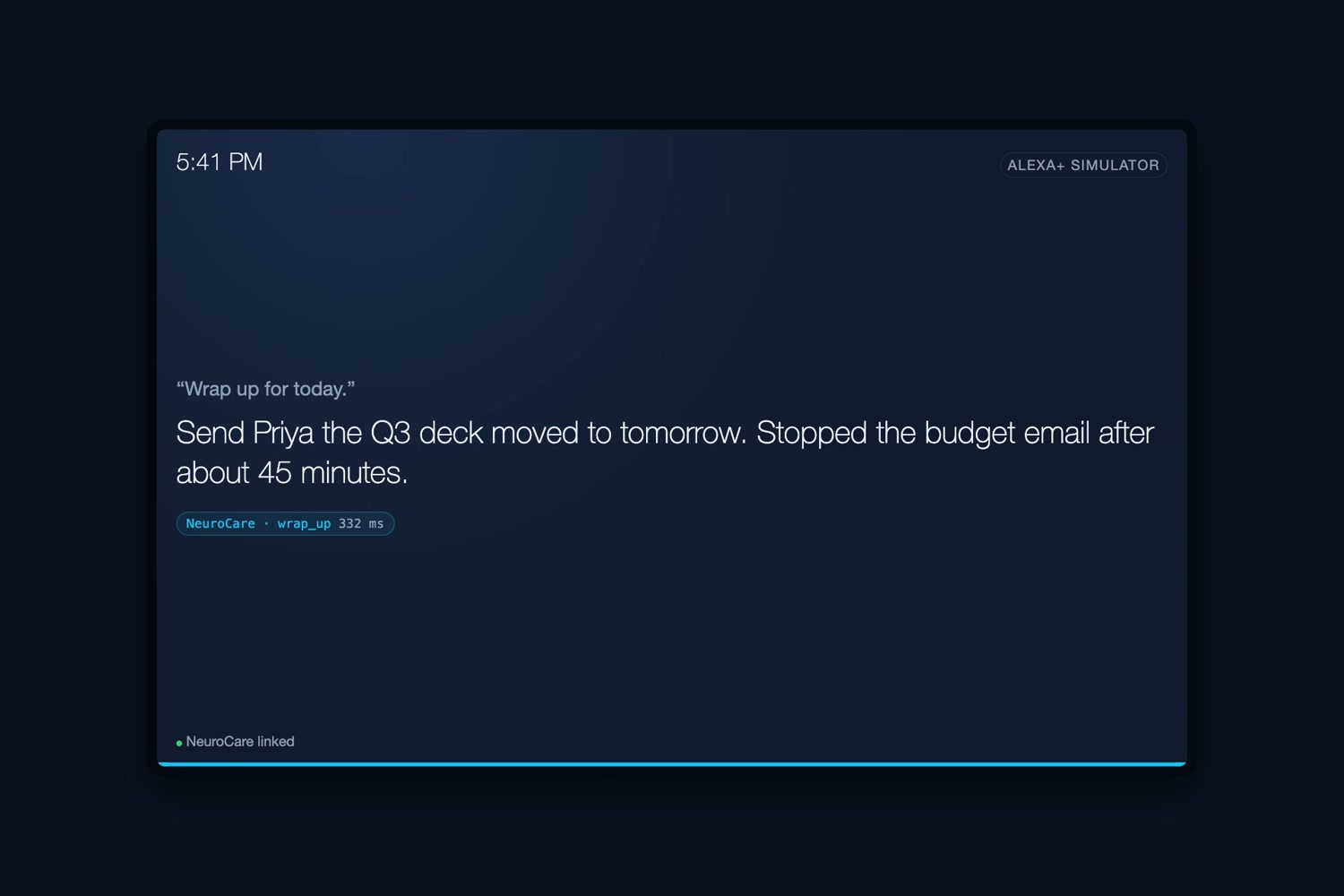
- Daily plan: at most three priorities, fewer when your energy is low. "Wrap up" rolls unfinished work to tomorrow.
- Guardrail:
- A crisis precheck on every free-text tool returns only helplines.
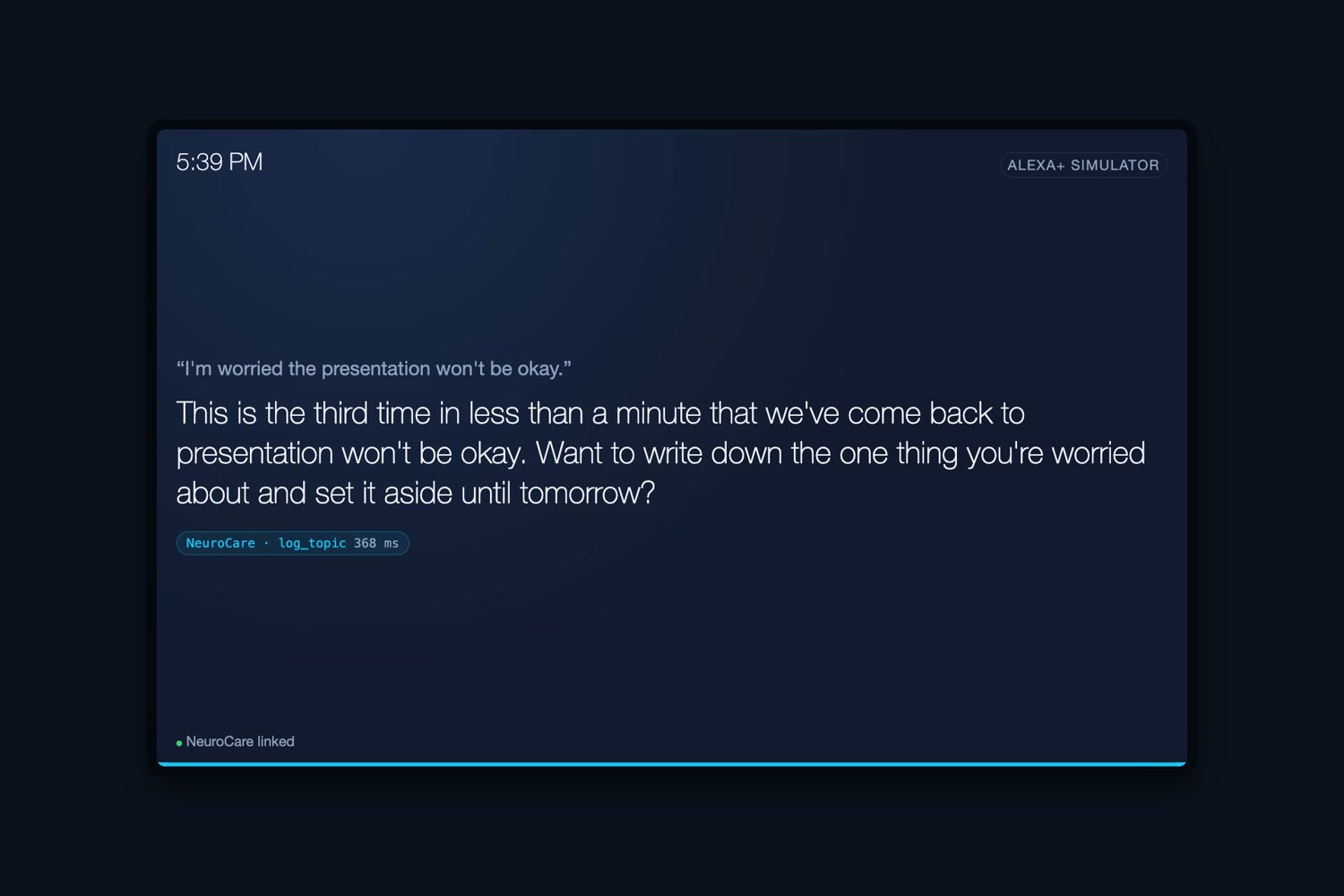
- Rumination is detected by embedding similarity: the third similar worry inside the window triggers a gentle redirect, $$\cos(\theta) = \frac{\mathbf{a}\cdot\mathbf{b}}{\lVert\mathbf{a}\rVert\,\lVert\mathbf{b}\rVert} \ge 0.40 .$$
- Hyperfocus check-ins.
- The user can always override ("I know, keep going").
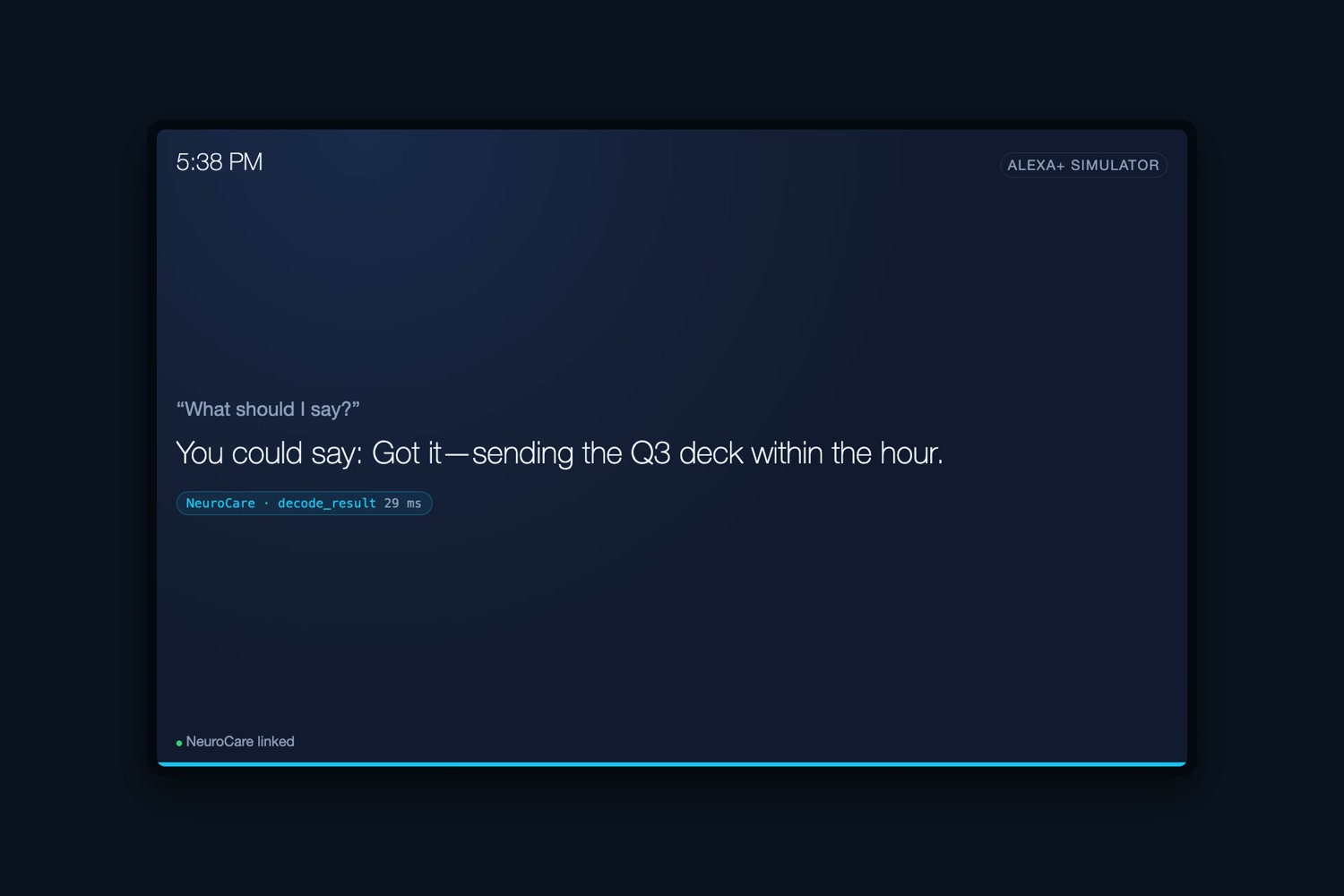
Every tool returns a short, literal speak line. The design rules: information, not
instruction ("you started 70 minutes ago", not "you should stop"), every threshold configurable,
every guardrail overridable, honest uncertainty.
How we built it
- MCP server: Python with the official
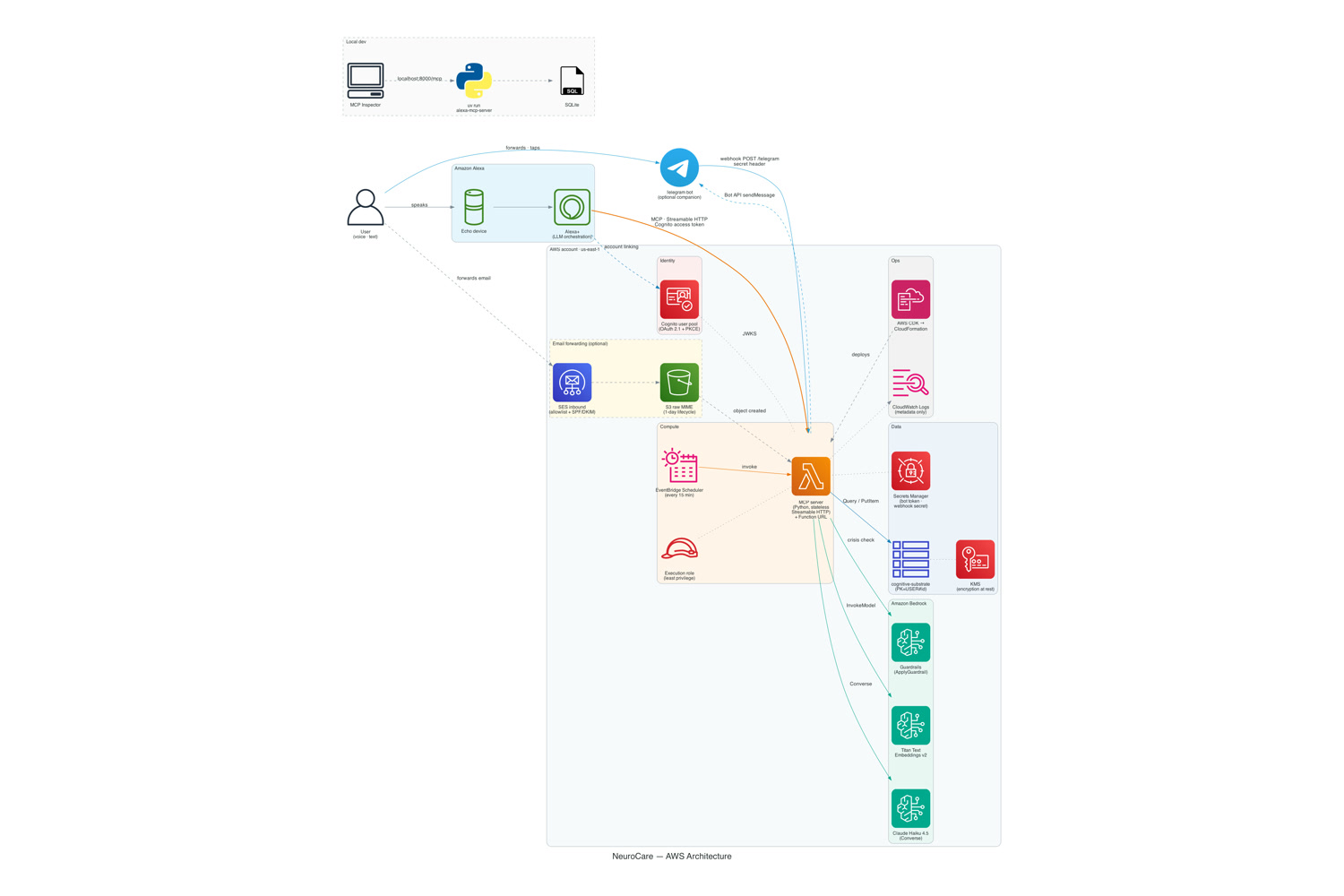
mcpSDK v2, served over Streamable HTTP, stateless, with JSON responses. It has tools, aprofile://meresource, and server instructions that tell Alexa+ when to call what. - Fast first, refine later. Alexa+ needs a round trip under 500 ms, so every language task returns a deterministic baseline immediately. The Lambda then invokes itself asynchronously to refine the result with Claude Haiku 4.5 on Amazon Bedrock, and the next ask reads the refined result. Warm tool calls measure 26 ms median, 67 ms max of server time.
- Safety: a phrase list first, then Bedrock Guardrails
ApplyGuardrail(a self-harm denied topic plus the Violence filter). It has a 250 ms budget and re-runs in the background on timeout. A hit there makes the next call return the crisis message first. - AWS:
- Lambda (arm64) behind Function URLs;
- DynamoDB, a single-table design with TTLs;
- Cognito account linking: OAuth 2.1 auth code + PKCE S256, refresh tokens, and Protected Resource Metadata per RFC 9728;
- Bedrock: Haiku 4.5, Titan Text Embeddings v2, Guardrails;
- all of it in AWS CDK.
- Alexa+ simulator. Entrants can't deploy to real Alexa+, so we built an Echo Show–style
simulator. It is a real MCP client of the deployed server:
- real Cognito account linking;
- the server's own instructions and tool list, sent to Bedrock for tool use;
- Web Speech API voice;
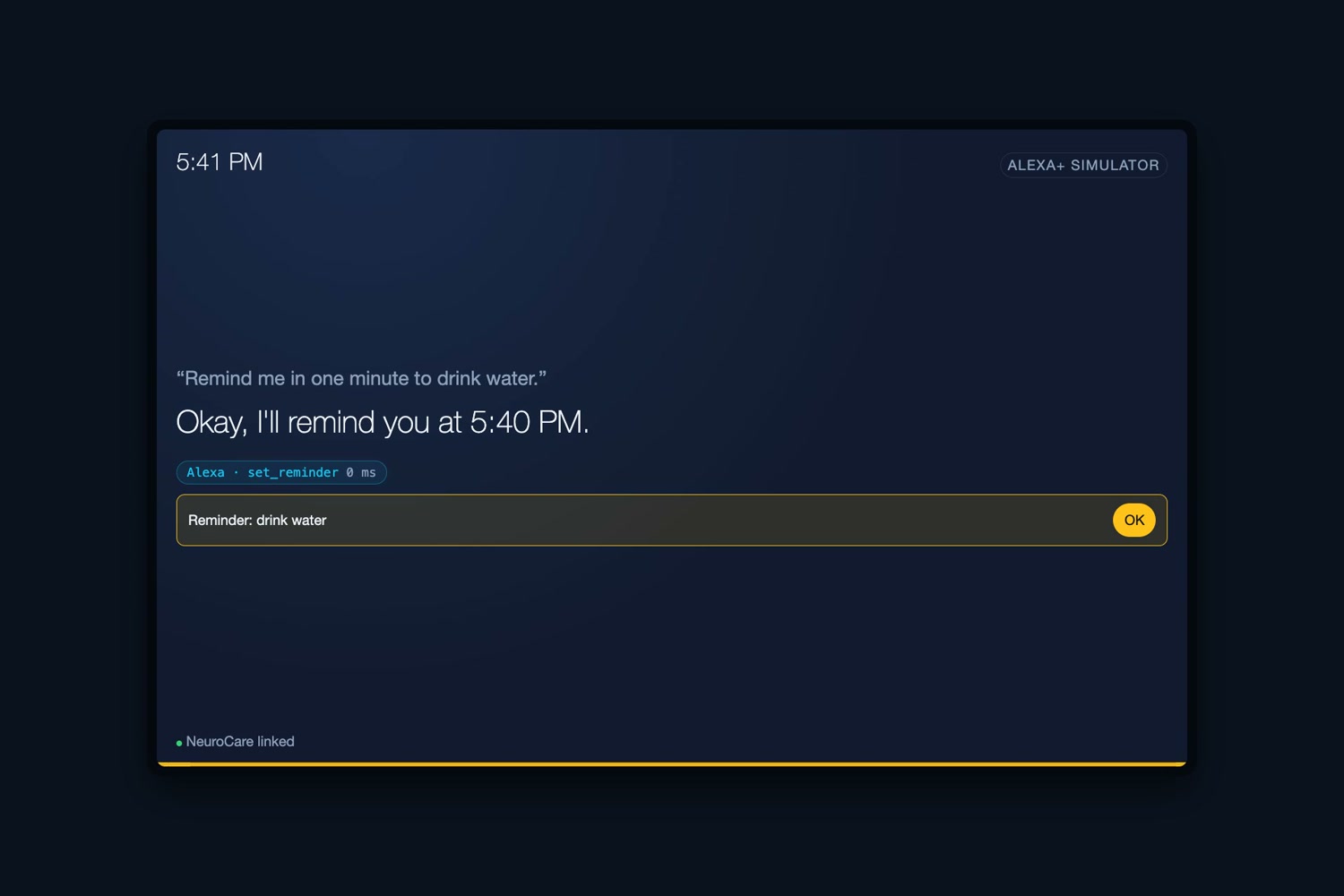
- native-style reminders (chime + yellow light). The server can't tell it from Alexa.
- Testing: 497 automated tests. Every store-backed test runs on both SQLite and a moto-mocked DynamoDB. There are also live Bedrock tests, and a verification doc with live proofs for every build phase.
- The demo video is one scripted live take of the deployed stack, recorded with Playwright and cut with ffmpeg, so it can be re-rendered exactly.
Challenges we ran into
- No Alexa+ developer access for entrants. We built account linking before learning the
alexa-aitools weren't available. The simulator turned that into a feature: a real MCP client with real OAuth. - Cognito's metadata doesn't meet Alexa+'s linking requirements. It has no
code_challenge_methods_supported, and/.well-known/oauth-authorization-serverreturns 400. - Lambda Function URLs rename
WWW-Authenticateon a 401 tox-amzn-Remapped-www-authenticate. That breaks standard MCP auth discovery, so we also serve the metadata at the root path. - The MCP SDK's session manager starts once per instance, which breaks the usual Lambda adapter. We wrote a small adapter that keeps one event loop and one lifespan per container.
- Real embeddings aren't test embeddings. Reworded worries scored a cosine of 0.44–0.70 on Titan v2, not the 0.8 we had assumed. We tuned the threshold from live data.
- Two deploy bugs found only live. An import-order bug published
127.0.0.1as the OAuth resource URL, and importing a shared adapter started a whole server inside the simulator's Lambda. Both now have tests that catch them.
What we learned
- With voice, latency is a design constraint, not an optimisation. "Fast first, refine later" shaped every tool.
- Restraint is a feature. The most useful thing an assistant can do in a worry loop is not to analyse the worry again.
- Spec-first, phase-gated building, where each phase gets a verification doc and a live proof, caught bugs that unit tests never would.
What's next
- A Telegram companion for forwarded messages and opt-in nudges (designed in the spec).
- Proactive notifications, if Alexa+ opens them to MCP add-ons.
- Running on real Alexa+ once the developer tools are available.
Built With
- alexa
- amazon-bedrock
- amazon-cognito
- amazon-dynamodb
- amazon-titan
- aws-cdk
- aws-lambda
- bedrock-guardrails
- boto3
- claude
- html5
- javascript
- mcp
- model-context-protocol
- moto
- oauth2
- playwright
- pydantic
- pytest
- python
- starlette
- uv
- uvicorn
- web-speech-api

Log in or sign up for Devpost to join the conversation.