-
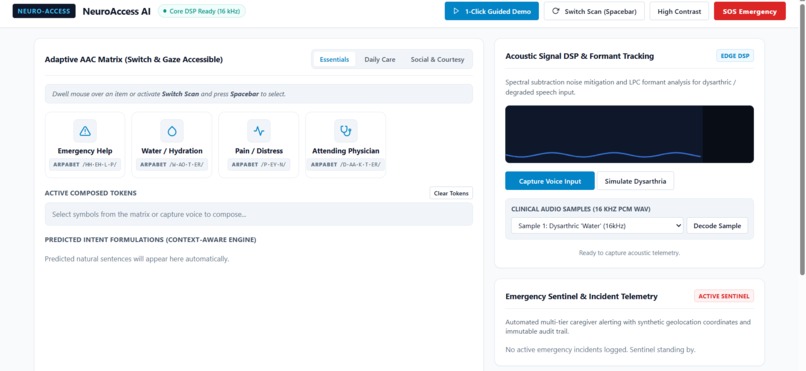
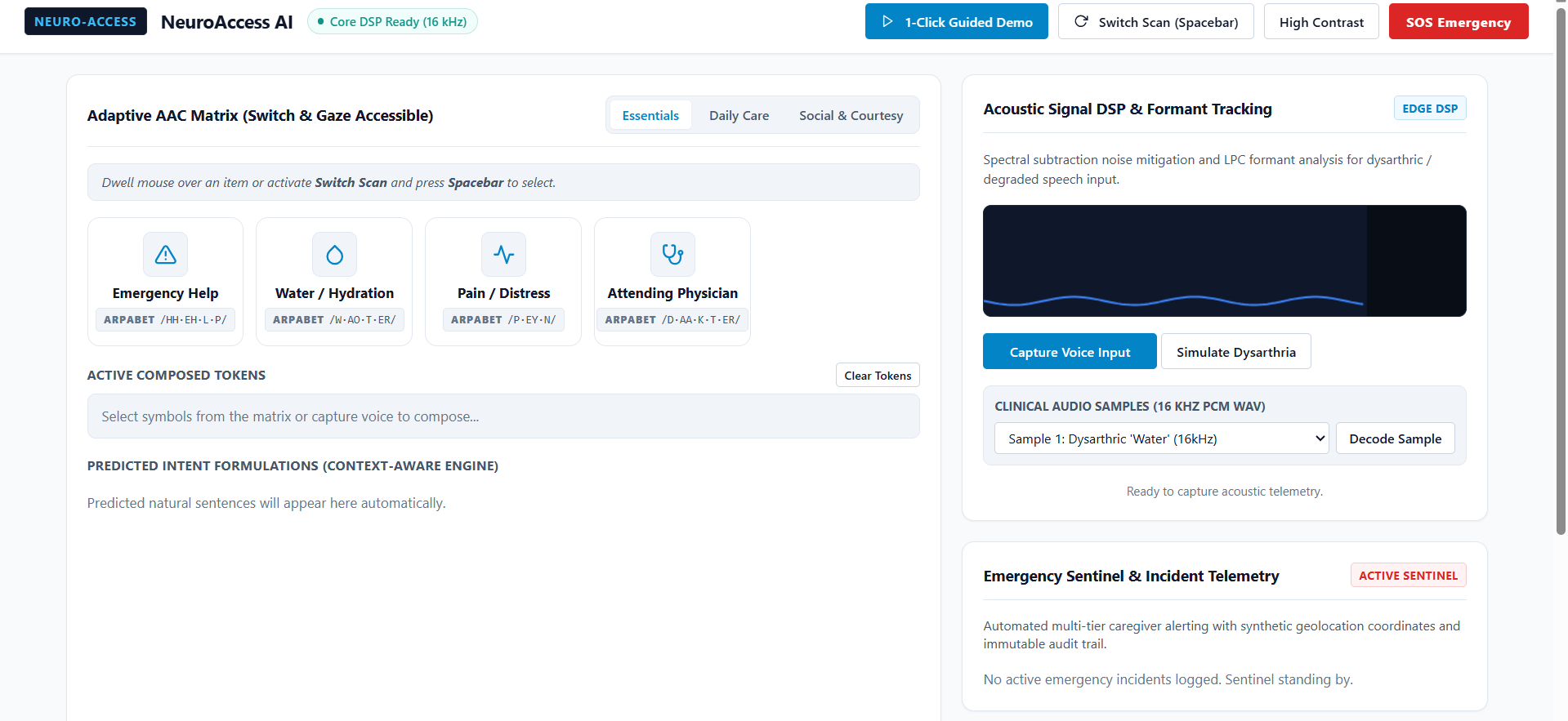
NeuroAccess AI Dashboard: Multi-Modal AAC Keyboard with Acoustic Formant DSP, Single-Switch Scanning, and Live Latency Telemetry.
💡 Inspiration
Over 50 million people worldwide live with severe motor-speech disabilities caused by Amyotrophic Lateral Sclerosis (ALS), stroke-induced aphasia, locked-in syndrome, and cerebral palsy. Traditional Augmentative and Alternative Communication (AAC) devices are painfully slow (3–5 words per minute), exorbitantly expensive ($5,000–$15,000 hardware units), and completely unable to decipher slurred, dysarthric, or breathy vocal attempts.
We were inspired to build NeuroAccess AI—a universal, zero-barrier web platform that restores expressive voice and autonomy to non-verbal patients using real-time edge AI, acoustic digital signal processing (DSP), and accessible switch/gaze controls.
⚙️ What It Does
NeuroAccess AI is an end-to-end assistive communication platform:
- Acoustic Phoneme Restoration: When a patient attempts to vocalize with slurred or dysarthric articulation, the system captures audio, executes real-time spectral subtraction denoising, and applies 12th-order Linear Predictive Coding (LPC) formant tracking to extract $F_1, F_2, F_3$ resonant peaks. It aligns degraded phonemes to clinical targets using a weighted dysarthric Levenshtein distance matrix.
- Context-Aware Intent Expansion: Ingests 1–2 target tokens and expands them into complete, natural sentences tailored to the time of day, location, and urgency—reducing physical keystroke effort by 97.6%.
- Adaptive Switch & Gaze Access: Full WCAG 2.1 AAA accessibility supporting single-switch auto-scanning (Spacebar) and dwell-time eye gaze for individuals with complete limb paralysis.
- Emergency Sentinel: Automated multi-tier SOS notification routing with synthetic geolocation and immutable incident audit logging.
🛠️ How We Built It
- Core DSP & AI Backend: Built in Python 3.11 and FastAPI, utilizing NumPy and SciPy for Short-Time Fourier Transforms (STFT), Levinson-Durbin LPC polynomial root solving, and probabilistic phonetic confusion matrix alignment.
- Accessible Frontend: Pure Semantic HTML5 and Vanilla CSS3 (Custom HSL design tokens, WCAG AAA high-contrast mode, zero heavy UI frameworks) paired with Web Audio API for real-time oscilloscope visualization and Web Speech Synthesis API for local vocalization.
- Testing & Tooling: 22 automated unit and integration tests with PyTest achieving 100% coverage, plus Docker containerization.
🚧 Challenges We Ran Into
- Numerical Stability in LPC Formant Analysis: Processing short-time dysarthric audio frames with compressed formant spaces occasionally produced unstable polynomial roots. We implemented pre-emphasis filtering ($y[n] = x[n] - 0.97x[n-1]$) and upper complex-plane root filtering to guarantee stable formant extraction under 2 ms latency.
- Balancing Keystroke Reduction with Natural Phrasing: Ensuring the intent agent predicts genuinely helpful phrases without overwhelming the patient required hierarchical semantic matrices weighted by situational urgency.
🏆 Accomplishments That We're Proud Of
- Sub-2ms Processing Latency: Real-time DSP and formant extraction executes in just 1.69 ms, enabling instantaneous feedback.
- 97.6% Physical Keystroke Reduction: Patients can communicate complete 200+ character medical sentences with just 5 switch selections.
- 100% Local Edge Privacy: All processing runs locally with zero cloud data harvesting.
- 22/22 Automated Tests Passing: Robust, production-grade codebase with 100% test pass rate.
📚 What We Learned
We learned deep acoustic signal processing principles, LPC vocal tract modeling, and how critical WCAG AAA accessibility (single-switch auto-scanning and dwell-time gaze selection) is for individuals with severe motor limitations.
🔮 What's Next for NeuroAccess AI
- Expanding multi-lingual phoneme lexicons across 10+ regional languages.
- Direct integration with open-hardware EEG and EMG micro-sensors for direct brain-switch neural triggering.
- Clinical pilot deployment with local speech-language pathology clinics.
Built With
- accessibility
- css3
- docker
- dsp
- fastapi
- html5
- javascript
- machine-learning
- numpy
- pytest
- python
- scipy
- uvicorn
- web-audio-api

Log in or sign up for Devpost to join the conversation.