Inspiration
Universities today run on deeply fragmented systems. Facilities, academics, energy management, and administration all use separate applications. This disjointed architecture creates massive inefficiencies, delayed response times, and critical operational blind spots. We were inspired to bridge this gap not by adding yet another dashboard or app, but by fundamentally rethinking campus infrastructure. We wanted to transform a passive, reactive campus into a self-orchestrating, intelligent entity, giving the university a true physical "nervous system."
What it does
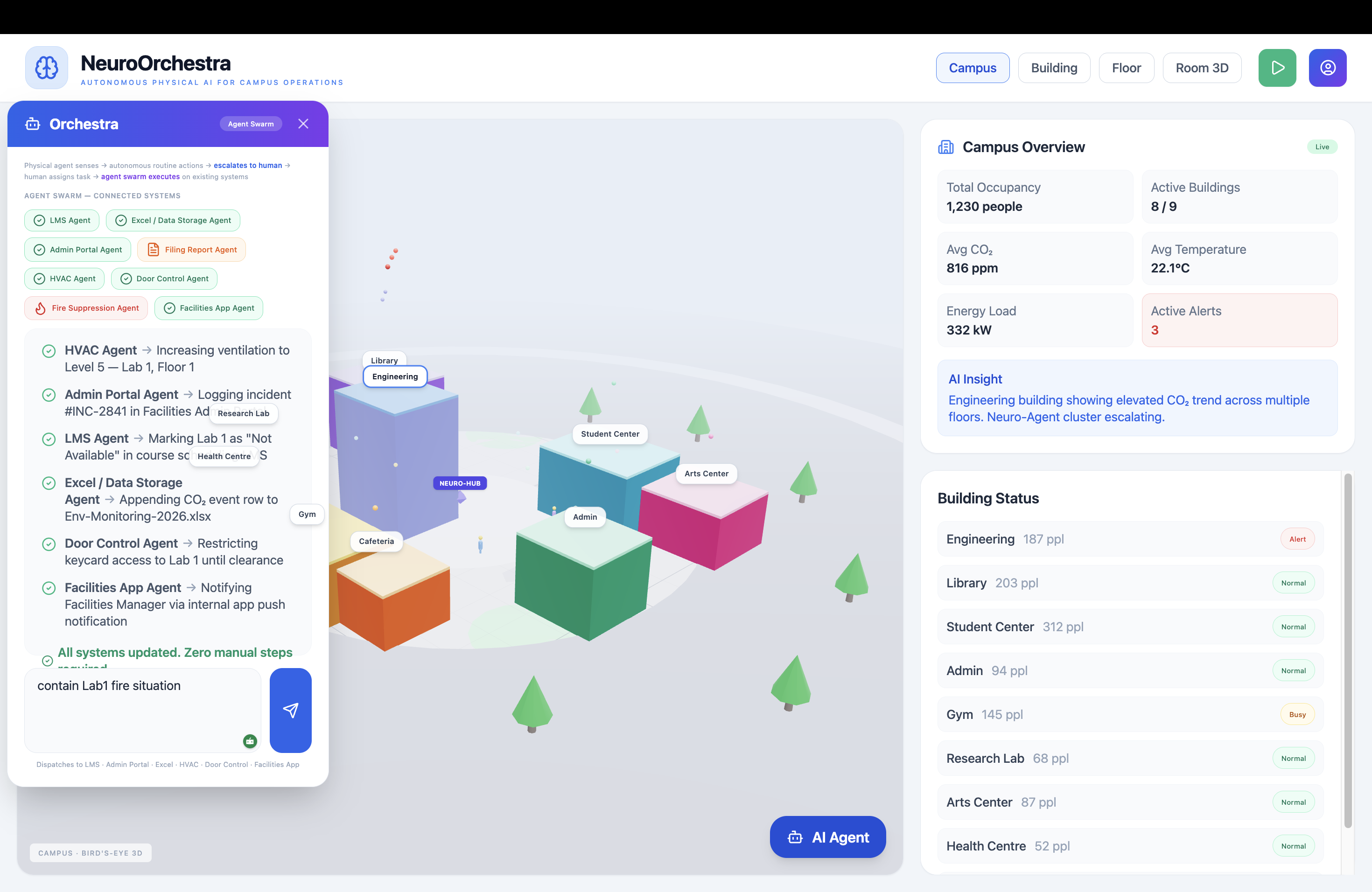
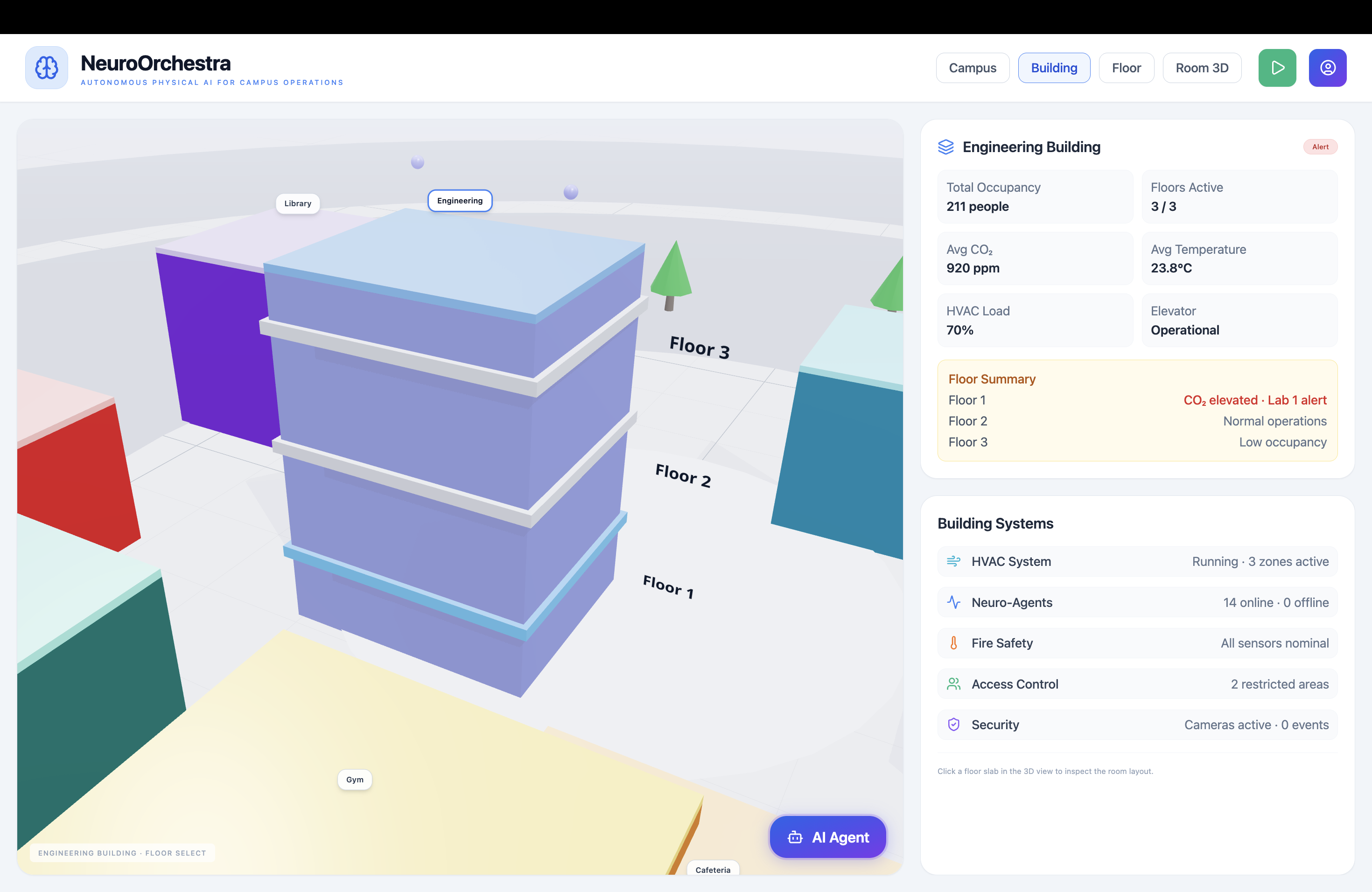
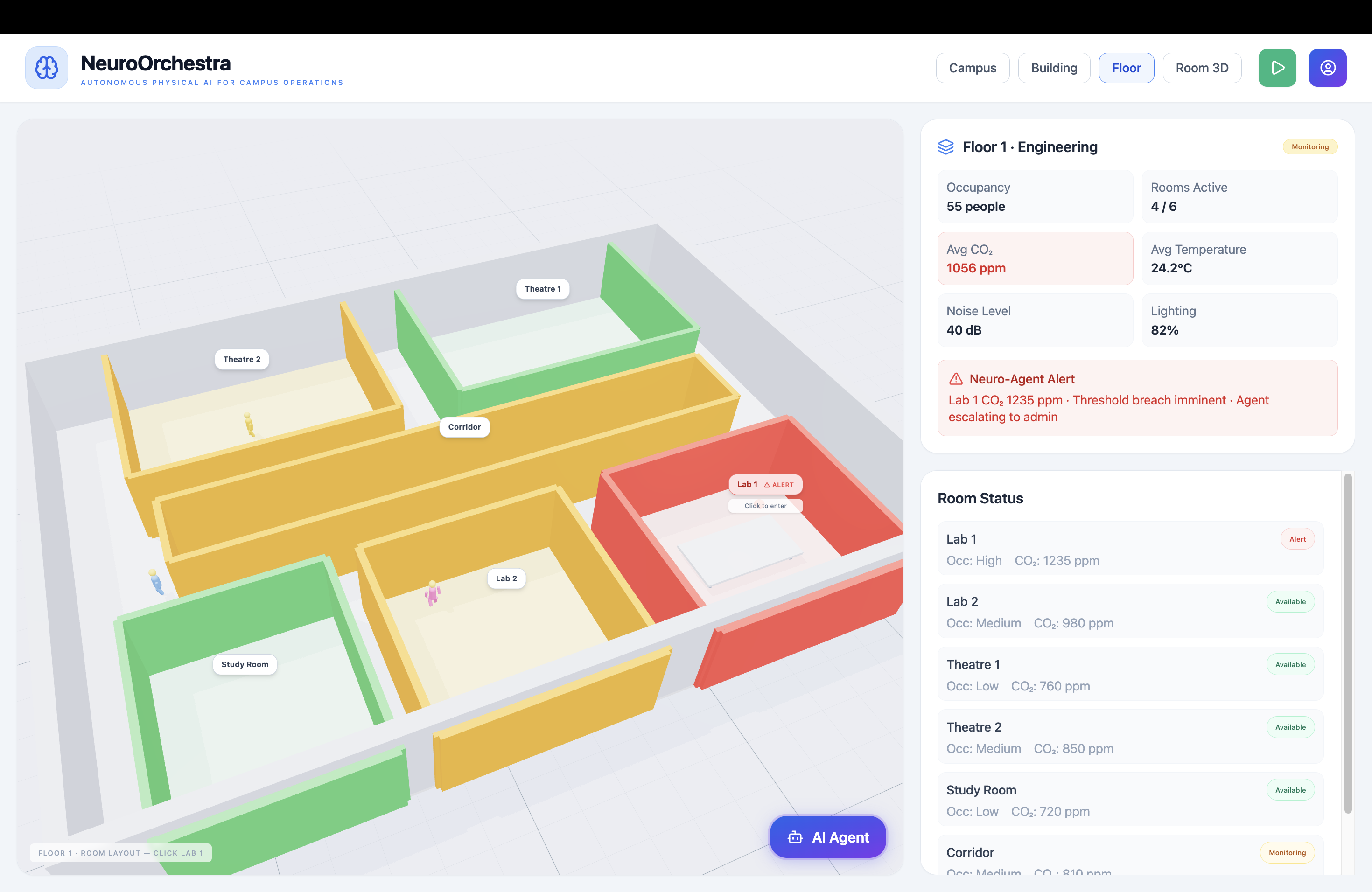
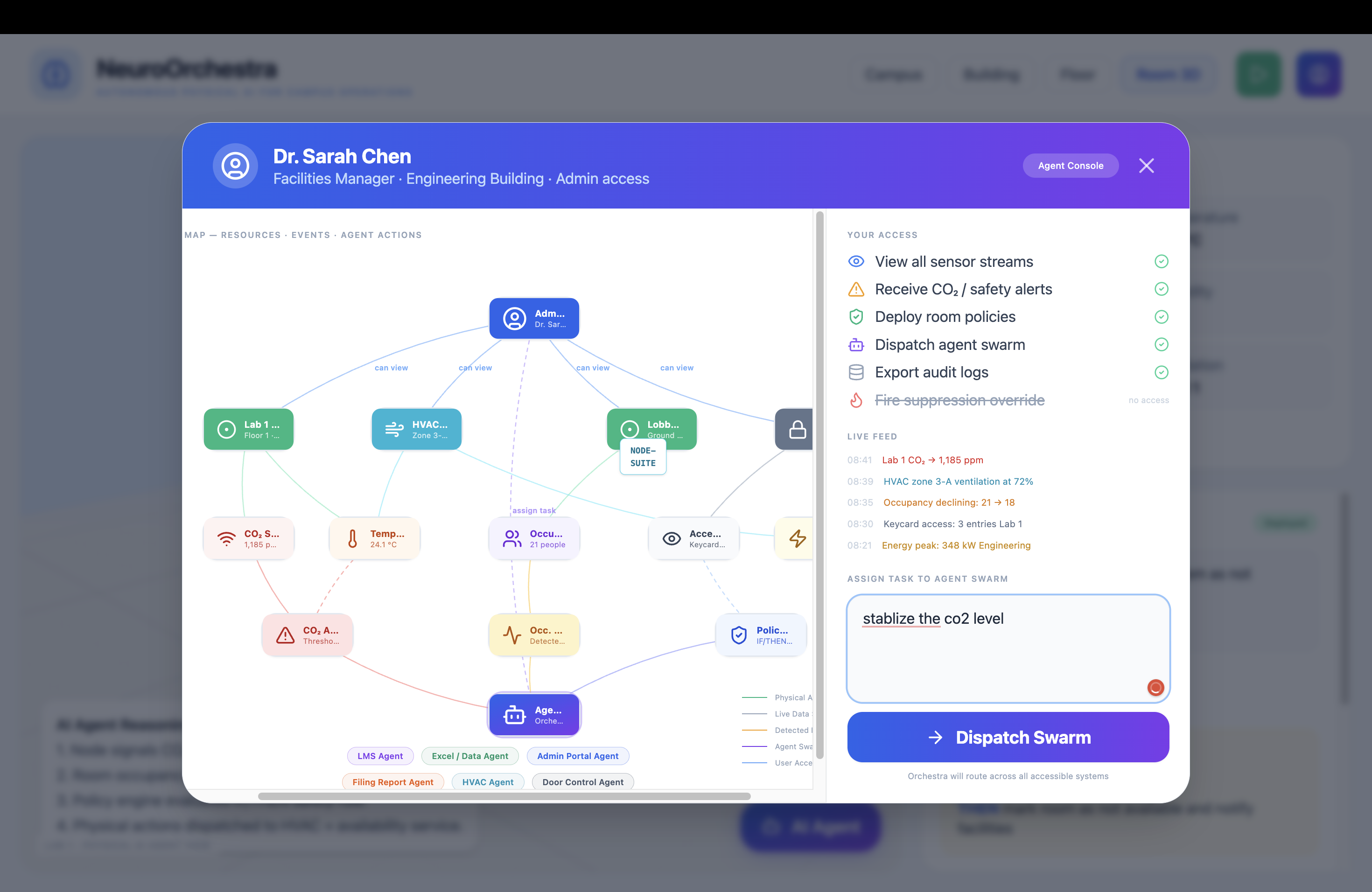
Neuro-Orchestra is an agentic physical AI network that plugs directly into existing university environments. We deploy autonomous edge AI agents across campus to sense, decide, and act in real time.
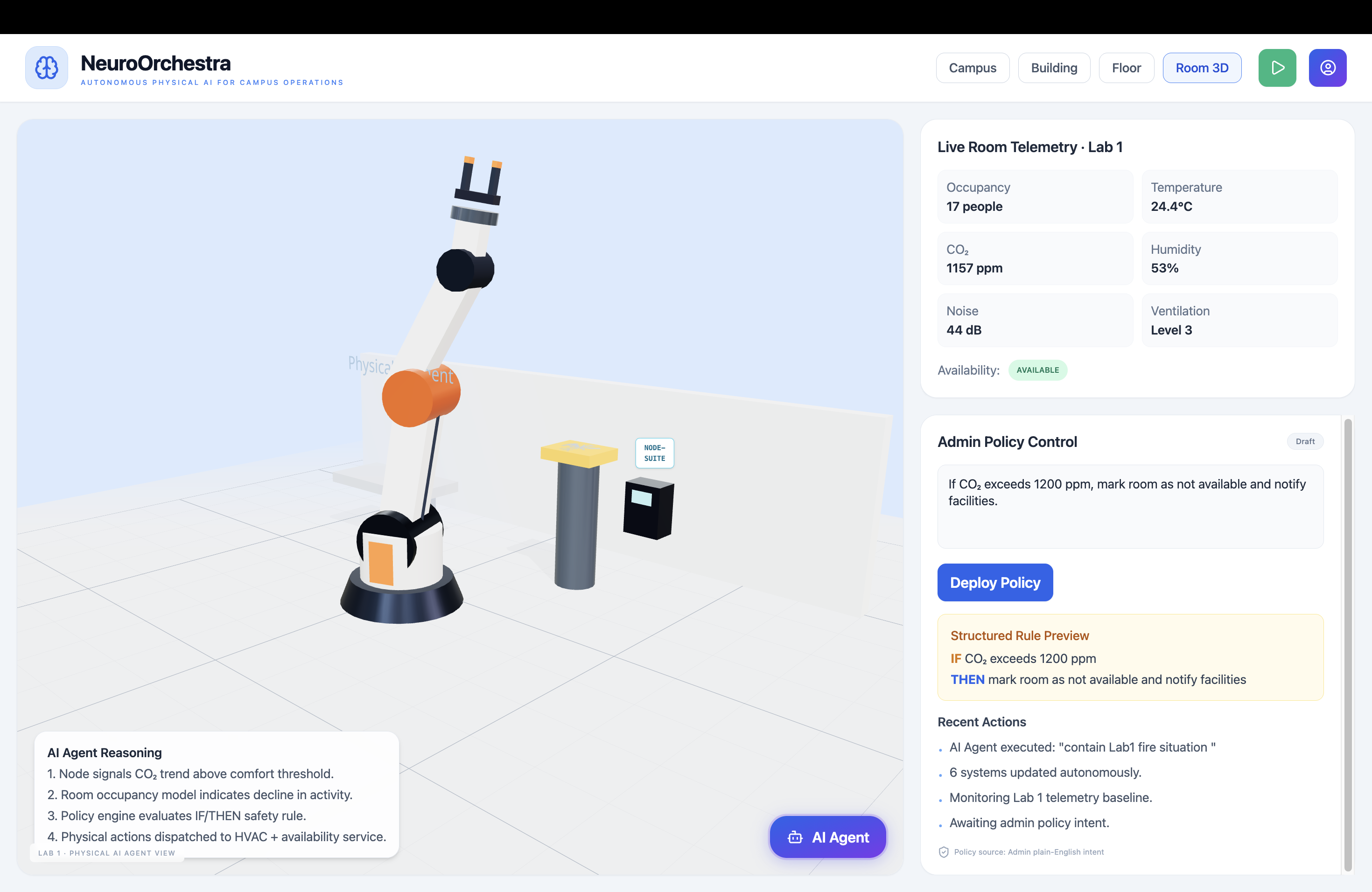
Local Autonomous Action: At the edge, hardware nodes monitor environmental and operational data. Routine issues (like optimizing HVAC based on room occupancy, or shutting down idle lab equipment) are handled automatically by local agents.
Swarm Coordination & Escalation: Critical events or anomalies are instantly escalated to human administrators.
Natural Language Infrastructure: Instead of navigating complex legacy software, administrators can reprogram and coordinate this swarm of physical agents across buildings using simple natural language commands.
How we built it
We built Neuro-Orchestra as a full-stack hardware and software ecosystem.
The Physical Edge: We utilized microcontrollers like the Arduino UNO Q paired with various sensor shields to collect environmental data (temperature, motion, light). ESP32 modules were used to give these edge nodes wireless connectivity and allow them to communicate securely.
The Nervous System: The edge devices feed data to a central orchestrator. We built an NLP interface that translates natural language commands from administrators into actionable, encoded instructions that the microcontrollers can execute.
Agentic Logic: We designed a lightweight decision-making architecture that allows the edge nodes to operate semi-autonomously, only pinging the central server when a threshold is breached or a cross-campus coordinated response is required.
Challenges we ran into
Hardware-to-Software Bridge: Ensuring ultra-low latency communication between the physical microcontrollers (ESP32s/Arduinos) and the central AI orchestrator.
Translating NLP to Physical Action: It was challenging to parse ambiguous natural language from an administrator into the rigid, precise state changes required by hardware components without causing system errors.
Edge Constraints: Balancing the limited computational power and memory of edge microcontrollers with the need for them to run autonomous, intelligent logic without constantly relying on the cloud.
Accomplishments that we're proud of
Successfully creating a closed-loop system where physical hardware can both sense the environment and autonomously act on it without human intervention.
Building a seamless natural language interface that actually triggers real-world hardware state changes across a distributed network of microcontrollers.
Taking a highly abstract concept (an "agentic nervous system") and proving it works on physical hardware within the time constraints of a hackathon.
What we learned
We deepened our understanding of hardware integration, specifically managing the intricacies of sensor data filtering and ESP32 networking.
We learned how to design more resilient prompts and agentic workflows to ensure that NLP models safely control physical infrastructure.
We realized the immense potential of edge computing, processing data exactly where it is gathered drastically reduces latency and reliance on central servers.
What's next for Neuro Orchestra
Advanced Adaptive Policies: We want to implement Reinforcement Learning so that the edge agents can optimize campus energy and facility management policies dynamically over time, learning the unique rhythms of the student body.
Expanded Sensor Suites: Integrating more complex hardware, such as computer vision modules or advanced air quality sensors, to give the "nervous system" richer context.
Predictive Maintenance: Moving from real-time reactions to predictive models, allowing the system to flag failing university infrastructure before a breakdown actually occurs.


Log in or sign up for Devpost to join the conversation.