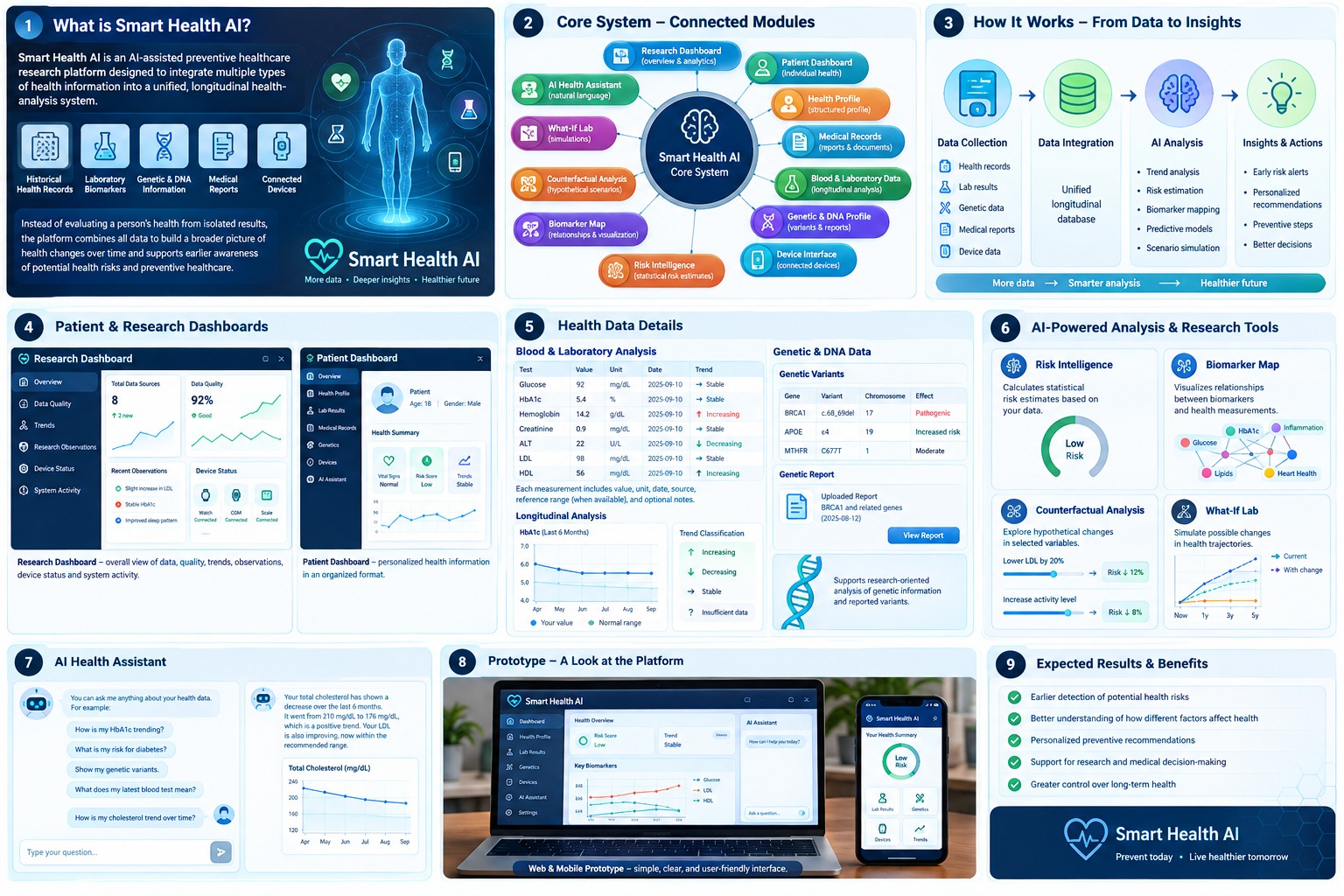
About Smart Health AI
Inspiration
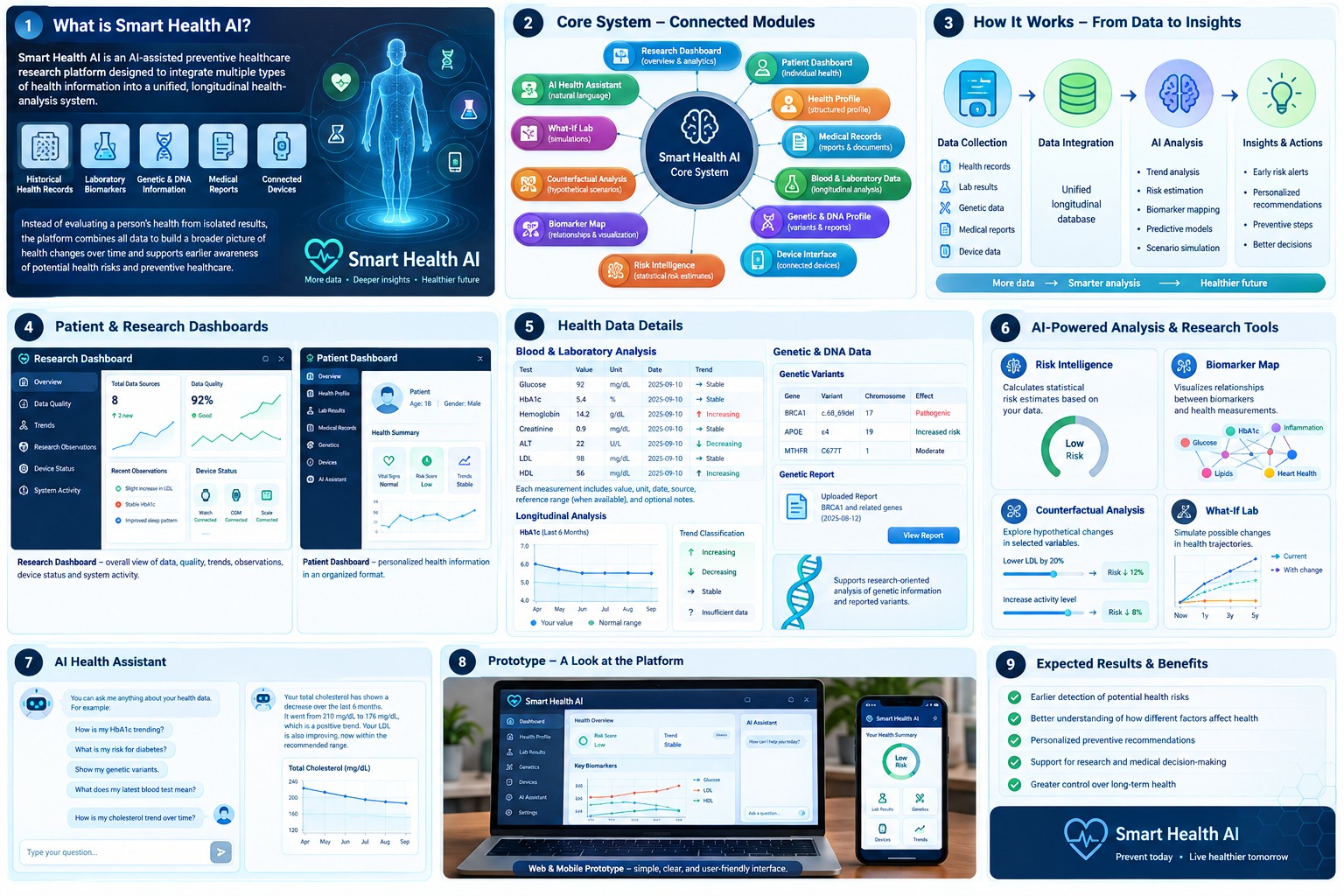
Smart Health AI was inspired by a major challenge in modern healthcare: personal health information is often scattered across laboratory reports, medical records, prescriptions, and different healthcare platforms. Understanding this information and connecting it to gain a clearer picture of one's health can be difficult.
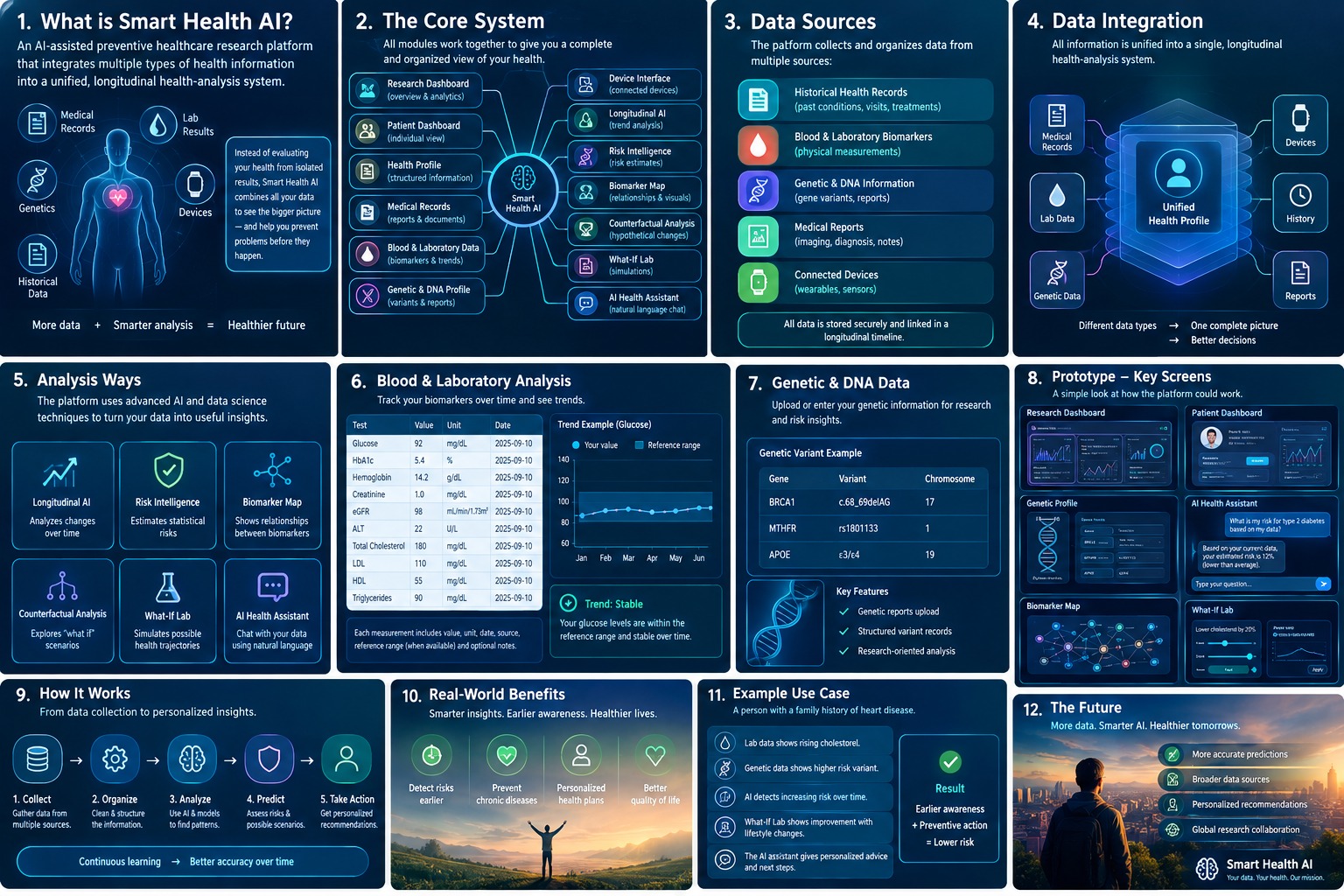
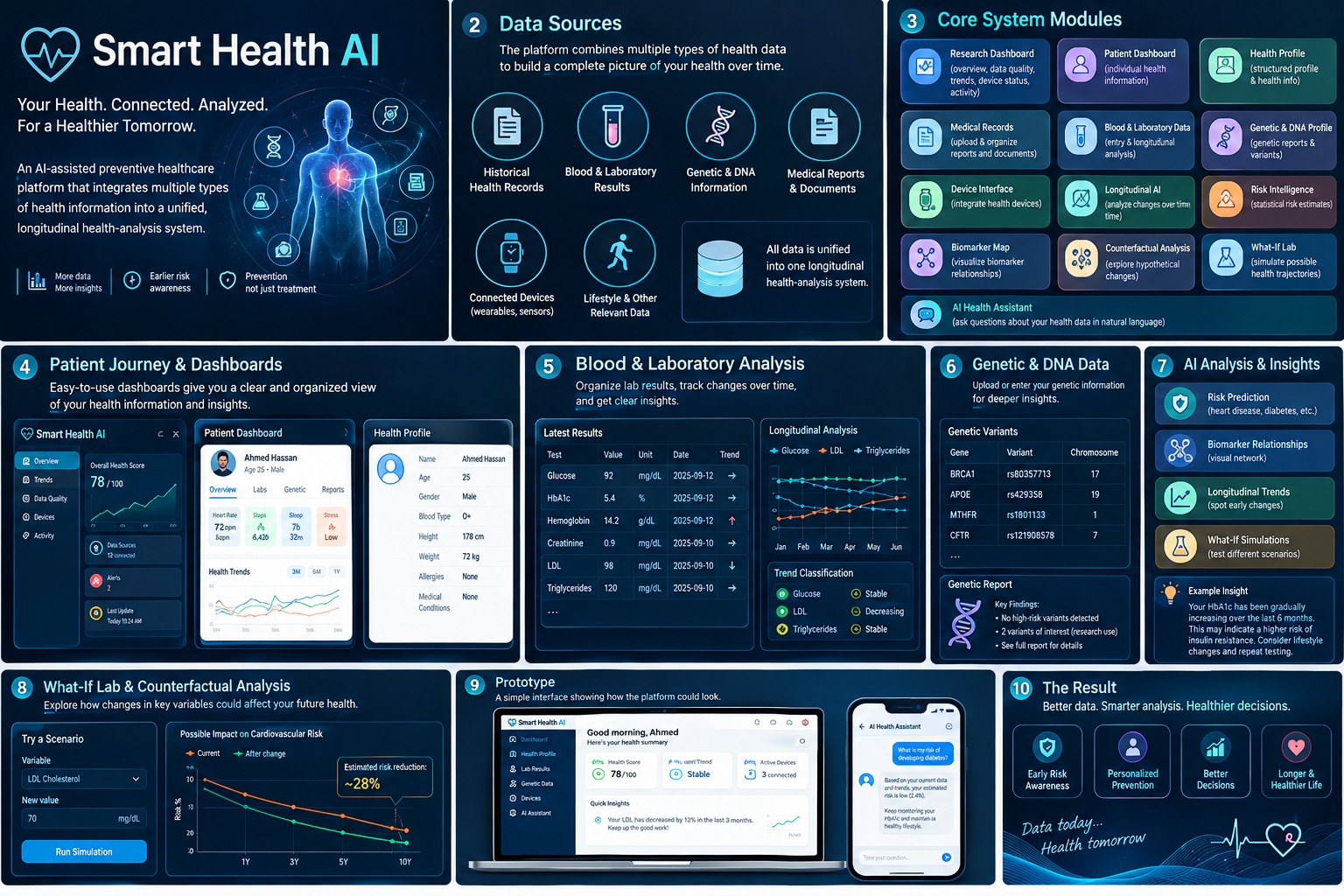
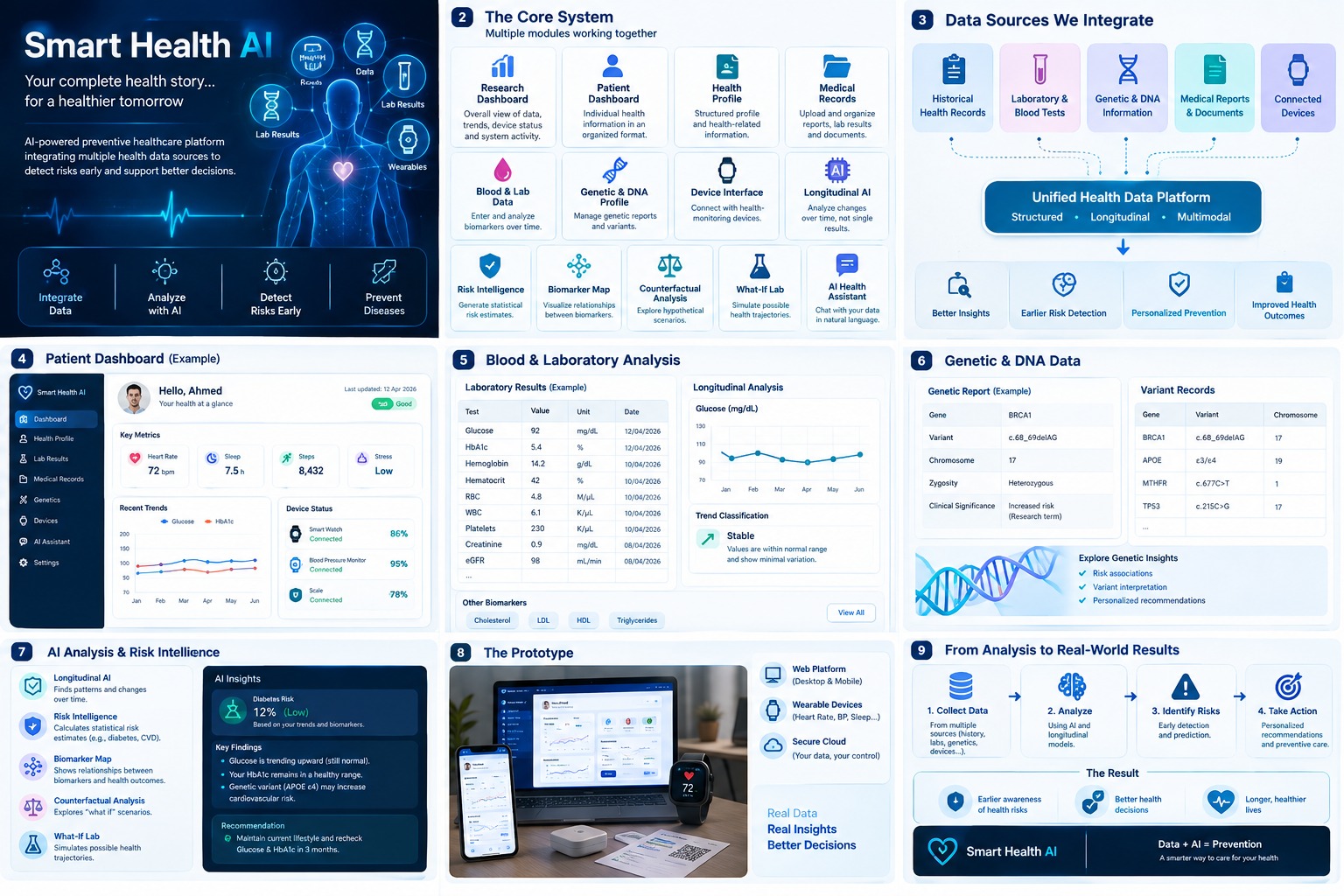
We wanted to explore how artificial intelligence could make healthcare information more accessible, organized, and easier to understand. This inspired us to develop Smart Health AI, an intelligent health platform designed to bring medical records, biomarkers, laboratory results, genetic information, and medical research together in one place.
Our vision is to help people better understand their health information and make more informed decisions with the support of reliable medical knowledge.
What We Learned
Throughout this project, we learned that developing healthcare technology requires much more than building an AI model or designing an attractive interface.
We gained experience in full-stack development, database architecture, API integration, authentication, and handling complex medical data. We also explored medical concepts such as biomarkers, laboratory reference ranges, liver fibrosis assessment, genetic inheritance, and health-risk indicators.
Most importantly, we learned that accuracy and responsibility are essential in healthcare AI. Medical information must be supported by reliable evidence, uncertainty must be communicated clearly, and users' privacy must always be protected.
How We Built It
We designed Smart Health AI as a modular, full-stack platform that connects several healthcare-related components.
- Frontend: React and TypeScript provide an interactive interface for accessing health information and platform features.
- Backend: Node.js, TypeScript, and Express handle application logic and communication through APIs.
- Database: PostgreSQL and Prisma organize and manage structured health information.
- Medical Intelligence: Dedicated modules support medical calculations, biomarker analysis, genetic-risk assessment, and health-data processing.
- AI and Research: AI-assisted features are designed to connect health information with reliable medical references and evidence-based research.
- Security: Authentication, authorization, and patient-data isolation are incorporated into the system's architecture.
The platform brings together personal health profiles, medical records, laboratory results, biomarkers, research tools, and health-risk insights. Instead of treating each feature as an isolated tool, our goal is to connect them into a unified health-information experience.
Challenges We Faced
One of our biggest challenges was integrating multiple complex systems into a single platform. Connecting the frontend and backend, designing database relationships, and ensuring that different modules communicate correctly required significant planning and problem-solving.
Another major challenge was working with medical information. Laboratory tests can use different units and reference ranges, and medical indicators do not always provide definitive diagnoses. We had to consider how to process and present information responsibly without misleading users.
We also faced technical challenges while organizing the application into a consistent architecture, transitioning toward a unified TypeScript-based system, and connecting previously independent modules.
These experiences taught us the importance of modular development, continuous testing, reliable data management, and validating medical logic rather than focusing only on whether a feature appears to work.
Our Vision
Smart Health AI aims to make healthcare information more understandable, accessible, and connected through artificial intelligence and evidence-based medical knowledge.
We plan to continue improving its accuracy, security, usability, and ability to organize complex health information.
Our goal is not to replace doctors or healthcare professionals. Instead, we want to build a tool that helps individuals understand their health information, explore reliable medical knowledge, and participate more confidently in their healthcare decisions.
Built With
- api
- database
- etc
