-
-
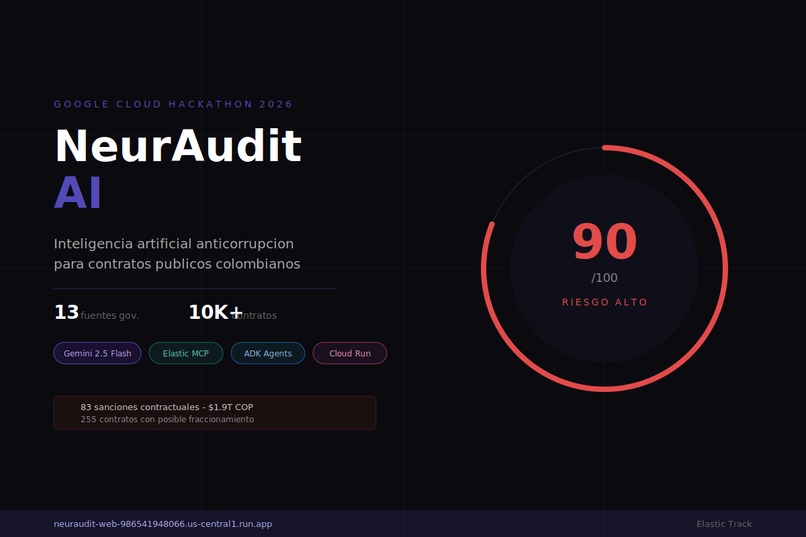
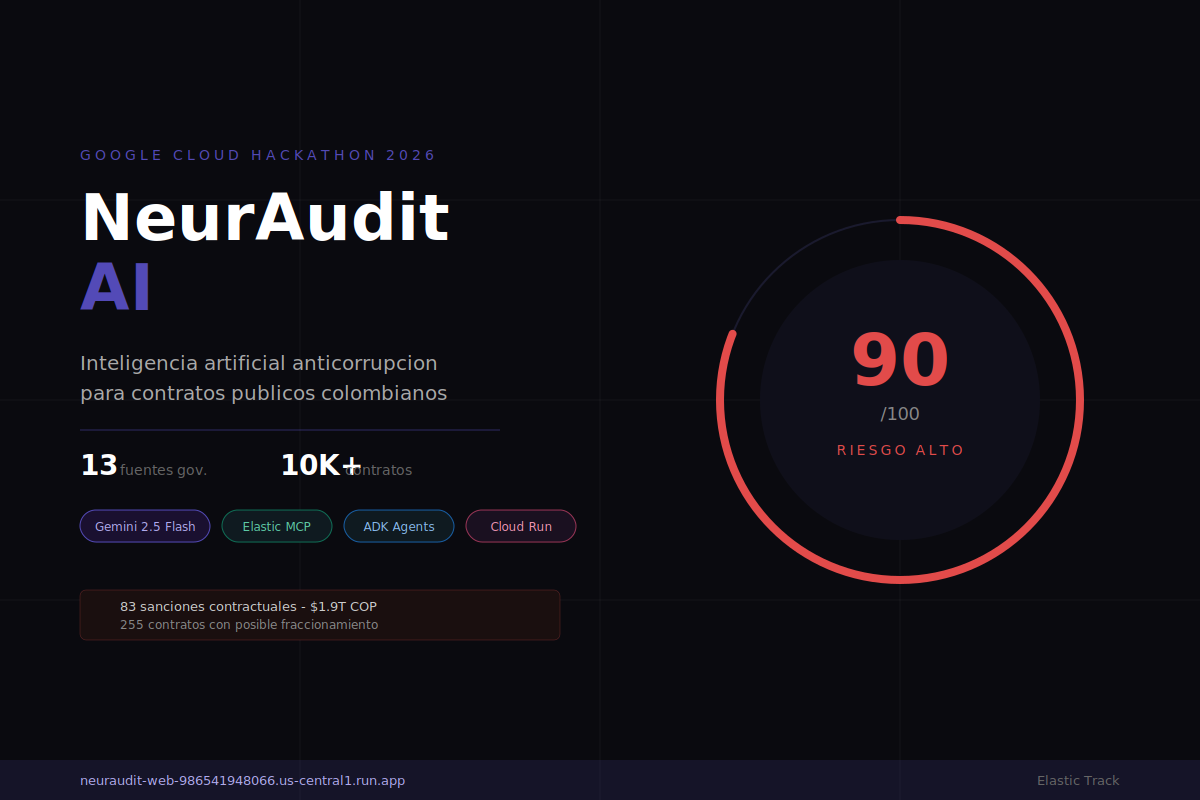
ICBF investigation showing a 90/100 corruption risk score generated from 13 Colombian government data sources using Gemini and ADK Agents.
-
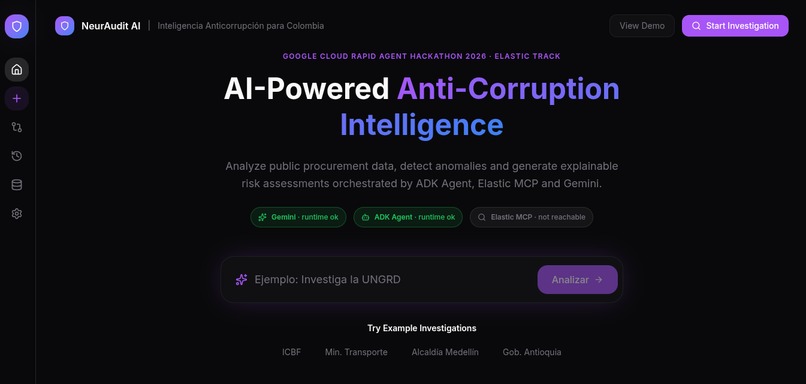
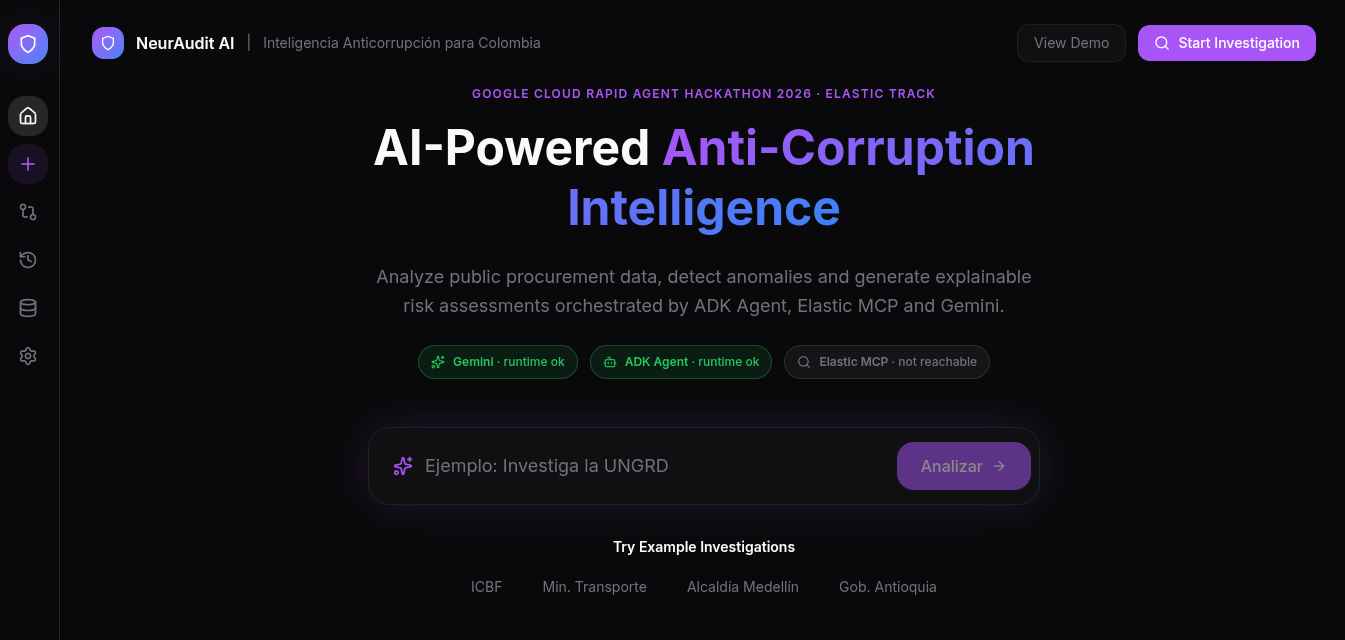
NeurAudit AI homepage powered by Gemini 2.5 Flash, Google ADK Agents and Elastic MCP for public procurement investigations.
NeurAudit AI
The Story Behind NeurAudit AI
NeurAudit AI was born from a simple observation:
The information needed to detect corruption often already exists, but finding it is incredibly difficult.
In Colombia, billions of pesos are allocated every year through public procurement processes. While transparency mechanisms exist, the information is scattered across multiple independent government platforms, databases, reports, and registries.
Auditors, journalists, watchdog organizations, and citizens frequently spend days or even weeks manually searching through these systems, downloading documents, comparing records, and attempting to identify patterns that may indicate risk.
By the time suspicious activity is discovered, public resources may already have been lost.
As someone passionate about technology and its potential to solve real-world problems, I began asking a question:
What if AI agents could perform these investigations automatically?
What if instead of navigating dozens of disconnected systems, a user could simply enter the name of a public institution and receive a complete risk assessment within minutes?
That idea became the foundation of NeurAudit AI.
The project started as an effort to improve transparency and accountability in Colombia, but quickly evolved into something bigger.
The challenges faced by auditors and investigators are not unique to a single country. Around the world, public information is often fragmented, difficult to analyze, and inaccessible to most citizens.
NeurAudit AI explores how modern AI agents, reasoning models, retrieval systems, and cloud infrastructure can transform that reality.
By combining Google ADK Agents, Gemini 2.5 Flash, Elastic MCP, and Google Cloud infrastructure, NeurAudit AI transforms fragmented public data into actionable intelligence that helps identify corruption risk indicators in minutes rather than weeks.
While the first version focuses on Colombian public procurement, the long-term vision is much broader:
To build an AI-powered transparency platform capable of helping governments, journalists, oversight agencies, researchers, and citizens investigate public institutions anywhere in the world.
NeurAudit AI is not just about detecting risks.
It is about making public accountability more accessible, scalable, and proactive through artificial intelligence.
The Problem
Public procurement investigations are difficult because relevant information is distributed across multiple independent government systems.
Investigators must manually review:
- Procurement processes
- Contract awards
- Sanction records
- Disciplinary investigations
- Fiscal responsibility reports
- Government transparency databases
- Public contracting registries
Each source provides only a partial view.
Finding meaningful corruption indicators requires connecting information across all of them.
This process is slow, expensive, and difficult to scale.
As a result, many risk indicators remain undiscovered until significant damage has already occurred.
My Solution
NeurAudit AI is an intelligent multi-agent investigation platform designed to identify corruption risk indicators in Colombian public procurement.
The platform simultaneously analyzes information from 13 official Colombian government sources and transforms fragmented public data into actionable intelligence.
Instead of spending weeks performing manual investigations, users receive an automated institutional risk assessment in minutes.
The system was designed to assist:
- Government auditors
- Oversight agencies
- Investigative journalists
- Anti-corruption organizations
- Researchers
- Citizens seeking transparency
How It Works
The investigation workflow is fully automated.
Step 1
The user enters the name of a public institution.
Examples include:
- ICBF
- Ministry of Transport
- Regional governments
- Municipal governments
- Public agencies
Step 2
Google ADK Agents orchestrate the investigation process and coordinate data collection across 13 official government sources.
Step 3
Elastic MCP provides retrieval, indexing, and search capabilities that allow information from multiple systems to be consolidated into a unified investigation context.
Step 4
Gemini 2.5 Flash analyzes the collected evidence, reasons across sources, and identifies corruption risk indicators.
Step 5
NeurAudit generates a transparent risk score ranging from 0 to 100.
Unlike black-box systems, every score is supported by evidence gathered during the investigation.
Step 6
A professional institutional PDF report is automatically generated, including:
- Findings
- Evidence
- References
- Risk indicators
- Source citations
The report can be used for further investigation, oversight activities, reporting, or transparency initiatives.
Real Investigation Example — ICBF
To validate the platform, NeurAudit AI analyzed ICBF, one of Colombia's largest public institutions.
The system completed the investigation in under two minutes.
Risk Score
90 / 100 — High Risk
Findings
- 83 contractual sanctions
- 79 disciplinary records
- More than 10,000 single-bidder procurement processes
- 255 potential contract splitting cases
- Multiple high-risk procurement indicators
Most importantly, these findings were generated automatically by the investigation workflow rather than through manual review.
This demonstrates how AI agents can dramatically reduce the time required to identify potential risk patterns.
Why Google Cloud
NeurAudit AI was built around Google's AI ecosystem because the project requires reasoning, orchestration, scalability, and explainability.
Google ADK Agents provide the framework necessary to coordinate multiple investigation tasks simultaneously.
Gemini 2.5 Flash provides reasoning capabilities that allow the system to interpret findings, identify patterns, and generate meaningful conclusions from large amounts of public data.
Google Cloud Run enables scalable deployment and execution of the platform.
Together, these technologies make it possible to transform a complex multi-source investigation into an automated workflow that can be executed in minutes.
Why Elastic MCP
Elastic MCP plays a critical role in the platform.
Government data is fragmented across many sources.
Elastic MCP enables retrieval, indexing, and contextual access to information required by the investigation agents.
Without this retrieval layer, consolidating information across multiple government platforms would be significantly more difficult.
Elastic MCP allows the agents to access the right information at the right time and produce more accurate reasoning outcomes.
Challenges I Faced
One of the most difficult challenges was consolidating information from multiple independent government systems into a single investigation workflow.
Each source presents data differently and often lacks a standardized structure.
Another challenge was designing a transparent risk scoring methodology.
The goal was not simply to generate a number but to provide explainable findings supported by evidence.
I also needed to ensure that the investigation process remained understandable and useful for non-technical users.
What I Learned
This project demonstrated the power of combining AI reasoning with public data.
I learned that multi-agent systems can dramatically reduce investigation time when paired with reliable retrieval systems and trustworthy data sources.
I also learned how agent orchestration, reasoning models, and retrieval infrastructure can work together to solve real-world public sector problems.
Most importantly, I discovered that AI can help make transparency more accessible by transforming large volumes of public information into understandable and actionable insights.
Beyond Colombia
Although NeurAudit AI currently focuses on Colombian public procurement data, the architecture was intentionally designed to be adaptable.
The same approach can be extended to:
- Government procurement systems in other countries
- Public spending transparency initiatives
- Anti-corruption investigations
- Regulatory compliance monitoring
- Public sector risk assessment
- Investigative journalism workflows
Because the platform is built around AI agents, retrieval systems, and reasoning models rather than country-specific rules, NeurAudit AI has the potential to become a global transparency and accountability platform.
The long-term objective is to help organizations and citizens transform fragmented public information into actionable intelligence anywhere in the world.
Future Roadmap
NeurAudit AI is only the beginning.
Future versions will include:
- Additional government data sources
- Historical trend analysis
- Institution-to-institution risk comparisons
- Real-time monitoring
- Automated alerting systems
- Geographic risk visualization
- Cross-country expansion across Latin America
- Continuous investigation agents
- AI-powered procurement monitoring dashboards
- International public transparency datasets
My long-term vision is to create an AI-powered transparency platform capable of helping governments, watchdog organizations, journalists, researchers, and citizens identify risks before public resources are lost.
Impact
NeurAudit AI transforms weeks of manual investigation into minutes of automated analysis.
By combining Google ADK Agents, Gemini 2.5 Flash, Elastic MCP, and Google Cloud infrastructure, the platform demonstrates how AI can be applied to one of the most important challenges facing public institutions today: accountability.
The mission is simple:
Transform public data into actionable intelligence and help strengthen transparency through AI.
Built With
- 2.5
- adk
- agents
- cloud
- data
- elastic
- flash
- gemini
- government
- mcp
- next.js
- procurement
- public
- run
- typescript
- vertex


Log in or sign up for Devpost to join the conversation.