-
-
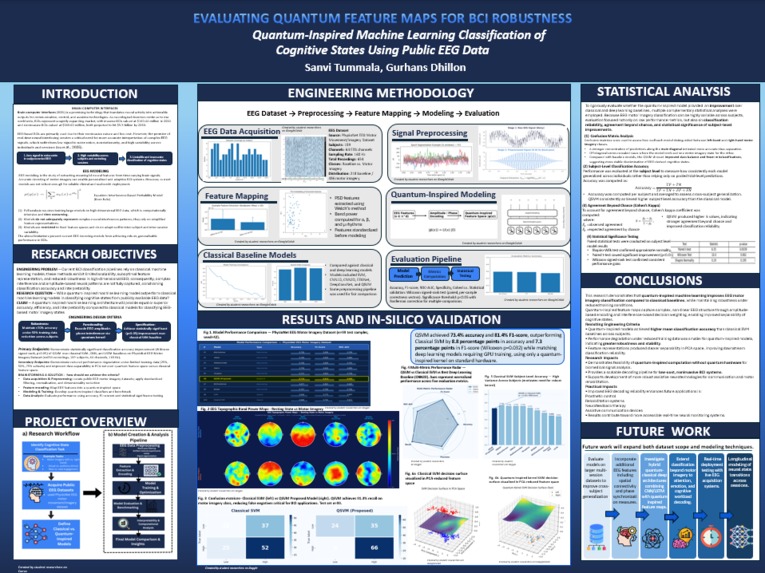
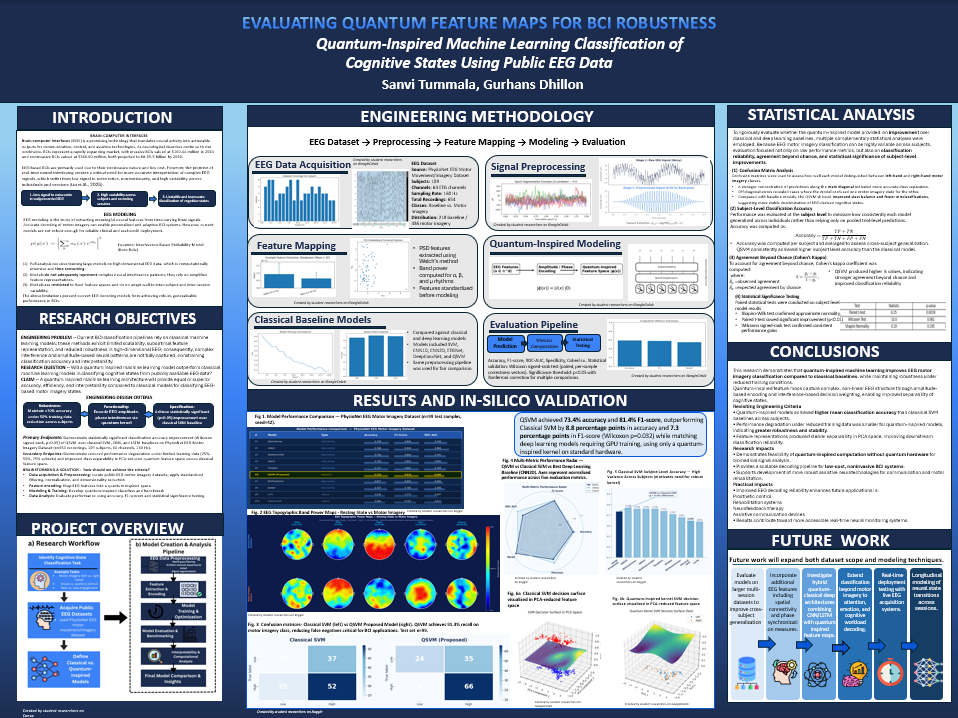
Our Florida State Science & Engineering Fair board, where NeuralQ placed 2nd in the state out of hundreds of researchers.
Inspiration
NeuralQ began at a TopGolf in Florida. We saw the word "quantum" on a screen and couldn't stop asking, what if quantum mathematics could solve one of the hardest problems in neuroscience? The deeper motivation was personal. Co-founder Sanvi's grandmother suffered from paralysis, and our family watched helplessly as simple communication became impossible. Over 5.4 million Americans live with severe paralysis today, trapped in their own bodies, relying on Brain-Computer Interfaces that require $50,000 hospital machines and hours of exhausting daily calibration. We decided we weren't going to wait for someone else to fix it.
What it does
NeuralQ is a quantum-inspired machine learning platform that decodes EEG brainwave signals with greater accuracy and resilience than classical AI, using only standard hardware available today. The core engine is a Quantum Support Vector Machine (QSVM) powered by a Quantum Feature Map. Where classical AI struggles to separate overlapping, noisy brain signals, our algorithm mathematically projects that data into a high-dimensional Hilbert Space where signals become cleanly separable. The result: 73.4% classification accuracy versus 62.3% for classical SVM, a statistically significant improvement (p < 0.01), and a robustness stress test showing only 3.8% performance degradation when 50% of training data is removed, compared to 10.5% collapse in classical models. NeuralQ learns faster with less data from patients who have the least to give.
How we built it
We engineered a full multi-stage EEG decoding pipeline from scratch. We used the PhysioNet EEG Motor Movement/Imagery Dataset across 109 subjects and 9,500 trials. Raw signals were cleaned using an 8–30 Hz band-pass filter to isolate Mu and Beta motor rhythms, then segmented into 4-second epochs. We extracted features using Logarithmic Power Spectral Density, which turns volatile brainwaves into stable frequency fingerprints. Those features were fed into our Quantum Feature Map classifier and evaluated using 5-fold cross-validation against classical SVM, Random Forest, and Deep Neural Network baselines. We also applied Grad-CAM heatmaps to confirm the model was actually reading motor cortex activity and not just memorizing background noise. The whole pipeline was built in Python using PennyLane, Scikit-learn, MNE, and NumPy.
Challenges we ran into
EEG data is incredibly noisy and changes from person to person, so getting consistent results across 109 subjects was genuinely hard. A model that works well on one person's brain signals often fails completely on someone else's. We had to spend a lot of time on preprocessing and feature engineering before the quantum classifier could show its real advantage. Simulating quantum mechanics on classical hardware is also computationally expensive, so scaling the feature map required real tradeoffs to keep the pipeline practical without hurting accuracy.
Accomplishments that we're proud of
We placed 2nd at the Florida State Science and Engineering Fair, competing against hundreds of the top student researchers in the state. We also won the Shrimp Tank VC pitch competition and took home $500 in our first external funding, which validated that the commercial model makes sense beyond just the research. On the technical side, we're proud that we demonstrated a statistically significant accuracy improvement over classical AI baselines and proved our model holds up under data-scarce conditions, which is the scenario that actually matters for real patients.
What we learned
The hardest part wasn't the math. It was making sure every technical decision connected back to a real patient who is paralyzed and exhausted. That constraint forced us to think differently about what "good enough" actually means in this context. We also learned that quantum advantage doesn't require quantum hardware, the mathematical framework delivers real, measurable gains today on standard machines, which is what matters for actually getting this into clinics.
What's next for NeuralQ
We want to expand validation to larger datasets and real-time EEG streams, then build out the NeuralQ SaaS API for licensing to rehabilitation clinics and neuro-tech hardware manufacturers. Long term, the goal is an affordable at-home headset that performs at clinical-grade accuracy, getting this technology to the patients who need it most.
Built With
- github
- mne
- numpy
- pennylane
- python
- scikit-learn


Log in or sign up for Devpost to join the conversation.