Inspiration
Traditional learning tools present information in static formats like text or slides, which often fail to capture how humans naturally think—through connections and associations. We wanted to build a system that mirrors the way the brain works: non-linear, visual, and expandable.
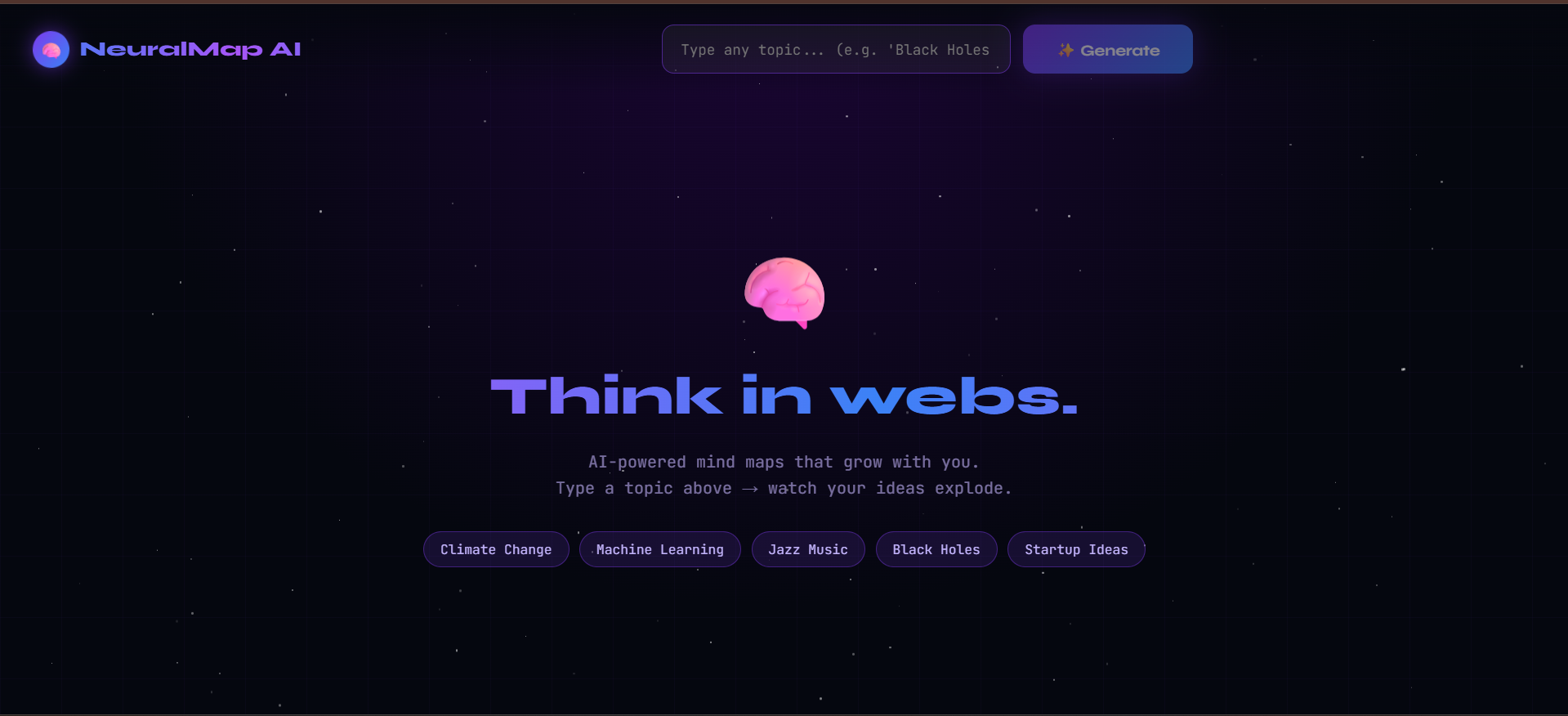
The idea behind NeuralMap AI was to create an intelligent tool where users can input any topic and instantly see it unfold into a dynamic network of ideas. Instead of searching and scrolling, users can explore knowledge visually and interactively.
What We Built
We developed an AI-powered interactive mind map generator that transforms any topic into a structured graph of connected ideas.
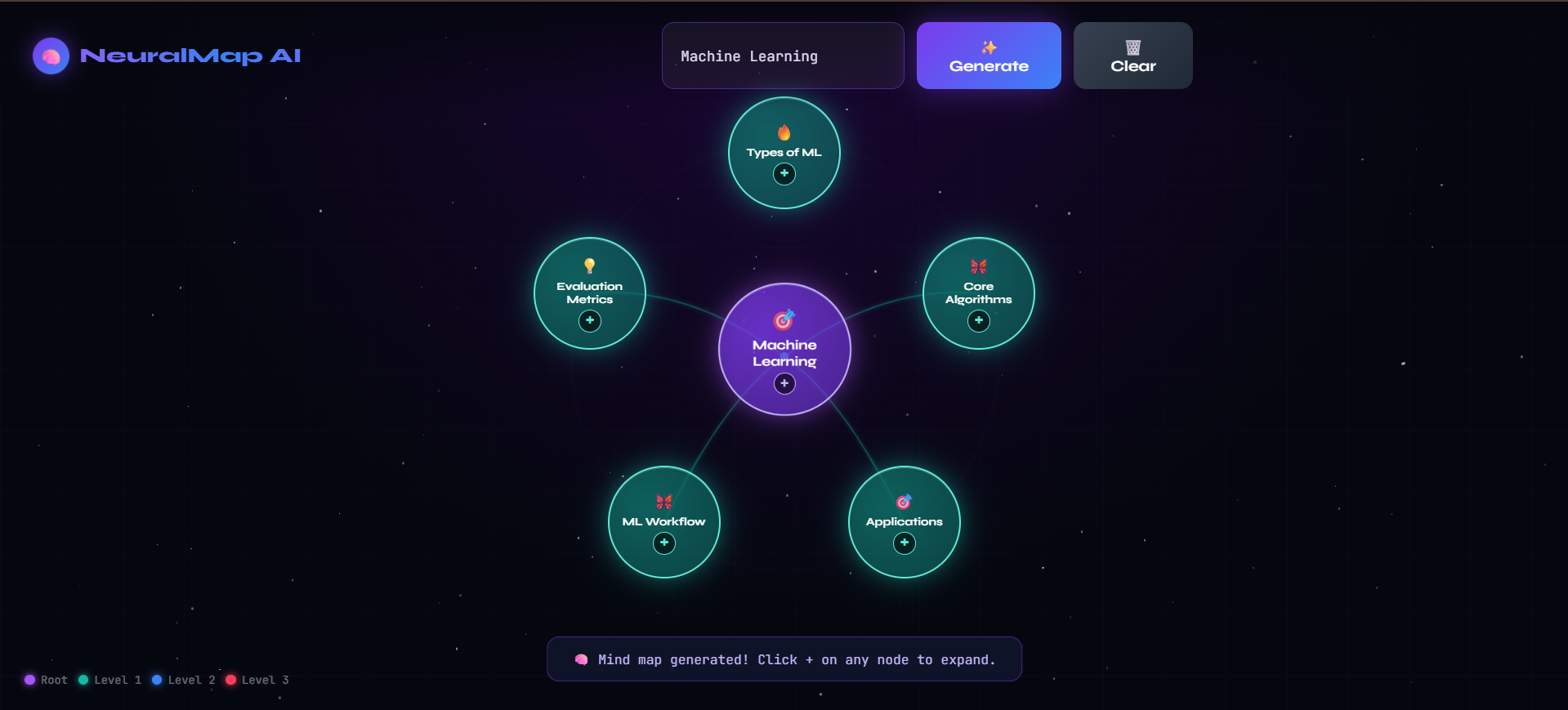
- Users enter a topic → AI generates a mind map
- Nodes represent concepts, edges represent relationships
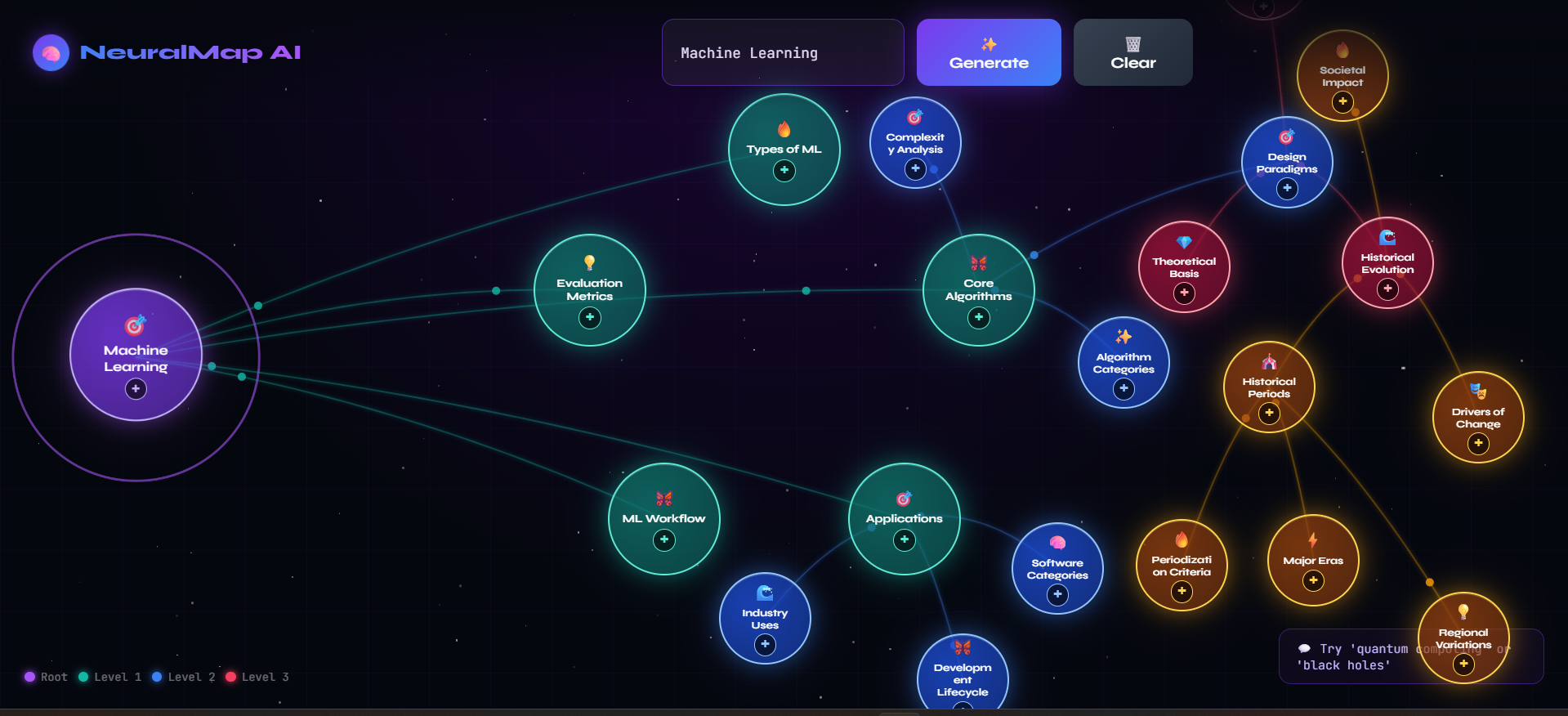
- Users can expand any node dynamically to explore deeper levels
- The interface includes animated nodes, particle effects, and smooth transitions for an engaging experience
The system combines:
- A frontend visualization layer built with React and canvas-like animations
- A backend powered by Gemini AI to generate structured JSON graphs
- Real-time interaction between frontend and backend for seamless expansion
How We Built It
Backend
- Built using Node.js + Express
- Integrated with Gemini API to generate structured mind map data
- Designed prompts to ensure consistent JSON output (nodes + edges)
- Implemented retry logic and JSON repair to handle unreliable AI responses
Frontend
- Built using React (via Babel in browser)
- Created a custom graph system (not using libraries)
Implemented:
- Node dragging
- Expand-on-click functionality
- Animated edges and particles
- Dynamic layout positioning
Data Flow
- User inputs a topic
- Frontend sends request to backend
- Backend calls AI → returns structured graph
- Frontend renders nodes + edges
- Clicking a node triggers expansion
Challenges We Faced
1. Unstable AI Output
AI responses were sometimes:
- Invalid JSON
- Missing fields
- Inconsistent structure
Solution:
We used JSON cleaning (jsonrepair) and strict prompt engineering to enforce structure.
2. API Rate Limits & Model Issues
We encountered:
- 404 errors (wrong models)
- Rate limit errors
Solution: Switched to stable models and added retry + backoff logic.
3. Graph Rendering Complexity
Managing:
- Node positions
- Edge connections
- Dynamic expansion
Solution: Built a custom positioning system and unique ID handling to avoid collisions.
4. UI Performance
Animations + real-time updates caused:
- Lag
- Rendering conflicts
Solution: Optimized state updates and limited unnecessary re-renders.
What We Learned
- How to integrate LLMs into real-time applications
- Importance of data contracts between frontend and backend
- Handling unpredictable AI outputs
- Building interactive visual systems from scratch
- Designing for both performance and user experience
What Makes Our Project Unique
- Real-time AI-generated knowledge graphs
- Fully interactive and expandable mind maps
- Combines AI + visualization + animation
- Designed for exploration, not just information consumption
Future Improvements
- Add streaming nodes (real-time generation animation)
- Improve layout using force-directed graphs
- Add voice input → mind map
- Enable export/share mind maps
- Introduce collaborative editing
Conclusion
NeuralMap AI transforms how we explore ideas—turning static information into living, interactive knowledge networks. It bridges the gap between AI generation and human understanding by making knowledge visual, dynamic, and explorable.
Built With
- axios
- css
- express.js
- google-gemini-api
- html
- javascript
- jsonrepair
- node.js
- react

Log in or sign up for Devpost to join the conversation.