-
-
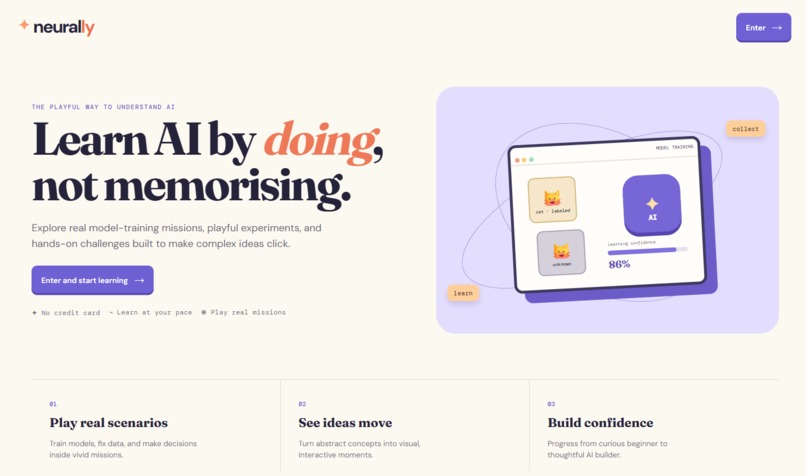
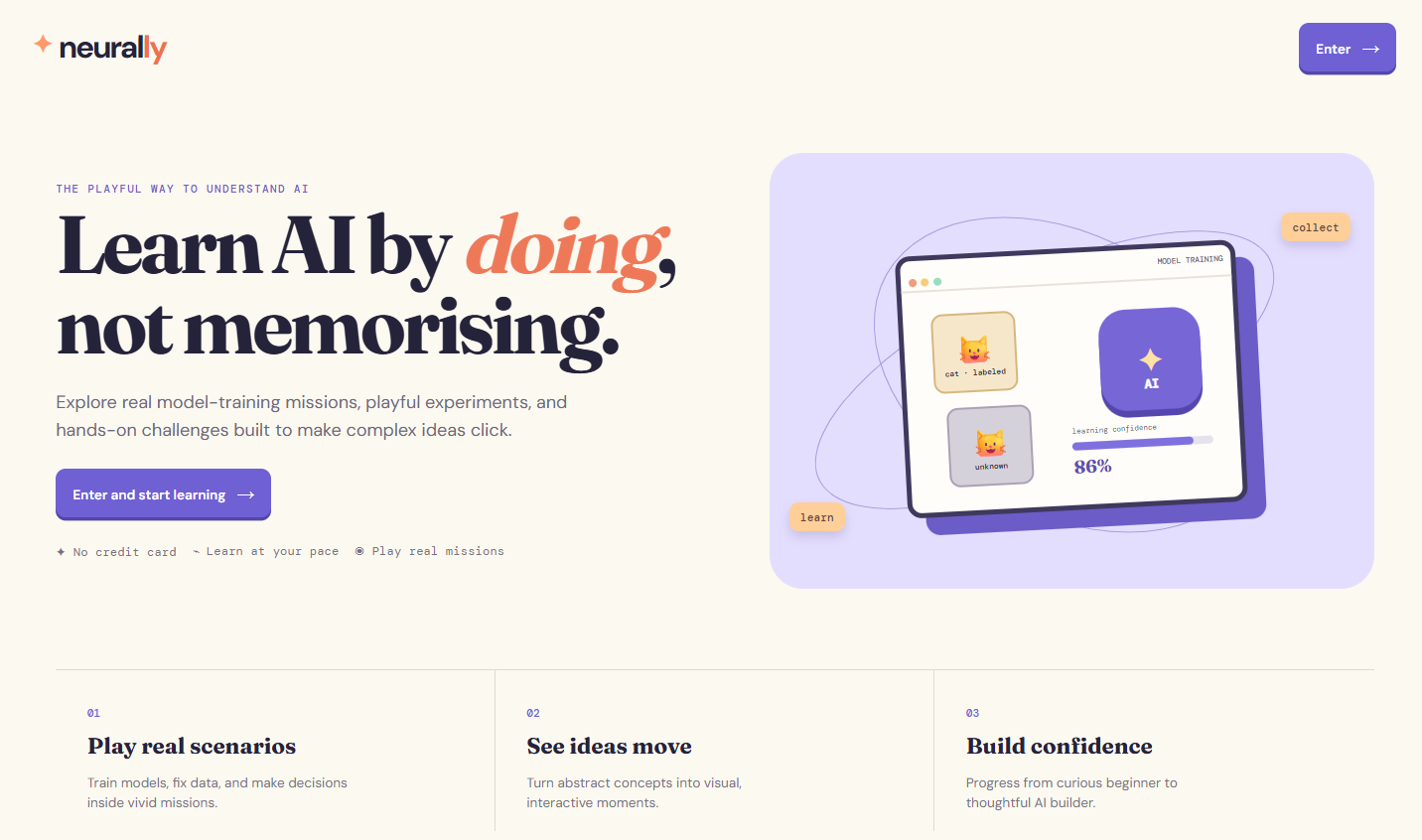
Landing Page
-
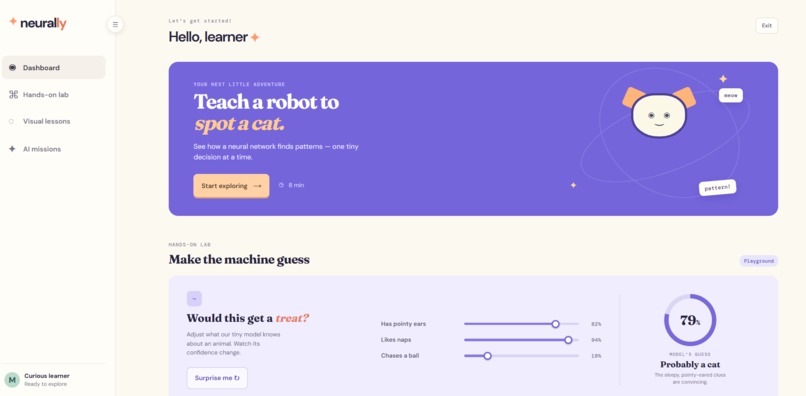
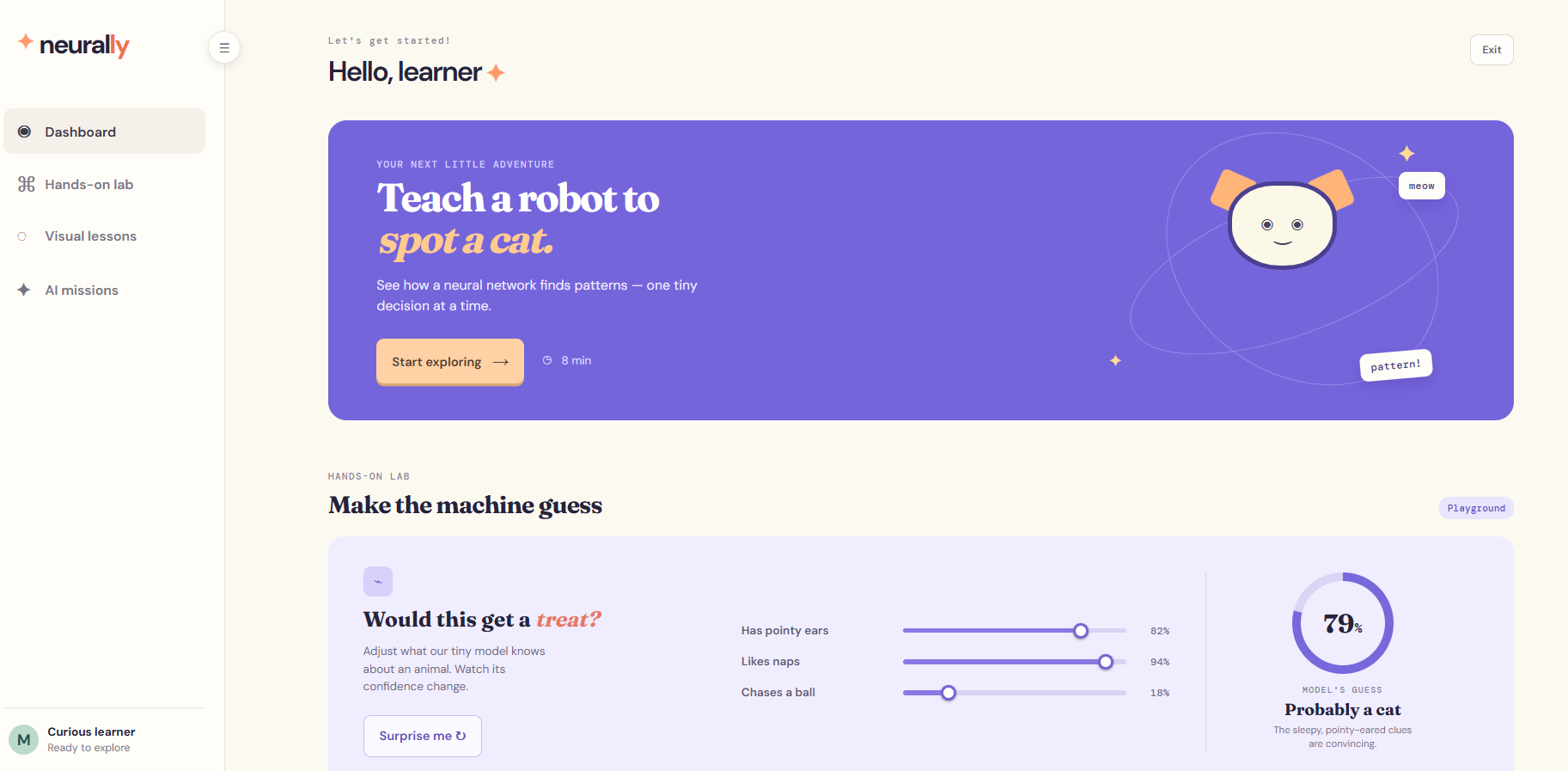
DashBoard Page
-
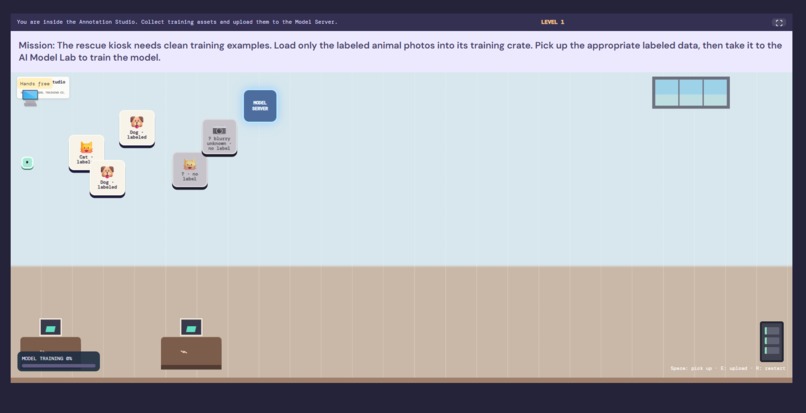
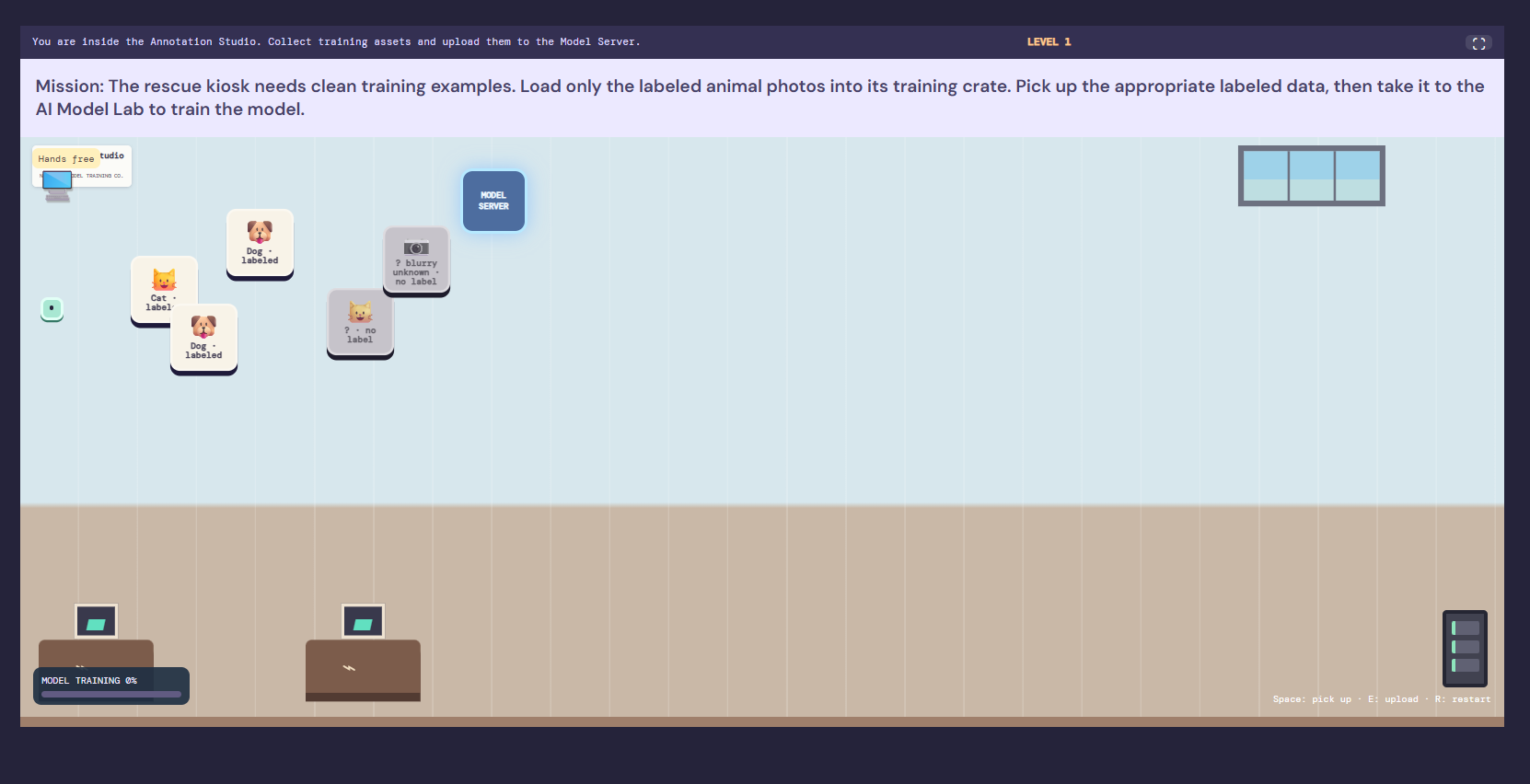
Training Model
-
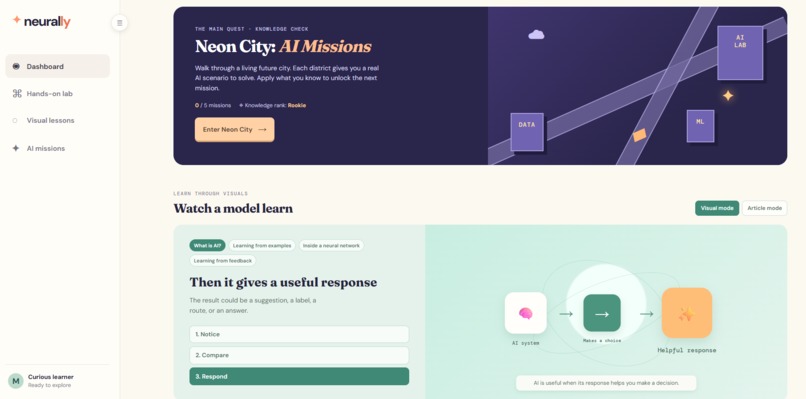
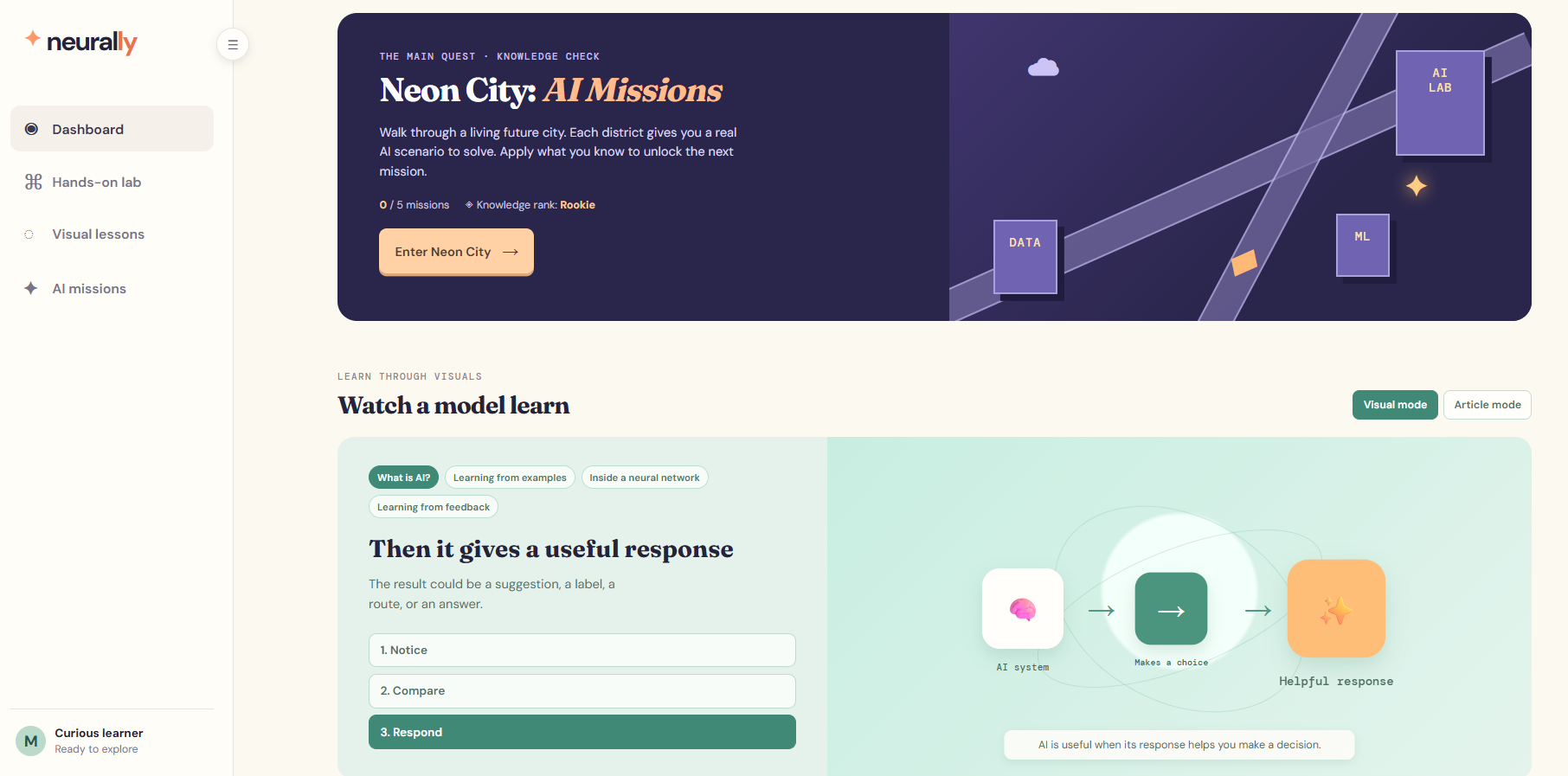
AI Mission, Visual mode and Article Mode
Inspiration
I have seen in most places to learn AI through a wall of text: definitions, diagrams, maybe a video which are all informative, but passive. I read about how a model "learns from labeled examples," nod along, and forget it by next week, because I never actually did anything.
I wanted to flip that. What if instead of reading that a model needs labeled data to learn, I had to walk into a rescue kiosk, sort real photos into "labeled" and "unlabeled" piles all by myself, and physically carry the good data over to train the model , watching the training percentage climb because of a decision I made? That single idea, make the abstract concept the mechanic of the game, not a caption under it, is what Neurally is built around. The goal was a project where people don't just learn AI, they genuinely enjoy the process of learning it.
What it does
Neurally is a playful, hands-on platform for learning core AI concepts:
A dashboard that welcomes learners and walks them through a short mini-lesson to get oriented. AI missions — small 2D game scenes (like the Annotation Studio) where you physically collect, sort, and upload labeled training data to train a model in real time, learning concepts like labeled data, training signal, and model confidence by doing them instead of reading about them. Visual lessons — a tabbed, animated explainer covering the building blocks of AI: What is AI?, Learning from examples, Inside a neural network, and Learning from feedback — each pairing plain-English text with a simple animated diagram. A progression system (Neon City) where each "district" is a real AI scenario to solve, and your knowledge rank climbs as you complete missions — turning learning into something you want to keep coming back to.
The entire thing is a static, client-side website: HTML, CSS, and vanilla JavaScript — no backend, no database, no authentication, no API calls. Everything runs in the browser.
How I built it
I built Neurally using GPT-5.6 and Codex together, in a tight planning-and-execution loop rather than writing code by hand from scratch:
GPT-5.6 was the planning layer. I started with one broad prompt describing the whole product vision, then broke it down into step-by-step prompts for each individual feature — the landing page, the dashboard, the game missions, the visual lessons, the Articles. Whenever a feature turned out not to add value once it existed, I'd prompt again to strip it back out. GPT-5.6 was essentially my thinking partner for turning a rough idea into a clear, buildable, feature-by-feature plan.
Codex was the execution layer, working directly inside the project workspace to: Build the HTML structure for the landing page, dashboard, lessons, sidebar, and game scenes. Write the CSS for the responsive layout, animations, visual learning modules, the collapsible sidebar, and the game environments. Write the JavaScript powering navigation, interactive lessons, AI missions, fullscreen gameplay, visual/article mode toggles, and dashboard controls. Test JavaScript syntax and check code quality after every change, so features could be added or removed without quietly breaking something else.
Codex wasn't part of the app itself — it was the tool that built the app. The final product is 100% static frontend code that runs with no runtime dependency on any AI service.
Challenges I ran into
1.Turning abstract AI concepts into game mechanics. It's one thing to explain "labeled data" in a sentence, and another to design a mission where sorting labeled vs. unlabeled photos is the lesson. Getting the mission design simple enough to play but accurate enough to actually teach the concept took several rounds of trimming. 2.Iterating with prompts instead of code. Directing GPT-5.6 and Codex step-by-step meant learning to write prompts precise enough to get a usable feature on the first or second try, and being willing to prompt a feature back out the moment it didn't earn its place — rather than leaving in something that "sort of" worked. 3.Keeping it fully client-side. With no backend, no database, and no auth, every piece of state — mission progress, training percentage, knowledge rank — had to be handled cleanly in the browser without the safety net a server would normally provide. 4.Consistency across a growing UI. As the sidebar, dashboard, lessons, and game scenes all grew in parallel, keeping the visual language (colors, animations, layout) consistent required going back through earlier CSS as new sections were added.
Accomplishments that I am proud of
Turning an abstract subject into something playable. Neurally doesn't just describe how AI learns — you feel it, by sorting real data, watching a training percentage move because of your choices, and seeing a model's "confidence" respond to what you fed it. Actually finishing the loop. It's easy to prototype one flashy mission and stop there. I carried the idea all the way through: onboarding → hands-on mission → conceptual lessons → a progression system that gives people a reason to come back. Learning to direct AI tools like a product team of one. Going from one broad prompt to a disciplined, feature-by-feature build — and being willing to prompt features back out when they didn't earn their place — is its own skill, and it got noticeably tighter over the course of the build. A genuinely fun result. The best test was watching someone play the game for the first time and light up at "wait, I just trained a model" — exactly the reaction the whole project was chasing.
What I learned
Building Neurally taught me as much about how to direct AI tools well as it did about AI concepts themselves. I learned to separate planning from execution — using GPT-5.6 to think through what the product should do, and Codex to actually build and verify it — instead of trying to do both at once. I got a much clearer, hands-on feel for how concepts like labeled data, model training, and feedback loops actually work, because I had to turn each one into an interactive mission rather than just a paragraph. And I learned that the fastest way to a good feature set isn't building everything you can think of — it's building fast, testing honestly, and being willing to cut what doesn't earn its place.
What's next for Neurally
More AI missions covering additional concepts (like overfitting and bias), more Neon City districts, and a lightweight way to track and share your knowledge rank progress with others learning alongside you.
Built With
- css
- html
- javascript
- vanilla


Log in or sign up for Devpost to join the conversation.