-
prediction.jpg
-
model-metrics.jpg
-
dashboard.jpg
Inspiration
Industrial equipment can fail without enough warning. Unexpected failures can cause costly downtime, interrupt production, and create safety risks. We wanted to explore how machine learning could help maintenance teams identify potential equipment problems earlier.
That inspired us to build NeuralGuard AI, an AI-powered predictive maintenance prototype that analyses equipment sensor readings and estimates the risk of potential failure.
What it does
NeuralGuard AI provides an interactive dashboard for monitoring simulated industrial equipment. It analyses four sensor measurements:
- Temperature
- Vibration
- Pressure
- Rotational speed (RPM)
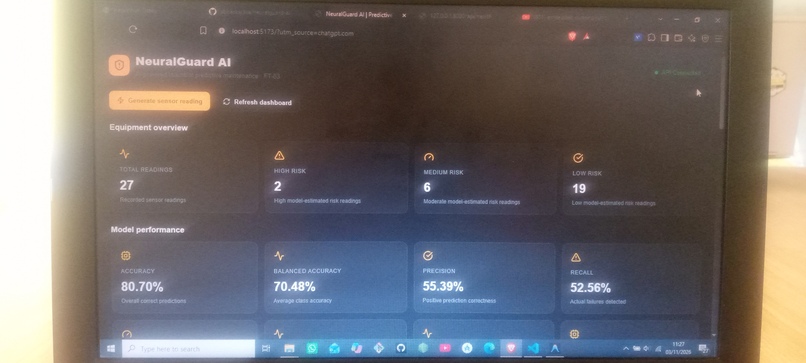
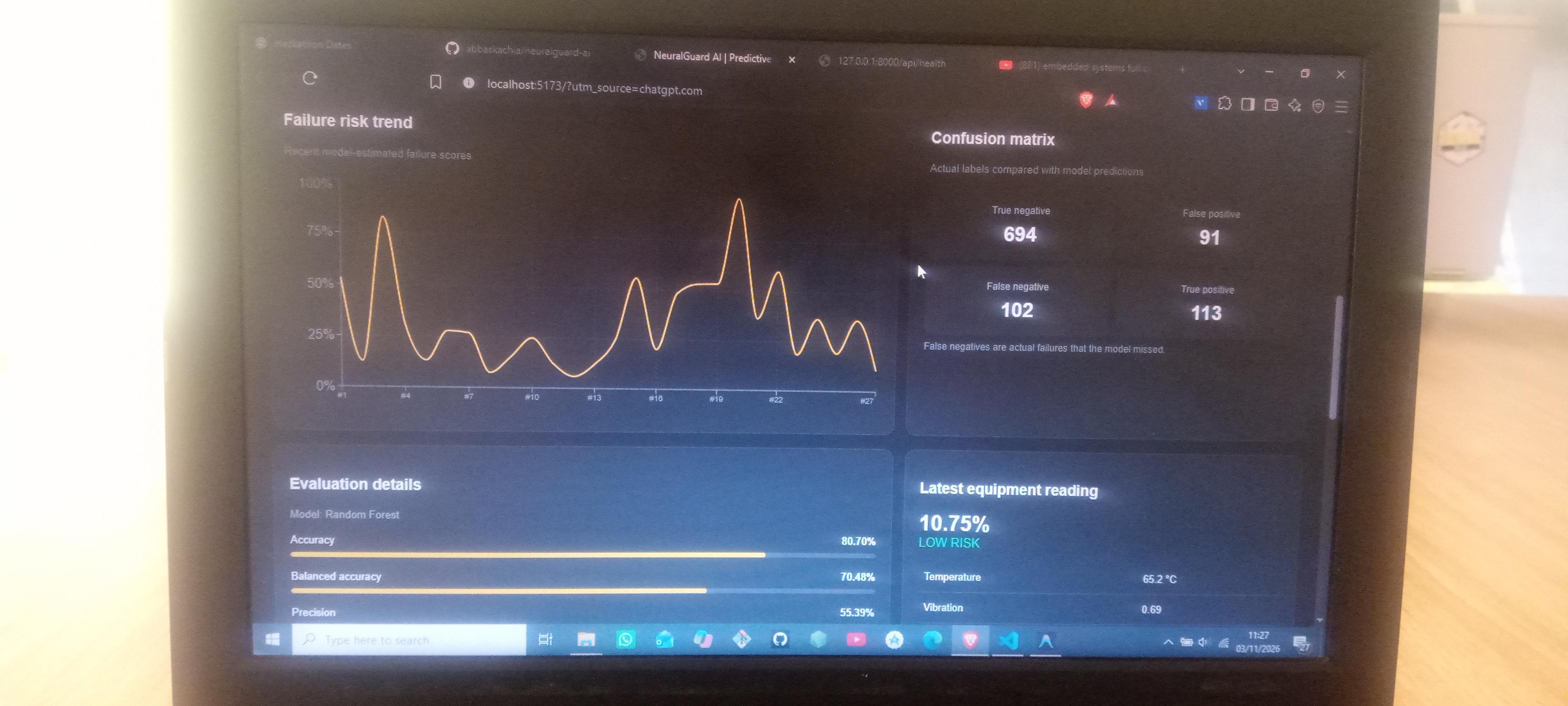
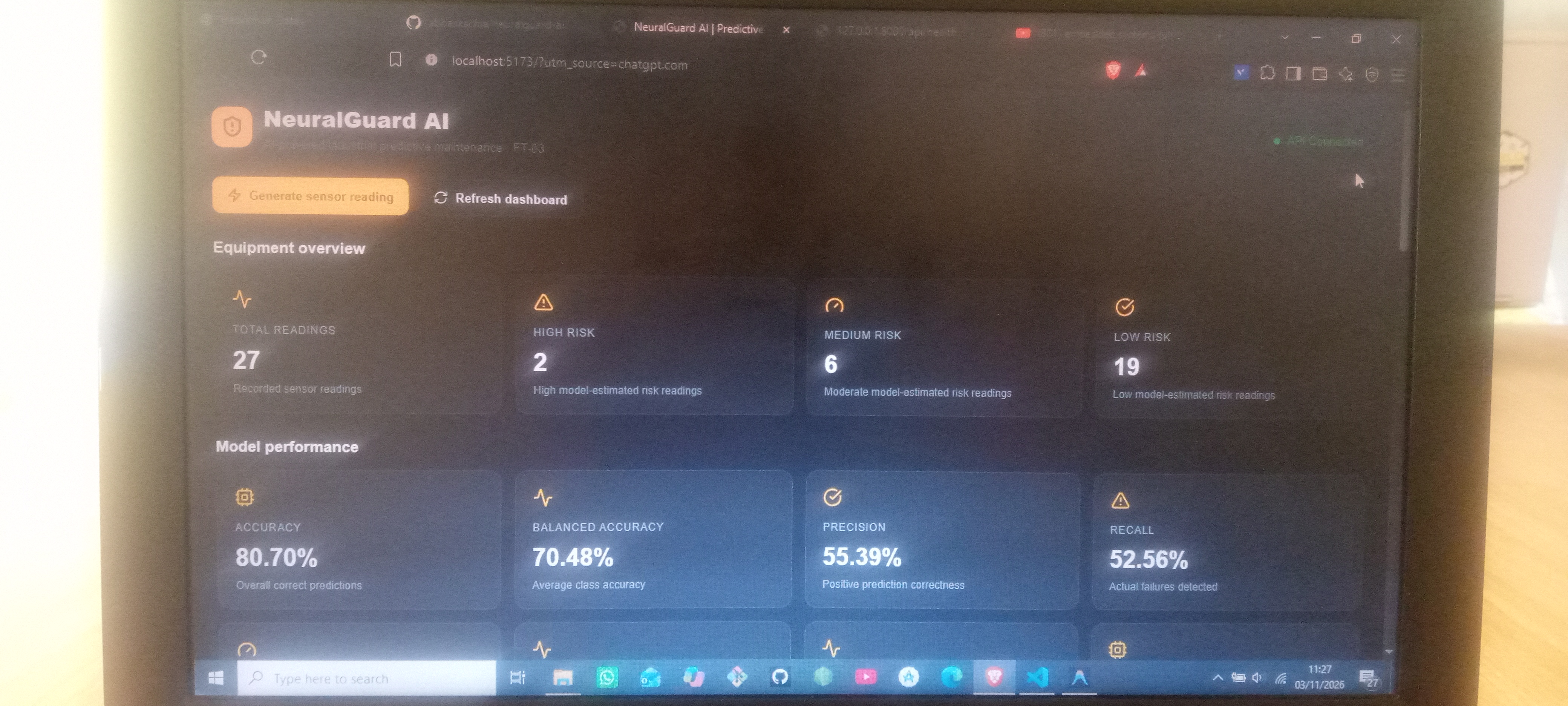
A machine-learning model evaluates the readings and produces a failure-risk score. The dashboard displays the latest telemetry, historical readings, risk categories, equipment metrics, and prediction results.
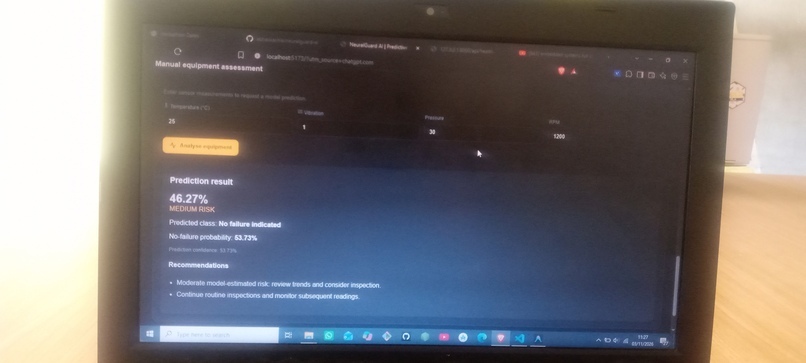
Users can simulate new readings or enter sensor values manually to explore how changing operating conditions affect the model's predictions.
How we built it
We built NeuralGuard AI using a Python machine-learning backend and a React frontend.
Machine learning and backend
- Python
- FastAPI
- Scikit-learn
- Random Forest Classifier
- Pandas and NumPy
Frontend
- React
- Vite
- Recharts
- Lucide React
The backend exposes API endpoints for equipment telemetry, dashboard metrics, simulation, and predictions. The frontend communicates with these endpoints to display live prototype updates and visualisations.
We trained the Random Forest model using a synthetic dataset of 5,000 equipment records. The dataset was split into 4,000 training records and 1,000 testing records.
Model evaluation
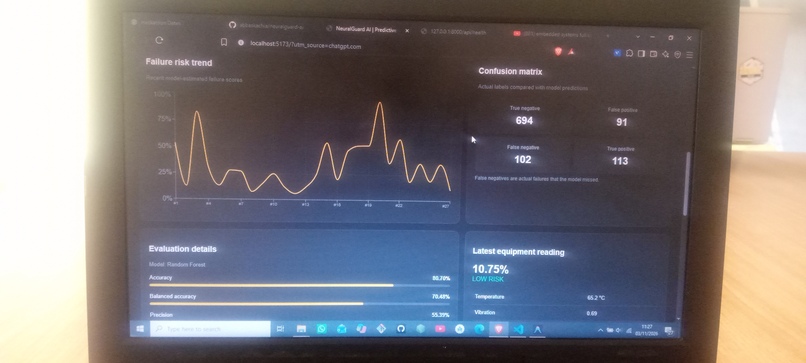
On the held-out test set, the model achieved:
| Metric | Result |
|---|---|
| Accuracy | 80.70% |
| Balanced accuracy | 70.48% |
| Precision | 55.39% |
| Recall | 52.56% |
| F1-score | 53.94% |
| ROC-AUC | 75.30% |
These results show that the prototype can identify patterns in the synthetic dataset, but its current recall also shows that some failure cases are missed. The model needs further improvement and validation before any real industrial use.
Challenges we faced
One of the main challenges was connecting the machine-learning backend to the React dashboard and ensuring that predictions, simulated telemetry, and visualisations remained consistent.
We also had to evaluate the model beyond accuracy. In predictive maintenance, missing an actual failure can be particularly important, so we included precision, recall, F1-score, and ROC-AUC in our evaluation.
Another challenge was designing risk categories that make model outputs easier to understand without presenting predictions as guarantees.
What we learned
Building NeuralGuard AI helped us understand how machine learning can be integrated into a practical software application. We gained experience with model training and evaluation, REST API development, frontend-backend integration, synthetic data, and interactive data visualisation.
The project also reinforced the importance of evaluating model limitations instead of relying on accuracy alone.
What's next
Our next steps include:
- Integrating real sensor data from hardware such as Arduino and industrial sensors.
- Collecting and validating real equipment datasets.
- Improving failure detection and reducing missed failure cases.
- Adding equipment-specific monitoring and maintenance recommendations.
- Exploring deployment for remote equipment monitoring.
Responsible use and limitations
NeuralGuard AI is currently a prototype trained and tested on synthetic data. Its predictions are experimental estimates, not verified real-world failure probabilities. It is not a certified industrial safety system and should not be used as the sole basis for maintenance or safety decisions.
AI tools disclosure
AI assistance, including ChatGPT, was used for technical guidance, debugging support, documentation, and presentation preparation. The project implementation, integration, testing, and submission were carried out by the project author.
Built With
- artificial-intelligence
- data-visualization
- fastapi
- industrial-iot
- javascript
- machine-learning
- predictive-maintenance
- python
- react
- recharts
- rest
- scikit-learn
- vite
