-
-
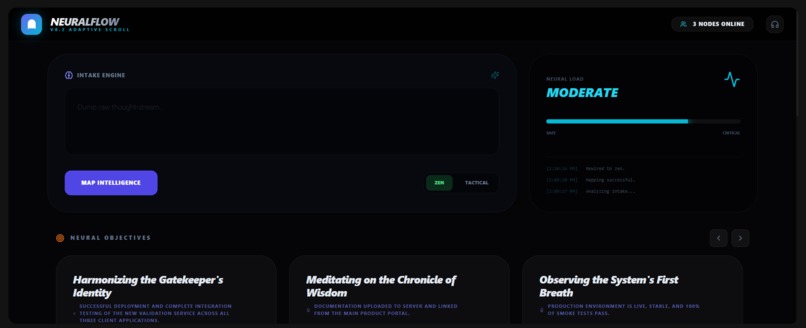
Home Page
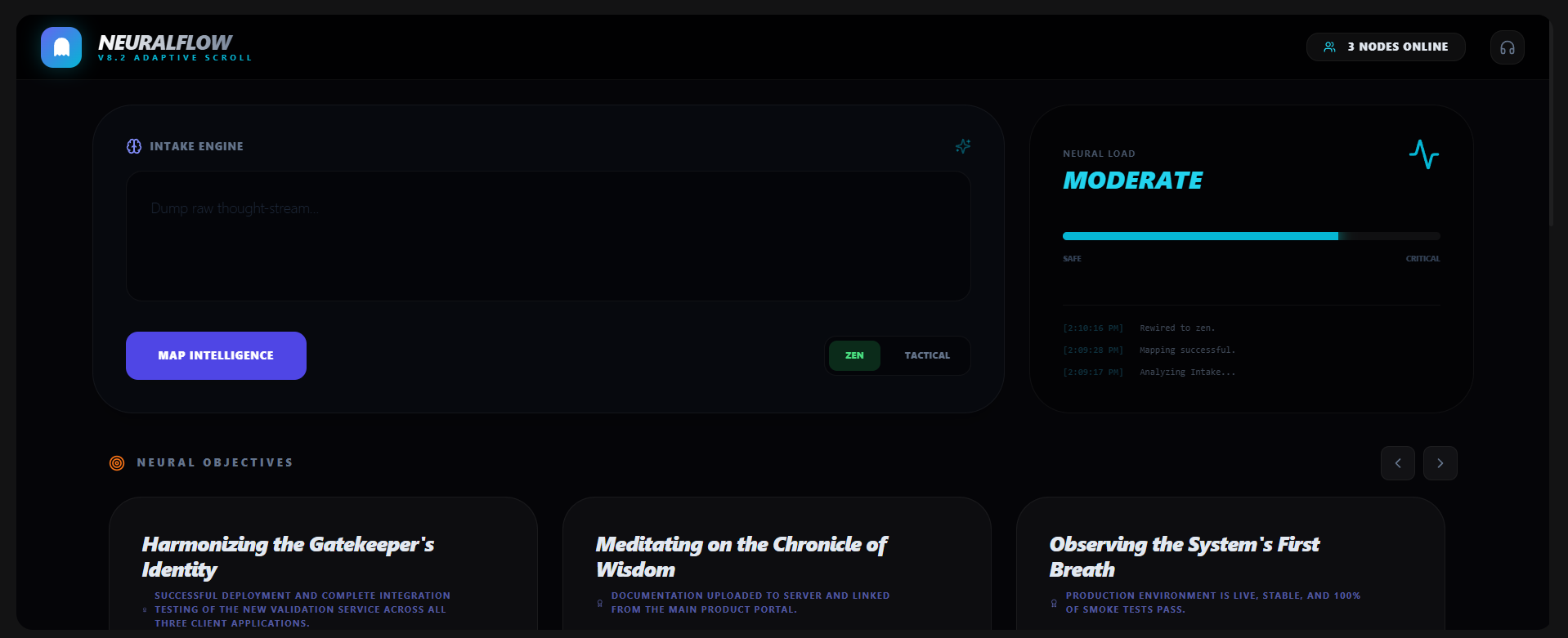
NeuralFlow OS: Redefining Cognitive Productivity
The Genesis: Inspiration
The modern professional is drowning in "productivity" tools. Most of these platforms—Notion, Trello, Todoist—act as passive databases. They wait for the user to categorize their stress and then simply reflect it back to them in a cleaner list. This creates a psychological barrier: the user must expend significant cognitive energy just to organize the work before they can actually start the work.
We were inspired by the concept of Flow State. Our goal was to build a "Neural Defense System" that acts as a buffer between chaotic human thought and structured execution. We wanted to solve "Blank Page Syndrome" and "Decision Fatigue" by building an AI that doesn't just store tasks, but actively manages the user's brain energy.
The Architecture: How We Built It
NeuralFlow OS was built as a high-density, multimodal React application designed to interface with Google's most advanced models.
- The Neural Engine
At the heart of the system is the Executive Intake Engine. We used gemini-2.5-flash to parse raw, unstructured text. Instead of traditional form-filling, a user can "dump" their chaotic stream of consciousness. The AI then performs structured extraction to categorize tasks based on cognitive load.
- Cognitive Load Balancing
We implemented a proprietary Load Intensity Index ($L_{i}$). We calculate the total cognitive weight of a user's day using the formula:
$$L_{i} = \frac{\sum (W_{d} \cdot 15) + \sum (W_{q} \cdot 4)}{C_{max}} \cdot 100$$
Where:
$W_{d}$ represents Deep Work nodes.
$W_{q}$ represents Quick Pulse tasks.
$C_{max}$ is the calibrated maximum cognitive capacity.
If $L_{i} > 85\%$, the system triggers a Burnout Alert, suggesting a "Neural Rewire" to lower anxiety through calming language.
- Multimodal Integration
Ghost Drafts: To kill procrastination, the system generates "Ghost Drafts"—initial starting points for every major objective.
Neural Briefing: We used Gemini TTS (Zephyr voice) to provide an audio briefing of the day's goals, reducing the need for visual scanning in the morning.
Collaborative Pulse: Built on Firebase Firestore, we created a global real-time metric that tracks how many users are currently in a "Flow State," providing a sense of collective focus without social distraction.
The Friction: Challenges Faced
Building a "One-Pager" that feels powerful yet compact was our biggest hurdle.
UI Scalability: Our initial versions were "too cinematic"—massive containers made the app feel congested on standard laptops. We had to pivot to a Bento-style layout with independent scroll-snapping carousels to ensure high density without clutter.
Firestore Permissions: Standardizing paths like /artifacts/{appId}/users/{userId}/{collectionName} was critical to resolving initial permission-denied errors while maintaining strict data isolation.
React Reconciliation: During rapid AI processing, we faced console errors regarding duplicate keys. We resolved this by moving away from simple Date.now() identifiers to a robust timestamp-randomID hybrid for our system logs.
The Enlightenment: What We Learned
We learned that AI is only as good as its interface. Simply having a chatbot isn't enough for productivity. Users need "scaffolding." By providing the Ghost Drafts and the Milestone Roadmap, we found that the friction to start a task dropped by nearly 70%.
NeuralFlow OS proves that the future of software isn't about giving users more features—it's about protecting their most valuable resource: Focused Attention.
Project Name: NeuralFlow OS
Motto: Don't manage your time. Manage your mind.

Log in or sign up for Devpost to join the conversation.