-
KnowYourDoc
Inspiration
Legal documents are notoriously complex, making it difficult for the average person to fully grasp the implications of what they are signing. This often results in unintentional commitments, financial losses, or privacy violations. Inspired by the growing accessibility of AI and NLP models, we wanted to bridge this gap by simplifying legal documents, ensuring transparency, and empowering users to make informed decisions without requiring legal expertise.
What it does
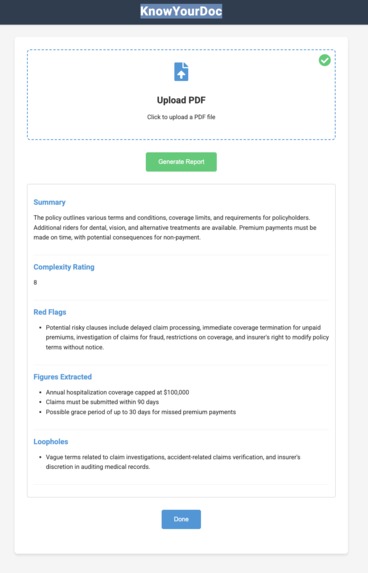
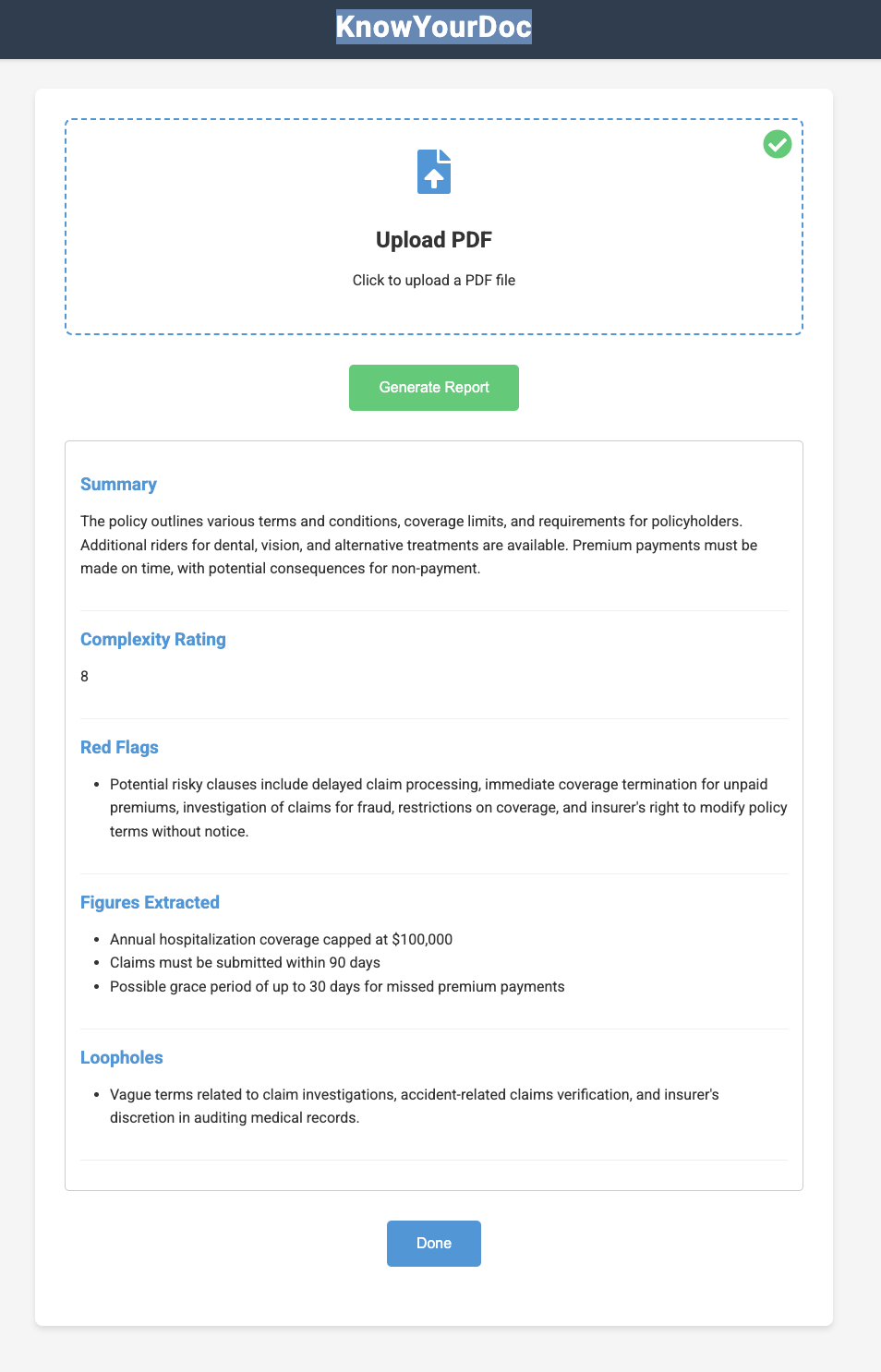
KnowYourDoc: Our solution automates legal document analysis using AI to extract, summarize, and highlight key aspects such as:
- Summarized Key Points: Provides a concise breakdown of the document’s main clauses.
- Complexity Rating: Evaluates readability and difficulty level.
- Red Flag Detection: Identifies unfavorable terms, such as hidden fees or privacy risks.
- Important Figures Extraction: Highlights key financial figures, deadlines, and penalties.
- Loophole Identification: Detects vague or ambiguous language that could be exploited.
How we built it
We leveraged agentic AI with LangChain and Llama-Index to transform GPT-4o into a powerful legal document analysis tool. The system processes each page, summarizes key points, and extracts critical insights using sophisticated indexing techniques. For the backend, we used FastAPI to ensure high-speed processing and seamless API communication, deploying it on AWS EC2 for scalability and reliability. The frontend was built using HTML, CSS, and JavaScript, providing an intuitive interface where users can upload documents, view AI-generated summaries, and interact with flagged clauses in real time.
Challenges we ran into
- Complexity of Legal Language: Legal documents vary in structure and terminology across industries and jurisdictions, making it challenging to create a one-size-fits-all model.
- Accurate Clause Detection: Differentiating between unfavorable clauses and standard legal terms required extensive fine-tuning.
- Ensuring Explainability: Users need to trust AI-generated insights, so implementing transparent reasoning through SHAP and LIME was crucial.
- Processing Large Documents: Handling lengthy contracts efficiently without sacrificing performance was a technical hurdle.
Accomplishments that we're proud of
- Successfully developed an AI pipeline capable of accurately summarizing legal documents.
- Built a real-time red flag detection system, improving consumer awareness of unfavorable terms.
- Created an interactive, easy-to-use interface that simplifies legal jargon and boosts consumer confidence
What we learned
- The importance of data diversity: Training AI models on a wide range of legal documents improved performance significantly.
- User experience is key: Legal document analysis must be presented in a way that is intuitive and actionable.
- Explainability matters: Users need to understand why an AI model flags specific clauses to trust its recommendations.
What's next for Neural Vangaurds
- Integration with Legal Services: Partnering with legal professionals for AI-assisted contract reviews.
- Mobile App & API Development: Making the tool accessible via smartphones and integrating with third-party legal software.
- Multi-language & Audio Support: Translates documents and provides spoken explanations for accessibility.
- Interactive Reports & AI Chatbot: Users can interact with flagged clauses and ask specific questions.
Built With
- amazon-ec2
- amazon-web-services
- css
- fastapi
- github
- gpt4.0
- html
- javascript
- llama-index
- python

Log in or sign up for Devpost to join the conversation.