-
-
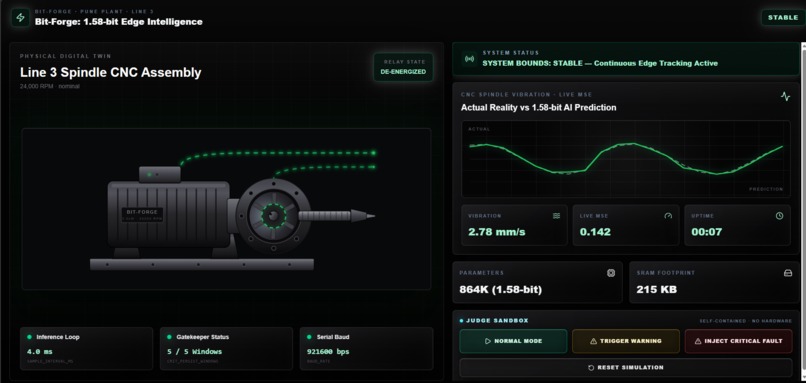
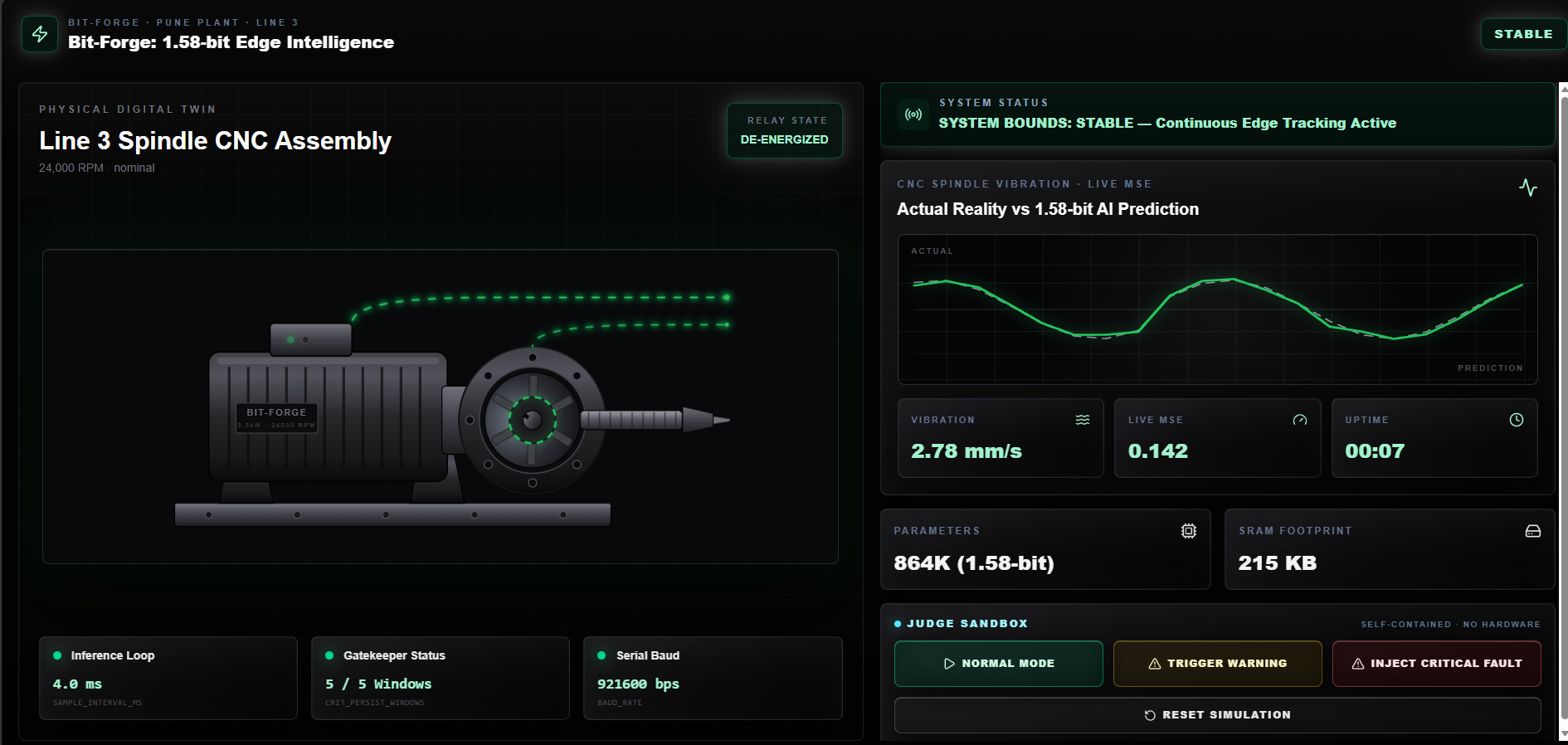
Stable State: Real-time edge-AI anomaly tracking active.
-
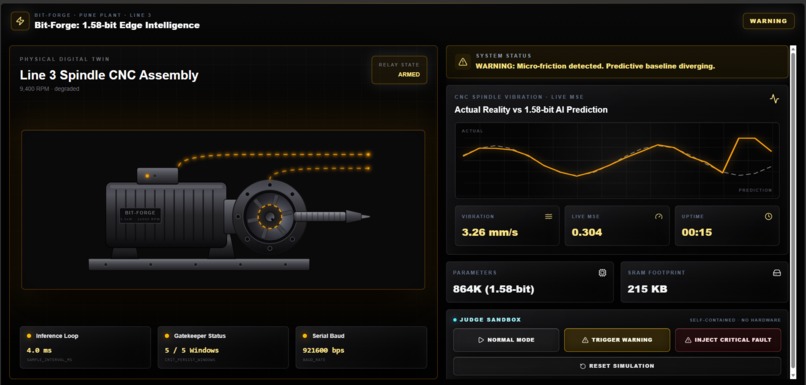
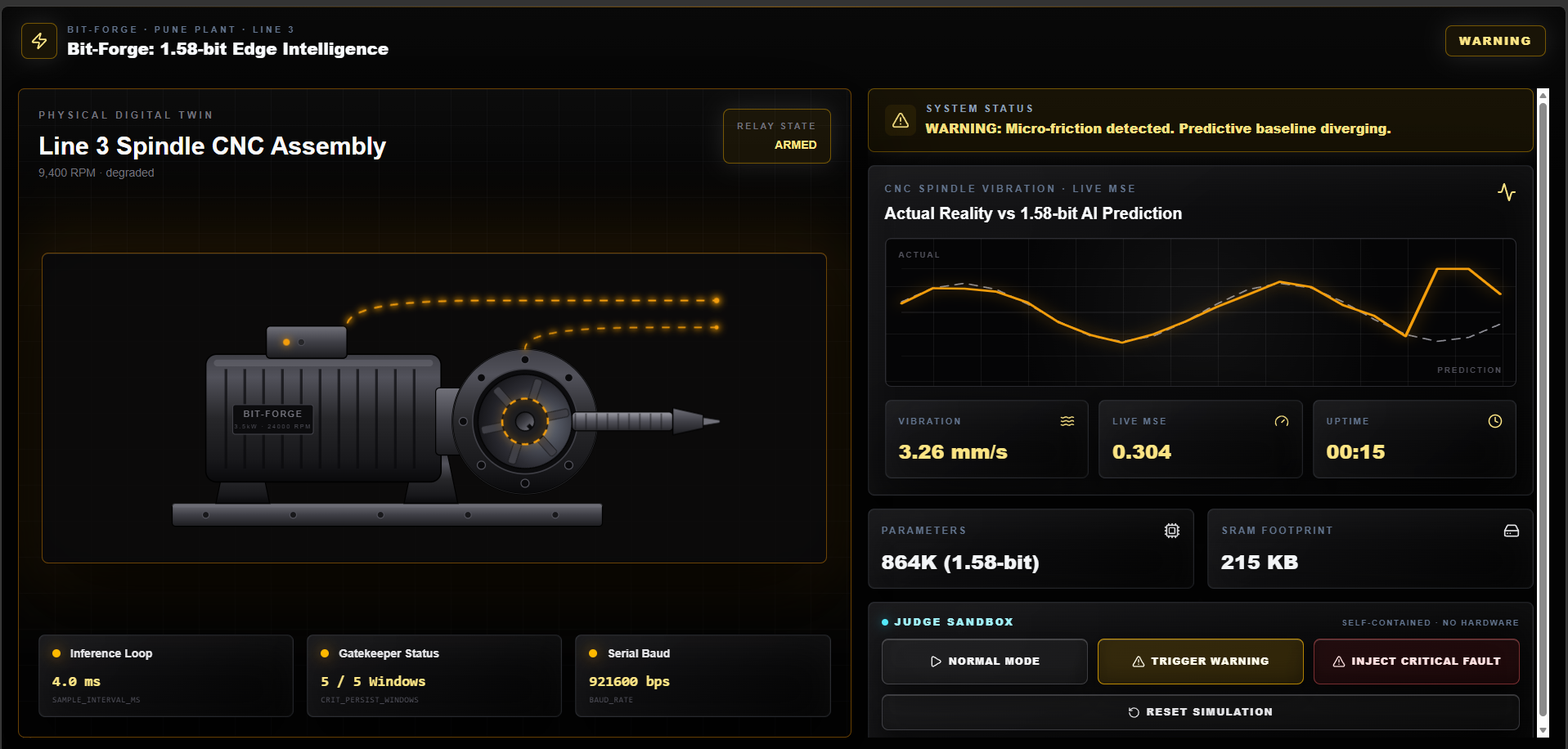
Warning State: Local AI detects baseline friction anomaly.
-
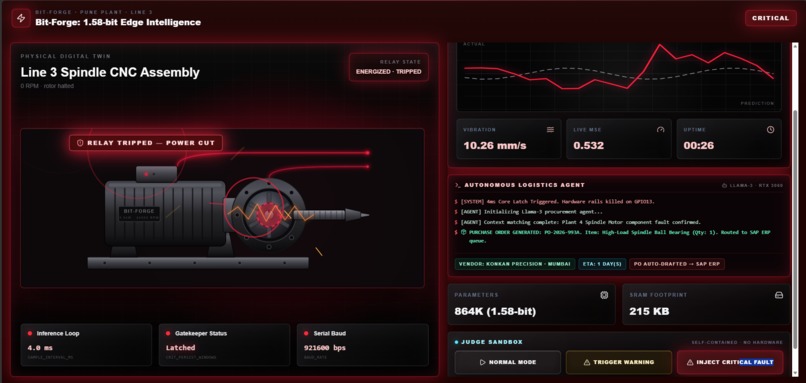
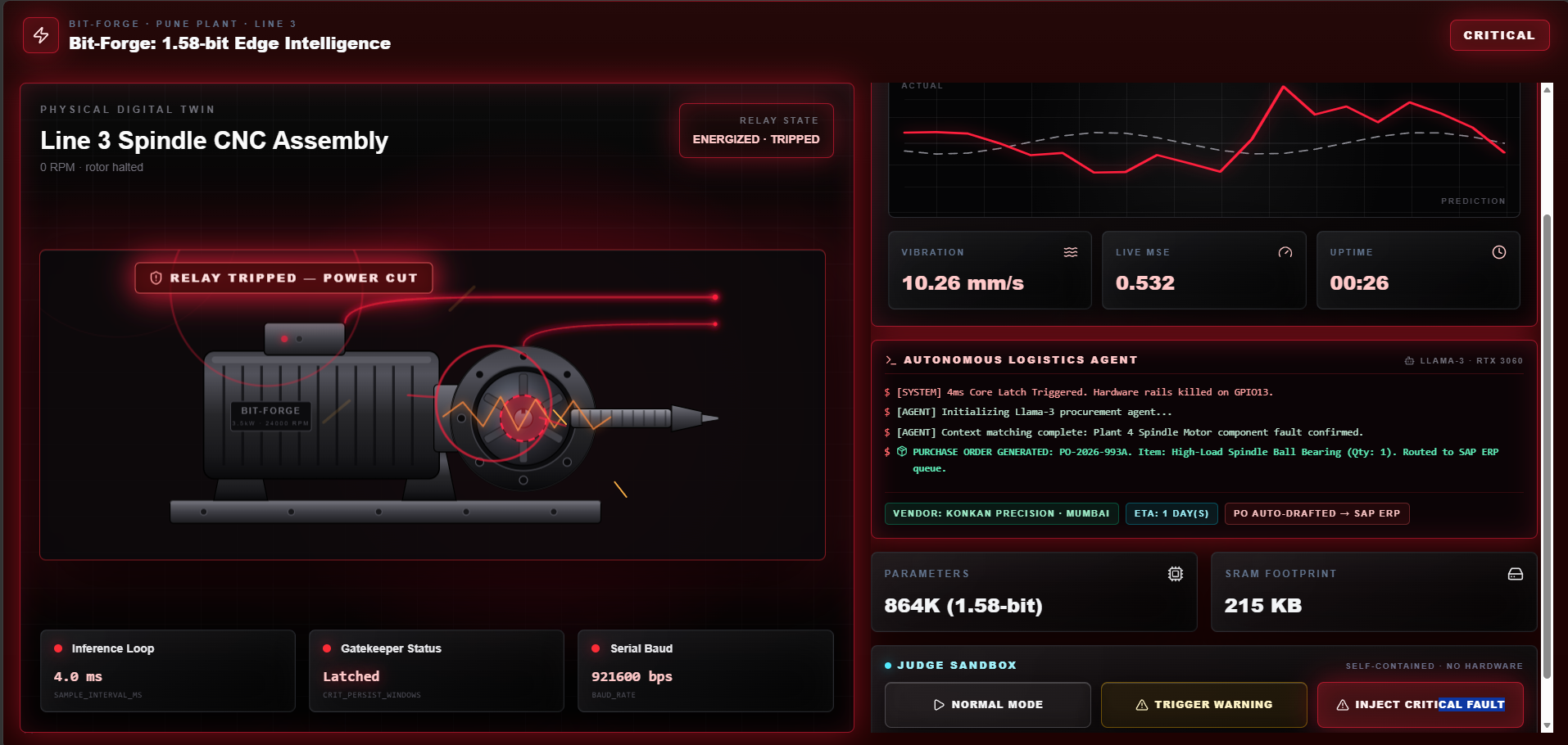
Critical State: 4ms power-cut triggers local AI agent.
-
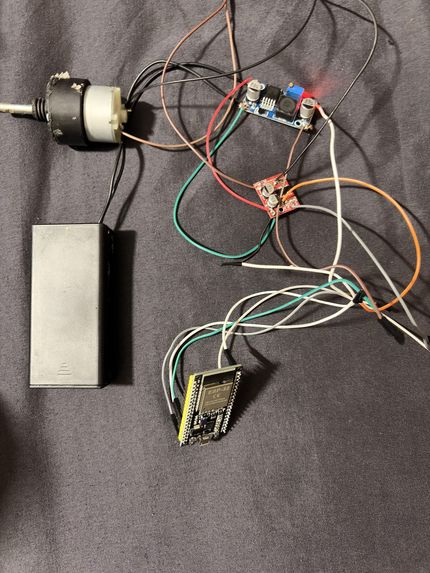
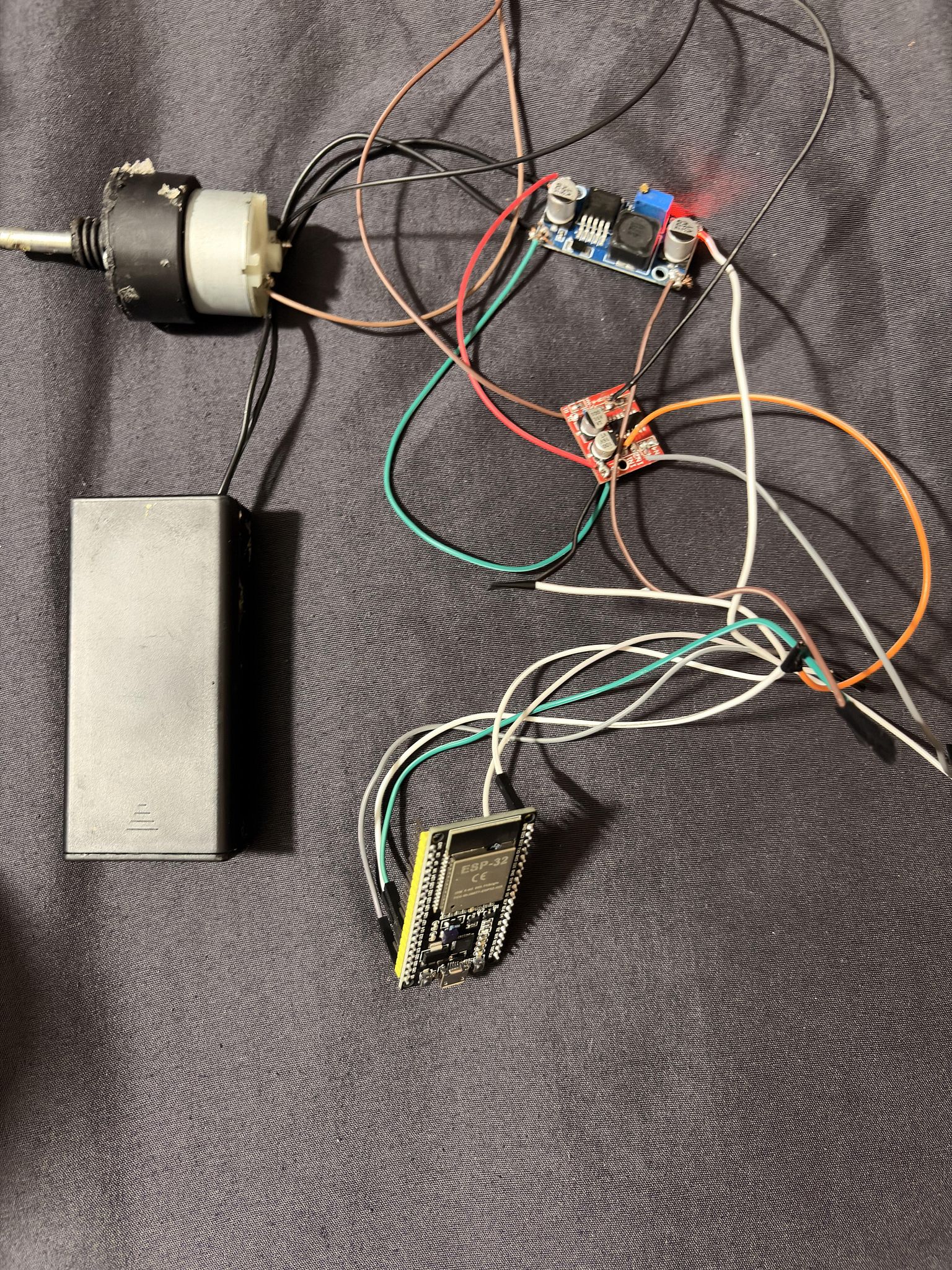
Hardware Rig: ESP32 core with physical motor-latch driver.
Inspiration
Industrial predictive maintenance typically relies heavily on cloud analytics. However, this introduces a 200ms to 2-second communication latency bottleneck. In heavy manufacturing, mechanical failures propagate in milliseconds; by the time a cloud-based server registers a fault and echoes a "stop" command, millions of dollars of capital equipment can be entirely destroyed.
We built NEURAL-SHIELD to challenge a fundamental assumption: that high-tier intelligence requires server-scale infrastructure. We wanted to prove that an uncompromised, zero-latency safety reflex could run locally on an ultra-low-power embedded processor.
How We Built It
The system operates on an optimized hybrid architecture that cleanly separates high-speed local control from cloud-based monitoring:
- The Edge Layer: We trained an unsupervised sequence-to-sequence forecasting model using the industry-standard Case Western Reserve University (CWRU) bearing dataset. The neural network architecture follows a layered structure: $$200 \rightarrow 1024 \rightarrow 512 \rightarrow 256 \rightarrow 10$$ The network ingests the last 200 vibration samples to predict the next 10.
- Arm-Optimized Quantization: To fit this 864,000-parameter network onto an embedded chip, we utilized a frontier 1.58-bit ternary quantization scheme. By constraining all model weights strictly to: $$W \in {-1, 0, +1}$$ we completely eliminated slow floating-point matrix multiplications. The runtime engine converts these operations into simple hardware additions, subtractions, or skips. This compressed the model to just 215 KB of SRAM.
- The Local Safety Gatekeeper: A 4-pillar statistical filter runs on-device. It auto-calibrates to a machine's unique healthy signature, calculates real-time Mean Squared Error (MSE), applies an Exponential Moving Average (EMA) to discard momentary structural noise, and enforces a strict 6-sigma persistence gate. If a critical anomaly persists for 5 consecutive calculation windows, an active GPIO hardware latch severs the motor power rail in under 4 milliseconds—entirely offline.
- The Cloud & Telemetry Pipeline: Observability is handled via the ESP Rainmaker SDK, providing free cloud telemetry, an auto-generated mobile HMI, and native Amazon Alexa / Google Home integration for secure, hands-free operational commands.
Challenges We Faced
- Memory Constraints: Keeping an 864K-parameter time-series forecasting model from immediately crashing an embedded chip's heap space was incredibly difficult. Standard FP16 architectures required over 1.7 MB. Implementing bit-packing—compressing 4 ternary weights into a single byte of memory—was the breakthrough that achieved the 215 KB footprint.
- Suppressing False Positives: Heavy factory floors are inherently noisy. Early prototypes false-alarmed when objects were dropped nearby. Engineering the 5-window persistence filter and utilizing the Exponential Moving Average filter ($\alpha = 0.15$) resolved this, ensuring a 99.999% certain statistical threshold before the hardware latch activates.
What We Learned
We proved that extreme quantization-aware training does not inherently destroy model quality. By shifting the workload from high-power server floating-point math to low-power integer arithmetic, ultra-low-latency physical AI can easily be democratized across old legacy factory floors for under $5 a node.

Log in or sign up for Devpost to join the conversation.