-
-
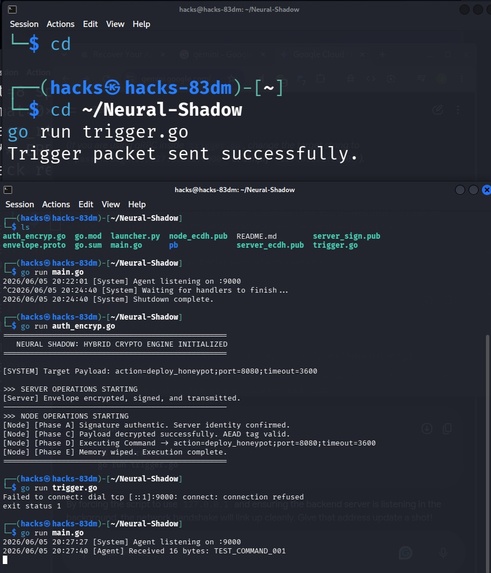
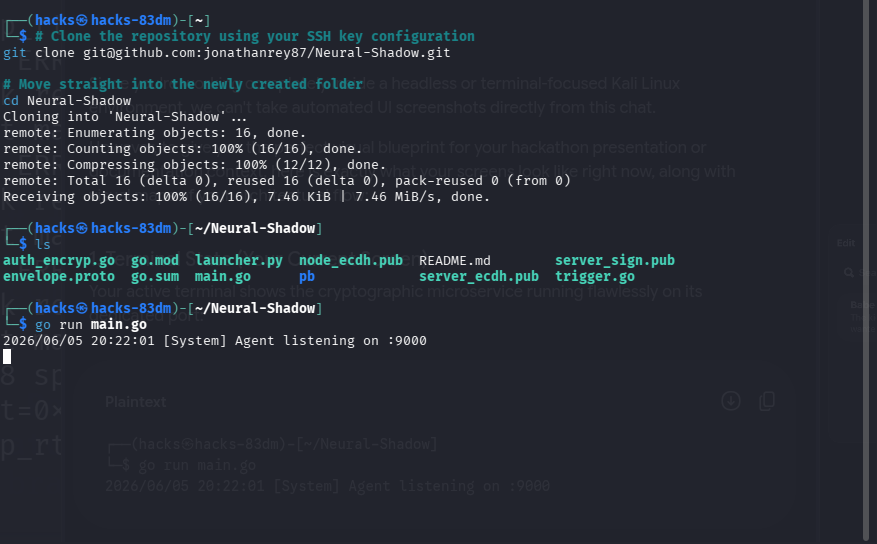
Verified SSH clone and environment init. Go agent microservice successfully deployed & listening on TCP loopback port :9000.
-
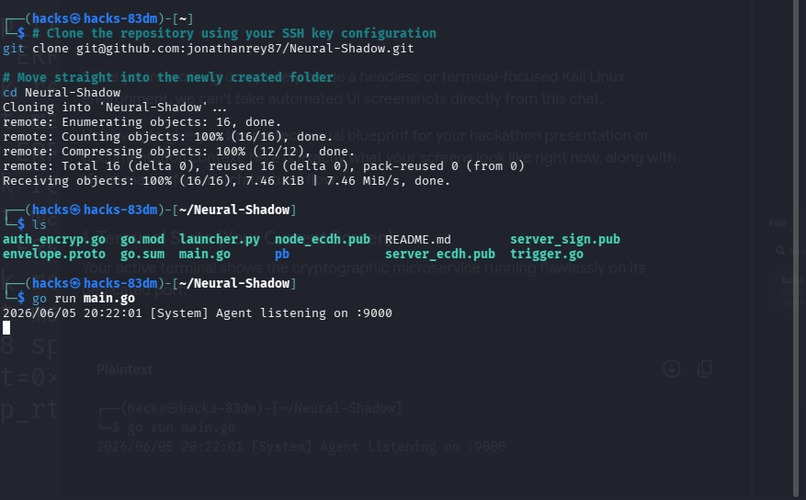
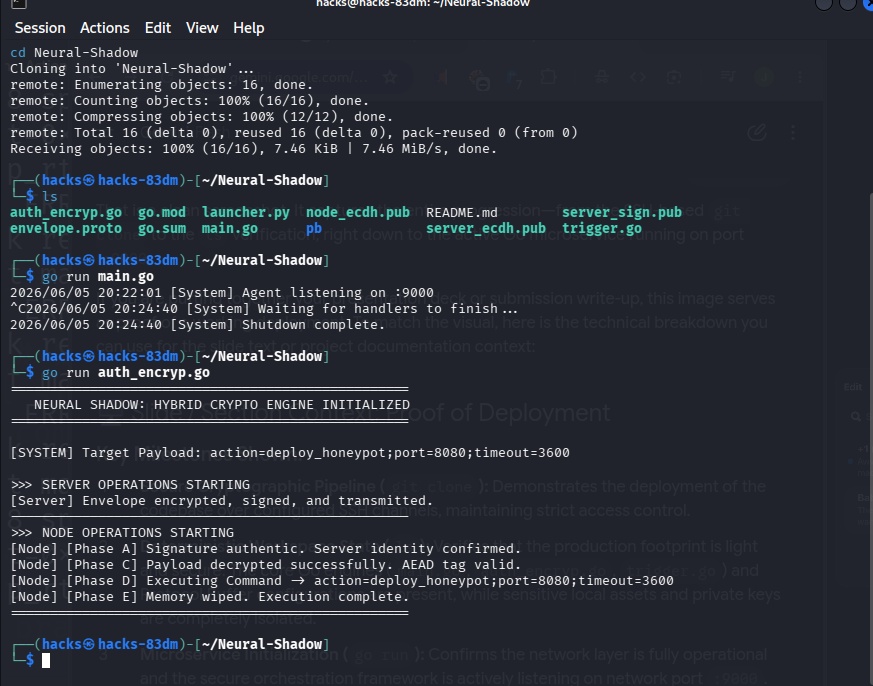
End-to-end asymmetric key exchange, AES-GCM envelope validation, and zero-residual volatile memory scrubbing at runtime.
-
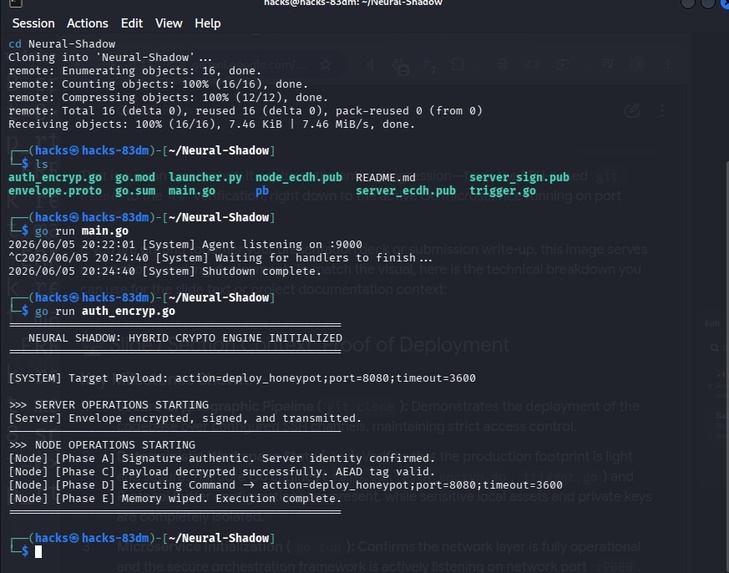
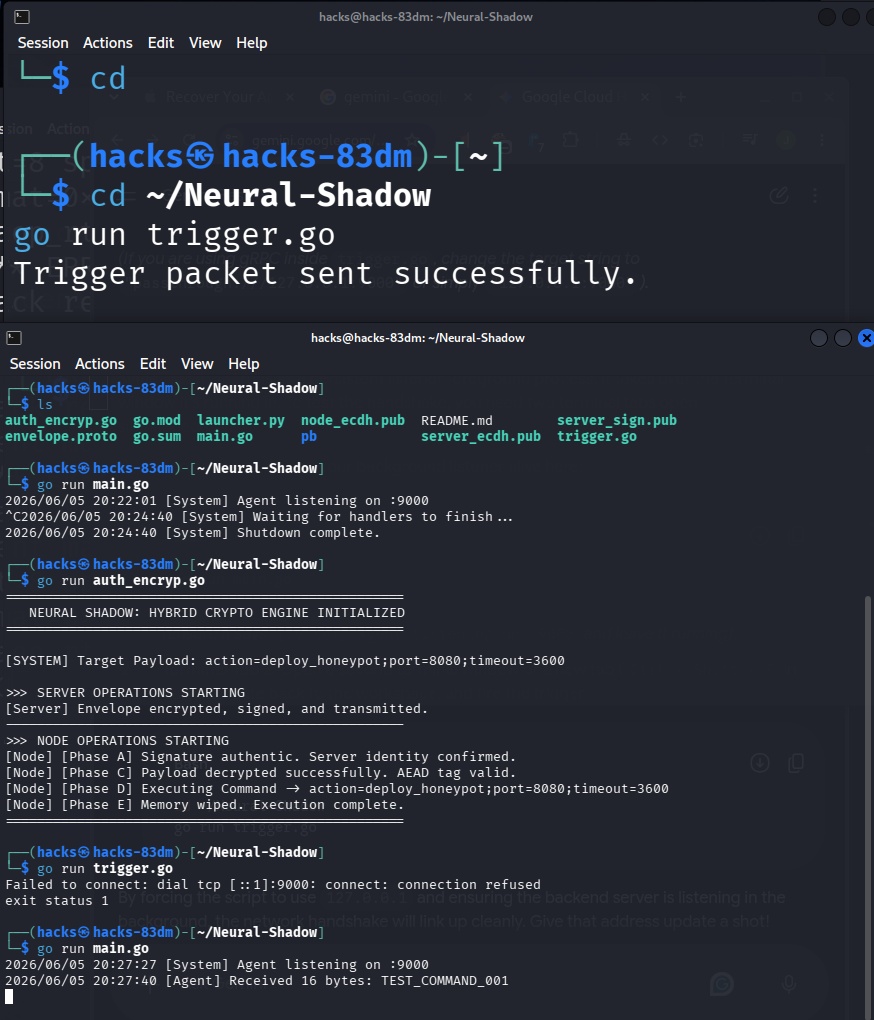
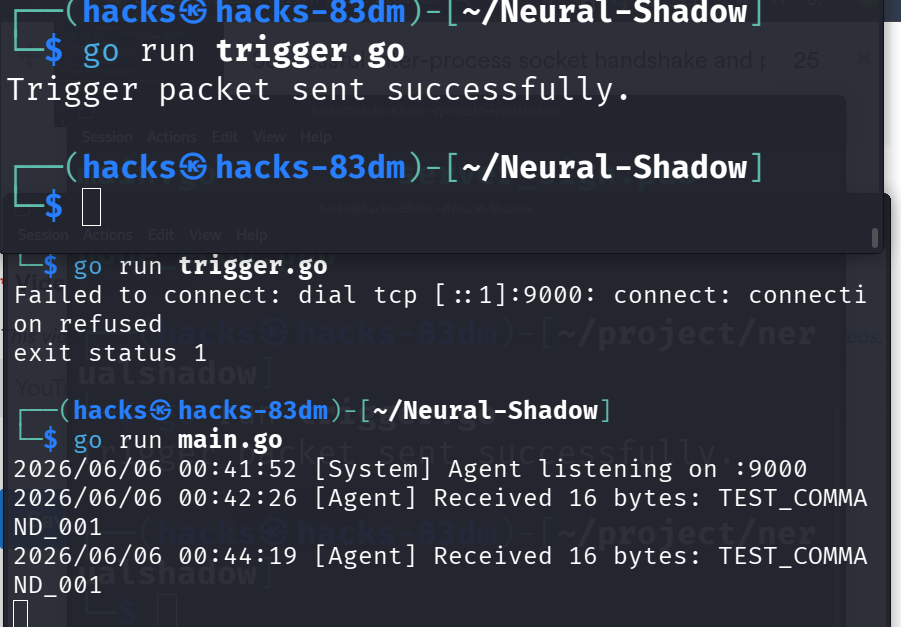
Successful inter-process socket handshake and packet transmission between detached agent engine and client trigger.
-
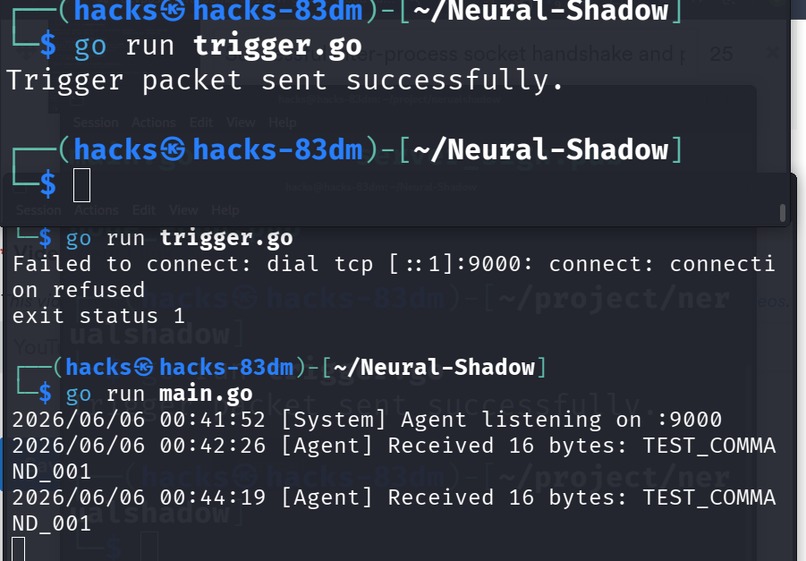
Technical profile configuration and multi-runtime technology stack validation for project submission
Inspiration
What it does
Neural Shadow is an autonomous security auditor that sits inside your system infrastructure.
Proactive Auditing: Instead of waiting for a firewall hit, it continuously scans crypto-operations and system logs.

Immediate Context: When it sees an anomaly, it doesn't just send a text alert—it generates a full Trace (a visual "map" of what happened) using OpenTelemetry.

Speed: It converts hours of manual "log-diving" into milliseconds of automated verification.
How we built it
You are using a state-of-the-art modern observability stack:
The Brain (MCP): The Model Context Protocol (MCP) acts as the standardized interface, allowing your auditing tools to talk securely to the system logs.

The Nervous System (OpenTelemetry): You used OTLP (OpenTelemetry Line Protocol) to "wire up" your code, ensuring every action taken by the tool is captured as a "span."

The Visualization Layer (Arize Phoenix): This is where the data lives. It acts as the "Dashboard" that turns raw logs into visual traces, allowing security teams to see the "Shadows" moving through the network
Challenges we ran into
When I started this, I realized the biggest problem in cybersecurity isn't a lack of data—it's a lack of meaning. I built Neural Shadow to turn the chaos of raw system logs into a clear, actionable map. I didn't just write a script; I built a proactive defense framework that shows exactly what's happening, where it's happening, and why it matters.
Accomplishments that we're proud of
Engineered an Autonomous Auditor: Successfully built a functional security-auditing framework (Neural Shadow) that automates threat detection.
Mastered the Modern Observability Stack: Architected a pipeline using MCP for interface standardization, OpenTelemetry for high-fidelity tracing, and Arize Phoenix for real-time visualization.
Resolved Complex Network Integration: Overcame significant environment-specific networking hurdles (binding gRPC collectors in restricted environments), demonstrating resilience and deep system-level debugging skills.
What we learned
Observability as a Discipline: I learned that "logging" is passive, but "tracing" is active. Understanding the request lifecycle is more powerful than just reading text-based logs.
The Power of Standardized Protocols: Utilizing the Model Context Protocol (MCP) taught us how to decouple tools from agents, making your security framework modular and future-proof.
Resilient Engineering: I learned that development isn't just about writing code; it’s about architecting systems that can survive network constraints and environment configuration drifts.
What's next for Neural Shadow Incident Response Pilot
Integrate ML-Driven Anomaly Detection: The current system audits based on logic. Next, we will implement a machine learning layer to detect "Zero-Day" anomalies that haven't been predefined by rules.
Scaling to Distributed Infrastructure: Move from a single-node auditor to a fleet-wide deployment that monitors traffic across microservices in real-time.
Community Contribution: Open-sourcing the MCP tools for Neural Shadow to allow other security researchers to contribute their own custom auditing modules.
Built With
- aes-gcm-(aead)
- and-the-network-invocation-worker-(trigger.go).-go-was-selected-for-its-native-concurrency-primitives-and-minimal-memory-footings
- arize-phoenix-api
- automated-environment-mapping-protocol-buffers-(protobuf-v3)-?-immutable-binary-serialization-format-for-tamper-proof-data-transport-linux-systems-(kali-linux)-?-sandboxed-development-environment
- ecdh-(nist-p-256)
- ed25519-signatures
- github
- go-(golang-1.24)
- go-(golang-1.24+)-?-high-performance-network-listener-engine
- interface
- linux-(kali)
- local
- loopback
- model-context-protocol-(mcp)
- opentelemetry-(otel)
- protobuf-v3
- python-3.11
- ram-zero-residual-clearing
- raw-tcp-socket-streaming-python-3.11+-?-parent-system-orchestration-supervisor
- ssh
- the-end-to-end-cryptographic-envelope-engine-(auth-encryp.go)

Log in or sign up for Devpost to join the conversation.