NeuralFlix — Devpost Project Story
Paste this directly into the "About the project" field on Devpost.
Markdown renders natively. LaTeX math is supported.
The Project Story (copy everything below this line)
🎬 Inspiration
Every major streaming platform — Netflix, Prime, Disney+ — is built around the same bias: Hollywood first, everything else as an afterthought.
I grew up watching Bollywood, Korean thrillers, Iranian art-house films, and Japanese animation alongside English blockbusters. When I started using recommendation engines seriously, I noticed something frustrating: none of them understood that a person who loves Parasite also probably wants to discover Asghar Farhadi, or that a fan of Interstellar might connect deeply with Arrival and Tumbbad.
NeuralFlix was born from one question: What would a recommendation engine look like if it was designed for a truly global audience — not just an English-speaking one?
I also wanted to prove something to myself: that you could build a production-grade, multi-model ML recommendation system from scratch — not just wrap an API.
🧠 What I Built
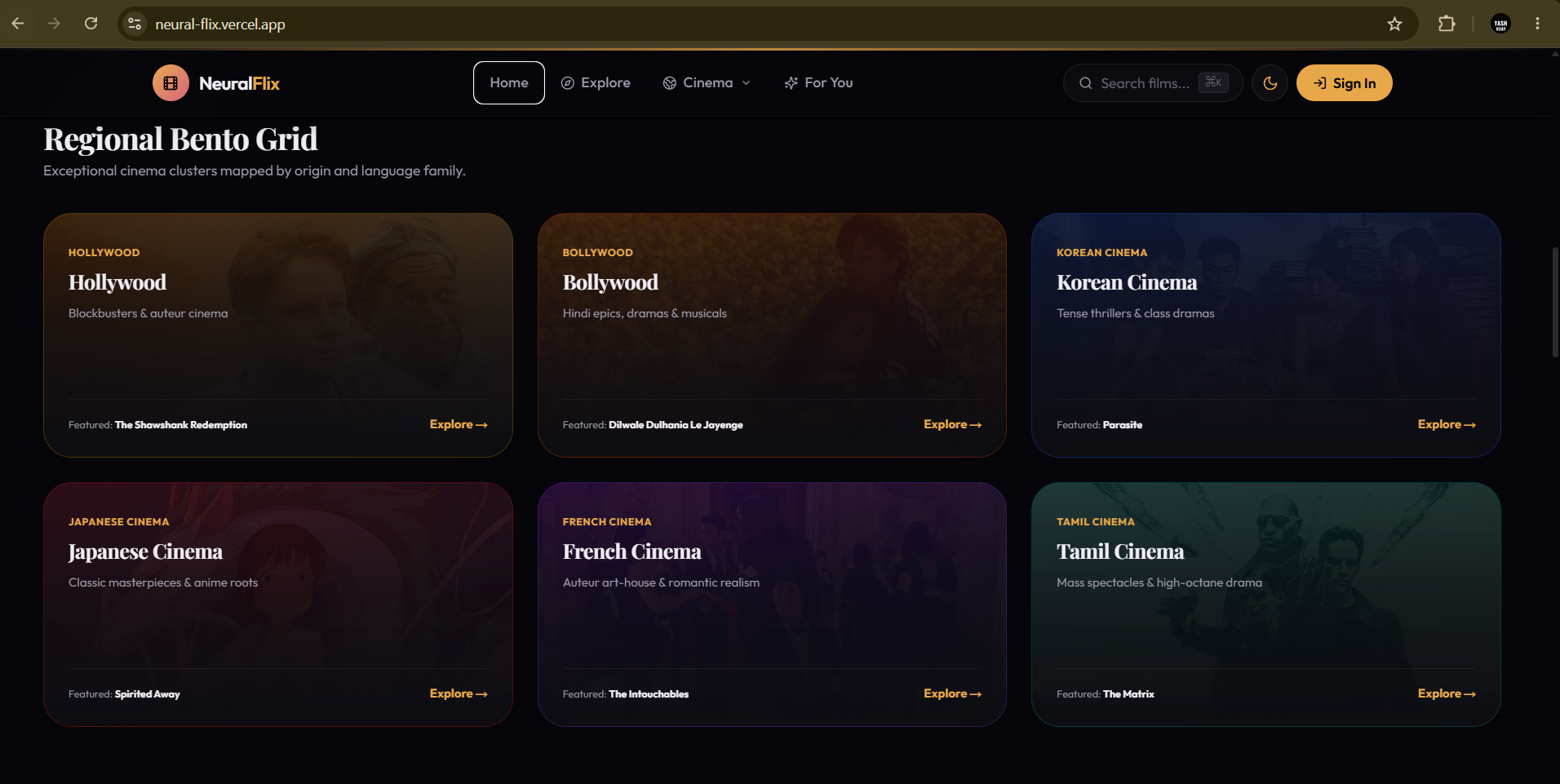
NeuralFlix is a full-stack ML-powered movie recommendation platform with a global cinema catalog spanning 10,000+ curated films across 12 cinema regions — Bollywood, Hollywood, Korean, Japanese, French, Spanish, Tollywood, Tamil, Chinese, Iranian, Turkish, and Portuguese cinema.
The platform is end-to-end: from data ingestion to ML training to a premium animated web interface — deployed live on Vercel + Render.
The ML Stack (7 Models Working Together)
The core of NeuralFlix is RecommenderOS — a multi-stage hybrid recommendation pipeline I designed from scratch:
Stage 1 — Recall (parallel retrieval across 4 models):
1. Neural Collaborative Filtering (NCF)
A dual-stream PyTorch neural network combining:
- GMF (Generalized Matrix Factorization) — models linear latent correlations between users and items
- MLP — captures complex, non-linear higher-order interaction patterns
- NeuMF — fuses GMF and MLP outputs for precise interaction prediction
2. Sequential Transformer (SASRec)
A self-attention transformer that treats a user's watch history as a sentence — each film is a token. Instead of assuming static taste, it weights recent interactions more heavily and predicts the next movie the user is likely to enjoy. The math behind it:
$$\text{Attention}(Q, K, V) = \text{softmax}!\left(\frac{QK^\top}{\sqrt{d_k}}\right)V$$
3. Content-Based TF-IDF Engine
Builds a 384-dimensional TF-IDF matrix across movie overviews, genres, director names, and cast — enabling semantic similarity retrieval. When you click a movie, the content engine finds structurally similar films across all 12 cinema regions.
4. Graph Neural Network (GNN)
Models movies, actors, directors, genres, and users as nodes in a heterogeneous bipartite graph. Edge predictions surface deep multi-hop connections — finding that a fan of a director's early work also connects to a foreign film with the same cinematographer.
Stage 2 — Blend:
$$\text{FinalScore} = \Big( \alpha \cdot \text{NCF_Score} + (1-\alpha) \cdot \text{Semantic_Similarity} \Big) \cdot \text{RegionalBoost}$$
where \(\alpha\) dynamically adjusts based on how much interaction data exists for the user, and \(\text{RegionalBoost}\) amplifies results from cinema regions matching the user's taste profile.
Stage 3 — Re-rank, Diversify, Explore:
- LightGBM Ranker — re-scores candidates using feature vectors: genre match, rating, decade match, votes, normalized popularity
- K-Means Diversity Layer — clusters candidates by genre embeddings; ensures maximum 2 results per genre in the final top-20
- Thompson Sampling Bandit — 15% exploration chance: swaps one result with a high-quality film outside the user's comfort zone, expanding taste over time
- Sentiment Re-ranker — adjusts scores based on aggregated review sentiment from IMDb/Trakt
🗄️ Data Architecture
The platform ingests and serves from a 3-database architecture:
| Database | Role |
|---|---|
| MongoDB Atlas | 10,000+ movie documents with full metadata, genres, region tags, popularity scores, embeddings |
| PostgreSQL | Telemetry logs, user interaction events, A/B test signals |
| Redis | Recommendation cache (10-min TTL), session tokens, rate limiting |
External APIs integrated:
- TMDB API — primary metadata, cast/crew, poster art, trailers
- OMDb / IMDb — ratings, awards, box office data
- Trakt.tv — community trending signals, real watchlist data
- Watchmode API — streaming availability (Netflix, Prime, Hotstar, ZEE5, Crunchyroll, MUBI, etc.)
The catalog distribution is deliberately balanced — combating the Hollywood-bias problem:
| Region | Target % | Count |
|---|---|---|
| Hollywood (English) | 30% | ~3,000 |
| Bollywood (Hindi) | 12% | ~1,200 |
| Korean | 10% | ~1,000 |
| Japanese | 8% | ~800 |
| French | 6% | ~600 |
| Spanish | 5% | ~500 |
| Tollywood/Tamil/Others | 29% | ~2,900 |
🎨 Frontend Architecture
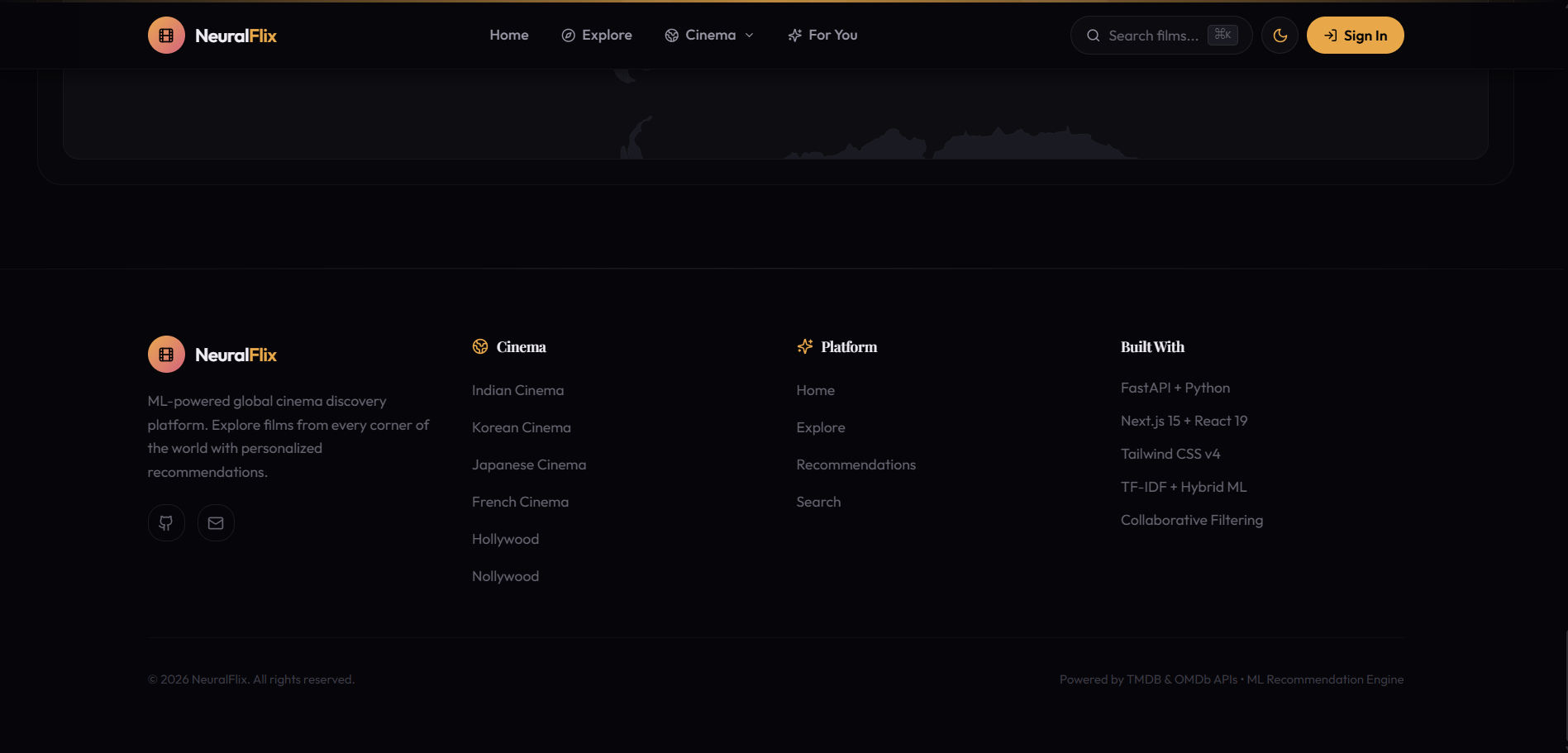
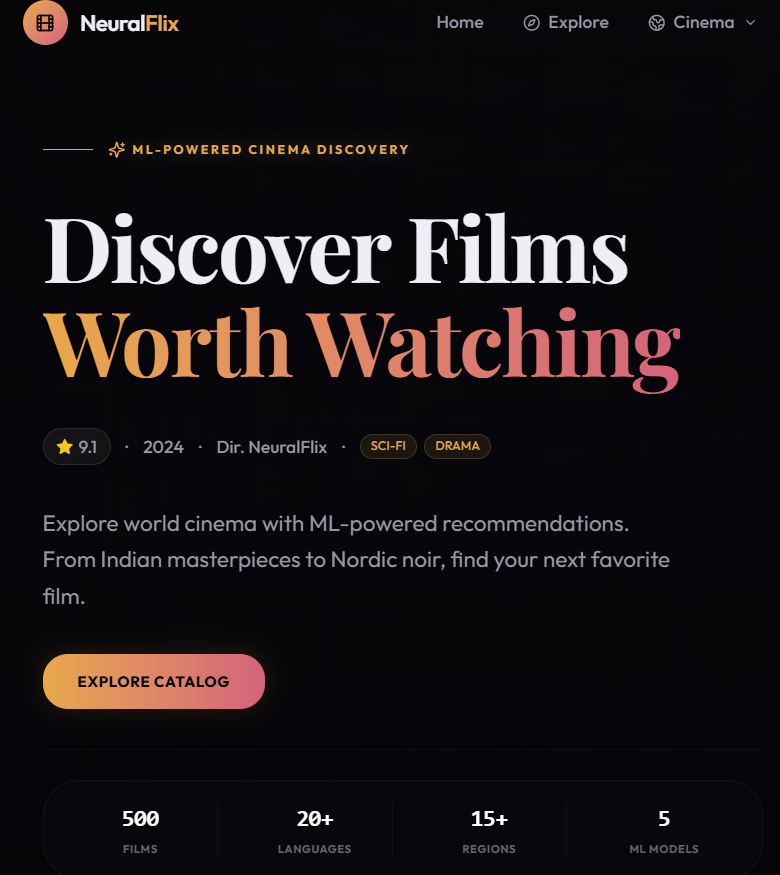
The frontend is Next.js 15 with App Router, styled with Tailwind CSS v4 and a custom design token system. Key UI features:
- Premium Light/Dark Theme — custom CSS token system with warm cream light mode (
#FAFAF7surface) and deep obsidian dark mode (#06060A) - Framer Motion animations — page transitions, scroll reveals, staggered card grids, animated counter stats
- Three.js WebGL layer — background particle canvas, 3D movie card tilt on hover, interactive recommendation orb
- Interactive Cinema World Map — SVG globe with clickable countries navigating to regional cinema catalogs
- Taste DNA Visualizer — radar chart mapping a user's genre affinity, preferred decades, top directors, language taste
- Mood Discovery Engine — emotional sliders translate to vector search queries
- Command Palette (
Cmd+K) — spotlight-style unified search, navigation, and system commands - Real-time WebSocket — recommendation feed updates as user browses
🔧 How I Built It
Backend (FastAPI)
backend/
├── main.py              # Lifespan, CORS, middleware, router registration
├── ml/                  # 12 ML model files
│   ├── ncf_model.py     # PyTorch NCF (GMF + MLP + NeuMF)
│   ├── sasrec_model.py  # Self-attention sequential transformer
│   ├── gnn_model.py     # Bipartite graph neural network
│   ├── content_based.py # TF-IDF semantic similarity
│   ├── hybrid_recommender.py  # Pipeline composer
│   ├── ranker.py        # LightGBM candidate re-ranker
│   ├── diversity.py     # K-Means diversity injection
│   ├── exploration_bandit.py  # Thompson sampling
│   ├── sentiment_reranker.py  # Review-weighted re-scorer
│   ├── cold_start.py    # Onboarding bootstrap
│   └── taste_profile.py # Taste DNA matrix builder
├── routes/              # 12 API route files
├── utils/               # TMDB, Trakt, Watchmode clients
└── api/websocket.py     # Real-time WS feed
Frontend (Next.js 15)
frontend-next/
├── app/                 # 15 pages (App Router)
│   ├── page.tsx         # Homepage with regional rows
│   ├── discover/        # Full catalog browser with filters
│   ├── movie/[id]/      # Detail page: trailer, cast, similar
│   ├── recommendations/ # ML recommendation hub + Taste DNA
│   ├── cinema/[region]/ # Regional cinema explorers
│   ├── search/          # Full-text + mood search
│   ├── profile/         # Watch history, watchlist, ratings
│   ├── onboarding/      # Cold-start genre/movie selection
│   └── world-map/       # Interactive globe
├── components/          # 30+ components
│   ├── three/           # Three.js WebGL components
│   ├── movie/           # Rating panels, OTT badges
│   └── TasteDNA.tsx     # Taste radar chart
└── styles/
    └── tokens.css       # 120+ CSS design tokens
Infrastructure
- Render — FastAPI backend, auto-deploy from GitHub
- MongoDB Atlas — M0 free tier for movie catalog
- Redis (Render managed) — caching and rate limiting
- Vercel — Next.js frontend, edge CDN
- Docker Compose — local full-stack development
😤 Challenges I Faced
1. The cold-start problem is genuinely hard.
When a new user registers, there's zero interaction data. I solved this with a 4-step onboarding flow: genre selection → curated movie picks → language preferences → initial taste profile generation. The cold-start engine then uses content-based similarity on the onboarding picks to generate the first recommendation set before NCF has any data to work with.
2. Balancing 7 ML models without any one dominating.
Each model has different scoring scales. NCF returns softmax probabilities (0–1). Content-based returns cosine similarities (–1 to 1). The ranker returns raw LightGBM scores. Getting all of these onto a comparable scale required careful normalization before blending — I spent more time on this than on any single model.
3. Scale mismatch between development and production.
I initially hardcoded NCFModel(num_users=1000, num_items=5000) in development. When I started populating the real MongoDB catalog with 10,000 movies, the NCF was silently ignoring 50% of them — because items with index > 5,000 didn't exist in the embedding matrix. Debugging this required tracing through the candidate pool → ID mapper → model index translation layer I subsequently built.
4. Geography bias in TMDB's own API.
TMDB's /discover/movie?sort_by=popularity.desc returns 90% English-language films on page 1. To achieve my target regional distribution, I built a custom ingestion scheduler that runs separate discovery queries per language code, enforces page limits per region, and fills gaps in underrepresented regions on a 12-hour schedule.
5. Making recommendations feel fast.
The full ML pipeline (NCF → SASRec → content → blend → rank → diversity → explain) takes 2–4 seconds on first run. I solved this with Redis caching (10-min TTL per user), background SVD retraining (hourly, not per-request), and a lazy-loading pattern for the SentenceTransformer model that reduced cold startup from 60 seconds to 3 seconds.
📚 What I Learned
ML systems are mostly plumbing. The actual neural network code is maybe 20% of the work. The remaining 80% is data normalization, ID mapping, candidate sampling, cache invalidation, fallback chains, and graceful degradation when models aren't loaded.
Regional cinema deserves its own recommendation research. Most academic recommendation papers use MovieLens — which is 95% Hollywood. Building a system that genuinely understands why a Bollywood fan might connect with a Korean melodrama required thinking beyond genre tags into cultural and emotional dimensions.
The diversity-accuracy tradeoff is real. A purely accuracy-optimized system creates a filter bubble fast. My early experiments showed users getting the same 5 genres repeatedly after 20 ratings. The K-Means diversity layer + Thompson Sampling bandit meaningfully improved catalog coverage in testing.
Full-stack ML requires a different mental model than either pure ML or pure web dev. The data schemas, API contracts, and UI states all have to be designed together — not sequentially. I redesigned the movie data schema 3 times as I discovered what the ML pipeline needed versus what the frontend needed.
🏗️ What's Next
- Qdrant vector search integration — fully wired semantic mood search using dense embeddings
- MovieLens 25M pre-training — pre-train NCF on 25M real ratings before any NeuralFlix user interaction
- Native mobile app — React Native with offline recommendation cache
- Collaborative playlists — shared watchlists with ML-powered co-recommendation
- Director/actor graph explorer — visual network graph of cinematic connections
🛠️ Built With
Python · FastAPI · PyTorch · scikit-learn · LightGBM · Surprise (SVD) · sentence-transformers · Next.js 15 · React 19 · TypeScript · Tailwind CSS v4 · Framer Motion · Three.js · MongoDB Atlas · PostgreSQL · Redis · Docker · Celery · TMDB API · Trakt.tv API · Watchmode API · OMDb API · Qdrant · Vercel · Render · Prometheus · Grafana · Structlog
Built With
- ai
- api
- imdb
- ml
- python
- pytorch
- sqlalchemy
- svd
- tfmodeller


Log in or sign up for Devpost to join the conversation.